
Modern Thermal Heat Pump Heating System for Efficient Commercial Buildings
Why Commercial Buildings Need Smarter Heating Systems
Unlike residential properties, commercial buildings experience highly variable thermal loads. Hotels see morning and evening hot water spikes, healthcare facilities require consistent availability, and multi-tenant buildings face unpredictable usage patterns. Oversizing boilers or electric heaters has traditionally been the solution—but this approach wastes energy and increases capital costs.
A modern thermal heat pump heating system addresses this challenge by producing heat efficiently while relying on thermal storage to absorb variability. Instead of chasing peak demand, the system runs steadily at optimal efficiency and uses stored thermal energy when demand rises.
This shift—from instant generation to managed energy flow—is the foundation of high-performance commercial heating.
How a Thermal Heat Pump Heating System Works in Commercial Applications
A thermal heat pump heating system extracts low-grade heat from ambient air or other sources and upgrades it to usable hot water or space heating temperatures. Heat pumps are inherently efficient because they move energy rather than generating it directly.
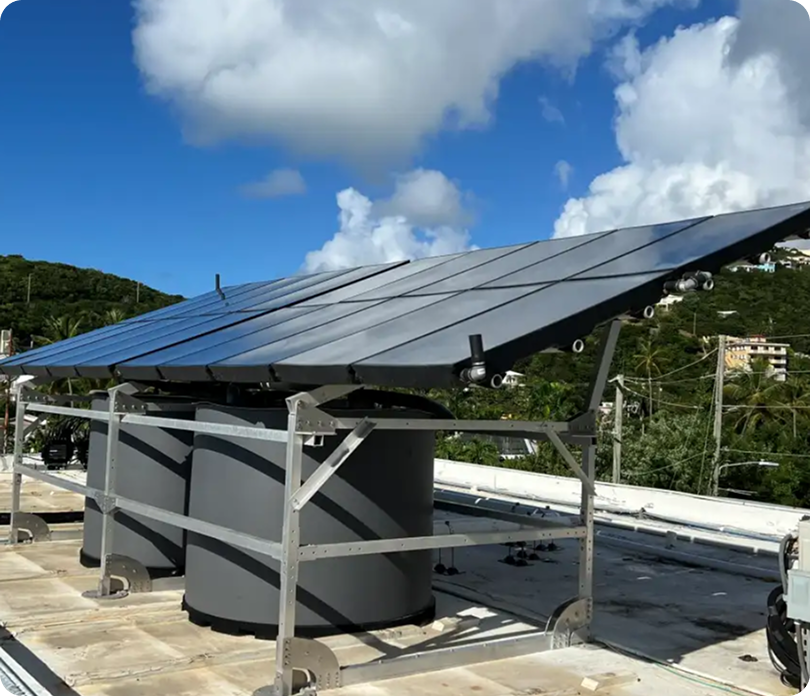
In commercial settings, the heat pump is paired with a thermal storage heater, typically a high-insulation heat storage tank. The tank acts as a thermal battery, storing hot water or thermal energy until it is needed by the building.
The result is a system that separates when heat is generated from when heat is used—a critical distinction for efficiency, reliability, and cost control.
Load Matching: The Key to System Efficiency
Load matching refers to how closely a heating system’s output aligns with actual building demand. Poor load matching leads to short cycling, inefficiency, and accelerated wear on equipment. A thermal heat pump heating system improves load matching by operating continuously at its most efficient range while the heat storage tank absorbs excess energy. During low-demand periods, the system charges the tank. During high-demand periods, stored heat supplements or replaces real-time heat pump output.
This approach delivers several benefits:
- Stable operating conditions for the heat pump
- Higher average coefficient of performance (COP)
- Reduced electrical demand spikes
- Longer equipment lifespan
For commercial buildings with variable loads, load matching is often more important than peak system capacity.
Tank Buffering: Why Thermal Storage Changes Everything
In practice, this means:
- The heat pump can run during off-peak electricity hours
- Stored heat is dispatched instantly during demand surges
- Electrical demand charges are reduced
- System sizing can be optimized instead of oversized
A well-designed heat storage tank with high insulation retains thermal energy for extended periods with minimal losses. This makes tank buffering especially effective in commercial hot water systems, where short, intense draw events are common.
Comparing Heating Approaches in Commercial Buildings
| Feature | Traditional Electric/Gas Heating | Thermal Heat Pump Heating System With Storage |
|---|---|---|
| Load Handling | Direct Response To Demand | Load Shifted Via Heat Storage Tank |
| Peak Demand | High | Significantly Reduced |
| Energy Efficiency | Moderate To Low | High System-Wide Efficiency |
| Equipment Cycling | Frequent | Minimal Due To Buffering |
| Operating Cost Control | Limited | Strong Via Off-Peak Charging |
| Scalability | Equipment-Heavy | Storage-Based, Modular |
Talk to our experts about your energy situation today.
Financial Benefits for Commercial Building Owners
From an operational standpoint, the financial case for a thermal heat pump heating system is compelling. Electricity consumption is reduced compared to resistance heating, and demand charges can be managed more effectively through tank buffering.
Additionally, thermal storage allows building operators to take advantage of time-of-use electricity pricing. By charging the heat storage tank during low-rate periods and discharging during peak hours, operating costs drop without sacrificing performance.
Over the system’s lifespan, reduced maintenance, longer equipment life, and lower energy bills contribute to faster payback and stronger long-term returns.
Reliability and Resilience Through Thermal Storage
Commercial buildings cannot afford downtime. The combination of a thermal storage heater and heat pump improves system resilience by adding a thermal buffer between energy generation and consumption.
Even if the heat pump is temporarily offline or operating at reduced capacity, the heat storage tank continues to supply hot water or heating. This is especially valuable in hospitality, healthcare, and industrial applications where uninterrupted service is critical.
Thermal storage also enables hybrid system designs, where existing boilers or heaters remain as backup rather than primary equipment.
Why This System Scales So Well
One of the strongest advantages of a thermal heat pump heating system is scalability. Instead of installing larger and larger heating equipment, designers can scale capacity by increasing heat storage tank volume.
Multiple thermal storage heaters can be added modularly to match growing demand. This flexibility reduces upfront capital costs and allows systems to evolve alongside building needs.
The Future of Commercial Heating
As energy costs rise and decarbonization becomes a priority, commercial buildings need heating systems that are efficient, flexible, and future-proof. A modern thermal heat pump heating system—enhanced by intelligent load matching and tank buffering—meets these requirements better than conventional solutions.
By integrating a high-performance thermal storage heater and a well-designed heat storage tank, commercial operators gain control over energy use, operating costs, and system performance. The result is not just a more efficient heating system, but a smarter way to manage thermal energy across the entire building lifecycle.