
Why a Modular Design Tank Is the Future of Commercial Thermal Storage
Commercial buildings are changing faster than the infrastructure inside them. Loads are less predictable, space is tighter, and system upgrades are no longer one-time events—they are ongoing. After working across commercial hot water and thermal energy projects, one limitation shows up repeatedly: traditional thermal storage tanks are rigid systems in a flexible world. This is why the modular design tank is emerging as the future of commercial thermal storage tanks and thermal energy storage systems. Modularity removes long-standing constraints around logistics, installation, and scalability, while improving performance and long-term system value. Instead of forcing buildings to adapt to tanks, modular tanks adapt to buildings.
The Limits of Traditional Thermal Storage Tanks
What Is a Modular Design Tank?
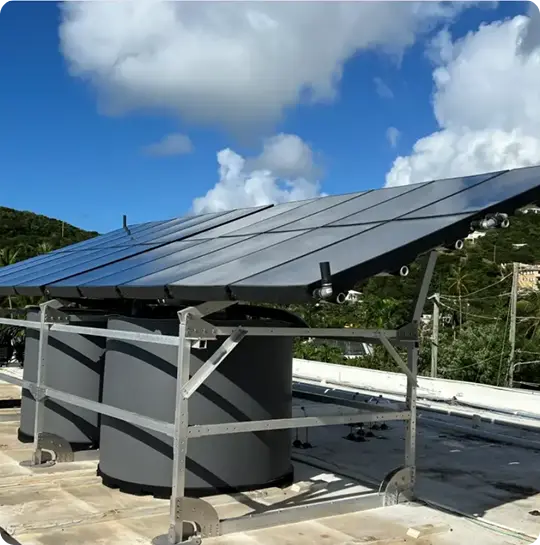
A modular design tank is a thermal storage tank built from lightweight, standardized components rather than a single rigid vessel. Structural panels, insulation elements, liners, and manifolds are delivered separately and assembled in the final location. Functionally, the tank behaves like any high-performance heat storage tank—storing thermal energy and transferring it to the load through a heat exchanger. The difference lies in how the tank is transported, installed, and adapted over time. In practice, modularity shifts thermal energy storage from being a construction constraint into a system design advantage.
What Makes a Modular Design Tank Different?
Logistics Advantages of Modular Design Tanks
Logistics is where modular design delivers its first and most immediate impact. Traditional thermal storage tanks are heavy before installation and extremely heavy once filled, often requiring cranes, rigging plans, structural analysis, and narrow delivery windows. Modular design eliminates many of these barriers.
Logistics advantages of modular design
- Low component weight: Individual parts are light enough for manual handling, avoiding specialized lifting equipment
- Access flexibility: Components pass through standard doors, elevators, stairwells, and tight corridors
- Efficient shipping: Compact packaging reduces freight cost and minimizes damage risk
- Simplified staging: No need for large laydown areas or coordinated crane access
From experience, these logistics benefits often determine whether a thermal storage project moves forward at all—especially in retrofit buildings where access limitations are the primary obstacle.
Installation Speed and Site Efficiency
Installation speed directly affects project cost, downtime, and customer acceptance. In occupied commercial buildings, long mechanical shutdowns are rarely an option. This is where modular tanks consistently outperform traditional designs. Instead of cutting walls, reinforcing floors, or scheduling heavy equipment, modular systems are brought in piece by piece and assembled where they will operate.
Installation advantages of modular tanks
- Rapid assembly: Full tanks can be assembled in hours rather than days
- Minimal disruption: No demolition, roof penetrations, or structural modifications required
- Reduced labor complexity: Smaller crews and fewer specialized trades
- Predictable timelines: Installation duration is consistent and repeatable across projects
In hotels, healthcare facilities, and multifamily buildings, this predictability is often more valuable than the equipment itself.
Why Do Modular Tanks Install Faster?
Performance and Scalability Benefits of Modularity
Modular design is not only about convenience—it directly improves how thermal energy storage systems perform over time. Because modular tanks are engineered as systems rather than single vessels, insulation continuity, thermal retention, and load matching are easier to optimize. Just as important, modular tanks scale with the building.
Performance and scalability advantages
- Precise sizing: Storage volume matches measured demand instead of rough estimates
- Expandable capacity: Additional tanks can be added without removing existing storage
- Improved thermal retention: Engineered insulation reduces standby losses
- Longer system life: Equipment avoids stress caused by undersizing or oversizing
In long-term system planning, this scalability is critical. Buildings evolve, and thermal storage must evolve with them rather than become a limiting factor.
Talk to our experts about your energy situation today.
Weight Specs and Structural Flexibility
Why Modularity Matches the Future of Energy Systems
The Bottom Line
A modular design tank solves the most persistent challenges in thermal energy storage—logistics, installation speed, weight constraints, and scalability—while improving real-world performance and long-term flexibility. For commercial buildings investing in thermal energy storage or heat storage tanks, modularity is no longer a nice-to-have feature. It is the architecture that allows thermal storage to keep pace with how buildings actually operate today—and how they will operate tomorrow.