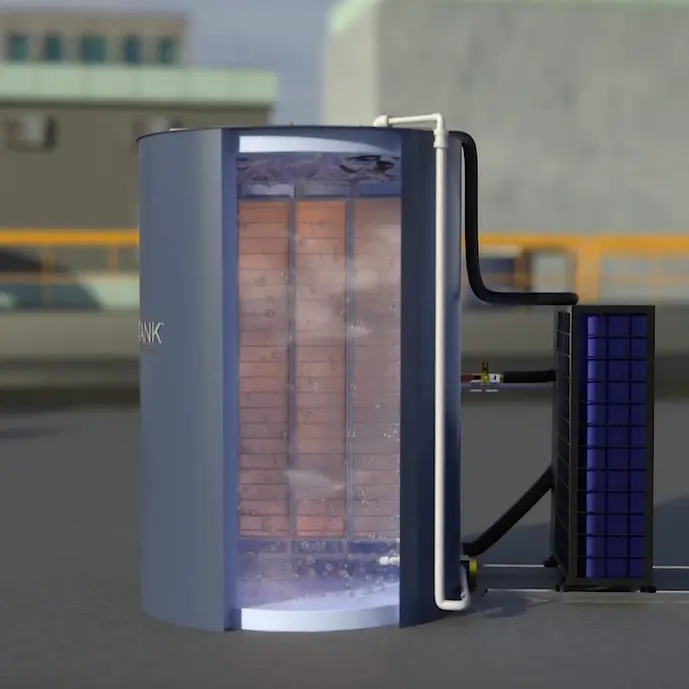
In today’s market, sustainability is no longer a “nice to have”—it is a fundamental requirement for builders, engineers, and facility managers evaluating new energy and water-heating solutions. As more organizations adopt heat pumps, solar-thermal systems, and hybrid energy platforms, the supporting components must also perform well under environmental scrutiny. Our ThermalEnergyHQ Thermal Tank was designed from the ground up to deliver high performance with a dramatically reduced environmental footprint. This blog summarizes the results of an environmental impact assessment of our tank’s materials, manufacturing process, transportation footprint, recyclability, and long-term sustainability benefits. The bottom line: a lighter, simpler, safer, and more environmentally responsible approach to thermal storage.
Low-Impact Materials Designed for Modern Standards
The ThermalEnergyHQ tank is constructed using three proven, safe, and highly controllable materials: expanded polypropylene (EPP) structural wall elements, a thermoplastic polyolefin (TPO) exterior surround, and a PVC liner. These materials were selected for their durability, thermal performance, and low embodied energy, but they also offer a significant environmental advantage: they do not rely on PFAS (“forever chemicals”) or other persistent contaminants to perform their function.
EPP and TPO are both polyolefin-based polymers, produced without fluorinated compounds. PVC manufacturing historically raised concerns due to chlorine and plasticizer use, but modern U.S. and EU producers operate under tightly regulated emissions controls that sharply limit release of VOCs, dioxins, or hazardous by-products. Across the entire assembly, no components require PFAS coatings, flame-retardant additives of concern, or specialty chemicals typically found in fluoropolymer membranes. Choosing materials that avoid these legacy chemical risks provides a safer long-term profile for both indoor mechanical rooms and outdoor installations.
Low Energy Input Compared to Stainless Steel
Traditional commercial hot-water tanks often rely on stainless steel—a strong, familiar material, but one with a substantial environmental footprint. Producing stainless steel requires mining iron, chromium, nickel, and other alloys, followed by extremely energy-intensive smelting and rolling operations. Per kilogram, stainless steel can require 20–35 megajoules of energy and generate 4–6 kg CO₂e of embodied carbon. And because steel tanks are heavy, this footprint scales quickly.
In contrast, EPP, TPO, and PVC require far less energy to produce and process. The tank’s overall weight is only a fraction of a comparable steel vessel, reducing material inputs from the start. The energy used to mold, thermoform, and fabricate these polymer components is dramatically lower—typically 70–90% lower per kilogram—resulting in a significantly smaller upstream carbon footprint for the finished product. When evaluating the tank through a cradle-to-factory-gate lens, the difference in embodied energy becomes one of the most compelling environmental advantages.
Cleaner Manufacturing with Fewer Emissions
Stainless steel fabrication involves multiple steps with non-trivial environmental impacts: smelting, annealing, welding, acid pickling, and surface finishing. These steps can generate heavy-metal effluents, nitrate-rich wastewater, and airborne particulates if not properly controlled. Even with compliant facilities, the process remains energy-intensive and material-intensive.
Our manufacturing process avoids these concerns entirely. EPP is formed through a steam-expansion process with very low emissions. TPO and PVC components are shaped through thermoplastic forming—no solvents, no combustion, no acid finishing steps. There are no welding fumes during assembly, no cutting oils, and no corrosion-protection coatings required. For customers seeking low-impact procurement options, this translates into a cleaner, simpler, and more responsible production chain.
Lower Transportation and Installation Emissions
Environmental assessments often overlook the impact of logistics, but transportation contributes meaningfully to total lifecycle emissions. A stainless-steel tank’s mass significantly affects how many units can be shipped per truckload and how much fuel is consumed per mile.
Because the ThermalEnergyHQ tank is lightweight and modular, more tanks can be shipped at once, reducing emissions across the supply chain. Installation sites benefit as well: lighter components require smaller equipment, less energy to move, and generally lower job-site disturbance. This is especially valuable in island environments, dense urban settings, and remote regions where freight costs and emissions can be unusually high.
Talk to our experts about your energy situation today.
Long Service Life and End-of-Life Options
Sustainability doesn’t stop at installation. Because EPP, TPO, and PVC resist corrosion, microbial degradation, and thermal cycling, the tank delivers a long, predictable service life without coatings, anti-corrosion additives, or sacrificial elements. Stainless steel tanks—especially in high-chloride environments—can corrode, pit, or require early replacement.
At end-of-life, EPP is easily mechanically recyclable, TPO is among the more recyclable thermoplastics, and PVC can be recycled through specialized regional streams. The tank’s modular construction also simplifies disassembly: individual components can be reclaimed without destroying the entire vessel. This reduces landfill volumes and provides multiple pathways for responsible recovery.
A Planet-Friendlier Path Forward
When viewed holistically—materials, manufacturing, transportation, performance longevity, and recyclability—the ThermalEnergyHQ Thermal Tank offers a favorable environmental assessment compared to traditional metal tanks. Its lower embodied carbon, PFAS-free material selection, lightweight design, and simplified recycling pathway align with modern sustainability expectations for commercial and residential hot-water systems.
As organizations look to pair thermal storage with heat pumps, solar-thermal systems, and load-shifting strategies, choosing a tank that supports environmental goals is just as important as choosing the right energy source. Our tank helps customers do both: improve system performance while reducing environmental impact.
Talk to our experts about your energy situation today.
About the Author

Dr Oliver Buechse
Oliver is a McKinsey-trained strategist with deep expertise in Digital Transformation and Climate Change Impacts. Diverse background in Banking, Government, and Non-profit. PhD in Economic Psychology.