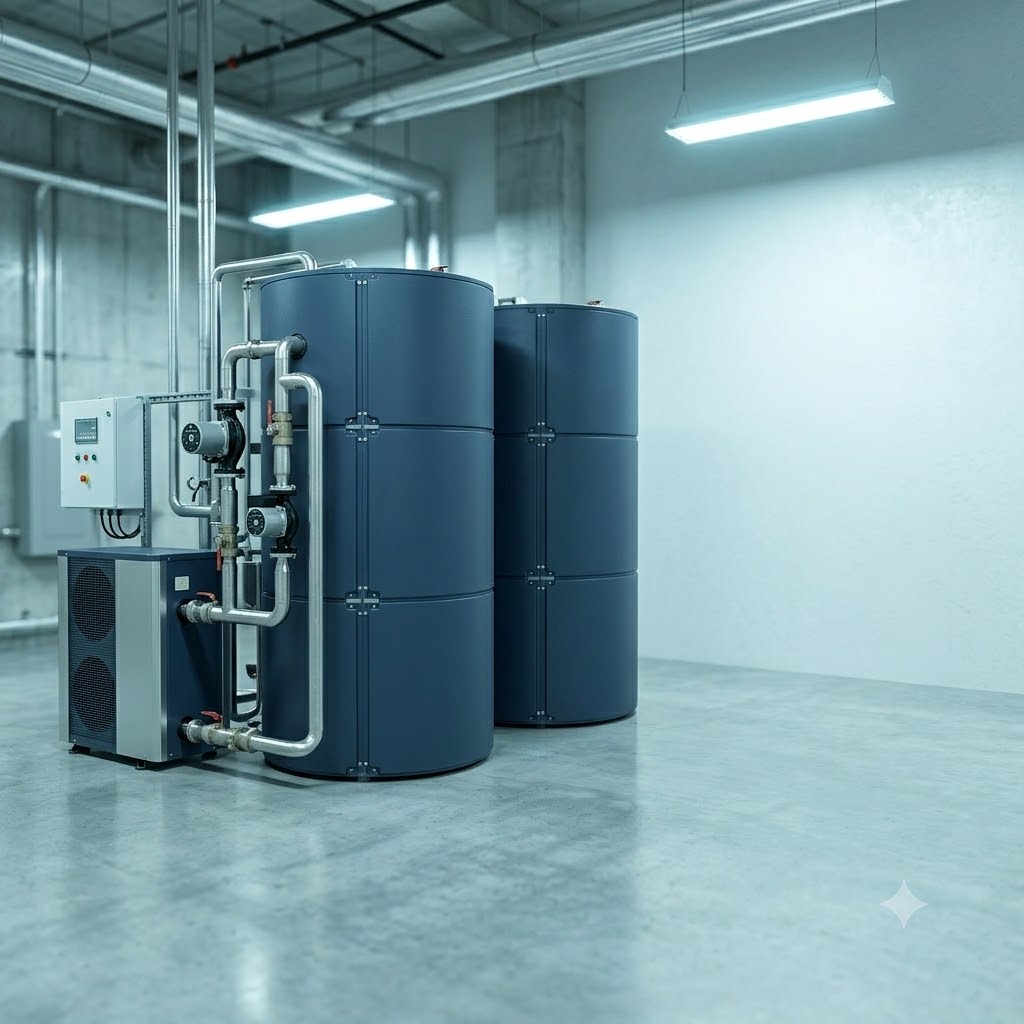
Ask three installers whether your heat pump needs a buffer tank and you may get three different answers—partly because “buffer tank” and “storage tank” get used interchangeably when they describe two different jobs. If you're specifying a heat pump system for a home, a commercial building, or a multifamily central hot water plant, the distinction determines what you buy, how you pipe it, and how long your compressor lives.
In short: A buffer tank is a small insulated vessel piped into a closed heating or cooling loop to add water volume, so the heat pump runs longer, steadier cycles instead of short cycling. A storage tank holds hot water as usable energy—most commonly domestic hot water that ends up at a tap or shower, or thermal energy banked for later. Whether you need a buffer depends on your system's water volume, zoning, and your heat pump's minimum-volume requirement in the installation manual. In larger buildings, a properly designed thermal storage tank frequently does both jobs at once—buffering the heat pump and carrying the morning peak.
In this article
Both are insulated tanks of water, which is exactly why they get confused. The difference is what the water is for.
A buffer tank holds heating-loop water—a closed circuit that never touches a tap. Its water is a transport medium: the heat pump warms it, the radiators, air handlers, or radiant floors draw it down, and it circulates indefinitely. The tank exists to add volume and thermal inertia to that loop, and often to provide hydraulic separation between the heat pump's fixed-flow requirement and a zoned distribution system whose flow varies as valves open and close.
A storage tank holds energy you intend to use. The clearest example is the tank on every heat pump water heater: as the U.S. Department of Energy's water heater guidance describes, a heat pump water heater pairs a compressor with an insulated storage tank that holds heated water for later use. Storage can also mean something bigger: banking thermal energy generated during cheap or solar hours and discharging it at peak—the load shifting pattern the DOE Better Buildings thermal energy storage fact sheet identifies as the strongest storage use case in buildings with time-varying rates.
The confusion is understandable because the categories overlap in hardware. A large, well-insulated tank piped between a heat pump and its loads is simultaneously buffering the compressor and storing energy. The distinction that matters for your project is functional: buffer volume is sized to protect the machine; storage volume is sized to serve the load.
A heat pump is happiest running long, steady cycles at moderate output. Short cycling is the opposite: the compressor starts, satisfies a small load in minutes, shuts down, and restarts shortly after—over and over. Each start carries an efficiency penalty and mechanical wear, and a compressor that logs tens of thousands of unnecessary starts fails years early.
The physics has been measured in the field. A UK government field study on the effects of cycling on heat pump performance instrumented ground source heat pumps under different cycling regimes and buffer arrangements and found that cycling behavior—and even how the buffer tank was piped—measurably changed delivered coefficient of performance. On the modeling side, the National Renewable Energy Laboratory's validated framework for air source heat pumps with a water tank operating in a buffer configuration evaluated how tank integration shifts heat pump operation toward more favorable conditions across a full year of climate data.
Three situations create short cycling risk. First, low system volume: small-bore piping and low-mass emitters mean the heat pump warms the entire loop in minutes. Second, micro-zoning: when most zone valves are closed, a heat pump sized for the whole building sees a load that is a small fraction of its capacity. Third, defrost: an air source heat pump in cold weather periodically reverses to defrost its outdoor coil and needs a reservoir of loop heat to draw on without freezing the space. A buffer tank addresses all three by giving the machine a mass of water to work against.
Sometimes. The honest engineering answer is a short checklist, not a blanket yes—and vendors who insist every system needs one are selling tanks, not designing systems.
Start with the installation manual. Every heat pump specifies a minimum system water volume and minimum flow rate. If the water already contained in your piping, emitters, and equipment meets that minimum—common in homes with underfloor heating, whose slab already acts as thermal mass, or systems with generous open, unzoned volume—a dedicated buffer adds cost, floor space, and standing heat loss for little benefit. Some inverter-driven units modulate low enough to make buffers unnecessary in simple systems, and some manufacturers state buffer requirements as warranty conditions in either direction.
A buffer earns its place when:
Sizing targets a minimum compressor run time—the tank must absorb enough energy that the heat pump runs several minutes per cycle even when only the smallest zone calls. Published planning guidance clusters into consistent ranges, but they are starting points: refrigerant type, turndown ratio, and control logic all move the number, and the manufacturer's installation manual always governs.
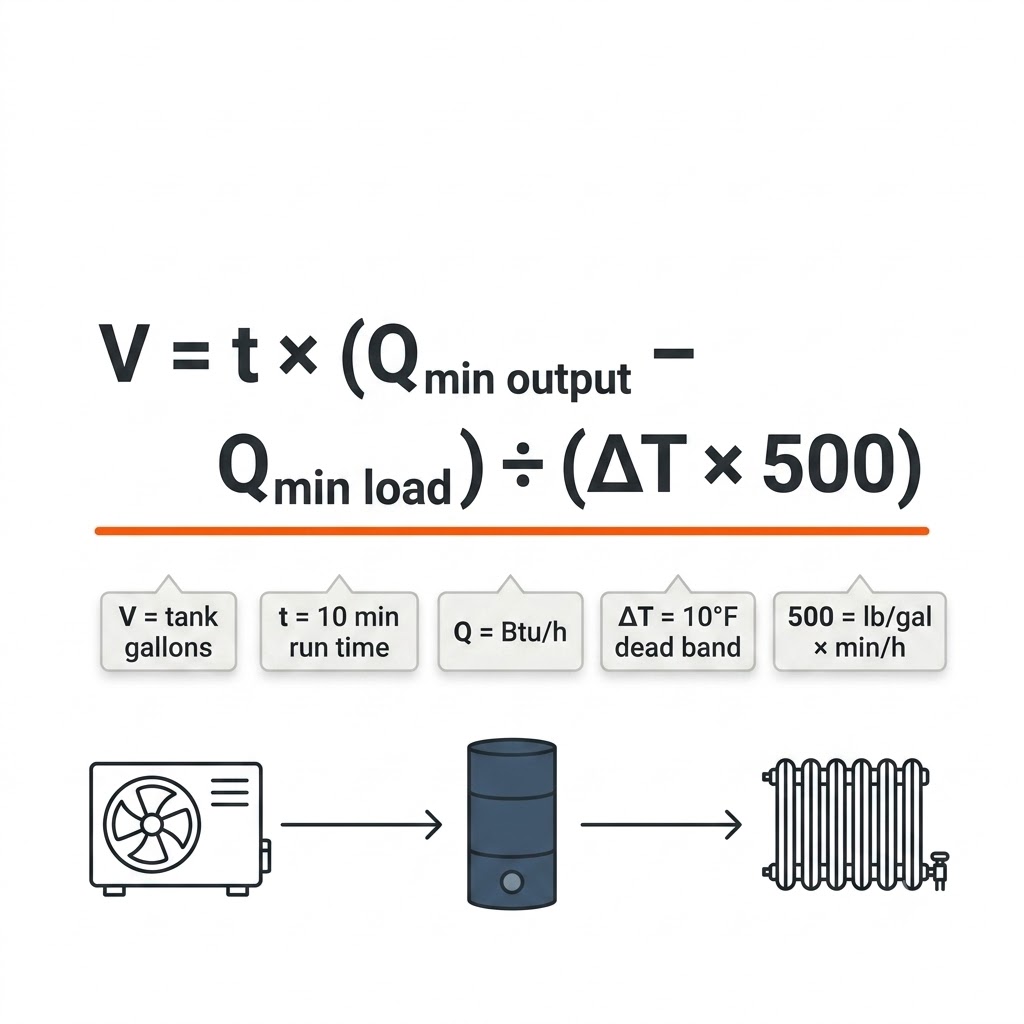
Common buffer tank planning ranges.
Residential air-to-water, metric practice10–20 L per kW of heat pump output. Higher end for heavy zoning or low-mass emitters.
US hydronic / geothermal practice10–15+ gallons per ton. Driven by minimum flow, approximately 3 GPM per ton, versus low distribution flow.
Commercial plants are sized from minimum load plus target 5–10 min off-cycle time. Calculated from flow rate, delta-T, and compressor minimum run time.
Two cautions. Oversizing is not free: a larger buffer means more standing loss and a longer charge time, so bigger is not automatically better for pure buffering. And a buffer sized only for cycle protection is not a storage strategy—if the goal is shifting load to off-peak or solar hours, you are sizing a storage tank, and the arithmetic changes from minutes of run time to kilowatt-hours of demand. An 80-gallon tank holding roughly 668 pounds of water stores about 12 kWh of usable heat at a 35°C temperature delta; a 700-gallon module stores 108 kWh. That is battery-scale energy, at tank-scale cost.
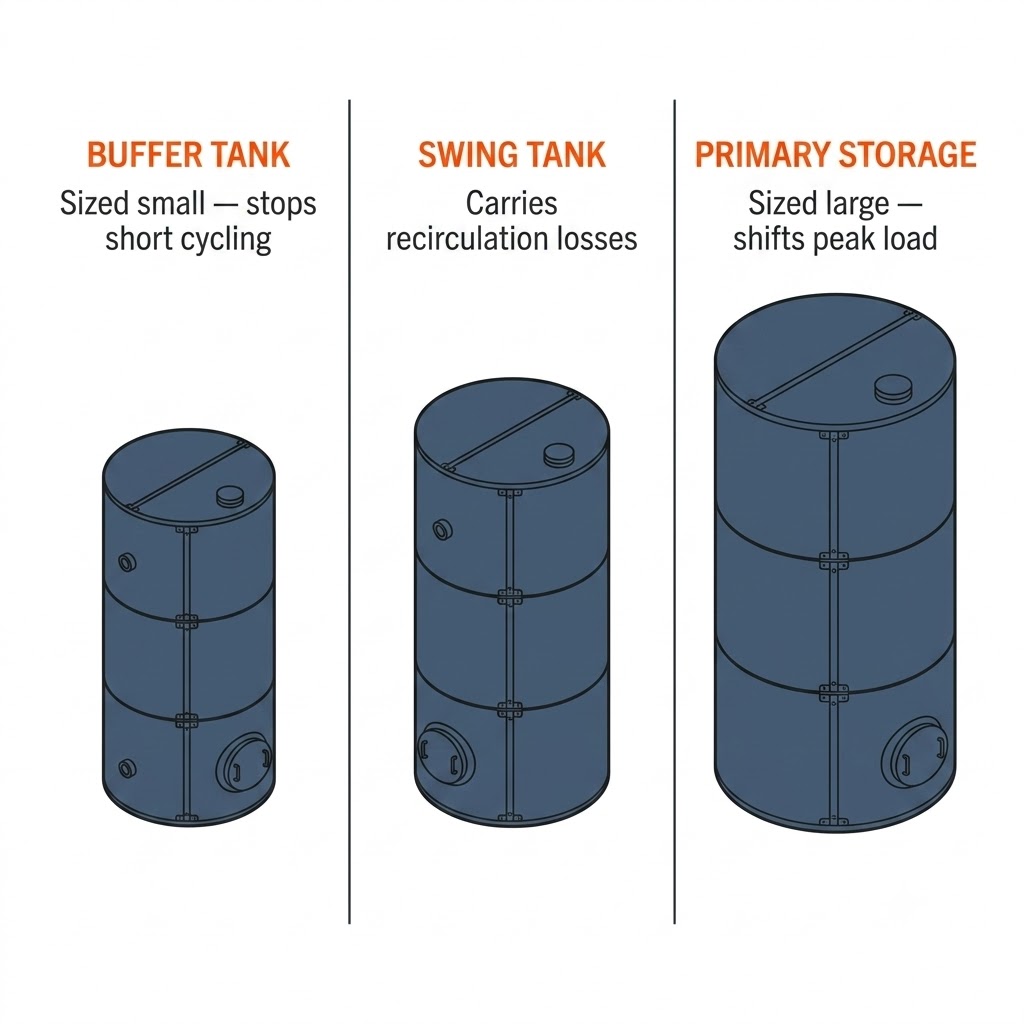
The buffer-versus-storage distinction gets most interesting in multifamily and commercial buildings with central domestic hot water. There, the right storage tank is the buffer—and considerably more.
A central heat pump plant sized to meet a building's peak morning draw directly must be large, expensive, and heavily cycled. Add insulated storage and the same load is met by a smaller heat pump running long, steady cycles—charging the tanks during off-peak or solar hours while stored hot water carries the peaks. The compressor gets the long run times a buffer would provide, and the building gets dispatchable hot water. Federal guidance points the same direction: the ENERGY STAR heat pump water heater technical guide notes that upsizing tank volume increases thermal energy storage potential and lets owners take maximum advantage of utility load-shifting programs, and ENERGY STAR's heat pump water heater program documents the efficiency case for the underlying technology.
Thermal Energy HQ's modular tanks are built for the retrofit reality of occupied buildings: the patented panelized design passes through standard doorways and assembles inside mechanical rooms where a welded, crane-set tank could never go, then scales by adding modules as loads grow. Potable water stays separate—the tank holds thermal mass, and domestic hot water is served through heat exchangers, which is exactly the buffer-plus-storage architecture. See the modular thermal storage tank design and specifications.
Small dedicated buffer tanks for residential systems typically run in the hundreds to low thousands of dollars installed, depending on volume and insulation. Modular thermal energy storage tanks—sized to buffer a heat pump and store meaningful energy—cost between roughly $1,200 and $5,800 per tank at list price, equivalent to $54–$97 per kWh of thermal storage. That is the vessel itself; a complete installed system adds the heat source, heat exchangers, piping, controls, and labor, which vary by site.
Current published list pricing for Thermal Energy HQ's tank line:
Thermal Energy HQ modular tank list pricing
ModelList price$/kWh storedStorage capacity*Standing loss
80 gallon$1,190$9712.0 kWh7–8°F / 24 hr
350 gallon$3,427$6354.6 kWh3.8°F / 24 hr
500 gallon$4,464$5877.0 kWh3.0°F / 24 hr
700 gallon$5,798$54108.0 kWh2.4°F / 24 hr
*Rated at a 35°C temperature delta. Pricing current as of July 2026; see the full thermal tank comparison and specifications for complete data. Cost per stored kWh drops about 44% from the smallest to the largest tank, and because modules interconnect, capacity can be phased—buffer-sized today, storage-sized as loads electrify. For a packaged storage-plus-heat-pump skid, see the All-In-One thermal energy system.
A tank bought purely as a buffer rarely qualifies for anything on its own. A tank designed as thermal energy storage can. The federal investment credit regime covers energy storage technology placed in service after December 31, 2024, through the IRS Clean Electricity Investment Credit, and the statutory definition of energy storage technology explicitly includes thermal energy storage under 26 U.S.C. §48E. Credit value depends on project size, prevailing wage and apprenticeship compliance, and sourcing rules—confirm specifics with a tax professional. Utilities also offer custom commercial and multifamily rebates tied to demand reduction, which is precisely what storage-first hot water design delivers. California multifamily projects have a deeper stack still—see our guide to the CEC Equitable Building Decarbonization (EBD) Program for how direct-install funding, HEEHRA rebates, and the §73 exclusion combine.
A buffer tank is piped into a closed heating or cooling loop to add water volume, preventing the heat pump from short cycling and providing hydraulic separation; its water is never consumed. A storage tank holds hot water as usable energy—domestic hot water served to fixtures, or thermal energy banked during off-peak or solar hours and discharged at peak. Large, well-insulated tanks in central plants often perform both functions simultaneously.
Not always. Check the heat pump manufacturer's minimum system volume and minimum flow requirements first: if your piping, emitters, and equipment already meet them—common with underfloor heating and open zoning—a buffer may be unnecessary. A buffer earns its place with heavy zoning, low-mass emitters, limited compressor turndown, air source defrost demand, or multiple heat sources needing a hydraulic hub.
Common planning ranges are roughly 10–20 liters per kW of heat pump output, or about 10–15+ gallons per ton in US hydronic practice, with commercial plants sized from minimum load and a target 5–10 minute off-cycle time. Refrigerant type, turndown ratio, and control logic all shift the number, so the manufacturer's installation manual and a proper system volume calculation govern final sizing.
Short cycling is rapid, repeated compressor starts and stops caused by a load that is small relative to heat pump output—typically from low system water volume or closed zones. Each start carries an efficiency penalty and mechanical wear; government field testing has measured cycling behavior and buffer configuration directly affecting delivered coefficient of performance. Added water volume, via a buffer or storage tank, is the standard remedy.
Yes, when it is piped into the heating loop with adequate connections and the potable side is served through heat exchangers. In central hot water plants this is the preferred architecture: the storage tank gives the heat pump long, steady run times exactly as a buffer would, while also carrying peak draws and shifting load to cheaper hours. Modular thermal storage tanks list from $1,190 for 80 gallons and 12 kWh to $5,798 for 700 gallons and 108 kWh.
A small tank installed purely for cycle protection generally does not. Thermal energy storage does fall within the statutory definition of energy storage technology under the federal Section 48E investment credit for qualifying projects placed in service after December 31, 2024, and utility programs reward the demand reduction storage delivers. Eligibility always depends on system configuration and tax position—confirm with a tax professional.
Buffer tanks and storage tanks answer different questions. “How do I keep my compressor alive?” is a buffer question, and the answer starts with the installation manual, not a catalog. “How do I serve my load on the cheapest, cleanest energy available?” is a storage question, and in any building with central hot water it is the more valuable one. The best-designed systems collapse the two: enough insulated, well-piped water volume that the heat pump runs long and steady, sized in kilowatt-hours rather than minutes.
The fastest way to get real numbers for your system is a short engineering conversation about your building's draw profile and zoning.
Garth Schultz is President & Inventor of Thermal Energy HQ, where he leads development of modular thermal energy storage systems manufactured in the United States. He is the inventor named on patents covering hybrid photovoltaic-thermal (PVT) solar panels and insulated modular storage tank construction, and has worked in solar-thermal product development since founding the company's technology line in 2007. Connect on LinkedIn.

Tell our team about your building, operating goals, and energy needs.