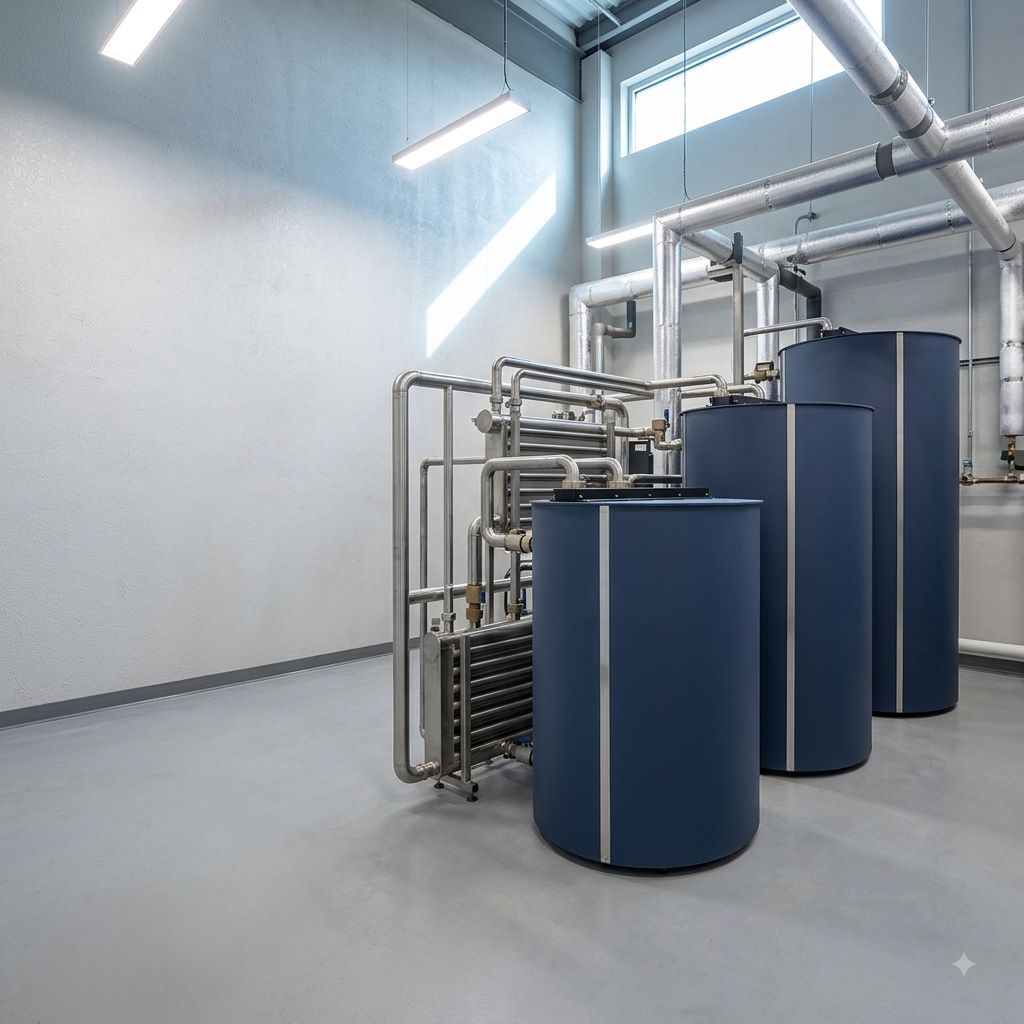
The hot water storage tank is the least glamorous line on a mechanical schedule and the one most likely to decide whether a building actually has hot water at seven in the morning. Size it from a rule of thumb and you either overspend on a vessel that never empties or field a callback from a hotel with a hundred cold showers. The calculation itself is not difficult — peak-hour draw, minus what the heat source can recover during that hour, divided by how much of the tank you can actually use — but most specification guidance published online skips at least one of those three terms, and nearly all of it skips the fourth question an engineer eventually has to answer: will the tank fit through the door, and will the floor hold it?
In short: A commercial hot water storage tank is an insulated vessel that holds heated water so a smaller heat source can serve a larger peak draw. Federal regulation calls the externally heated version an unfired hot water storage tank and requires a minimum of R-12.5 thermal insulation. Tanks exceeding 120 gallons nominal capacity, 200,000 Btu/h of input, or 210°F generally require ASME code construction. Storage volume is sized from peak-hour demand minus recovery, divided by usable draw-down, then corrected for the difference between storage and delivery temperature. Modular tanks list from $1,190 (80 gallons / 12 kWh) to $5,798 (700 gallons / 108 kWh) — roughly $54 to $97 per kWh of stored thermal energy.
Key Takeaways
A commercial hot water storage tank is an insulated vessel that holds heated potable or process water so that a heat source smaller than the building’s peak draw can still meet that peak. The tank decouples when energy is added from when hot water is used. That decoupling is the entire point, and it is what separates a storage design from an instantaneous one.
Federal regulation draws the category lines precisely, and the definitions are worth knowing because they determine which efficiency standard a piece of equipment has to meet. Under 10 CFR 431.102, an unfired hot water storage tank is a tank used to store water that is heated externally and that is industrial equipment — no burner, no element, heat comes from somewhere else. A storage water heater heats and stores water within the appliance itself. The dividing line between a storage water heater and an instantaneous one is a ratio: below 4,000 Btu/h of rated input per gallon of stored water it is classed as storage; at or above that ratio it is classed as instantaneous. That single number is a useful sanity check on any manufacturer’s claim that a small-tank appliance is really a storage system.
Three vessels get confused with one another on drawings, and specifying the wrong one is expensive:
The distinction matters in practice because a buffer tank sized for short-cycle protection is almost never large enough to serve a domestic hot water peak, and a thermal storage tank charged by solar or off-peak electricity is sized by energy (kWh) rather than by volume alone. Buildings on time-of-use rates frequently need the third kind and get quoted the first. The Department of Energy’s Better Buildings guidance on thermal energy storage in commercial buildings treats hot water storage as the most straightforward load-shifting measure available to a building operator, precisely because the storage medium is water the building already needs.
In this article
What is a commercial hot water storage tank?
A commercial hot water storage tank is an insulated vessel that holds heated potable or process water so that a heat source smaller than the building’s peak draw can still meet that peak. The tank decouples when energy is added from when hot water is used. That decoupling is the entire point, and it is what separates a storage design from an instantaneous one.
Federal regulation draws the category lines precisely, and the definitions are worth knowing because they determine which efficiency standard a piece of equipment has to meet. Under 10 CFR 431.102, an unfired hot water storage tank is a tank used to store water that is heated externally and that is industrial equipment — no burner, no element, heat comes from somewhere else. A storage water heater heats and stores water within the appliance itself. The dividing line between a storage water heater and an instantaneous one is a ratio: below 4,000 Btu/h of rated input per gallon of stored water it is classed as storage; at or above that ratio it is classed as instantaneous. That single number is a useful sanity check on any manufacturer’s claim that a small-tank appliance is really a storage system.
Three vessels get confused with one another on drawings, and specifying the wrong one is expensive:
The distinction matters in practice because a buffer tank sized for short-cycle protection is almost never large enough to serve a domestic hot water peak, and a thermal storage tank charged by solar or off-peak electricity is sized by energy (kWh) rather than by volume alone. Buildings on time-of-use rates frequently need the third kind and get quoted the first. The Department of Energy’s Better Buildings guidance on thermal energy storage in commercial buildings treats hot water storage as the most straightforward load-shifting measure available to a building operator, precisely because the storage medium is water the building already needs.
Common vessel types
VesselWhat it holdsWhere it sitsTypical trigger
Hot water storage tankPotable domestic hot water at delivery temperature or aboveDownstream or alongside the heat source, in the potable loopPeak draw exceeds heat source recovery rate
Buffer tankNon-potable hydronic loop waterBetween a heat pump or chiller and the distribution loopHeat source short-cycles at low load
Thermal storage tank (TES)Heat as energy, transferred through an exchangerOn the source side, charged off-peak or by solarTime-of-use rates, demand charges, or solar charging
How do you size a commercial hot water storage tank?
Storage volume follows from four inputs. Work them in order; skipping the third and fourth is the most common reason a correctly “sized” tank runs out.
1. Establish peak-hour demand at delivery temperature. Not daily total — the worst single hour. For apartments and hotels this is a morning shower peak; for restaurants it tracks meal service; for a fitness facility it follows class schedules. Use metered data if the building exists. If it does not, use per-fixture or per-capita profiles from the ASHRAE Handbook — HVAC Applications service water heating chapter, and note in your submittal which profile you used.
2. Subtract the recovery the heat source delivers during that same hour. A heat source is not idle while the peak runs. Recovery in gallons per hour equals input capacity in Btu/h, times efficiency, divided by (8.34 × temperature rise in °F). Heat pumps recover more slowly than gas burners of comparable cost, which is exactly why heat pump projects need more storage.
3. Divide by the usable draw-down fraction. No tank delivers its full nameplate volume at usable temperature. Incoming cold water mixes with the stored charge and the outlet temperature falls before the tank is empty. A poorly baffled tank may give up only 60% to 70%; a well-stratified tank with a diffuser at the inlet does considerably better. Use the manufacturer’s tested draw-down efficiency, not an assumption.
4. Correct for storage temperature. If you store hotter than you deliver and blend down at a thermostatic mixing valve, each stored gallon yields more than one delivered gallon. The blend ratio is (storage temp − cold inlet) ÷ (delivery temp − cold inlet). This step alone often reduces required tank volume by a quarter.
Worked example: 120-unit multifamily building
Assumptions stated so they can be substituted. Peak-hour demand of 600 gallons at 120°F; a central heat pump plant delivering 150 gallons per hour of recovery at the design rise; 80% usable draw-down; storage at 140°F, cold inlet at 55°F, delivery at 120°F.
Four hundred thirty gallons is the requirement. In practice that rounds up to a 500-gallon vessel, or to a modular array assembled from smaller units. Notice what step four did: without the temperature correction the answer was 563 gallons, and the engineer would have specified a larger tank, a larger footprint, and a heavier floor load to store the same delivered hot water.
Verify the energy rating yourself. Storage capacity in kWh should reconcile against the heat equation. For 500 gallons across a 35°C (63°F) delta: 500 gal × 8.34 lb/gal × 1 Btu/lb·°F × 63°F = 262,710 Btu, or 77.0 kWh at 3,412 Btu per kWh. That is the figure published for the 500-gallon module on the thermal tank comparison table, and it is a reasonable thing to check on any vendor’s spec sheet before you accept it. A rating that does not reconcile against volume and temperature delta is a rating built on an unstated assumption.
How much does a commercial hot water storage tank cost?
A modular thermal storage tank costs roughly $1,200 to $5,800 per tank at list price depending on capacity — about $8.28 to $14.88 per gallon, or $54 to $97 per kWh of stored thermal energy. That figure is the storage vessel only. A complete installed system adds the heat source, heat exchangers, piping, circulators, controls, seismic or wind restraint, insulation of connecting pipe, and labor, all of which vary widely by site. Published tank pricing is uncommon in this category; most commercial tank manufacturers quote through a representative, which makes early budgeting harder than it should be.
Current published list pricing for Thermal Energy HQ’s tank line:
Pricing is current as of August 2026; see the full thermal tank comparison and specifications for complete data. Cost per stored kWh falls about 44% from the smallest module to the largest, which is the usual surface-area-to-volume economics of any pressure or storage vessel. Because modules interconnect, capacity can be phased — sized for today’s load and expanded as a portfolio grows. For a packaged storage-plus-heat-pump skid, see the All-In-One thermal energy system; for solar-charged configurations, see the Power Panel PVT system.
Thermal Energy HQ modular tank list pricing
ModelList price$/gallon stored$/kWhCapacity*Height × dia.Filled weightFloor load
80 gallon$1,190$14.88$9712.0 kWh60.0 × 30 in1,266 lb~100 lb/sq ft
350 gallon$3,427$9.79$6354.6 kWh49.6 × 60 in3,089 lb157.4 lb/sq ft
500 gallon$4,464$8.93$5877.0 kWh69.1 × 60 in4,351 lb221.7 lb/sq ft
700 gallon$5,798$8.28$54108.0 kWh88.6 × 60 in6,046 lb308 lb/sq ft
When does a hot water storage tank need to be ASME code stamped?
A pressure vessel used for hot water service generally requires ASME code construction and a code stamp once it exceeds any one of three thresholds: a heat input rating of 200,000 Btu/h, a water temperature of 210°F, or a nominal water capacity of 120 gallons. Exceed one and the tank must be built and stamped to the applicable ASME rules — Section IV Part HLW for water heating vessels, or Section VIII for pressure vessels generally. This is why the commercial storage market has a visible break at 120 gallons and why quoted prices jump across it.
Three practical qualifications matter more than the thresholds themselves:
Where our own product sits, stated plainly. If a project requires a code-stamped, pressurized vessel holding potable water directly — a glass-lined or stainless ASME tank plumbed into the domestic loop — that is a distinct product category with established manufacturers, it arrives ready to set and pipe, and it is the right answer for that scope. Thermal Energy HQ’s modular tanks are thermal storage on the source side, transferring energy to the potable loop through a heat exchanger. That architecture trades the drop-in convenience of a stamped potable vessel for access, phasing, and distributed floor loading. Which of those two you need is a design decision made early, and it is worth making explicitly rather than discovering at submittal. Confirm the certification basis for any tank you specify against the manufacturer’s documentation — ours is published in the technical documentation library.
Insulation, standing loss, and the October 2026 efficiency change
Every unfired hot water storage tank manufactured on or after October 29, 2003 must have a minimum thermal insulation of R-12.5 under 10 CFR 431.110(b). That is a floor, not a target. R-12.5 on a 700-gallon vessel held at 140°F in a 70°F mechanical room still loses meaningful energy every hour of every day for the life of the tank, and the loss is paid at whatever the building pays for energy — which, for an electrified plant on a time-of-use tariff, may not be the cheap rate.
Two ways of expressing that loss appear on spec sheets, and they are not interchangeable. Federal standby loss for electric commercial storage equipment is expressed as a percentage per hour of the heat content of the stored water above room temperature, with a maximum of 0.30 + 27/Vm percent per hour, where Vm is measured storage volume. Manufacturers more often publish a temperature drop over 24 hours, which is intuitive but depends entirely on the starting temperature and ambient conditions of the test. Ask for the test basis.
Published standing loss for the modular tank line, as measured at the manufacturer’s stated conditions:
Anyone specifying gas-fired commercial water heating this fall should look carefully at the calendar. Under Table 1 to 10 CFR 431.110(a), minimum thermal efficiency for gas-fired storage water heaters and storage-type instantaneous water heaters rises from 80% to 95% for equipment manufactured on and after October 6, 2026. Gas-fired instantaneous water heaters and hot water supply boilers rise from 80% to 96%. Maximum standby loss for gas-fired storage equipment tightens by a factor of 0.86 over the same date. Oil-fired equipment and electric storage water heaters are unchanged.
The practical consequence: a 95% thermal efficiency floor is a condensing requirement in all but name. Condensing gas equipment changes venting, condensate handling, and combustion air — and it changes installed cost on a retrofit where the existing flue was sized for an atmospheric appliance. For a building already weighing gas replacement against electrification, that shift narrows the gap, and it is a reason to run the comparison now rather than assume last year’s numbers hold. Verify current requirements against the live regulation, since standards and their effective dates are periodically amended.
Published standing loss for the modular tank line
ModelStanding lossSurface-to-volume effect
80 gallon7–8°F per 24 hoursHighest loss per gallon — small vessels have proportionally more surface
350 gallon3.8°F per 24 hoursRoughly half the per-gallon loss of the 80-gallon unit
500 gallon3.0°F per 24 hoursLoss continues to fall as volume grows faster than surface area
700 gallon2.4°F per 24 hoursBest retention in the line; about a third the drop of the smallest module
What changes on October 6, 2026
Anyone specifying gas-fired commercial water heating this fall should look carefully at the calendar. Under Table 1 to 10 CFR 431.110(a), minimum thermal efficiency for gas-fired storage water heaters and storage-type instantaneous water heaters rises from 80% to 95% for equipment manufactured on and after October 6, 2026. Gas-fired instantaneous water heaters and hot water supply boilers rise from 80% to 96%. Maximum standby loss for gas-fired storage equipment tightens by a factor of 0.86 over the same date. Oil-fired equipment and electric storage water heaters are unchanged.
The practical consequence: a 95% thermal efficiency floor is a condensing requirement in all but name. Condensing gas equipment changes venting, condensate handling, and combustion air — and it changes installed cost on a retrofit where the existing flue was sized for an atmospheric appliance. For a building already weighing gas replacement against electrification, that shift narrows the gap, and it is a reason to run the comparison now rather than assume last year’s numbers hold. Verify current requirements against the live regulation, since standards and their effective dates are periodically amended.
Getting a high-capacity tank into an existing mechanical room
More retrofits fail on geometry than on thermodynamics. Two constraints do most of the damage, and both are checkable in an afternoon before a tank is ever selected.
The doorway
A 500-gallon vertical vessel is roughly 60 inches in diameter. A standard 36-inch commercial door leaf gives about 34 inches of clear opening. The tank does not fit, and neither does anything else in that capacity class. In a new building this is a coordination item. In an occupied building it can mean a knock-out panel, a crane pick over the roof, or abandoning the design. Only the 80-gallon module, at 30 inches in diameter, passes a standard opening assembled. The larger modules are panelized: components pass through the door and the tank is assembled inside the room. That is the specific problem the patented panelized construction was built to solve, and it is also an honest trade — field assembly adds labor and requires a trained installer, where a stamped tank arrives on a pallet and sets in an hour.
The floor
Filled weight concentrated on a small footprint is the constraint engineers discover last and like least. A 60-inch diameter tank occupies about 19.6 square feet. Filled, the 700-gallon module weighs 6,046 pounds — about 308 pounds per square foot. Many elevated structural slabs in existing buildings were designed for considerably less live load than that, and a slab-on-grade may still need a housekeeping pad or spread base.
Distributing volume across modules helps materially. Four 500-gallon modules hold 2,000 gallons across roughly 78 square feet at about 222 lb/sq ft. A single 2,000-gallon vertical vessel of about 72-inch diameter concentrates a comparable filled weight on roughly 28 square feet — in the neighborhood of 620 lb/sq ft, nearly three times the distributed figure. Where the structure is the binding constraint, an array is often the only configuration that works without reinforcement. Confirm the maximum interconnected array size with the manufacturer; more modules also means more connections to commission and maintain.
Restraint and the rest of the checklist
The delivery path should be walked before ordering — elevator dimensions, stair turns, ceiling height, and door swing have all killed otherwise sound designs. The contractor resources cover the field sequence.
Storage tank, buffer tank, or tankless: which does the building need?
The choice is rarely binary. A central plant serving a hotel might use a storage tank for the shower peak, a booster heater for a 180°F dish sanitizing load, and a controls strategy that charges storage off-peak. The Department of Energy notes that more than 45% of electricity consumption in U.S. buildings goes to thermal uses such as air conditioning and water heating — which is why storage, the cheapest way to move that consumption in time, earns a look on nearly every electrification project. Commercial building energy use patterns are documented by the U.S. Energy Information Administration if you need baseline figures for a proposal.
Comparing commercial hot water approaches
ApproachWorks well whenStruggles whenWatch out for
Storage tank with modest heat sourcePeak draw is short and sharp; energy is cheaper at some hours; heat source is a heat pumpSpace is unavailable and the floor cannot be reinforcedStanding loss; usable draw-down below nameplate
Instantaneous / tanklessDraw is intermittent and modest; space is severely limited; gas is the fuelSimultaneous demand is high; flow varies widely; electric service is constrainedFull peak flow must be met with no buffer; heavy electrical or gas service
Buffer tank on a hydronic loopA heat pump short-cycles at low load; loop volume is inadequateThe problem is domestic hot water peak, not cyclingNot a substitute for DHW storage; usually non-potable
Thermal storage (TES) charged off-peak or by solarTime-of-use spread or demand charges are meaningful; solar thermal or PVT is availableThe tariff is flat and there is no solarSized by energy, not volume; needs controls and a charging strategy
Storage temperature, Legionella, and mixing valves
Storage temperature is where energy efficiency and public health pull in opposite directions, and the resolution is well established. CDC guidance on controlling Legionella in potable water systems recommends storing hot water above 140°F, keeping circulated hot water from falling below 120°F, and recirculating continuously where possible. The growth range to stay out of is roughly 77°F to 113°F. Cold water should be stored and circulated below 77°F.
Scald risk is managed at the fixture rather than at the tank. Thermostatic mixing valves installed close to the point of use let the system hold storage and distribution hot while delivering safe temperatures at the tap. OSHA’s guidance on Legionellosis control makes a related point worth repeating to any operator tempted by a quick fix: raising the water heater setpoint without also addressing stagnation, dead legs, heat loss, and cross-connection is generally not sufficient control on its own. ASHRAE Standard 188 and ASHRAE Guideline 12 are the building-specific standards a water management program is usually written against.
There is a design bonus hiding in the health requirement. Storing at 140°F rather than 120°F does not just suppress bacterial growth — it increases usable volume by about 31%, as step four of the sizing method showed. A tank sized on the assumption of 120°F storage is a tank sized larger than it needed to be, and one that will run in the temperature band a water management program is trying to avoid. Dead legs, low-flow fixtures, and infrequently used outlets need flushing regardless of how well the tank is specified.
Frequently Asked Questions
What is a commercial hot water storage tank?
A commercial hot water storage tank is an insulated vessel that holds heated water so a heat source smaller than the building’s peak demand can still meet that peak. Federal regulation defines an unfired hot water storage tank as a tank used to store water that is heated externally and that is industrial equipment; tanks with an integral burner or element are classed as storage water heaters instead. Every unfired hot water storage tank manufactured on or after October 29, 2003 must carry at least R-12.5 thermal insulation.
How do you size a commercial hot water storage tank?
Take peak-hour hot water demand at delivery temperature, subtract the recovery the heat source delivers during that same hour, divide the remainder by the tank’s usable draw-down fraction, then divide by the blend ratio if stored water is hotter than delivered water. For a 600-gallon peak hour, 150 gallons per hour of recovery, 80% draw-down, and 140°F storage blended to 120°F from a 55°F cold inlet, the requirement is about 430 gallons of storage.
How much does a commercial hot water storage tank cost?
Modular thermal storage tanks list from $1,190 for an 80-gallon, 12 kWh module to $5,798 for a 700-gallon, 108 kWh module — roughly $8.28 to $14.88 per gallon, or $54 to $97 per kWh of stored thermal energy. That is the vessel alone. A complete installed system also includes the heat source, heat exchangers, piping, controls, restraint, and labor, which vary by site. Cost per stored kWh falls about 44% from the smallest module to the largest.
When does a hot water storage tank need to be ASME rated?
ASME code construction is generally required once a vessel exceeds a heat input rating of 200,000 Btu/h, a water temperature of 210°F, or a nominal water capacity of 120 gallons. Section IV Part HLW covers water heating vessels and Section VIII covers pressure vessels generally. Adoption and enforcement vary by jurisdiction, some authorities assess connected multi-tank systems rather than individual vessels, and an insurer or engineer of record may require a stamp that code does not.
What is a high-capacity hot water tank?
In commercial practice, high-capacity generally means above the 120-gallon ASME threshold, with common sizes running from a few hundred gallons to several thousand. Above 120 gallons a tank typically requires code construction, a structural check on floor loading, and a delivery path that a standard doorway will not provide. Modular tanks reach high capacity by interconnecting smaller units, which distributes floor load and allows components to pass through standard openings.
What temperature should a commercial hot water storage tank be set to?
CDC guidance recommends storing hot water above 140°F and keeping circulated hot water from falling below 120°F, with thermostatic mixing valves near fixtures to prevent scalding. Legionella grows in roughly the 77°F to 113°F range. Storing at 140°F also increases usable volume by about 31% compared with 120°F storage when blended to a 120°F delivery temperature from a 55°F cold inlet.
What is the difference between a hot water storage tank and a buffer tank?
A hot water storage tank holds potable domestic hot water and exists to meet a peak draw larger than the heat source can produce in real time. A buffer tank holds non-potable loop water and exists to add thermal mass so a heat pump or chiller does not short-cycle at low load. A buffer tank sized for cycling protection is almost never large enough to serve a domestic hot water peak, and the two are not interchangeable on a submittal.
Can a large hot water storage tank fit in an existing mechanical room?
Frequently, but only with two checks done first. A 500-gallon vertical vessel is about 60 inches in diameter and will not pass a standard 36-inch door assembled, so either a knock-out path or a panelized tank assembled on site is required. Filled weight also matters: a 700-gallon module imposes about 308 pounds per square foot, while four 500-gallon modules holding the same 2,000 gallons distribute to roughly 222 pounds per square foot across a larger footprint.
Conclusion
Specifying a commercial hot water storage tank well comes down to four numbers and two site facts. The numbers are peak-hour demand, recovery during that hour, usable draw-down, and the storage-to-delivery blend ratio. The site facts are what fits through the opening and what the floor will carry. Get the four numbers right and the tank is the correct size; get the two site facts right and it can actually be installed. Projects that skip either half tend to discover the omission at submittal review, when changing course is expensive.
Two things worth putting on the calendar this quarter: the October 6, 2026 thermal efficiency step for gas-fired commercial water heating equipment, which changes what a gas replacement costs, and a structural check on any mechanical room where storage volume is going to increase. The fastest way to get real numbers is a short engineering conversation about the building’s draw profile and the room the equipment has to live in.
Garth Schultz is President of Thermal Energy HQ, where he leads development of modular thermal energy storage systems manufactured in the United States. He is the inventor named on patents covering hybrid photovoltaic-thermal (PVT) solar panels and insulated modular storage tank construction, and has worked in solar-thermal product development since founding the company’s technology line in 2007. Connect on LinkedIn.