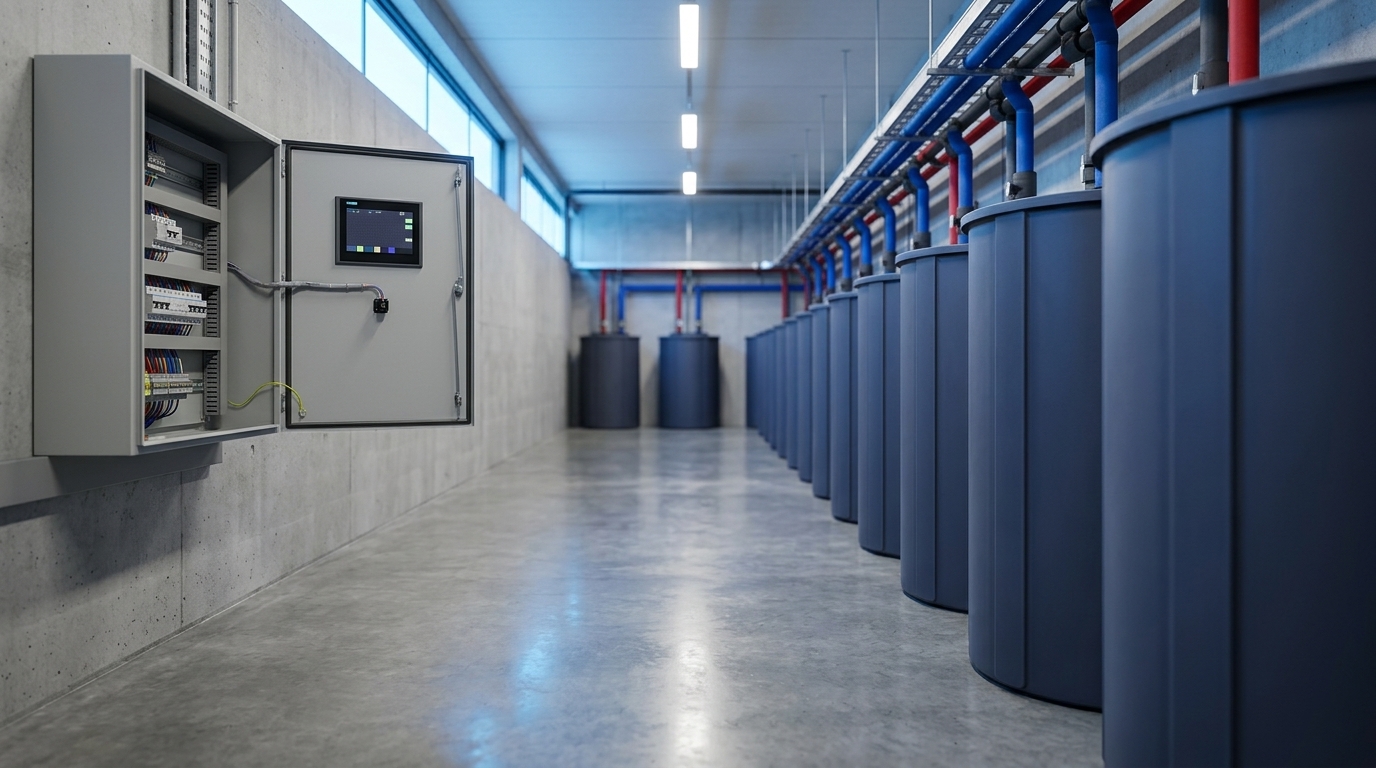
Every commercial building already contains a thermal battery. It is called the hot water system, and in most buildings it is operated with no awareness of what electricity costs at the moment it runs. Adding real storage capacity and a control signal turns that liability into a resource the grid will pay for — and, more importantly, into one your utility bill will stop punishing.
In short: Demand response thermal storage is the use of an insulated thermal energy storage tank as a dispatchable load resource. The tank is charged during off-peak, low-price, or low-renewable hours, so the heat pump, chiller, or electric element can be curtailed during a demand response event while occupants still get hot water or conditioned space. Because storage decouples when energy is bought from when heat is delivered, the load reduction is invisible to building users — which is the single biggest reason thermal loads outperform lighting, plug, and comfort-setback strategies in DR programs.
Demand response resources totalled about 33,272 MW across the seven U.S. wholesale markets in 2024, roughly 6.5% of wholesale peak demand, and the U.S. Department of Energy identifies thermal storage explicitly as an asset that can earn demand response revenue on top of its energy savings.
Key Takeaways
What is demand response thermal storage?
Demand response is defined by federal regulators as changes in electricity use by demand-side resources away from their normal consumption patterns, in response to price signals or incentive payments intended to reduce load when wholesale prices spike or system reliability is at risk. That definition and the national participation data are published annually in the FERC Assessment of Demand Response and Advanced Metering. Nothing in it requires the load reduction to be uncomfortable — only that it be real, measurable, and delivered when called.
That distinction is where thermal storage earns its place. Most demand response asks a building to give something up: dim the lights, let the space drift, or pause a process. Storage asks the building to give up nothing, because the energy was already purchased hours earlier and is sitting in a tank. The U.S. Department of Energy's Grid-interactive Efficient Buildings initiative frames this as demand flexibility rather than demand reduction: the building continues to serve its occupants identically while the timing of its electrical draw is repositioned around grid conditions.
Two things are worth separating early, because vendors routinely blur them. Passive thermal mass — concrete, masonry, and the building envelope — lets you pre-cool or pre-heat a space and coast through an event, but its capacity is fixed by the building and its discharge is uncontrolled. Active thermal energy storage is a tank you size, charge, and discharge deliberately. The DOE GEB technical report series treats water tanks and ice storage as controllable assets precisely because their state of charge is known and their discharge is scheduled. If you want a resource you can bid, you need the tank. For the underlying vessel physics, see our modular thermal storage tank design and specifications, and for the distinction between a storage vessel and an actively cycled thermal asset, see how a thermal battery differs from a conventional hot water tank.
In this article
The three grid services a thermal storage tank can provide
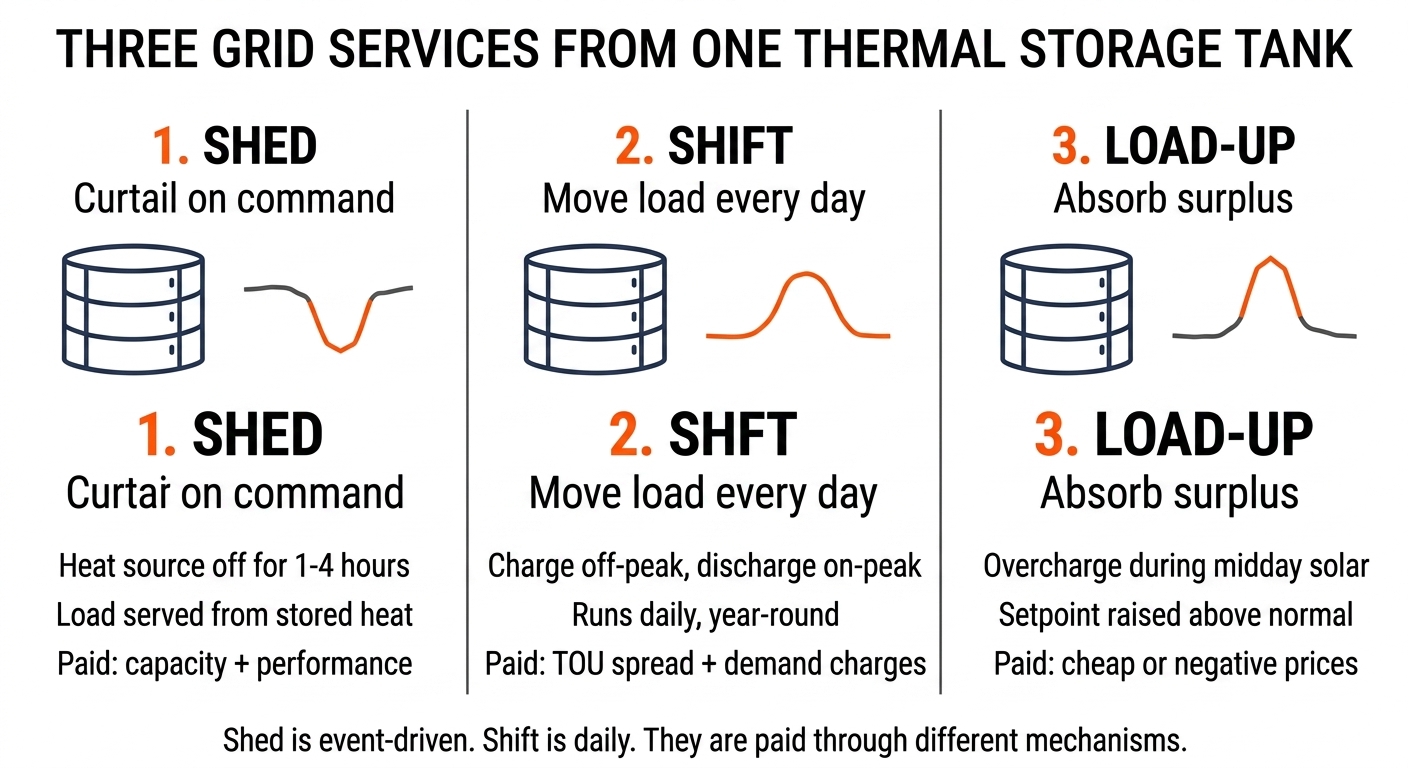
The DOE framework for grid-interactive buildings separates demand flexibility into distinct services, and a single hot-side thermal storage tank can deliver three of them. They are not interchangeable, they are paid through different mechanisms, and confusing them is the most common error in early-stage project economics.
The service a building should chase depends almost entirely on its tariff, not on its equipment. A facility on a flat commercial rate with a large demand charge wants shift and shed. A facility on aggressive time-of-use pricing wants shift first and treats shed as gravy.
The Lawrence Berkeley National Laboratory study Control of Thermal Energy Storage in Commercial Buildings for California Utility Tariffs and Demand Response makes this concrete: a full-storage system, sized to carry the entire on-peak load, cuts both peak demand and on-peak energy, while a partial-storage system carries only part of the load but responds faster and suits shorter events. Full storage is the better bill instrument; partial storage is often the better DR resource. Most real projects land between the two.
One concession is important: shifting load slightly increases total site energy consumption. A tank at elevated temperature loses heat to the plant room continuously, and that loss has to be made up. Standing loss on the larger modular tanks runs roughly 2.4–3.8°F over 24 hours, which is small but not zero. Thermal storage is a cost and peak-demand instrument, not an efficiency instrument.
Three grid services provided by thermal storage
ServiceWhat the tank doesHow oftenHow it gets paid
ShedHeat source is curtailed on command for a defined window, typically 1–4 hours. Load is served entirely from stored heat.Event-driven — commonly 10–60 hours per yearDR program capacity and performance payments; avoided coincident-peak charges
ShiftCharging is scheduled into off-peak or shoulder hours every day; discharge covers the on-peak window.Daily, year-roundTime-of-use energy arbitrage and monthly demand-charge reduction
Load-upTank is deliberately over-charged during surplus midday solar or negative-price hours, raising setpoint above normal.Seasonal or daily in high-solar territoriesCheap or negative-price energy; some programs pay for consumption increase
How much demand response capacity does a thermal storage tank actually represent?
Program enrollment is denominated in kilowatts of sustained load reduction, not kilowatt-hours of thermal capacity. The two numbers are related but they are not the same number, and confusing them will produce a bid you cannot deliver.
The recovery window matters
After an event you have to recharge, and if the program calls consecutive-day events you need to recharge inside off-peak hours without creating a new peak of your own. A larger tank does not just buy longer events; it buys slack in recovery. The same sizing logic governs conventional applications — see buffer tank versus storage tank selection and swing tank sizing for multifamily recirculation loops.
Modular capacity allows phased deployment
Because tank modules interconnect, capacity is a phasing decision rather than a one-time bet. A building can install enough storage to cover its daily shift economics now and add modules later when a DR contract makes longer events worth bidding. That sequencing is unavailable with a welded, crane-set vessel, and it is the practical reason modular construction matters to a load-flexibility project.
Where the money actually comes from
Three revenue layers stack on one asset. They are listed here in descending order of certainty, which is the opposite of the order most vendors present them in.
Layer 1 — Demand charge avoidance
Commercial customers are billed not only for energy consumed but for the highest average power draw in any interval — typically 15 minutes — during the billing period. National-lab analysis published as Identifying Potential Markets for Behind-the-Meter Battery Energy Storage: A Survey of U.S. Demand Charges found that demand charges commonly represent 30% to 70% of a commercial customer's total electric bill, and that roughly five million U.S. commercial customers sit on tariffs with demand charges of $15/kW or more.
One bad fifteen-minute interval sets the charge for the whole month regardless of how well you ran the other 2,975 intervals. A thermal tank that prevents the heat source from coinciding with the building peak addresses that directly, every month, with no program enrollment and no event call required. This layer alone frequently carries the project.
Layer 2 — Time-of-use arbitrage
Charging in the cheap hours and discharging in the expensive ones is the daily-shift service, and its value scales with the on-peak/off-peak price spread in your tariff. In high-solar territories the spread is widening: midday power is getting cheaper while the evening ramp gets more expensive. FERC reports advanced meter penetration at 76.8% while only about 11% of customers are on a dynamic pricing program. If your building has an interval meter and a flat rate, a tariff review is the cheapest project on this list. See our thermal energy storage cost and payback breakdown for the arithmetic.
Layer 3 — Demand response program payments
Programs pay in two forms: capacity payments for being available across a season, and performance payments for kW actually curtailed during called events. The DOE Better Buildings fact sheet Thermal Energy Storage in Commercial Buildings identifies demand response participation as an additional revenue stream available to thermal storage on top of its bill savings, the federal investment credit, and utility rebates.
Layer 3 is real, but it is rarely large enough to justify a thermal storage capital project on its own. Events are called a few dozen hours a year at most, program rules change between cycles, and payments are contingent on measured performance you have to prove. Treat DR revenue as an adder that improves an already-defensible project, not as the reason to build one.
Which demand response programs can thermal storage participate in?
There are three enrollment routes, and they differ far more in administrative burden than in physics. The tank does the same thing in all three; the paperwork, telemetry requirement, and payment scale are what change.
Demand response enrollment routes
RouteWho runs itWhat it demands of youFit for thermal storage
Retail utility DRYour electric utility, directlyEnrollment agreement, interval meter, and ability to reduce on notice, commonly 2–24 hours and sometimes 10 minutes for automated tiersStrong. Simplest path, lowest overhead, and automated tiers typically pay a premium that storage can capture.
Wholesale market via aggregatorRTO/ISO market through a curtailment service providerMetering and telemetry to market standard, audited baselines, performance testing, and penalties for non-performanceGood but demanding. Higher payments; the barrier is measurement, not capability.
State reliability programsState energy agenciesProgram-specific enrollment, often aggregator-mediated with minimum aggregation thresholdsSituational. Seasonal and budget-dependent, but explicitly designed to include flexible electric loads including water heating.
Wholesale aggregation
FERC Order No. 2222 requires regional grid operators to let aggregations of distributed energy resources compete in wholesale energy, capacity, and ancillary-services markets. Implementation is market-by-market and still unfolding; treat any specific market's participation rules as a live question for your aggregator.
California's Demand Side Grid Support program
The California Energy Commission's Demand Side Grid Support Program compensates customers for load reduction during extreme grid events from May through October. Its fourth-edition guidelines created a load-flexibility virtual power plant option in which aggregations may consist of dispatchable HVAC, electric water heaters, EV supply equipment, and behind-the-meter batteries, subject to minimum aggregation thresholds. Eligibility and program status should be confirmed during design.
For a broader map of what is available where, use our state-by-state energy incentive finder.
Why hot-side storage can serve more seasons
Cooling storage is a summer resource. Domestic hot water and space heating are year-round loads, which makes them relevant in winter-peaking territories and in markets moving toward all-season availability requirements. PJM, for instance, has been approved to move demand resources to a 24-hour, year-round availability window in later delivery years. If your utility peaks on a January morning rather than a July afternoon, an ice-storage system has nothing to offer you and a hot water tank has everything.
Controls, telemetry, and measurement: the real barrier to entry
A tank full of hot water is not a demand response resource. A tank full of hot water that can receive a signal, change its charge state on that signal, and prove afterward what it did — that is a demand response resource. Three capabilities are required, and the third is the one that disqualifies most projects.
Signal reception
Automated demand response runs on published protocols. OpenADR is the dominant utility-to-building and aggregator-to-device signalling standard for commercial facilities; version 2.0b remains the most widely deployed while 3.0 moved the architecture to REST APIs and JSON. CTA-2045 governs the device-level control port on grid-interactive appliances including water heaters, and IEEE 2030.5 governs inverter and DER communication. The OpenADR Alliance specifications and certification register distinguish between “OpenADR-compatible” and “OpenADR-certified,” which are not the same claim.
Integration for a thermal storage system is normally achieved at the controller layer: the building energy management system or a third-party gateway holds the protocol client and translates an event signal into a charge-inhibit or setpoint command to the heat source. Confirm the specific integration path with the manufacturer during design.
Control sequence
The sequence has to handle more than “turn off.” It needs a pre-event charge routine that brings the tank to full state of charge without creating a new demand peak, an event routine that holds the heat source off while monitoring delivery temperature against a floor, an abort condition that restores heating if that floor is breached, and a recovery routine that staggers restart.
If every curtailed load restarts simultaneously at event end, the snapback can set a monthly demand peak worse than the one avoided. Staged recovery is the fix.
Measurement and verification
Programs pay against a baseline — a counterfactual estimate of what you would have consumed absent the event — and the difference between baseline and actual is your paid reduction. FERC has approved market rule changes tightening baseline calculation and requiring written attestation and meter data from demand resources, following enforcement actions that produced eight-figure penalties and disgorgement for inflated baselines and unauthorized registrations.
The practical prerequisites are an interval meter at the point of measurement; sub-metering of the thermal plant if you want to isolate its contribution from whole-building noise; data retention meeting the program's audit window; and a documented, unmodified control sequence. Build these into the design.
How much does a thermal energy storage system cost?
A modular thermal energy storage tank costs between roughly $1,200 and $5,800 per tank at list price, depending on capacity — equivalent to $54–$97 per kWh of thermal storage. That is the storage vessel itself; a complete installed system adds the heat source, heat exchangers, piping, controls, metering, and labour, which vary by site. For a demand response project, budget the controls and metering line explicitly.
Pricing is current as of August 2026. See the full thermal tank comparison and specifications for complete data. Cost per stored kWh drops about 44% from the smallest to the largest tank. Standing loss matters when modelling a shed: a tank that will sit charged and waiting for an event call loses more of its value in the small sizes. For a packaged storage-plus-heat-pump skid, see the All-In-One thermal energy system.
Modular thermal energy storage tank list pricing
ModelList price$/kWh storedStorage capacityStanding loss
80 gallon$1,190$9712.0 kWh7–8°F / 24 hr
350 gallon$3,427$6354.6 kWh3.8°F / 24 hr
500 gallon$4,464$5877.0 kWh3.0°F / 24 hr
700 gallon$5,798$54108.0 kWh2.4°F / 24 hr
Federal tax treatment
Thermal energy storage falls inside the statutory definition of energy storage technology for the federal clean electricity investment credit — see 26 U.S.C. §48E and the IRS Clean Electricity Investment Credit page.
Treasury and IRS interim guidance issued as Notice 2026-15 uses thermal energy storage property as its worked example when illustrating new sourcing rules. The One, Big, Beautiful Bill Act added foreign-entity restrictions that generally took effect January 1, 2026. For energy storage beginning construction in calendar 2026, the guidance sets a material assistance cost ratio threshold of 55%. Confirm credit specifics with a tax professional before relying on them.
Thermal storage vs. batteries vs. ice: an honest comparison
Ice and chilled-water storage have an established third-party performance rating standard, AHRI 900/901, and a long demand-response program track record. Hot-side water storage does not have an equivalent rating infrastructure. Batteries beat thermal storage on service breadth and speed, while thermal storage can offer a lower cost per stored kWh for buildings with large, predictable thermal loads.
Comparison of hot-side water TES, lithium-ion batteries, and ice or chilled-water TES
CategoryHot-side water TESLithium-ion batteryIce / chilled-water TES
Services availableLoad shed, shift, and absorb — heating and DHW loads onlyEverything: shed, shift, export, frequency regulation, and backup powerLoad shed, shift, and absorb — cooling loads only
Response speedSeconds to minutesSub-secondSeconds to minutes
Can it back up the building?No. It cannot produce electricity.Yes, with the right inverter and switchgearNo
Third-party performance ratingNo equivalent standard in wide use for hot-side water storageExtensive; UL, IEEE, and manufacturer cycle dataYes — AHRI 900/901 rates thermal storage equipment for cooling
DegradationWater does not degrade with cycling; insulation and vessel are the wear itemsCapacity fade with cycles; replacement is a modelled costMinimal cycling degradation
$/kWh stored$54–$97, vessel onlySubstantially higher per kWh of usable storageVaries widely by configuration
Best fitBuildings with large, predictable hot water or heating loads; year-round and winter-peaking valueBuildings needing resilience, export, or fast ancillary servicesLarge cooling-dominated buildings in summer-peaking territories
Where each technology wins
A hot-side project carries more of its verification burden at the design stage because the engineer models the draw-down rather than reading it from a rating certificate. That is a real cost and it belongs in the schedule.
These technologies are not competitors in most buildings. Ice storage serves cooling; hot-side thermal storage serves heating and domestic hot water; batteries serve electrical services neither can touch. A large campus with a January peak, a July peak, and a resilience requirement may end up with all three. For multifamily and hospitality portfolios, that load is often central hot water — see central heat pump water heater systems in multifamily buildings and the pillar overview of commercial hot water storage tank design.
How to scope a demand-response-capable thermal storage system
A workable sequence, in the order that avoids expensive rework:
Frequently Asked Questions
What is demand response thermal storage?
Demand response thermal storage is the use of a thermal energy storage tank as a dispatchable load resource. The tank is charged during off-peak, low-price, or high-renewable hours, allowing the heat pump, chiller, or electric element to be curtailed during a demand response event while occupants continue to receive hot water or conditioned space. Because storage separates when energy is purchased from when heat is delivered, the load reduction is invisible to building occupants, which is why thermal loads generally outperform lighting and comfort-setback strategies in demand response programs.
How much load can a thermal storage tank shed during a demand response event?
The shed in kilowatts equals the electrical input of the heat source you curtail — the heat pump compressor, chiller, or resistance element — not the thermal capacity of the tank. The tank determines how long that shed can be sustained: usable stored energy above your minimum delivery temperature, divided by the building thermal load during the event window. Sizing requires a metered draw profile and a system-specific estimate of usable capacity, so it is established during engineering design rather than read off a product datasheet.
Can thermal energy storage participate in utility demand response programs?
Yes, in three routes. Retail utility demand response programs are the simplest and often pay a premium for automated response, which storage can capture because no human decision is required. Wholesale market participation through a curtailment service provider pays more but requires telemetry, audited baselines, and performance testing. State reliability programs sit in between, and some — including California's Demand Side Grid Support Program — explicitly name electric water heaters among eligible flexible loads. Eligibility and rules are program-specific and change between cycles, so confirm current terms with the utility or aggregator during design.
Is thermal storage better than a battery for demand response?
Neither is universally better; they do different things. A battery can shed, shift, export power, provide frequency regulation, and back up the building during an outage. A thermal tank can only reduce or shift a thermal load — it cannot produce electricity and cannot serve as backup power. Where thermal storage wins is cost per kWh of storage and cycling durability: water does not degrade with repeated charge and discharge. For a building with a large, predictable hot water or heating load, thermal storage addresses that load far more cheaply than a battery would. For resilience or fast ancillary services, a battery is the correct tool.
How do demand response programs verify that a thermal storage system actually reduced load?
Programs pay against a baseline, a counterfactual estimate of consumption absent the event, with the difference between baseline and metered actual constituting the paid reduction. Verification requirements have tightened considerably: grid operators have adopted stricter baseline calculation rules and written attestation requirements following federal enforcement actions against inflated baselines. Practically, this requires an interval meter at the point of measurement, ideally sub-metering of the thermal plant, data retention meeting the program audit window, and a documented control sequence. These should be specified during design, not retrofitted.
Does thermal storage reduce total energy consumption?
No — and any vendor claiming otherwise is selling the wrong benefit. Storing heat incurs standing losses, so shifting load slightly increases total kilowatt-hours consumed. What thermal storage reduces is cost and peak demand: it lets a smaller heat source run at favourable hours instead of a larger one running at expensive ones, and it prevents the thermal plant from coinciding with the building's billed peak. On tariffs where demand charges represent a large share of the bill, that trade is strongly favourable even though raw consumption rises marginally.
What controls does a thermal storage system need for automated demand response?
Three capabilities are required: signal reception, control response, and measurement. Signal reception generally uses OpenADR for commercial facility signalling, CTA-2045 for device-level appliance control, or IEEE 2030.5 for distributed energy resource communication, held either in the building energy management system or a gateway. Control response requires a sequence covering pre-event charging, event hold with a delivery-temperature floor, an abort condition, and staged recovery to prevent a rebound peak at event end. Measurement requires interval metering and data retention meeting program audit requirements. Confirm the integration path with the manufacturer during design.
Conclusion
The bottom line
Demand response has stopped being a niche program and started being a planning resource: about 33,272 MW across the seven U.S. wholesale markets, roughly 6.5% of wholesale peak demand, with grid operators deploying it during heat waves to avoid load shed. What has not kept pace is the building side. Most commercial facilities still run their thermal plant on a schedule written when electricity had one price.
Thermal storage is the least disruptive way to change that, because it is the only load flexibility strategy that costs the occupant nothing. The building gets its hot water on time; the grid gets its reduction; the difference sits in a tank. Build the business case on demand-charge avoidance and time-of-use arbitrage, which are reliable and require no program at all, and treat demand-response payments as the layer that improves an already-good project. Specify the controls and the metering at the same time as the tank, because measurement — not physics — is what decides whether you can participate.
The fastest way to get real numbers is a short engineering conversation about your load profile and your tariff.