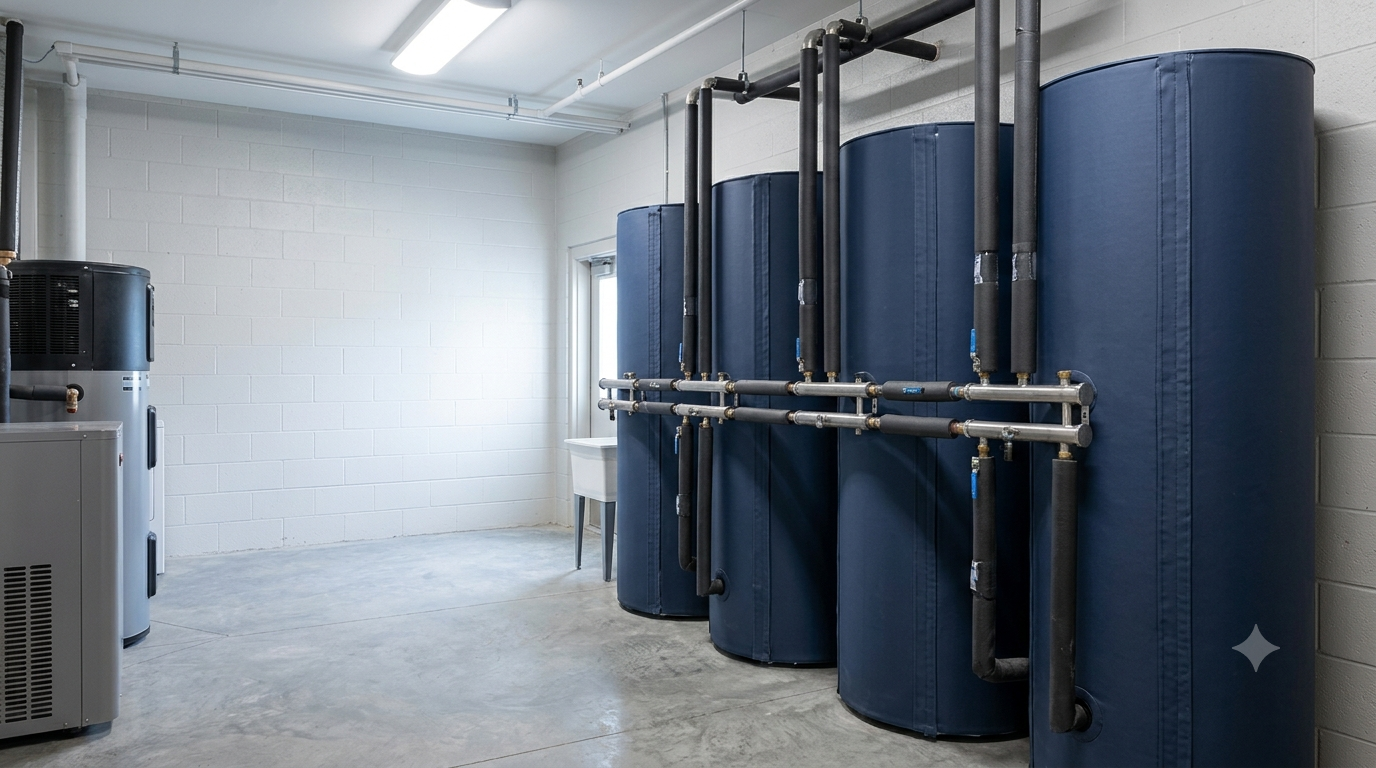
Most oversized heat pump water heater plants were sized correctly — for a gas boiler. That is the single most expensive mistake in central hot water electrification, and it happens because the sizing habit engineers built over thirty years of gas design inverts when the heat source becomes a compressor. Gas buys recovery cheaply and storage expensively. Heat pumps do the opposite.
Heat pump water heater sizing for multifamily and commercial buildings is a storage-first calculation, not a recovery-first one. Because compressor capacity is expensive and insulated storage is cheap, a well-designed central heat pump water heater (CHPWH) plant uses a smaller heat pump running 16–20 hours a day against a much larger tank volume than the gas system it replaces.
The plant must cover two distinct loads — primary domestic hot water and hot water circulation temperature maintenance — and it must be sized at design-day conditions, meaning the coldest entering city water temperature and the derated heat pump output that comes with it. Free tools such as the Ecosizer sizing tool generate the capacity-and-storage sizing curve; the engineer chooses the point on that curve.
Key Takeaways
Heat pump water heater sizing for multifamily and commercial buildings is different from gas water heater sizing because the cost structure is inverted. A gas-fired water heater buys recovery cheaply. A 400 MBH burner costs a fraction of what 400 MBH of compressor capacity costs, so standard gas design logic minimizes storage, maximizes input, and rides the peak on recovery.
Heat pumps reverse that relationship. Compressor capacity is expensive; insulated water volume is comparatively cheap. The result is a plant with lower recovery and higher storage capacity than the equivalent gas system.
Storage is also an efficiency tool. In a monitored 12-unit central HPWH installation at UC Davis West Village, steady-state COPs of 3.0–4.0 matched manufacturer data, but frequent short cycling and standby parasitics reduced annual system COP to 2.12 and reduced low-load summer performance to 1.7–1.9. The study, Multifamily Heat Pump Water Heater Evaluation, concluded that additional storage volume and a wider control dead band would lengthen compressor duty cycles and raise seasonal efficiency.
Storage is not just how the plant survives the morning peak. It is how the plant earns its efficiency rating.
In this article
Why heat pump water heater sizing is different from gas water heater sizing
Gas-fired systems trade storage volume for higher instantaneous output to minimize storage and standby loss. That logic produces a compact, inexpensive plant because gas buys recovery cheaply.
For HPWH systems, overestimating heat pump size unnecessarily increases project cost. Properly sized systems use much lower recovery and much higher storage capacity than equivalent gas systems.
Heat pumps also need sufficient run time to reach steady state. A compressor that cycles on and off in short bursts may show a strong steady-state rating while delivering much lower seasonal efficiency. More storage and a wider control dead band can lengthen compressor duty cycles.
The two loads every central plant has to cover
Before calculating capacity or storage, decompose the plant into its two loads. DOE guidance separates them because they behave differently and often need different equipment.
1. Primary DHW heating load
This is the energy required to raise entering city water to delivery temperature. It is the load heat pumps handle effectively: cold inlet water creates a large temperature lift across the condenser.
2. Hot water circulation temperature maintenance load
This is the energy required to replace heat lost from the recirculation loop, typically holding the loop between 115°F and 125°F. The load returns tepid water to the plant, where the small lift can produce poor efficiency and constant short cycling.
Swing tank and parallel loop configurations
A dedicated swing tank, or series temperature-maintenance configuration, places a small electric-resistance-equipped tank downstream of high-temperature primary storage. When the building draws hot water, hot make-up passing through the swing tank provides most of the loop maintenance heat for free.
A parallel loop tank routes loop return to its own tank served by a dedicated multi-pass heat pump tuned for the small lift. Both configurations are described, with schematics, in the DOE Building America CHPWH design guide, and both change the sizing arithmetic.
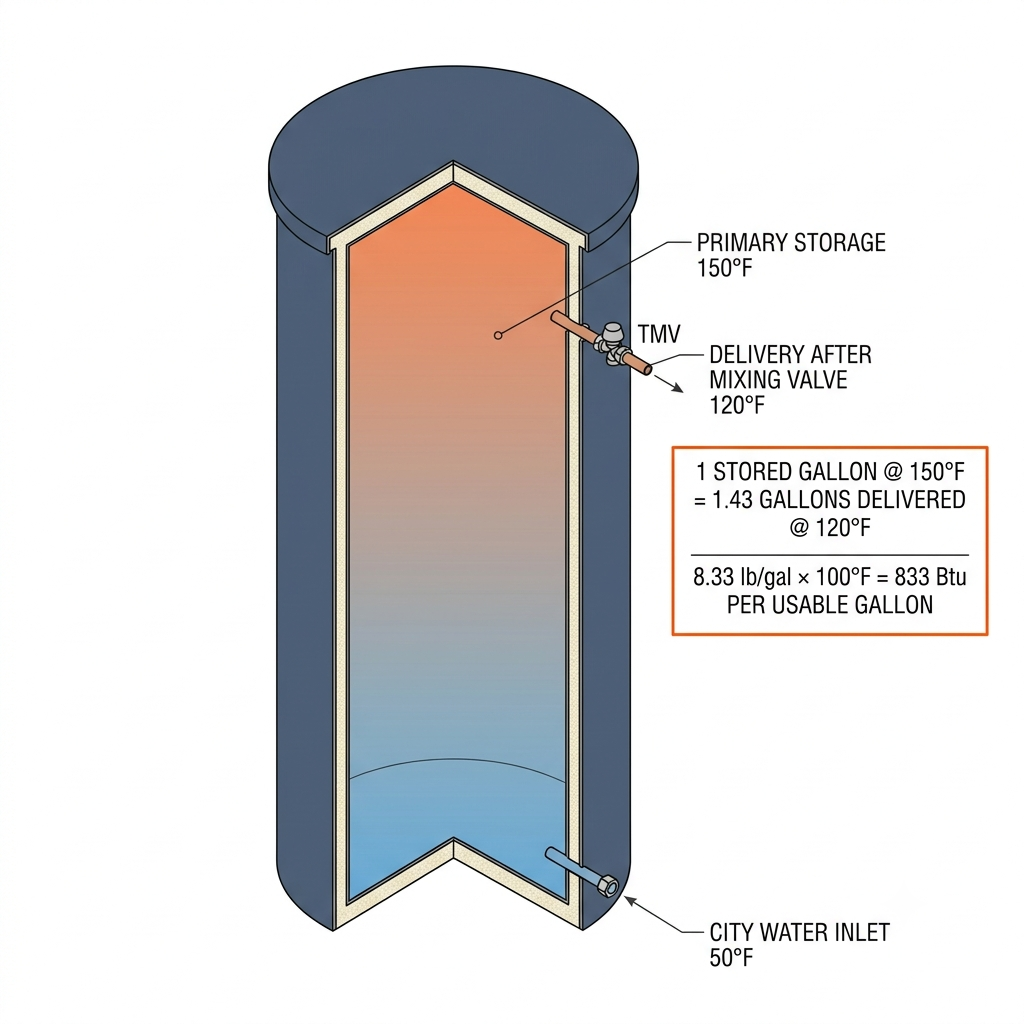
The swing tank approach depends on a high primary storage setpoint — typically 150°F or greater. That setpoint is a sizing input because it determines how much usable energy each stored gallon carries.
What you need before you can size anything
Every credible sizing method — ASHRAE, Ecosizer, or a manufacturer tool — needs the same six inputs. Missing any one of them means the output is a guess with decimal places.
Inputs required for central HPWH sizing
InputWhy it governsWhere it comes from
Occupancy, not unit countHot water follows people. Two studios and one three-bedroom are not the same load.Unit mix × bedroom-based occupancy factors, or measured data
Design-day cold water temperatureThe coldest entering water sets the largest temperature lift and largest energy per gallon.Local water utility, climate data, or tool default by ZIP
Delivery and storage setpointsDelivery temperature sets fixture blending; storage setpoint sets usable energy per gallon.Code, anti-scald requirements, and configuration choice
Peak-block load shapeA three-hour morning peak and a flat 24-hour draw with the same daily total need different plants.Building type profile or submetered retrofit data
Recirculation loop heat lossAdds continuous load and returns tepid water.Pipe length, insulation, and flow, or a flow meter and two temperature sensors
Derated heat pump output at design air temperatureNameplate capacity is not the design number. Capacity at design cold air temperature with defrost is the relevant value.Manufacturer performance data at record low, design cold, and design hot air temperatures
The Ecosizer method and the primary sizing curve
The most widely used public method for central HPWH sizing was developed in 2020 by Ecotope and is published as the Ecosizer sizing tool, with the method documented on the CalBEM Ecosizer documentation page.
The method accounts for hot water production during the peak demand period rather than assuming storage must cover the entire peak unaided. That is why it permits systems to be sized smaller than the classic ASHRAE approach.
The tool does not return a single answer. It returns a primary sizing curve: a locus of capacity-and-storage combinations that satisfy the same peak load. More compressor means less tank; more tank means less compressor. The tool derives peak demand from the 98th-percentile hot water day in an annual profile, per the Ecosizer CHPWH sizing tool manual.
It can run preset multifamily profiles, ASHRAE commercial building load shapes, or a custom draw profile. The custom option matters for hotels, laundries, correctional facilities, and other buildings whose draw pattern does not look like apartments.
How much storage per apartment, per unit, or per person?
Rules of thumb are dangerous because the correct number depends on where the project sits on the sizing curve. The following benchmarks provide anchors from monitored projects and modeling assumptions.
Multifamily hot water and storage benchmarks
BenchmarkFigureSource and context
Daily hot water per apartment~20 gal/apartment/dayField measurement of a central CO2 HPWH with swing tank, 60-unit low-rise, published in Sustainability
Daily hot water per person~11 gal/person/dayASHRAE service water heating apartment profile used in DOE Building America modeling
Compressor capacity per person~2,500 Btu/hMonitored 12-unit central plant, 42-occupant design basis
Storage per person in that same plant~6 galCompared with 15–20 gal/person typical of a single-family HPWH; the plant short-cycled
Recirculation loop adder+30% to +50% of delivered energyEPA ENERGY STAR central-system distribution loss range; 30% used in DOE climate modeling
HWC loop maintenance temperature115–125°FDOE Building America typical range
Primary storage setpoint, swing tank configuration150°F or greaterRequired for passive swing-tank heating to work
Worked example: a 100-unit multifamily retrofit

The arithmetic below is a teaching sequence, not a design. Real projects should run the Ecosizer or a manufacturer tool with site-specific inputs, and a licensed engineer of record should sign the result. None of the numbers below is a design output or specification.
Building: 100 units, approximately 180 occupants, an existing central gas plant with a recirculation loop, Sacramento climate, 50°F design cold water, 120°F delivery, and 150°F primary storage.
The single most important line in that example
The peak-block calculation produced roughly 305 gallons, while the time-of-use requirement added roughly 474 more. The time-of-use requirement is larger than the peak-hour requirement.
A plant sized only to survive the morning shower peak may be code-adequate but economically inert. A plant sized to move its electrical load off the evening peak is the one that changes the operating budget. If the owner has a demand charge, size for the rate, not just the draw.
Sizing for commercial buildings: where the multifamily playbook breaks
Multifamily draw profiles are sharp but predictable — a morning peak, an evening secondary peak, and a quiet night. Commercial buildings are not.
Use the right demand reference
For commercial buildings, use the Ecosizer custom load shape input, ideally from submetered data. The Service Water Heating chapter of the ASHRAE Handbook — HVAC Applications remains the reference for fixture-count and per-capita demand tables by building type. Use ASHRAE to establish the load and a heat-pump-specific method to size the plant that serves it.
Storage temperature, Legionella, and usable capacity
Storage temperature is simultaneously a public health parameter and a capacity parameter. The CDC guidance on controlling Legionella in potable water systems directs operators to store hot water above 140°F and keep circulating hot water from falling below 120°F, while noting that anti-scald requirements must still be met with a thermostatic mixing valve. ANSI/ASHRAE Standard 188 sets the water management program framework that many jurisdictions and healthcare payers now treat as mandatory.
Every degree of storage setpoint above delivery temperature increases the energy each stored gallon carries. At 150°F storage, 120°F delivery, and 50°F city water, one stored gallon blends into about 1.43 gallons of service hot water. At 130°F storage, the same gallon yields about 1.14 gallons — a 25% swing in effective tank size from a setpoint change alone.
Higher condensing temperature lowers heat pump COP. That is why the swing tank configuration exists: it allows the primary tank to sit hot for storage density and safety while a small dedicated heater handles the low-lift loop load.
Do not size the mixing valve as an afterthought
The thermostatic mixing valve makes high-temperature storage safe and converts stored energy into delivered gallons. Size it for peak instantaneous flow at design conditions, and verify that its inlet piping does not allow recirculation return to mix with cold make-up. That documented failure mode raises heat pump inlet temperature, reduces efficiency, and can make measured capacity fall 10–20% below nameplate.
Mechanical room reality: weight, doorways, and floor loading
A correctly sized storage volume that cannot physically be installed is not a design. In occupied retrofits, three constraints kill more projects than the thermal math: the tank will not fit through the door, the floor will not carry it, or crane access does not exist.
DOE guidance flags all three constraints, noting that full storage tanks are extremely heavy, tank locations must be coordinated with a structural engineer early, seismic bracing calculations are commonly required, and large tanks may not fit through finished doors. It also recommends vertical tanks in single-pass systems to maximize stratification.
Thermal Energy HQ’s patented panelized design assembles inside the mechanical room rather than arriving as a welded vessel, and capacity scales by adding modules as loads grow. See the thermal tank comparison and specifications for current planning data.
Published modular thermal storage planning data
ModelStorage capacityHeightDiameterFilled weightFloor loadingStanding loss
80 gallon12.0 kWh60.0 in30 in1,266 lb~100 lb/sq ft7–8°F / 24 hr
350 gallon54.6 kWh49.6 in60 in3,089 lb157.4 lb/sq ft3.8°F / 24 hr
500 gallon77.0 kWh69.1 in60 in4,351 lb221.7 lb/sq ft3.0°F / 24 hr
700 gallon108.0 kWh88.6 in60 in6,046 lb308 lb/sq ft2.4°F / 24 hr
Installation and load-shift considerations
The table’s standing-loss column is a sizing input for load-shift designs: a tank charged at 2 a.m. and drawn at 6 p.m. must still be hot at 6 p.m. Specifications are current as of August 2026; confirm height, diameter, filled weight, floor loading, and other data against the live product page.
For projects that want a coordinated assembly rather than field-built components, see the All-In-One thermal energy system. For sites pairing storage with on-site generation, Power Panel PVT collectors produce electricity and usable heat from the same aperture, changing the charging-hours assumption in the load-shift calculation.
How much does the storage side of the plant cost?
A modular thermal energy storage tank lists between roughly $1,200 and $5,800 per tank depending on capacity, equivalent to approximately $54–$97 per kWh of thermal storage. That is the storage vessel itself. A complete installed system adds heat pumps, heat exchangers, piping, controls, seismic restraint, and labor, which vary by site.
Illustrative modular thermal storage pricing
ModelList price$/kWh stored$/gallonStorage capacity
80 gallon$1,190$97$14.8812.0 kWh
350 gallon$3,427$63$9.7954.6 kWh
500 gallon$4,464$58$8.9377.0 kWh
700 gallon$5,798$54$8.28108.0 kWh
Storage economics and federal tax treatment
Cost per stored kWh drops about 44% from the smallest module to the largest. That is part of the arithmetic behind the storage-first design philosophy: buying toward more storage gets cheaper per unit as capacity increases, while buying toward more compressor does not.
The statutory definition of energy storage technology under 26 U.S.C. §48E includes thermal energy storage, and the Clean Electricity Investment Credit governs property placed in service after December 31, 2024. Credit value depends on project size, prevailing wage and apprenticeship compliance, and sourcing rules. Confirm specifics with a tax professional.
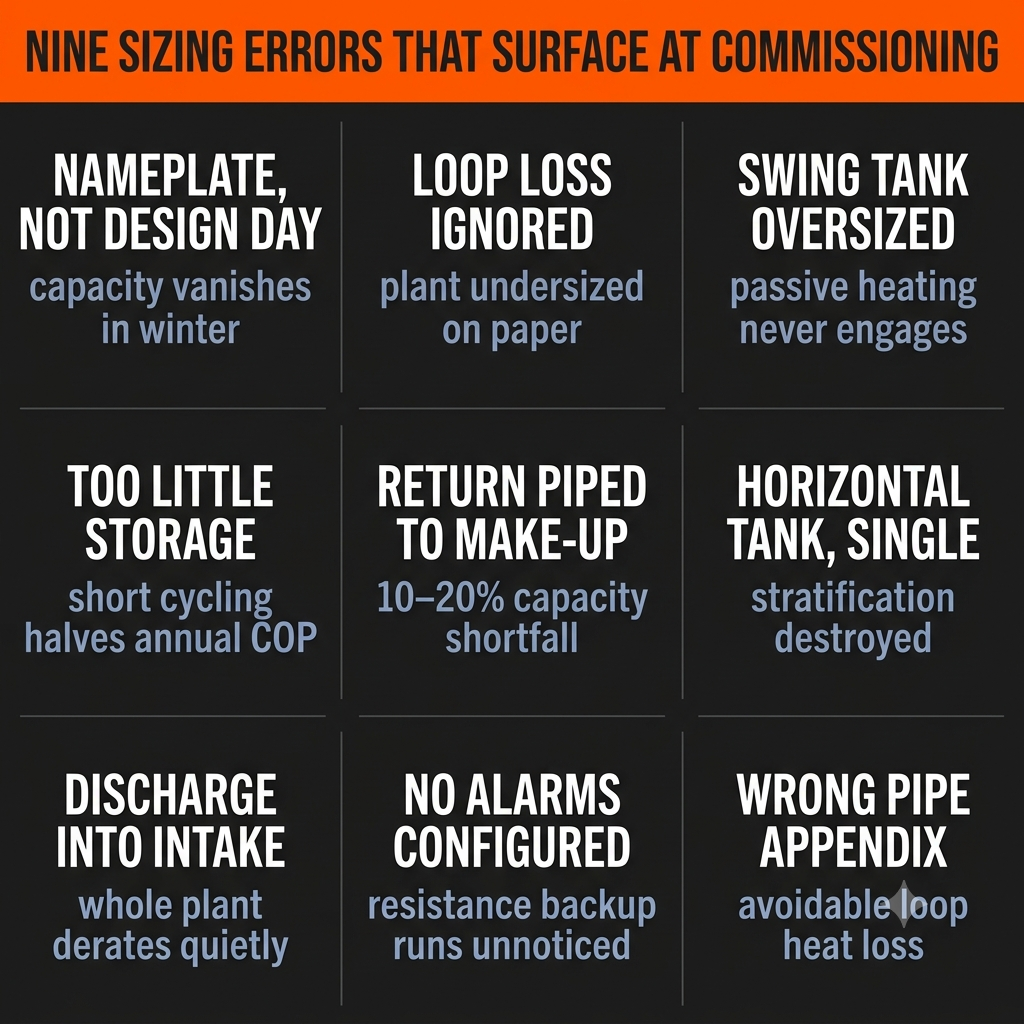
Nine sizing errors that surface at commissioning
Can storage let a heat pump plant ride through a grid event?
Partly, and the honest framing matters. A storage-heavy plant does not make a building independent of the grid. It decouples when the building buys energy from when it uses hot water.
Sized for a five-hour ride-through, a plant can stay off during the entire evening peak. Sized larger and charged by a photovoltaic-thermal array rather than grid electricity, most or all of a facility’s hot water energy can come from on-site solar with the grid as backup.
That capability also makes the plant eligible for a growing set of utility load-flexibility programs. California’s 2025 Building Energy Efficiency Standards, effective for permits submitted on or after January 1, 2026, push toward heat pump water heating with electric-ready provisions in multifamily construction. The compliance modeling is documented in the CEC water heating calculation method appendix.
Solar collection area, storage volume for multi-day autonomy, standing loss over the hold period, and backup heat are the four sizing questions an engineer models from a real draw profile. Examples of those tradeoffs are in the Thermal Energy HQ case studies, and full specification sheets are in the technical documentation library.
Frequently Asked Questions
How do you size a heat pump water heater for a multifamily building?
You size a central heat pump water heater by establishing the building’s design-day hot water load from occupancy and draw profile, adding recirculation loop heat loss of roughly 30–50%, then choosing a point on the capacity-versus-storage sizing curve that meets the peak block at design-day conditions. Because compressor capacity is expensive and storage is cheap, the standard approach is a smaller heat pump running 16–20 hours per day against a large storage volume — the opposite of gas water heater sizing. Free tools such as the Ecosizer generate the sizing curve; the engineer selects the point based on floor space, electrical service, and time-of-use rate structure.
How much hot water storage do I need per apartment?
There is no single correct number because storage trades against compressor capacity along a sizing curve. As anchors, monitored multifamily buildings show roughly 20 gallons of hot water use per apartment per day, and DOE Building America field work on a central plant documented about 6 gallons of storage per person — a plant that short-cycled and would have performed better with more. Storage sized to shift load off a time-of-use peak is typically larger than storage sized only for the morning peak.
What is a swing tank and how is it sized?
A swing tank is a temperature-maintenance tank plumbed in series downstream of high-temperature primary storage, usually with an electric resistance element. When the building draws hot water, hot make-up from the primary tank passes through the swing tank and heats it passively, so the efficient primary heat pump covers most of the recirculation loop load. The swing tank is sized for loop heat loss, not peak draw, and the configuration requires a primary storage setpoint of about 150°F or higher to work.
Why can’t I size a heat pump water heater the same way as a gas water heater?
Because the cost structure inverts. Gas buys recovery cheaply, so gas designs minimize storage and maximize input. Heat pumps buy storage cheaply and capacity expensively, so heat pump designs do the reverse. A heat-pump plant sized on gas logic ends up with an oversized, expensive compressor bank that short cycles, degrading seasonal COP below the steady-state rating — in one monitored project, from 3.0–4.0 steady-state to an annual 2.12.
What temperature should a central heat pump water heater store water at?
CDC guidance for potable water systems directs storing hot water above 140°F and keeping circulating hot water above 120°F, with a thermostatic mixing valve handling anti-scald compliance at delivery. Swing tank configurations typically run primary storage at 150°F or above, which also increases usable energy stored per gallon: at 150°F storage and 120°F delivery against 50°F city water, one stored gallon yields about 1.43 gallons of service hot water.
How is commercial heat pump water heater sizing different from multifamily?
The method is the same but the load shape is not. Hotels have compressed morning peaks with high simultaneity; laundries have sustained high-temperature draw with little diversity; commercial kitchens have schedule-driven sanitation loads and useful internal heat gain. Multifamily preset load profiles will misrepresent these buildings, so commercial sizing should use a custom draw profile, ideally from submetered data, with ASHRAE Handbook fixture and per-capita tables establishing the underlying demand.
Does adding thermal storage qualify for the federal energy storage credit?
Thermal energy storage is within the statutory definition of energy storage technology under 26 U.S.C. §48E, and the clean electricity investment credit applies to qualifying energy storage placed in service after December 31, 2024. Actual credit value depends on project size, prevailing wage and apprenticeship compliance, and sourcing rules, so confirm with a tax professional before including it in a pro forma.
Conclusion
Heat pump water heater sizing for multifamily and commercial buildings is not a harder version of gas sizing. It is a different problem with an inverted cost structure, two loads instead of one, and a design point that lives on a curve rather than at a number.
The plants that fail in the field are almost never the ones with too little compressor. They are the ones with too little tank — short cycling through shoulder seasons, leaning on resistance backup nobody configured an alarm for, and posting an annual COP that bears little resemblance to the rating that justified the project.
Get the load right, add the loop, size at design-day conditions, then buy storage until the compressors run long, quiet, and off-peak. The calculations and example in this article are a method, not a project specification; site-specific engineering review is required.
About the Author
Garth Schultz
Garth Schultz is President of Thermal Energy HQ, where he leads development of modular thermal energy storage systems and integrated thermal energy solutions.