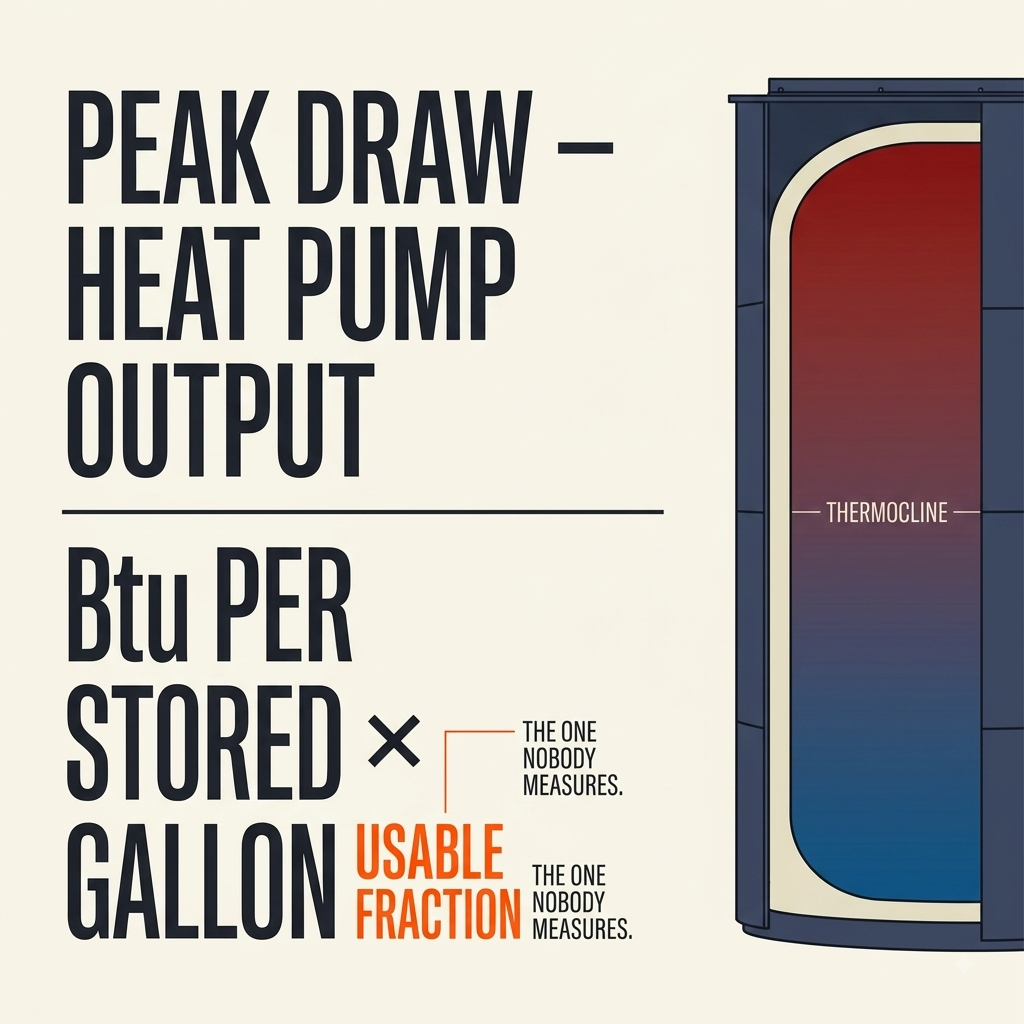
Sizing a storage tank for a heat pump water heater takes about four lines of arithmetic. The trouble is that one of the four inputs is almost never measured, is rarely published, and moves the answer by an entire size class. Two engineers can run the same calculation on the same building and land 150 gallons apart, both correctly, because they assumed different things about how much of the tank is actually usable.
In short: Required storage equals the hot water needed during the peak draw, minus what the heat pump delivers during that same window, divided by the usable energy per stored gallon, divided by the fraction of the tank that is actually deliverable. The first three terms are arithmetic. The fourth—usable volume, sometimes called draw-down efficiency—is the one to interrogate. And if you are specifying a tank separately from the heat pump, the First Hour Rating method that dominates search results for this question does not apply to your problem at all.
Key Takeaways
First question: are you sizing an appliance or a tank?
Almost every published guide to this question answers it for an integrated unit—a self-contained heat pump water heater with the compressor sitting on top of its own tank, of the kind installed in a basement or a garage. That is a legitimate question with a well-established answer, and it is the wrong answer for a split system. The two paths diverge immediately:
In this article
Integrated units versus separately specified tanks
The reason FHR cannot cross over is worth stating precisely, because it is the source of a great deal of confused specification. First Hour Rating measures how many gallons a fully heated appliance can deliver in one clock hour while its own heat source reheats incoming water throughout. It is therefore a combined result of tank volume, heat source capacity, and control behavior, produced by testing them together. Split the heat source out and specify it separately and the number has no referent—there is no appliance to test.
Worth noting too that the Federal Trade Commission does not require an EnergyGuide label on heat pump water heaters at all, so even in the integrated case the figure often has to come from manufacturer literature rather than the yellow label, as explained in the ENERGY STAR heat pump water heater FAQ.
If you are on the integrated path, the method is straightforward and you do not need the rest of this article. Estimate peak hour demand by adding up the hot water used by every fixture and appliance likely to run in your busiest sixty minutes, then select a unit whose First Hour Rating meets or exceeds it. DOE and PNNL publish a free First Hour Rating calculator built on the industry-standard AHRI method, and DOE’s Energy Saver program covers sizing and efficiency for storage, demand, and heat pump water heaters. Some jurisdictions publish minimum First Hour Ratings by bedroom count in code, and ENERGY STAR’s NextGen program sets minimum rated tank volumes the same way, so check the local requirement before selecting on calculation alone.
Everything below is the split-system path.
Sizing basis for integrated and separately specified systems
Integrated unitSeparately specified tank
What it isHeat pump, tank, backup element, and controls in one package
Sizing basisFirst Hour Rating (FHR), matched to peak hour demand
Where the rating comes fromA defined test of the whole appliance, published in manufacturer literature
Who this isHomeowners; small light-commercial loads
The five inputs
Establish these before touching the arithmetic. Four are measurable; the fifth is the one to be skeptical about.
Inputs for separate storage tank sizing
InputWhat it isWhere it comes from
Peak drawHot water needed during the worst window, at delivery temperature. Not the daily totalMetered data on an existing building; a validated load profile or sizing tool on a new one
Heat pump outputBtu/h the heat pump actually delivers during that windowManufacturer capacity at design cold ambient including defrost derate—not the rating-condition figure
Cold inlet temperatureEntering city water on the design day, which is the coldest dayLocal water utility, or measured. Varies seasonally by 15–25°F in many regions
Storage and delivery temperaturesHow hot the tank is held and what temperature reaches the fixtureDesign decision, bounded by scald limits and by pathogen control guidance
Usable volume fractionThe share of nominal volume that can actually be delivered before outlet temperature fallsManufacturer tested draw-down. If nobody can produce one, this is a guess and should be labeled as one
The formula
Four steps. Work them in order.
1. Peak draw energy. Gallons required during the peak window × 8.34 lb/gal × (delivery temperature − cold inlet temperature). Gives Btu.
2. Subtract heat pump contribution. Heat pump output in Btu/h × hours in the window. The heat pump is not idle while the peak runs, and treating it as though it were is the most common way these calculations come out oversized.
3. Convert the remainder to stored gallons. Divide by 8.34 × (storage temperature − cold inlet temperature). This is the usable energy one stored gallon carries when drawn down against cold make-up water.
4. Divide by the usable volume fraction. The result is the nominal tank volume to specify.
Note what step three does. Storing hotter than you deliver, and blending down at a thermostatic mixing valve, puts more usable energy into every gallon. Raising storage from 120°F to 140°F against a 55°F inlet increases usable energy per gallon by about 31%, which is a direct reduction in required tank volume, floor loading, and mechanical room footprint. It also keeps stored water above the range in which waterborne pathogens multiply, which is a separate and stronger reason to do it.
Worked example: 30-key boutique hotel
Illustrative arithmetic. It shows the shape of the calculation and is not a design input. Peak draw of 450 gallons at 120°F over one hour; heat pump rated 60,000 Btu/h at design cold ambient including defrost derate; cold inlet 55°F; storage held at 140°F.
The assumption that decides the answer
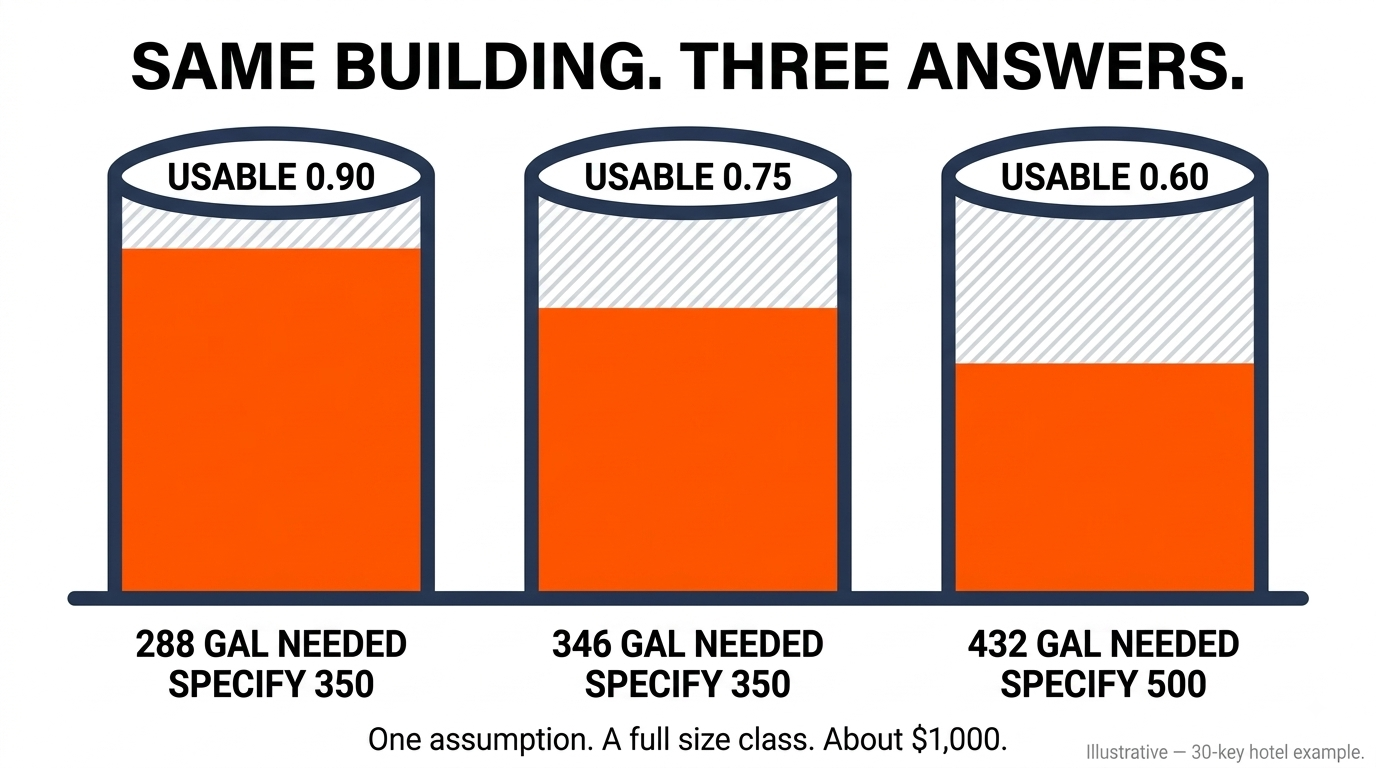
Now change nothing about that hotel except the usable volume assumption:
A 144-gallon spread and a $1,037 price difference, produced entirely by an assumption that most specifications never state. Nobody measured anything differently; nobody made an error. One engineer wrote 0.60 in a spreadsheet and another wrote 0.90.
What actually drives the number is how well the tank preserves stratification. Cold make-up water entering a tank wants to mix with the hot water above it, and once it does, outlet temperature starts falling while the tank is still nominally full. Tanks designed to resist this—with a diffuser or baffle that arrests inlet velocity so the cold layer stays put beneath a sharp thermocline—deliver a much larger share of their volume at usable temperature. It is a real engineering difference, not a marketing one, and it is why some commercial storage tanks are explicitly marketed on draw-down performance.
Which is a competitor advantage worth naming plainly. At least one established commercial tank manufacturer publishes a draw-down figure in the region of 95% for its stratification-baffled large-volume tanks. If a project hinges on extracting the maximum usable gallons from a constrained footprint, a tank with published, tested draw-down performance is a legitimate reason to choose that product, and a specifier should ask us for the same number rather than take a nominal volume on trust. The honest guidance here is the same regardless of who supplies the tank: ask for a tested draw-down percentage and the conditions it was measured at, and if the answer is a shrug, use a conservative fraction and say in your submittal that you did.
Sensitivity of required tank volume to usable volume fraction
Usable volume fractionRequired nominal volumeTank you would specifyList price at published modular rates
0.90—well stratified, diffused inlet288 gal350 gallon$3,427
0.75—typical assumption346 gal350 gallon$3,427
0.60—poorly baffled or heavily mixed432 gal500 gallon$4,464
Why heat pumps want bigger tanks than anything else
Run the same calculation for a gas-fired plant and the tank comes out small, because a burner recovers fast enough to meet most of the peak in real time. Run it for a heat pump and the tank comes out large, because the heat pump’s contribution during step two is modest. That is not a deficiency; it is the design intent. Heat pump capacity is expensive and storage is cheap, so the economical system is a smaller heat source running long hours against a bigger tank.
Three separate effects push the same direction:
The bound on all of this is physical rather than economic. Standing loss rises with volume, floor loading rises faster than most people expect, and the tank has to fit through the door. Those constraints are covered in the guide to commercial hot water storage tanks, and the system-level version of the capacity-versus-storage tradeoff is worked through in the guide to central heat pump water heaters for multifamily buildings.
Four checks that catch a bad answer
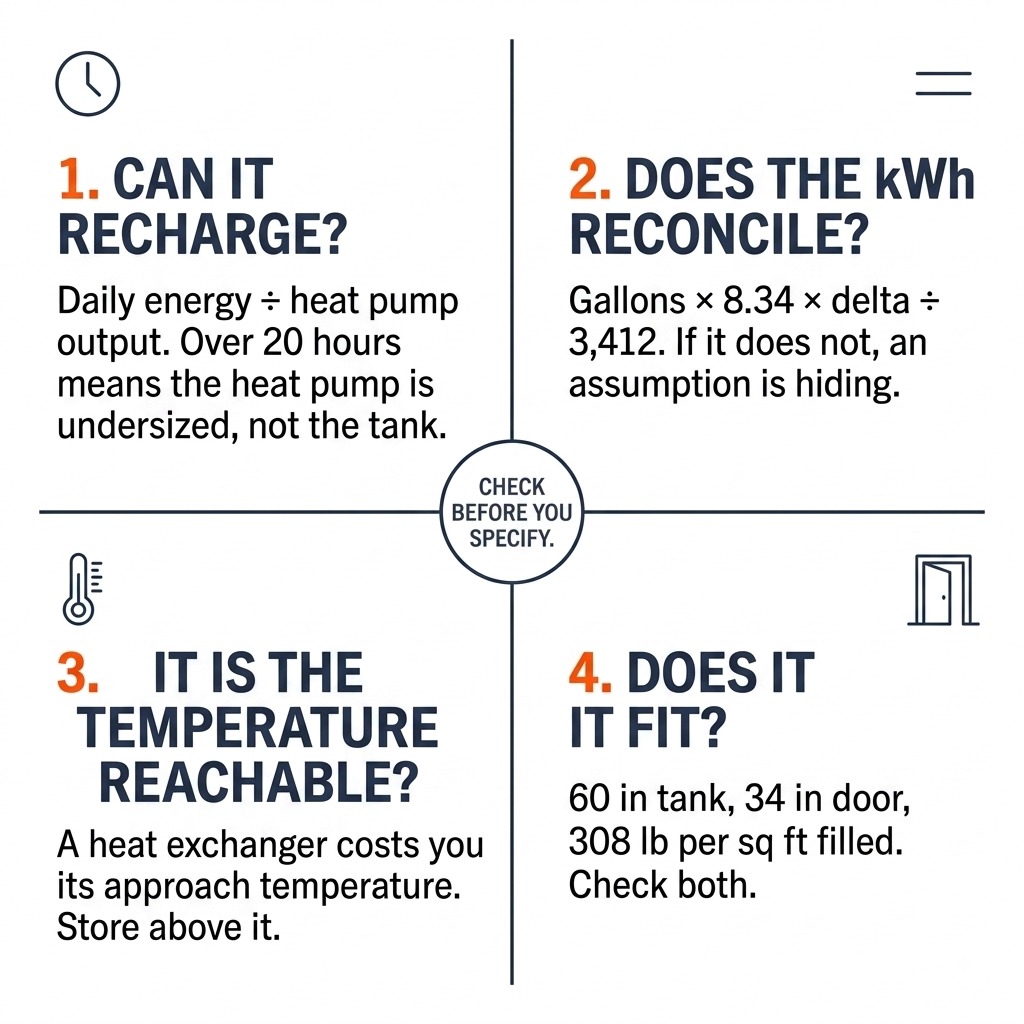
1. Can the heat pump recharge the tank at all? Divide the design day’s total energy by the heat pump’s output. If the result exceeds about 20 hours, the plant never catches up regardless of tank size, and the heat pump is undersized rather than the tank being too small.
2. Does the kWh rating reconcile with volume and temperature? Stored energy should equal gallons × 8.34 × temperature delta, divided by 3,412 for kWh. A published rating that does not reconcile is resting on an unstated assumption—usually a larger temperature delta than the system will ever see.
3. Is the delivery temperature achievable from the storage temperature? If a heat exchanger sits between the tank and the potable supply, the store has to run above delivery temperature by the exchanger’s approach temperature. Sizing on storage temperature the system cannot maintain produces a tank that is correct on paper only.
4. Does it physically fit, and will the floor carry it? A 500-gallon vertical vessel is roughly 60 inches in diameter against about 34 inches of clear opening in a standard commercial door, and a filled 700-gallon tank imposes roughly 308 pounds per square foot. Both checks take an afternoon and are cheaper than a change order.
Frequently Asked Questions
How do you size a storage tank for a heat pump water heater?
Take the hot water energy needed during the peak draw window, subtract the energy the heat pump delivers during that same window, divide by the usable energy per stored gallon, then divide by the fraction of the tank that is actually deliverable. Usable energy per gallon equals 8.34 multiplied by the difference between storage temperature and cold inlet temperature. The result is the nominal tank volume to specify.
Does First Hour Rating apply to a separately specified storage tank?
No. First Hour Rating is a test result for a complete appliance, combining tank volume, heat source capacity, and control behavior measured together. A bare storage vessel specified independently of the heat pump that charges it has no First Hour Rating, because there is no integrated appliance to test. Use the deficit method instead. First Hour Rating remains the correct basis for selecting an integrated heat pump water heater.
What is draw-down efficiency and why does it matter so much?
Draw-down efficiency, or usable volume fraction, is the share of a tank's nominal volume that can be delivered at usable temperature before the outlet cools. It matters because it is a divisor in the sizing formula, so it scales the entire answer. In a worked example of a 30-key hotel, assuming 0.90 rather than 0.60 changes the requirement from 432 gallons to 288 gallons, which is a full size class of tank. It is driven mainly by how well the tank preserves stratification as cold make-up water enters.
Why do heat pump water heaters need larger storage tanks?
A heat pump recovers more slowly than a gas burner of comparable cost, so it contributes less during a peak draw and storage covers more of it. Larger tanks also reduce reliance on electric resistance backup, lengthen compressor cycles and so improve seasonal efficiency, and make load shifting onto cheap or solar hours possible. ENERGY STAR guidance recommends upsizing tanks serving heat pump water heaters relative to standard practice for electric resistance or fossil-fuel equipment for these reasons.
What temperature should storage be held at when sizing?
Storing hotter than the delivery temperature and blending down at a thermostatic mixing valve puts more usable energy into every gallon and reduces the required tank volume. Raising storage from 120 to 140 degrees Fahrenheit against a 55 degree inlet increases usable energy per gallon by roughly 31 percent. Higher storage temperature also keeps stored water above the range in which waterborne pathogens multiply, which is an independent reason to do it, with scald protection handled at the fixture rather than at the tank.
What is the formula for usable energy per stored gallon?
Usable energy per stored gallon equals 8.34 pounds per gallon multiplied by the difference between storage temperature and cold inlet temperature, in degrees Fahrenheit. For water stored at 140 degrees against a 55 degree inlet, that is 8.34 multiplied by 85, or about 709 Btu per gallon. Dividing the storage deficit in Btu by this figure converts it directly into gallons.
How do I know if my tank is too small?
The symptom of an undersized tank is running out of hot water at the end of a peak while the heat pump is still running, or an electric resistance element engaging during normal peaks rather than only during unusual demand. Before adding storage, check whether the heat pump can recharge the tank at all: divide the design day energy by the heat pump output, and if the result exceeds roughly 20 hours the heat pump is undersized and more storage will not fix it.
Conclusion
## The bottom line
The arithmetic is not the hard part. Four lines get you a number, and any competent engineer can produce it in ten minutes. What separates a specification that works from one that disappoints is the quality of two inputs: the peak draw, which should be metered wherever a building exists to meter, and the usable volume fraction, which should come from a tested draw-down figure rather than from habit.
If you take one thing from this page, take the habit of asking for that second number. A tank quoted only in nominal gallons is being quoted on the dimension that matters least. Ask what percentage of it comes out hot, and under what test conditions, and the answer will tell you a great deal about the tank and about the vendor.