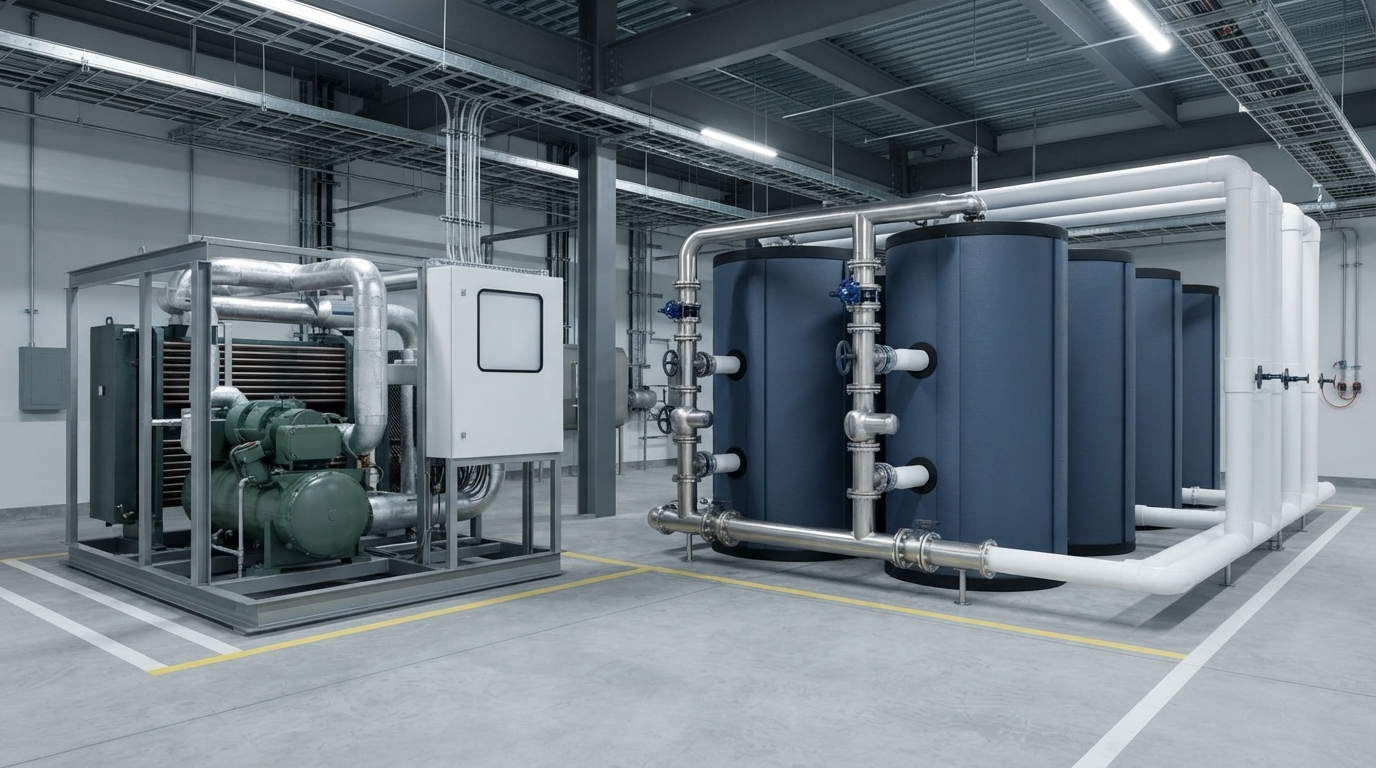
Industrial process heat is the largest unelectrified energy demand in American manufacturing, and the reason is not that nobody has tried. It is that the equipment which makes electrified heat efficient — the heat pump — wants to run steadily at a constant load, and almost no industrial process asks for heat that way. Sanitation runs at shift change. Clean-in-place runs between production batches. A brewhouse wants hot liquor in a rush and then nothing for hours.
Size a heat pump to serve those peaks directly and you buy a very expensive machine that spends most of its life at part load or off. That single mismatch has killed more process heat electrification business cases than any technical limitation of the heat pumps themselves.
In short: pairing an industrial heat pump with thermal energy storage decouples the machine from the process. The heat pump is sized to the average daily thermal load rather than the peak, runs long and steady at its best efficiency, and charges a store; the store serves the batch draws. That reduces installed heat pump capacity and cost, improves COP, and moves electrical consumption off expensive demand periods. The approach applies to low-temperature process heat — process hot water, wash-down, CIP, and similar duties — which is where much of the food and beverage opportunity sits. Steam and higher-temperature process heat are a different problem with different equipment, and this article says where the line is.
Key Takeaways
The scale of the low-temperature opportunity
DOE’s Industrial Decarbonization Roadmap frames the situation directly: more than half of all manufacturing energy is used for thermal processing, and less than 5% of those operations are electrified. The same roadmap identifies heat pumps as able to satisfy a range of thermal demands across low and medium temperatures in a range of industries — which is not a niche observation, because that band is where most of the demand lives.
Policy analysis from ACEEE’s brief on decarbonizing industrial process heat puts low-to-medium temperature process heating at roughly two-thirds of total U.S. manufacturing process heating demand, and notes that electrifying all process heat under 300°C with clean electricity could deliver something on the order of a 30% reduction in total industrial greenhouse gas emissions.
On why heat pumps specifically, Energy Innovation’s analysis of decarbonizing low-temperature industrial heat is blunt: direct electrification using heat pumps is the most efficient and cost-effective method of supplying low-temperature industrial process heat, because heat pumps move heat rather than creating it from their input energy and avoid the losses that combustion sends up the stack. Electrolytic hydrogen, bioenergy, and carbon capture cannot compete with heat pumps in this temperature range on economics.
For food and beverage the alignment is close to perfect. The overwhelming majority of that sector's thermal emissions come from low-temperature processes — the washing, sanitizing, pasteurizing, blanching, and cleaning duties that run on hot water rather than high-pressure steam. Those are exactly the loads a heat pump serves well, and exactly the loads a hot water store can buffer.
Where the water-storage band starts and stops
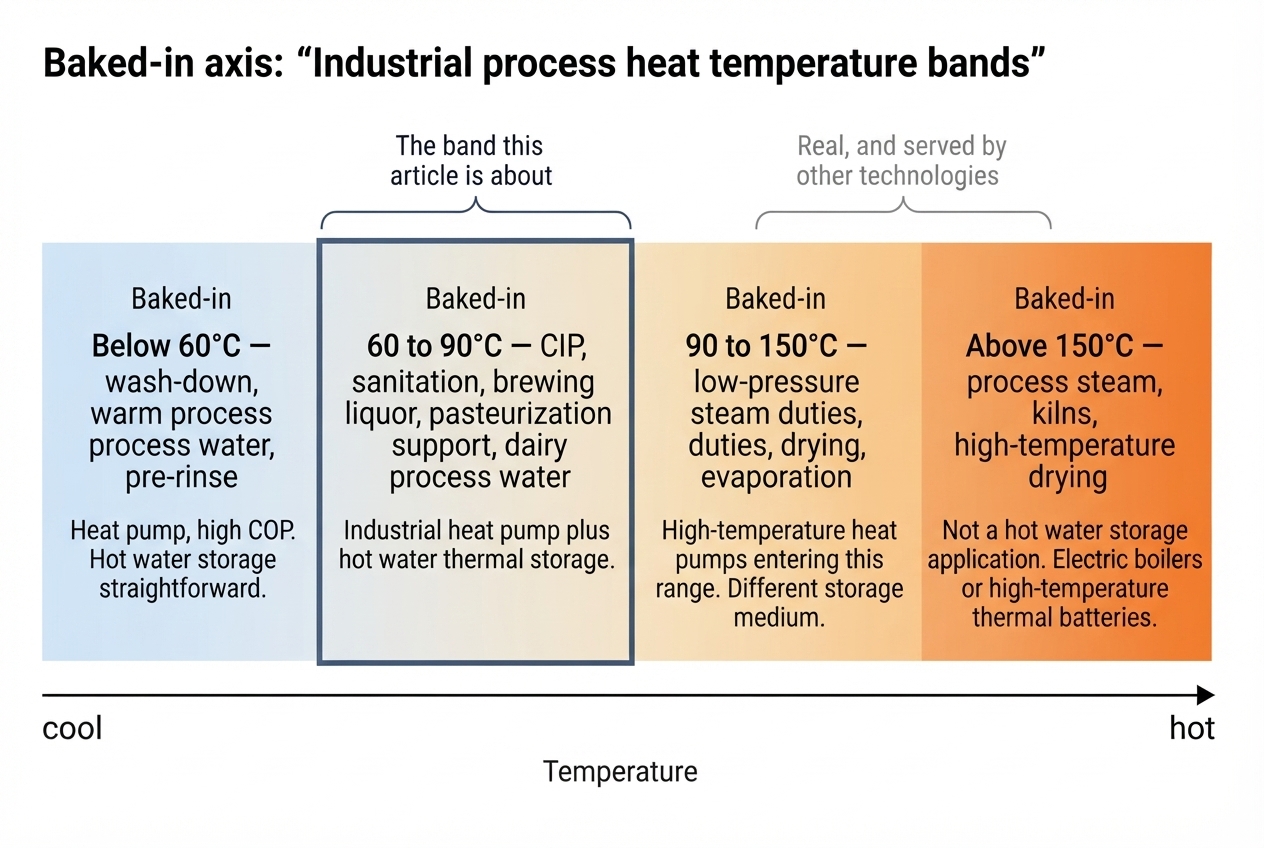
Before anything else, the boundary, because a page that blurs it is not worth reading.
Industrial heat pump and thermal storage temperature bands
Temperature bandTypical dutiesRight technology
Below ~60°CWash-down, warm process water, space heating, pre-rinse, some agricultural washingHeat pump, high COP; hot water storage is straightforward
~60–90°CCIP, sanitation hot water, brewing liquor, pasteurization support, blanching water, dairy process waterIndustrial heat pump plus hot water thermal storage — the core case for this article
~90–150°CLow-pressure steam duties, drying, some concentration and evaporationHigh-temperature heat pumps are entering this range; storage is typically pressurized or uses a different medium
Above ~150°CProcess steam, kilns, calcination, high-temperature dryingNot a hot water storage application. High-temperature thermal batteries, electric boilers, or continued combustion
Higher-temperature equipment has a different job
The upper band is real and is being addressed seriously by other technologies. A 2026 review of high-temperature heat pumps for industrial decarbonization reports systems operating between 120°C and 200°C achieving coefficients of performance of roughly 2.5 to 4.0 for 100–150°C outputs, aimed at chemicals, food processing, and metals. Refractory and brick-based thermal batteries target higher still.
None of that is a hot water tank's job. What a hot water tank serves is the middle band: process hot water, wash-down, clean-in-place, sanitation hot water, brewing liquor, pasteurization support, blanching water, and similar duties. That band covers much of what a food plant, brewery, dairy, produce packer, and commercial laundry actually do with thermal energy all day.
The sizing problem — and why storage is the answer
This is the section that matters, because it is where the money is.
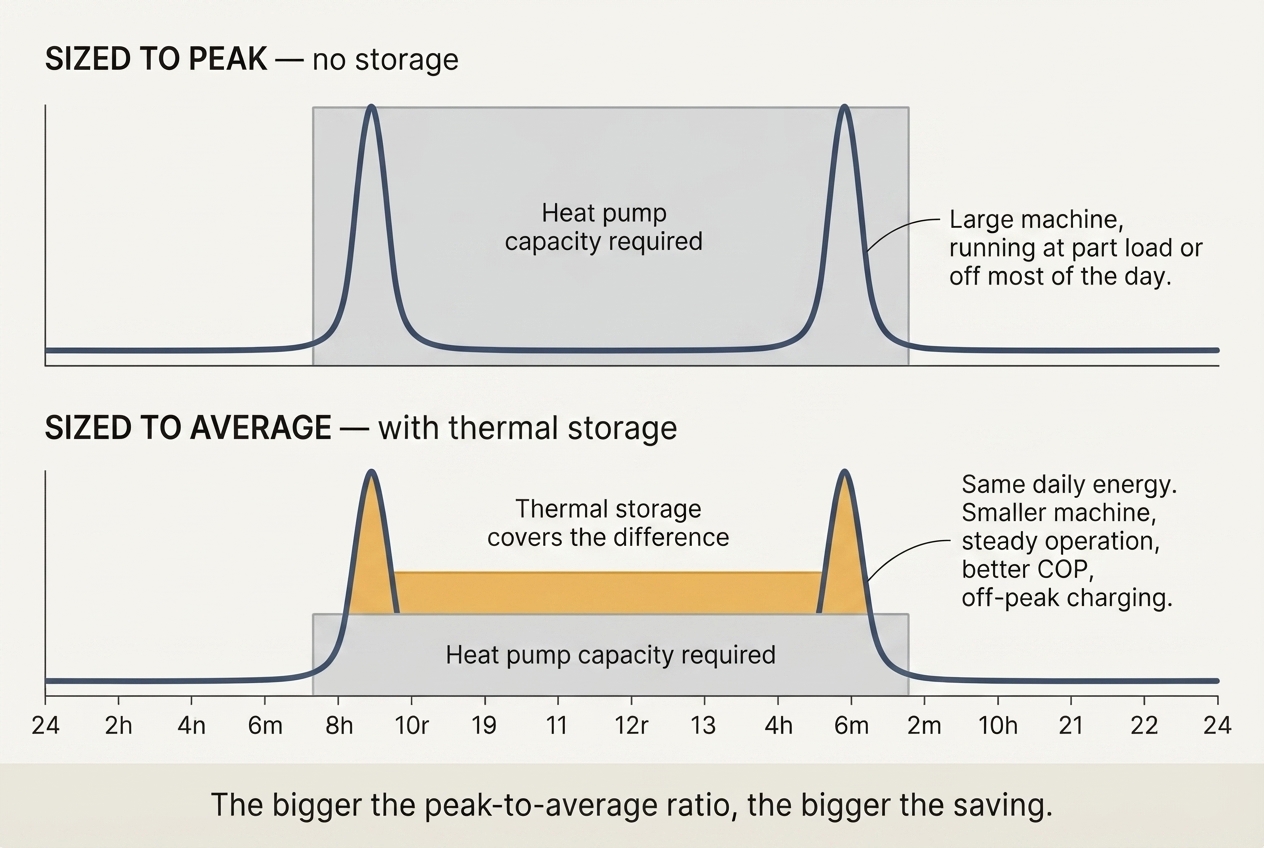
An industrial thermal load is rarely flat. A plant running two production shifts with a sanitation window between them might use nothing for hours and then draw its entire daily hot water volume in ninety minutes. A brewery's hot liquor demand spikes at mash-in. A CIP skid calls for a large volume at temperature, on a schedule set by production changeovers rather than by anything convenient.
Now consider what that does to equipment selection. A heat pump sized to meet the peak instantaneous draw directly must be large. Industrial heat pumps are capital-intensive machines, and cost scales with capacity. So the plant buys a big machine, runs it hard for ninety minutes, and then leaves it idling or cycling for the rest of the day — which also hurts efficiency, because heat pumps are happiest running steadily at a design point rather than modulating or short-cycling.
Insert a thermal store and the entire arrangement changes. This is the same logic described in the DOE Technology Strategy Assessment on thermal energy storage and DOE Better Buildings guidance on thermal energy storage.
Where the heat comes from: source temperature is everything
A heat pump's efficiency is governed by the lift — the temperature difference between where it takes heat from and where it delivers it. Halve the lift and the COP improves substantially. Which means the single most valuable thing an industrial site can do before specifying a heat pump is inventory its warm waste streams.
Waste-heat upgrading and batch storage
The best industrial heat pump projects are usually waste-heat-upgrade projects wearing a different name: take a stream the plant is currently paying to reject, lift it to process temperature, and store it until the process wants it. The storage tank is what lets a variable waste stream serve a batch demand, because neither one is on the other's schedule.
What the federal programs are actually funding
This is a live policy area and it is worth knowing what has been selected, because it shapes both the incentive landscape and the availability of vendors and integrators. DOE's Industrial Demonstrations Program overview targets energy-intensive industries including food and beverage and process heat specifically.
Among the selections for award negotiation in the heat category described by DOE are a Kraft Heinz project to decarbonize process heat across up to eleven facilities using heat pumps, electric heaters, and electric boilers alongside efficiency and renewable technologies, and a Diageo project applying thermal batteries, electric boilers, heat pumps, and heat exchangers to meet continuous site heating requirements at two beverage facilities. See the DOE selections for award negotiations in the Heat category and the DOE environmental compliance summary for the Diageo project.
ACEEE’s analysis of the program lists industrial heat pumps, electric boilers, and thermal batteries as the core food and beverage technology set. These projects should be described as selections or awards, not as completed installations.
The direction of travel matters more than any single award. DOE's technical program work on industrial heat pumping technologies places heat pumps within the roadmap's decarbonization pillars for exactly the subsectors — food and beverage among them — where low-temperature heat dominates.
Processes worth evaluating first
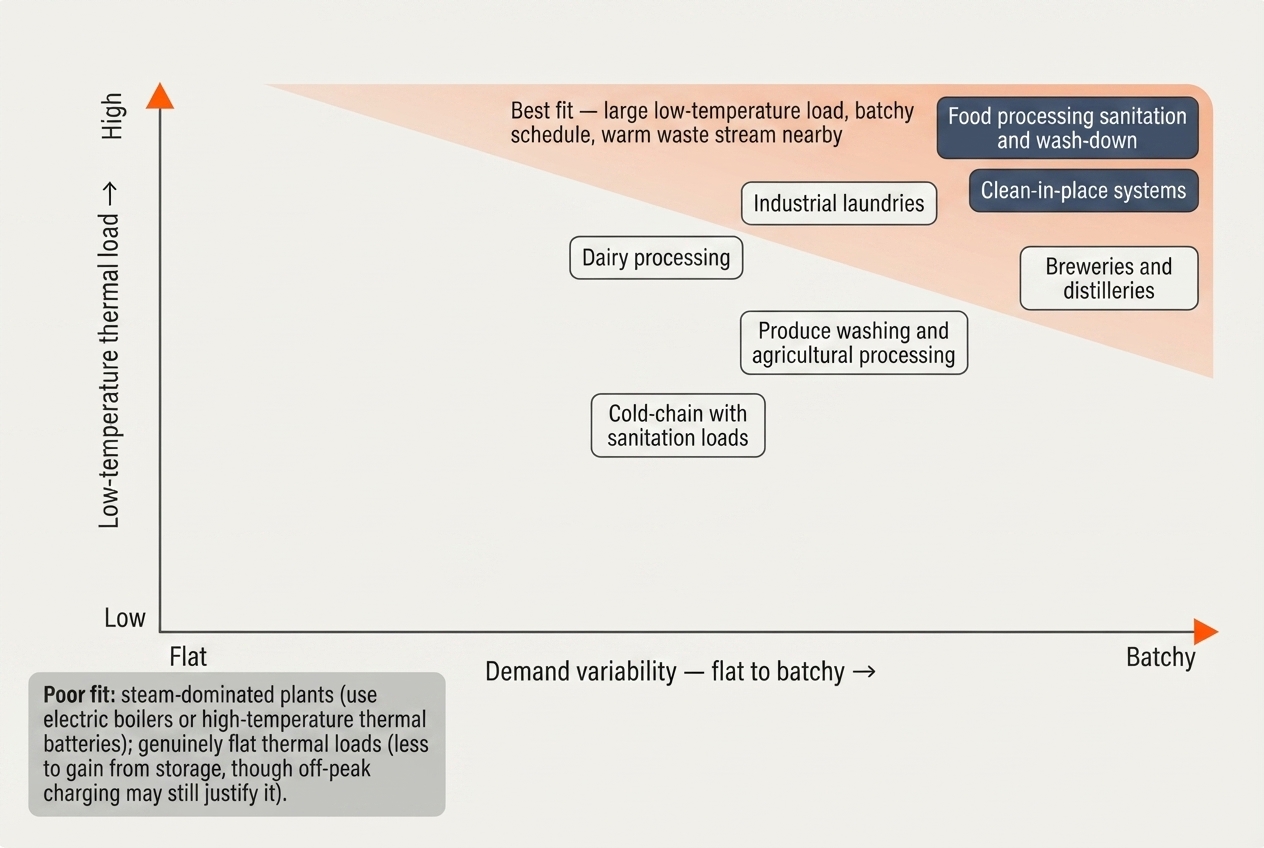
Screen for three things together: a substantial low-temperature thermal load, a batchy or shift-driven demand profile, and a warm waste stream nearby.
Poor candidates
A facility whose thermal demand is dominated by steam should be looking at electric boilers or high-temperature thermal batteries, not at this architecture. A facility with a genuinely flat thermal load has less to gain from storage, because there is no peak-to-average ratio to exploit — although off-peak charging may still justify it. And a facility with no warm waste stream and expensive electricity may find the heat pump economics marginal regardless of how the storage is arranged.
Modular storage and vessel selection
On the vessel itself, industrial-scale storage generally means a bank of modules rather than a single tank, and above a certain volume it means a different vessel class entirely. Modular construction earns its place in existing plants with constrained utility rooms, fixed shutdown windows, and no appetite for craning a vessel through a roof. Panelized modular tanks assemble inside the room and expand by adding modules. The architecture is also covered in this modular thermal energy storage guide and the high-capacity thermal water tank overview.
Water is the storage medium of choice in this band for the reasons set out in our comparison of sensible and latent heat storage: near-zero material cost, no degradation, transparent capacity math, and discharge at pump rate. Sandia’s thermal storage chapter of the DOE Energy Storage Handbook places liquid sensible storage as the mature baseline against which other media are measured.
The modular thermal storage tank line has the following current published list pricing:
Published modular tank pricing
Pricing is current as of August 2026. The rated storage capacities below use a 35°C temperature delta. Vessel only — an industrial system adds the heat pump, exchangers, pumps, controls, electrical service, and integration. See the full thermal tank comparison and specifications.
Published modular thermal storage tank pricing
ModelList price$/kWh storedStorage capacityStanding loss
80 gallon$1,190$9712.0 kWh7–8°F / 24 hr
350 gallon$3,427$6354.6 kWh3.8°F / 24 hr
500 gallon$4,464$5877.0 kWh3.0°F / 24 hr
700 gallon$5,798$54108.0 kWh2.4°F / 24 hr
Configuration options
For a packaged heat-source-plus-storage approach, see the All-In-One thermal energy system. For the wider configuration set, see Thermal Energy HQ’s system solutions. For how thermal storage compares with electrochemical storage on an industrial site, see thermal storage versus lithium-ion.
Incentives and program pathways
Industrial thermal projects sit at an unusual intersection of programs, and the storage vessel's treatment varies. Federal demonstration funding through the Industrial Demonstrations Program targets first-of-a-kind and replicable projects at scale rather than routine retrofits.
At the tax level, thermal energy storage falls within the statutory definition of energy storage technology under 26 U.S.C. §48E, though whether an industrial process heat storage tank qualifies depends on configuration and what it serves, and belongs with a tax professional. No current credit percentage is stated here.
Utility custom industrial programs typically evaluate the measure on energy and demand savings, which is where the storage side often scores well independently of the heat pump — a store that moves load off peak has a demand-charge case a program can measure. State programs vary widely; California in particular has been active in supporting industrial heat pump deployment. Ask program administrators early how they categorize the tank, because it materially changes the stack.
Frequently Asked Questions
Why do industrial heat pumps need thermal energy storage?
Because industrial thermal demand is usually batchy while a heat pump performs best running steadily. Without storage, the heat pump must be sized to meet the peak instantaneous draw, which means buying a large, capital-intensive machine that spends most of its time at part load or cycling. With storage, the heat pump is sized to the average daily thermal load, runs long and steady at its design point where it delivers its rated efficiency, and charges a store that serves the batch draws. On a load with a high peak-to-average ratio, that can substantially reduce installed heat pump capacity and cost.
What temperatures can industrial heat pumps deliver?
Conventional industrial heat pumps serve low-temperature duties well, and high-temperature industrial heat pumps have moved into higher ranges — a 2026 technical review reports systems operating between 120°C and 200°C achieving coefficients of performance of roughly 2.5 to 4.0 for outputs in the 100 to 150°C range. Efficiency falls as the temperature lift grows, so the economics are strongest when the heat pump draws from a warm waste stream and delivers a modest lift. Above roughly 150°C, electric boilers and high-temperature thermal batteries are generally the more appropriate technologies.
Can a hot water thermal storage tank serve process steam?
No. Steam and process heat above roughly 100°C are outside what a hot water thermal store can serve, and that duty belongs to different equipment — electric boilers or high-temperature thermal batteries built from refractory or similar media. Hot water thermal storage serves the low-temperature band: process hot water, wash-down, clean-in-place, sanitation, brewing liquor, pasteurization support, and similar duties. That band covers most of the thermal energy a food, beverage, or agricultural processing facility uses in a day, but it does not include steam.
How much of industrial process heat can actually be electrified?
A large share. DOE's industrial decarbonization work notes that more than half of all manufacturing energy is used for thermal processing while less than 5% of those operations are electrified. Policy analysis puts low-to-medium temperature process heating at roughly two-thirds of total U.S. manufacturing process heating demand, and estimates that electrifying all process heat under 300°C with clean electricity could reduce total industrial greenhouse gas emissions by roughly 30%. Food and beverage is the most accessible sector because the overwhelming majority of its thermal emissions come from low-temperature processes.
Where should an industrial heat pump get its heat from?
From the warmest waste stream available, because efficiency depends on the temperature lift. Process cooling water and condenser discharge are usually the largest and warmest continuous streams on site and are often already being rejected to a cooling tower. Refrigeration heat rejection is continuous and free in any facility with substantial refrigeration. Warm effluent from wash-down and clean-in-place is reliable but needs fouling-tolerant equipment. Ambient air or ground is the fallback when no waste stream exists, but it means a longer lift and a lower coefficient of performance.
Which industrial processes are the best candidates?
Those combining a substantial low-temperature thermal load, a batch or shift-driven demand profile, and a warm waste stream nearby. Food processing sanitation and wash-down, clean-in-place systems, breweries and distilleries, dairy operations, produce washing and agricultural processing, and commercial and industrial laundries all fit. Facilities whose thermal demand is dominated by steam are better served by electric boilers or high-temperature thermal batteries. Facilities with genuinely flat thermal loads gain less from storage, since there is no peak-to-average ratio to exploit, though off-peak charging may still justify it.
Conclusion
Process heat electrification is not held back by heat pump technology at low temperature. It is held back by the arithmetic of buying a machine large enough to serve a peak that lasts ninety minutes a day. Thermal storage is the component that fixes that arithmetic — not by making the heat cheaper, but by making the machine smaller, steadier, and cheaper to run.
It also does something quieter and more valuable in an operating plant: it puts a buffer between the process and the utility. Production schedules move, batches run long, and lines go down. A store absorbs that without the heat source chasing it, which is worth something on its own to anyone who has watched a boiler cycle against a changeover.
The band this applies to is real but bounded. If the plant runs on steam, this is the wrong architecture and there are companies doing serious work on that problem. If the plant runs on hot water — and a great many food, beverage, dairy, and agricultural facilities do, all day, every day — then the question is only how big the peak-to-average ratio is and where the waste heat is.
Garth Schultz is President of Thermal Energy HQ, where he leads development of modular thermal energy storage systems manufactured in the United States. He is the inventor named on patents covering hybrid photovoltaic-thermal (PVT) solar panels and insulated modular storage tank construction, and has worked in solar-thermal product development since founding the company's technology line in 2007. Connect on LinkedIn.
The fastest way to find out is a short engineering conversation about your load profile, your waste streams, and your production schedule.