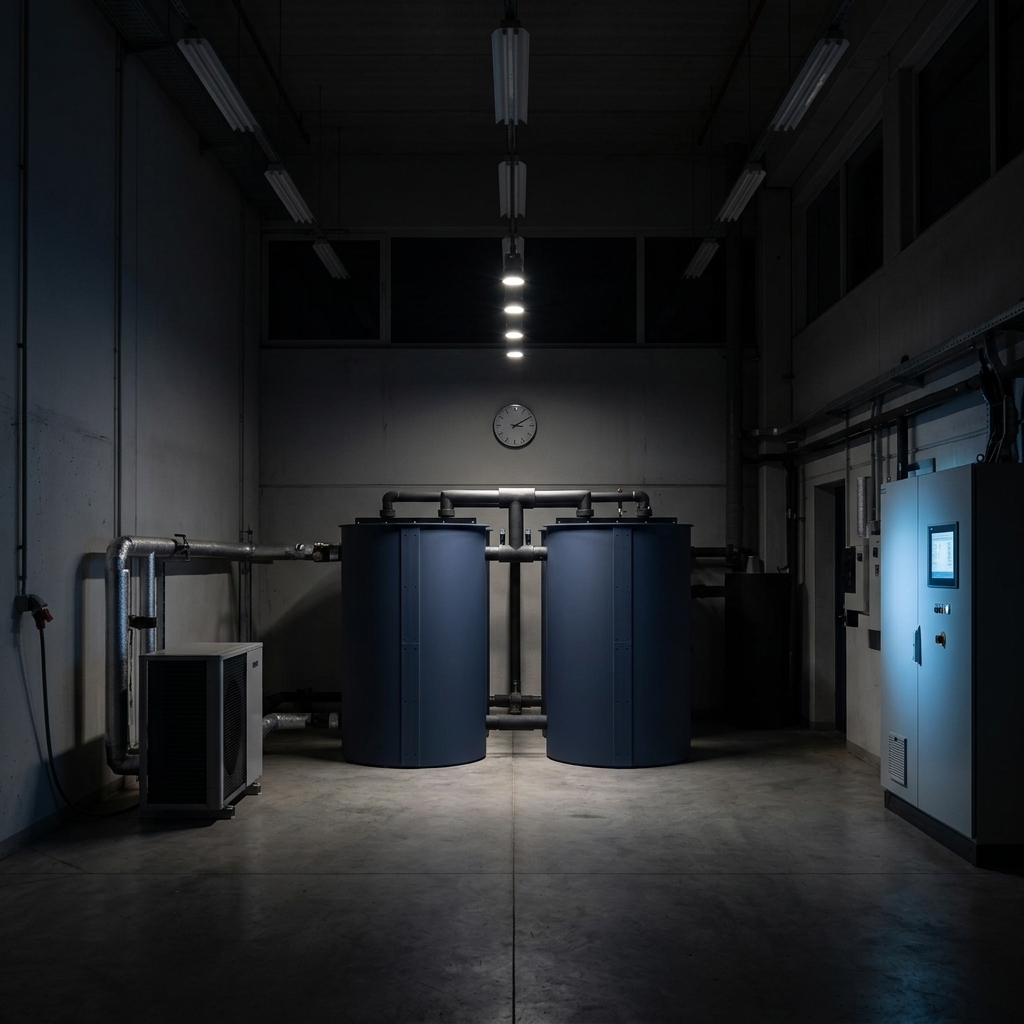
Hot water is the easiest load in a commercial or multifamily building to move through time. The demand is predictable, the storage medium costs almost nothing, and nobody notices what hour the water was heated — provided it is hot when they open the tap. That combination makes off-peak water heating the first load shift most buildings should attempt.
It also has a constraint that most articles on the subject skip entirely, and it is not a financial one.
Key Takeaways
In short: Load shifting hot water means producing and storing thermal energy during cheap or low-carbon hours and drawing on it during expensive ones, in commercial and multifamily buildings with central plant. It attacks the time-of-use energy charge rather than the demand charge. The design decisions are which window to charge in, how the plant is told to charge, how much storage the shift requires, and — critically — what temperature the water is held at. Stored water is held hot and mixed down at the point of delivery. It is never stored warm, because warm storage is the condition Legionella grows best in.
In this article
The temperature rule that governs everything else
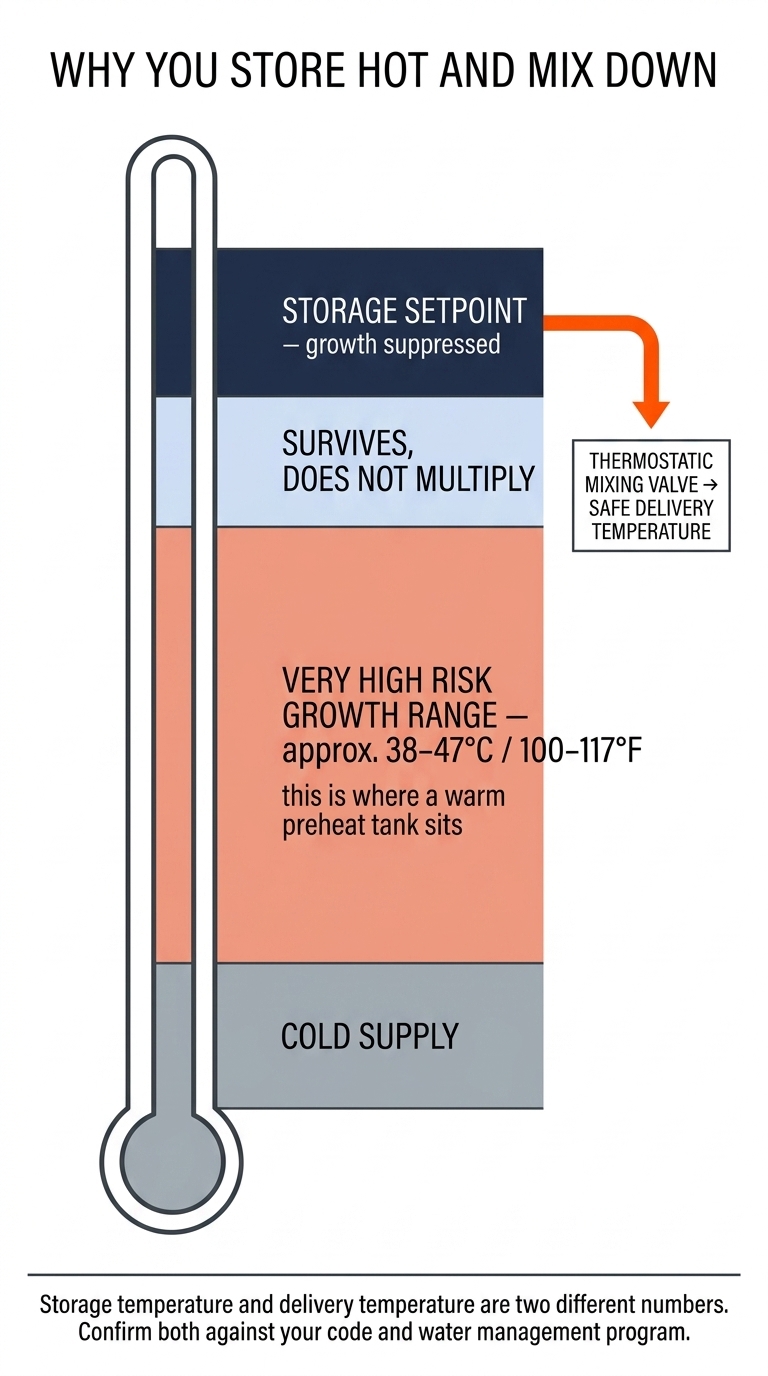
Start here, because it constrains every other decision on this page. The intuitive way to save money on off-peak water heating is to heat water to a modest temperature cheaply and let it sit. That intuition is dangerous.
Peer-reviewed testing of storage water heaters found that a tank set to a low temperature can hold essentially its entire volume within the high-risk growth range, while the same tank set hot confines the risk to a small stratified layer at the bottom. Legionella pneumophila grows in warm water.
CDC’s potable water systems guidance treats temperature as one of the core control factors, alongside sediment and biofilm, water age, and disinfectant residual. ANSI/ASHRAE Standard 188 sets the water management program framework that large buildings are expected to work within.
Why the temperature rule makes storage more attractive
Holding storage hot costs efficiency in a heat pump plant, because the machine works harder to reach a higher temperature. The way to recover that cost is volume: a larger tank lets the plant reach its setpoint over a long, gentle run in cheap hours instead of a hard, fast one. The temperature constraint and the load-shifting objective point in the same direction — toward more storage and a smaller, longer-running plant.
If your building has a recirculation loop, it has a continuous heat load that never shifts, and it must be maintained above the temperature at which growth resumes. That maintenance load is usually served by a dedicated swing tank or temperature maintenance heater rather than the primary plant — see swing tank sizing.
Choosing the charging window
“Off-peak” is not one thing. Four windows compete, and the right answer depends on the tariff and on whether the building has on-site generation.
Candidate charging windows for commercial hot water load shifting
WindowCharge whenBest whenWatch out for
Tariff off-peakThe time-of-use schedule prices energy lowest — typically overnight.There is a wide on-peak/off-peak spread on your schedule.A narrow spread makes the whole project marginal. Check the actual differential, not the existence of TOU.
Midday solarOn-site PV or PVT is producing more than the building is consuming.Export compensation is poor, so self-consumption is worth more than selling.Conflicts with tariff off-peak in markets with evening peaks — you may not be able to serve both.
Pre-peak recoveryThe hours immediately before the building’s own demand peak.The tariff has a significant demand charge and the plant would otherwise recover during the peak interval.This is peak shaving, not load shifting. It is a different objective, covered in
.
Utility signalA demand response or grid program dispatches a load-up or shed command.An enrolled program pays for the flexibility.You surrender some control of timing. Confirm the program’s override provisions before enrolling a critical load.
The scheduling error that costs money
Charging must finish before the peak window opens, not run into it. A plant that begins recharging at the start of the morning draw is adding electrical load during the interval most likely to set the demand charge — lowering the energy charge and raising the demand charge at the same time. On tariffs with a meaningful $/kW component that is a net loss. Model both bill lines before setting the schedule; our guide to reducing peak demand charges covers how to identify which interval you are protecting.
Three configurations, including the preheat-in-series option
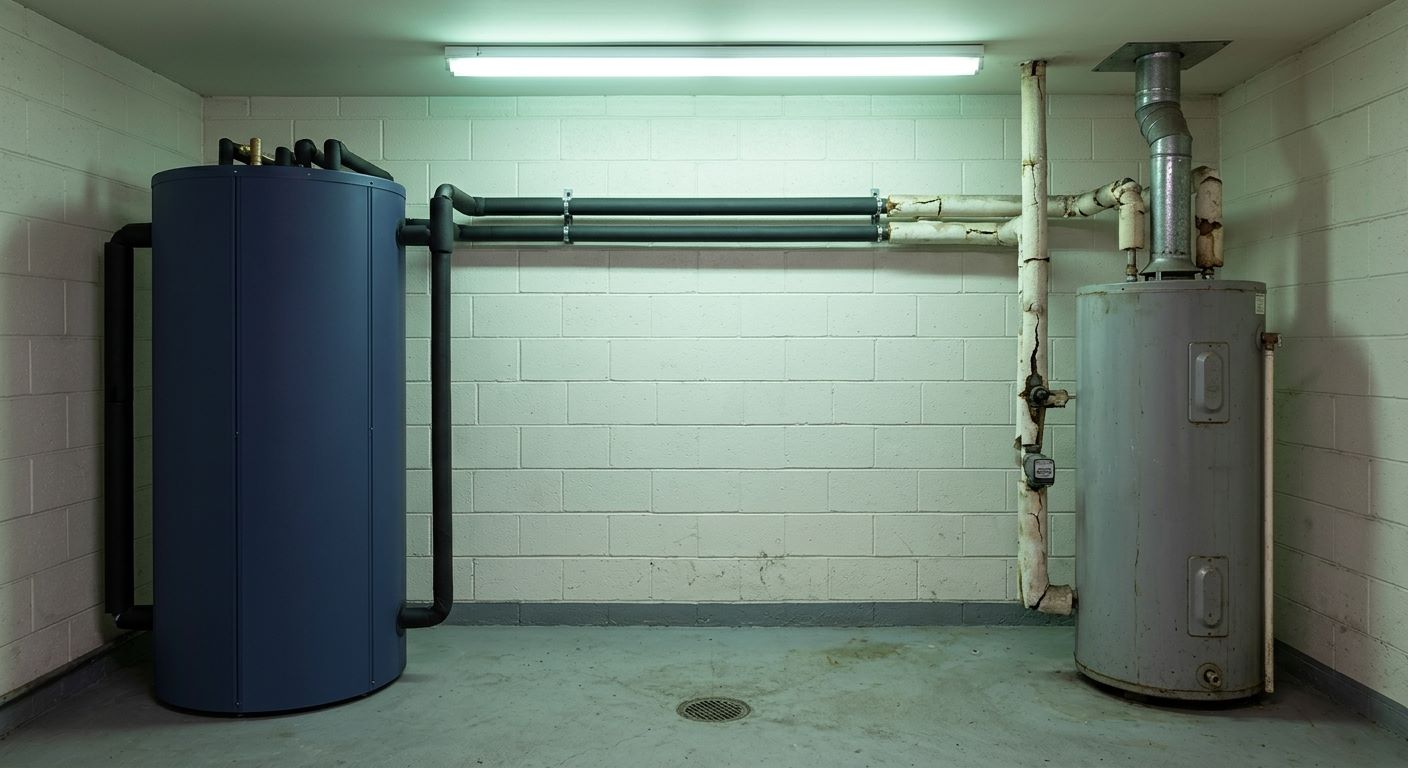
How the storage is piped determines how much shifting is possible and how much of the existing plant has to change.
Commercial hot water load-shifting configurations
ConfigurationHow it worksFitConstraints
Preheat in seriesA storage vessel sits between the cold main and the existing water heater. It is charged off-peak and raises the inlet temperature the existing heater sees, so the heater does less work during expensive hours.Lowest-intervention retrofit. The existing plant stays in place. Attractive where capital or downtime is constrained.The temperature rule applies with full force. A vessel between cold supply and a downstream heater is precisely where warm storage happens by accident. It must be held hot and managed within the building’s water management program, not treated as a passive buffer.
Central storage with the plantStorage sits with the primary heat source and serves the building directly through a mixing valve.New plant, plant replacement, or electrification projects. The most shifting capacity per dollar.Requires mechanical room space and a plant that can be resized around the storage — see
.
Distributed connected heatersIndividual water heaters with demand-responsive controls shift independently on a signal.Buildings with in-unit heaters and no central plant.Shifting capacity is limited by each unit’s tank volume. Behaviour varies by manufacturer.
The preheat-in-series configuration
The preheat configuration is a legitimate and widely used arrangement, and it is the cheapest route to a meaningful shift in a building whose plant is not due for replacement. It is also the configuration most often installed without a water management conversation, because it looks like plumbing rather than like a system change. If you are considering it, involve whoever owns your water management program before, not after.
What actually issues the command
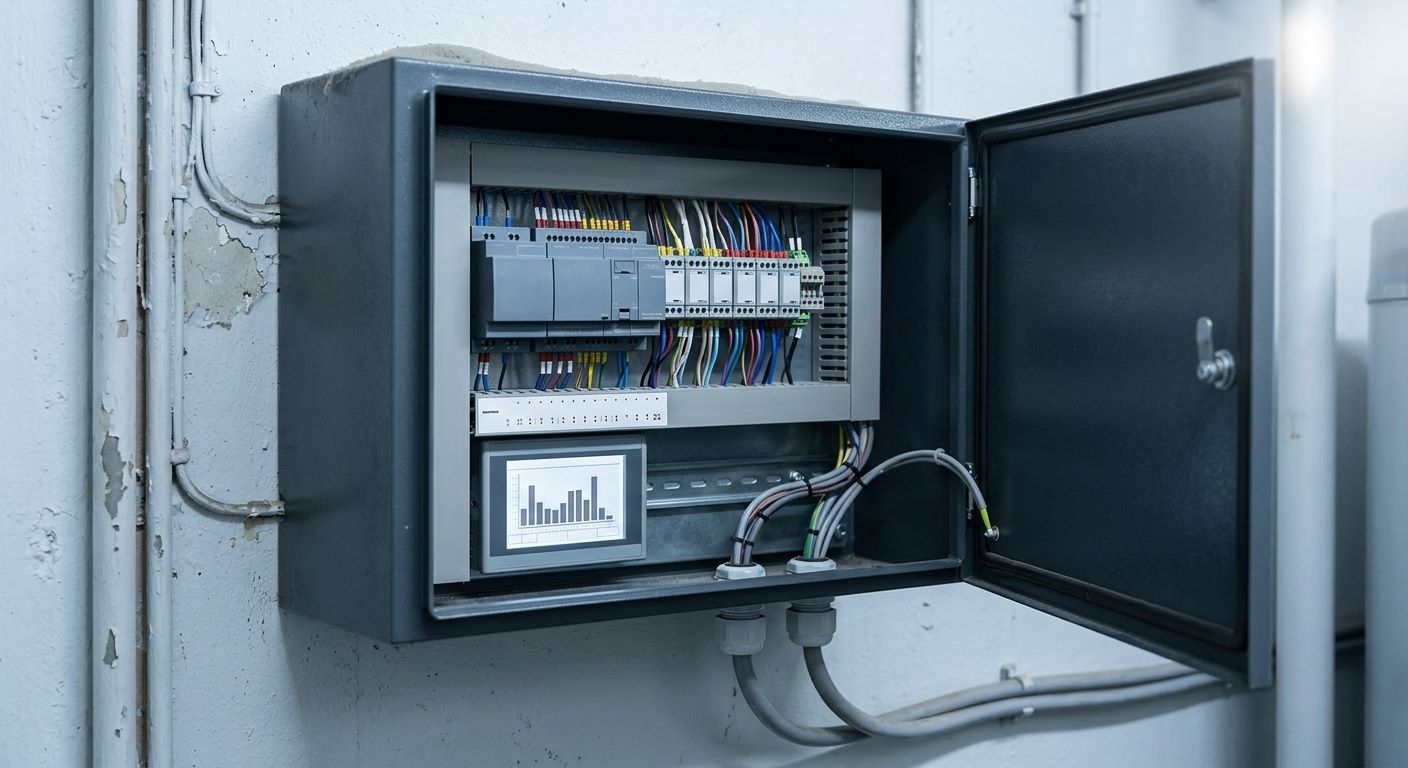
Load shifting is a controls project wearing a storage project’s clothes. Four mechanisms, in ascending order of capability:
Connected controls are OEM-dependent
The protocol standardises the interface, not the response. A NEEA conformance analysis notes that device behaviour following a command is defined by the manufacturer, which produces meaningful variation between models in how much load actually shifts. Do not assume that two compliant devices will behave the same way, and confirm expected behaviour with the manufacturer before specifying a fleet.
The broader framing is DOE’s grid-interactive efficient buildings work: buildings as flexible resources rather than passive loads. DOE’s GEB overview defines the four modes — efficiency, shed, shift, modulate — and the national roadmap led by Lawrence Berkeley National Laboratory treats demand flexibility as a portfolio. Hot water is usually the cheapest entry point into that portfolio.
How much storage a shift requires — and what it costs you
Peak shaving needs enough storage to cover the deficit during the peak interval. Load shifting needs enough to cover the entire load outside the charging window, which is a substantially larger number. A building charging for eight hours overnight and coasting for sixteen needs storage for sixteen hours of draw, not for the morning peak.
Sizing the plant against a design-day profile is an established method. Ecotope’s Ecosizer produces a curve of valid capacity-versus-volume combinations rather than one answer, and DOE and PNNL’s Building America guidance covers central heat pump water heating design.
Illustrative standing loss over an eight-hour hold
ModelStanding loss (°F / 24 hr)Approx. loss over 8 hr holdAs a share of stored energy
80 gallon7–8~2.5°Froughly 4%
350 gallon3.8~1.3°Froughly 2%
500 gallon3.0~1.0°Froughly 1.5%
700 gallon2.4~0.8°Froughly 1.3%
The standing loss trade, stated honestly
The figures above are illustrative, at published loss rates and a 35°C rating basis. The point is the ratio, not the decimals: small vessels are poor load-shifting assets. Surface area does not shrink as fast as volume, so the smallest module in our own line gives up roughly three times as much of its stored energy over an overnight hold as the largest does. If the objective is shifting rather than buffering, size up. Full specifications are on the thermal tank overview page.
This is also why load shifting slightly increases total energy consumption while reducing its cost. The trade is usually strongly favourable, but a project justified on “efficiency” rather than on rate arbitrage is justified on the wrong thing.
Two failure modes worth designing against
1. Cold water at the tap
The most common way a hot water load-shifting project fails is that someone runs out of hot water. In a large field demonstration of connected water heaters run under a Bonneville Power Administration and NEEA project, a meaningful share of participants reported cold water draws during shifting operation, and a small number withdrew over comfort. Most participants remained satisfied — but the failure mode is real, documented, and entirely predictable.
Shifting works by deliberately not producing hot water for part of the day, and if the stored volume runs out before the window closes, the building notices immediately and loudly. The CTA-2045 demonstration report documents the field-study findings.
2. The recharge that lands in the peak
Covered above, and worth repeating because it is invisible until the bill arrives: a recharge that overlaps the demand-setting interval can cost more than the energy arbitrage saved. Any schedule change should be checked against interval data after one full billing cycle.
Programs and tax treatment
Utility demand response and load management programs are the most direct fit here, because shifting is precisely the behaviour they pay for — and enrolling a hot water plant is usually simpler than enrolling process load. Start with the energy incentive finder, then confirm current status and override provisions with the administrator.
On the capital side, the federal clean electricity investment credit covers energy storage technology placed in service after December 31, 2024, and the statutory definition expressly includes thermal energy storage property, subject to post-2025 sourcing rules. Confirm with a tax professional.
DOE’s Better Buildings thermal storage brief covers the broader case for storage in commercial buildings, and EIA’s commercial buildings data shows why water heating is such a large share of the shiftable load to begin with.
Frequently Asked Questions
What is load shifting for hot water?
Load shifting for hot water means producing and storing thermal energy during hours when electricity is cheap or low-carbon, then drawing on that stored energy during expensive hours. Total consumption stays roughly the same or rises slightly through standing loss; what changes is when the energy was bought. It targets the time-of-use energy charge rather than the demand charge, which is a separate bill line addressed by peak shaving.
Is it safe to preheat water and store it off-peak?
It is safe when the water is stored hot and mixed down to a safe delivery temperature at the point of use. It is not safe when water is stored warm. Legionella grows fastest in warm water, and peer-reviewed testing has shown that a storage vessel held at a low temperature can keep essentially its whole volume inside the high-risk growth range. Storage temperature and delivery temperature are two separate numbers set by two separate pieces of equipment, and any off-peak strategy that lowers storage temperature to save energy has created a water quality risk rather than a saving.
What is a preheat tank and where does it go?
A preheat tank is a storage vessel piped between the cold water supply and an existing water heater. Charged during off-peak hours, it raises the inlet temperature the existing heater sees, so that heater does less work during expensive periods. It is the lowest-intervention way to add load shifting to a building whose plant is not due for replacement. Because it sits between cold supply and a downstream heater, it is also the configuration where accidental warm storage is most likely, so it must be held hot and included in the building's water management program.
When should the charging window be?
Whichever period the tariff or on-site generation makes cheapest, with one hard rule: charging must finish before the peak window opens rather than running into it. A recharge that overlaps the interval which sets the demand charge can raise that charge by more than the energy arbitrage saves. The four candidate windows are the tariff off-peak period, a midday solar production window, the hours immediately before the building's own peak, and a utility demand response signal.
Does load shifting hot water save energy?
No. It saves money by buying the same energy at a cheaper hour, and it slightly increases total consumption because heat held in storage for longer is lost to standing loss. The trade is usually strongly favourable where a real time-of-use price spread exists, but a project justified as an efficiency measure has been justified on the wrong basis.
Will we run out of hot water?
That is the most common failure mode and it is a sizing and commissioning question rather than an inherent flaw. Shifting works by deliberately not producing hot water for part of the day, so if the stored volume runs out before the window closes, occupants notice immediately. In a large field demonstration of connected water heaters, a substantial share of participants reported cold water draws. Design against it with margin on storage volume, a temperature-floor override that permits recovery, and a commissioning period that tunes the schedule against measured performance.
Does this apply to a house or a single water heater?
The physics is the same but the economics generally are not. This guide addresses commercial and multifamily buildings with central plant, where storage volumes are large enough and tariff spreads meaningful enough to justify the engineering. A single domestic cylinder on a residential time-of-use or off-peak tariff can be scheduled with a timer or a connected control, which is a worthwhile thing to do and not something that requires modular commercial storage.
Conclusion
Hot water is the cheapest load in most commercial buildings to move through time, which is why it is usually the first thing worth shifting. The engineering is not difficult: pick the window from the tariff, size storage for the hours you will coast rather than for the peak, give the plant something capable of holding a schedule, and finish charging before the peak opens.
The part that requires discipline is the temperature. Store hot, mix down at delivery, and keep whoever owns your water management program in the conversation from the beginning. A load-shifting project that saves a few thousand dollars a year and creates a water quality incident has not saved anything.