Peak shaving and load shifting are often used interchangeably, but they solve different billing problems and lead to different equipment sizes.
Peak shaving reduces the highest rate at which a building draws power, measured in kilowatts. That attacks the demand charge.
Load shifting moves energy use, measured in kilowatt-hours, from expensive hours to cheaper hours. That attacks the time-of-use energy charge.
Peak shaving changes the height of the load curve. Load shifting changes its timing. Most commercial and multifamily buildings pay both kinds of charges, so the real design question is how much storage can address both. On heating, cooling, and domestic hot water loads, thermal storage can perform both strategies from the same asset.
The strategies are complementary, but they are not interchangeable. Confusing them leads directly to incorrect tank, plant, and control sizing.
A commercial electric bill usually includes two different components. The energy charge is based on kilowatt-hours consumed. Under time-of-use pricing, the rate changes by hour and season. Load shifting attacks this line by moving use into cheaper periods.
The demand charge is based on the building’s highest average draw during a defined interval, commonly 15 minutes. One short event can set the charge for the entire month. Some tariffs also include ratchets that carry part of a previous peak into later billing periods.
A 2017 NREL and Clean Energy Group review of more than 10,000 tariffs found that demand charges often represented roughly 30%–70% of commercial electric bills and identified millions of customers facing charges above $15/kW. This is historical survey evidence, not a universal current figure. Verify the actual tariff.
A project can shift energy successfully and still miss the monthly demand peak. That is why blended average electricity rates are not enough for storage modeling.
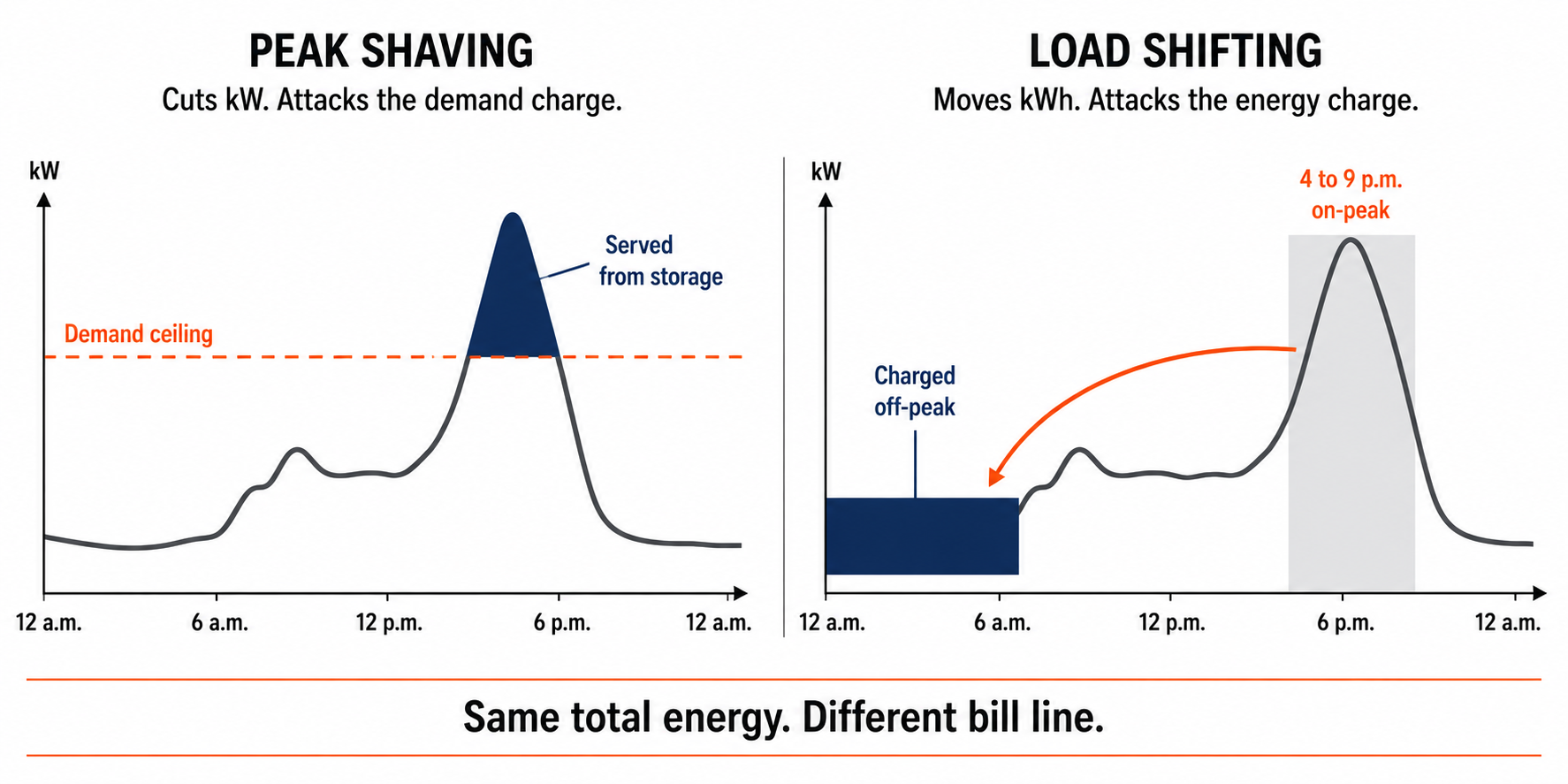
Peak shaving changes the height of the load curve, while load shifting changes its timing. The two strategies address different units, bill lines, storage requirements, and charging requirements.

Peak shaving compared with load shifting
CategoryPeak shavingLoad shifting
ChangesHeight of the load curveTiming of the load curve
UnitkWkWh
Bill lineDemand chargeTime-of-use energy charge
Energy consumedRoughly unchangedRoughly unchanged, but bought at different hours
SuccessClips the peak to a target ceilingMoves use outside the on-peak window
StorageEnough to cover the deficit during the peak intervalEnough to cover the full load outside the charging window
Charging capacityModest; slower charging over many hoursHigher; energy must be loaded during a compressed cheap period
Fails whenThere is no demand charge, or the peak is broad rather than spikyThe tariff is flat or the price spread is too small

Under time-of-use pricing, the energy rate changes by hour and season. Load shifting attacks the energy-charge line by moving use into cheaper periods.
The demand charge is based on the building’s highest average draw during a defined interval, commonly 15 minutes. One short event can set the charge for the entire month. Some tariffs also include ratchets that carry part of a previous peak into later billing periods.
A 2017 NREL and Clean Energy Group review of more than 10,000 tariffs found that demand charges often represented roughly 30%–70% of commercial electric bills and identified millions of customers facing charges above $15/kW. This is historical survey evidence, not a universal current figure. Verify the actual tariff.
A project can shift energy successfully and still miss the monthly demand peak. That is why blended average electricity rates are not enough for storage modeling.
Many California TOU plans use a late-afternoon or evening on-peak window, commonly 4–9 p.m. The change reflects the grid’s net-load profile: midday solar lowers net demand, followed by a steep evening ramp. For building owners, midday can be a good time to make heat, while evening is an expensive time to consume grid energy. Verify the current tariff before publication.
DOE and ASHRAE guidance distinguishes full storage from partial storage, with partial storage divided into load-leveling and demand-limiting.
Full storage: The plant runs during cheap or off-peak periods and turns off during the on-peak window. Storage carries the entire peak-period load. This is closest to pure load shifting. The trade-off is the largest storage volume and highest charging capacity, but maximum energy-cost arbitrage.
Partial storage: load-leveling. The plant runs at nearly constant output. Surplus charges storage during low-load hours; storage supplements the plant during peaks. This is closest to peak shaving. The trade-off is that it minimizes plant size and often produces the largest capital-equipment saving.
Partial storage: demand-limiting. The plant is held below a defined demand target during peak hours, and storage covers the remainder. This is closest to peak shaving to a kW ceiling. It is useful when demand charges or ratchets dominate.
This vocabulary matters because it turns a vague request into a design specification. Full storage maximizes energy-price savings. Load-leveling minimizes equipment size. Demand-limiting protects a defined demand ceiling.
Load shedding means reducing or eliminating consumption by turning equipment down or off. The service is not delivered at that moment.
Peak shaving and load shifting still deliver the service. Storage supplies the hot water, heating, or cooling instead of the grid or plant at that instant.
Demand-response programs often rely on shedding. In hotels, hospitals, or multifamily buildings, reducing occupant service may be unacceptable. Storage allows a building to reduce grid demand without sacrificing the service.
Illustrative only. This example omits coefficient of performance, standing loss, recovery time, temperature delta, and simultaneity. It explains the sizing structure; it does not size a real project.
Assume a building needs 600 kWh of domestic-hot-water heat per day, with 300 kWh concentrated in a four-hour morning peak.
No storage: 300 kWh ÷ 4 hr = 75 kW thermal plant. The plant is sized for a short peak and operates below that output most of the day.
Peak shaving with load-leveling: 600 kWh ÷ 24 hr = 25 kW constant plant output. During the four-hour peak, the plant produces 100 kWh and storage supplies the remaining 200 kWh. Two 700-gallon modules provide 216 kWh. Result: plant capacity falls from 75 kW to 25 kW, a two-thirds reduction.
Full load shifting: charge during a ten-hour low-cost window. 600 kWh ÷ 10 hr = 60 kW plant. Storage must cover all demand outside the charging period, so the tank bank is substantially larger.
The structural lesson is that peak shaving is mainly about buying less equipment, while load shifting is mainly about buying cheaper energy. A strong control strategy can combine both by charging during cheap hours and dispatching against a demand ceiling.
High demand charge, narrow TOU spread: prioritize peak shaving. Use demand-limiting partial storage and hold a defined kW ceiling.
Wide TOU spread, modest or no demand charge: prioritize load shifting. Move toward full storage and size for the on-peak period.
High demand charge and wide TOU spread: use both. Base the design on load-leveling, add a demand ceiling, and bias charging into cheap or solar hours.
Demand-charge ratchet: prioritize reliable peak shaving. One spike may affect several billing periods.
Flat energy rate and no demand charge: neither strategy has direct rate-arbitrage value. Storage may still provide plant downsizing, capacity, or resilience, but do not model savings that do not exist.
Onsite solar with low export value: prioritize self-consumption. Charge storage with midday generation rather than exporting it. PVT may be useful where both heat and electricity have value.
EIA reports that space heating and water heating together represent about 62% of household energy use. In many multifamily buildings, water heating is especially significant. That means a large share of the shaving and shifting opportunity is thermal.
Thermal storage can lower peak demand, move production into cheaper hours, allow a smaller heat pump or boiler plant, and change operating mode through controls rather than hardware replacement.
The same tank bank can run load-leveling in shoulder seasons, enforce a tighter demand ceiling when a ratchet is at risk, and move toward full shifting when seasonal price spreads widen.
Batteries remain better for fast electrical peaks and non-thermal loads. Thermal storage is usually more economical for longer-duration thermal loads.
Capacity is rated at a 35°C temperature delta. Verify pricing before publication.
These are vessel list prices. A complete installed thermal system also requires the heat source, heat exchangers, piping, controls, and labor. Ask every vendor for both vessel and installed pricing.
Batteries are the correct tool when the peak comes from elevators, EV charging, plug loads, refrigeration, manufacturing, or other electrical loads. Thermal storage cannot address those peaks.
Batteries also provide sub-second response and backup power. These are decisive advantages for electrical demand management.
Thermal storage is strongest when the peak comes from hot-water recovery, heating, or cooling. TEHQ vessel pricing is about $54–$97 per stored kWh, compared with an NREL benchmark near $334/kWh for a complete four-hour utility-scale lithium-ion system. The comparison is directional because the cost boundaries differ.
The correct design is a division of labor: electrical peaks belong to batteries, thermal peaks belong to thermal storage, and mixed buildings may need both, each sized to its own load.
A vendor should request the rate schedule, recent bills, and interval data before proposing equipment.
Utility custom commercial and multifamily programs may support measured demand and energy savings.
The federal §48E Clean Electricity Investment Credit includes qualifying energy storage technology, and the statutory definition expressly includes thermal energy storage. Eligibility depends on project facts, wage and apprenticeship requirements, and sourcing rules. Confirm with a tax professional.
California’s SGIP is primarily battery-focused and budget availability changes quickly. The §73 active solar property-tax exclusion may apply to qualifying solar systems and related storage completed before January 1, 2027, subject to current law. Recheck all policy statements before publication.
Peak shaving lowers the highest rate of power draw in kW and targets demand charges. Load shifting moves kWh into cheaper hours and targets time-of-use energy charges. One changes the curve’s height; the other changes its timing.
No. Load shedding removes or reduces service. Peak shaving and load shifting still deliver the service from storage.
It depends on the tariff. High demand charges favor shaving. Wide time-of-use spreads favor shifting. Many commercial tariffs reward both.
Full storage turns the plant off during peak hours and uses storage for the whole load. Partial storage keeps the plant running at reduced output while storage supplements it. Partial storage may be load-leveling or demand-limiting.
Not directly. It reduces the peak rate of draw. Total kWh usually stays similar, though steadier plant operation may improve efficiency indirectly.
Enough to cover the energy deficit during the peak interval. This is usually less than full load shifting requires.
Yes. The same tank bank can switch strategies through controls, depending on season, tariff, and demand conditions.
Use a battery for electrical peaks. Use thermal storage for hot water, heating, or cooling peaks. Buildings with both usually benefit from both.
A tariff rule that carries part of a previous peak into future billing periods. Where one applies, reliably holding a demand ceiling becomes especially valuable.
Peak shaving and load shifting are different jobs.
Peak shaving clips the top of the load curve to reduce demand charges. Load shifting moves energy into cheaper hours to reduce energy charges. Load shedding removes the load and reduces service.
They require different storage volume, charging capacity, and control logic. For many commercial and multifamily buildings, the right answer is a combination.
Thermal loads are often the cheapest place to begin because heating, cooling, and hot water represent a large share of building energy use. Thermal storage can reduce peak demand, move production to cheaper hours, and allow a smaller plant. Electrical peaks still belong on a battery.
The design should begin with the tariff, interval data, and load split—not a product brochure.

Tell our team about your building, operating goals, and energy needs.