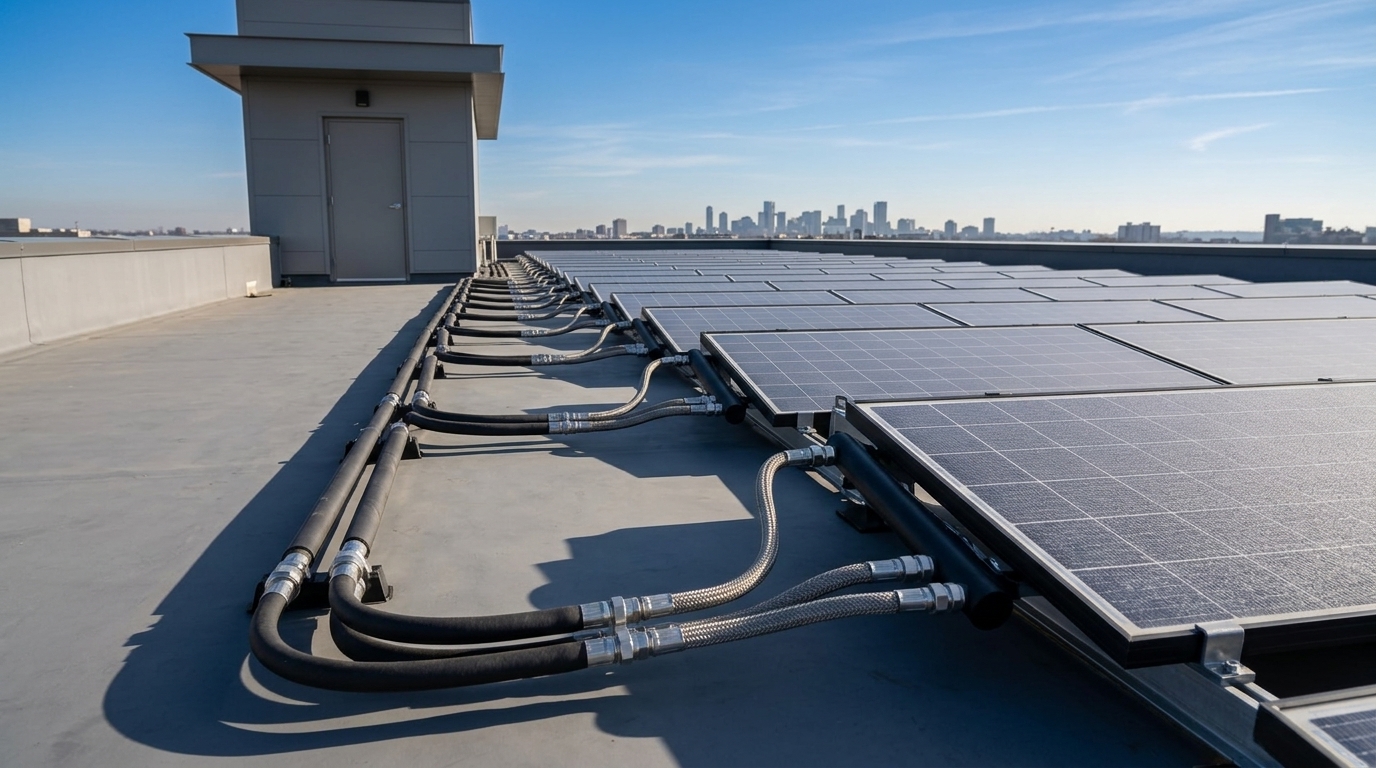
A standard photovoltaic panel turns something under a fifth of the sunlight hitting it into electricity. Nearly all the rest becomes heat — heat that warms the cells, which makes them measurably worse at their job, and then radiates uselessly into the sky. A photovoltaic-thermal panel puts a fluid circuit behind the cells to carry that heat away and deliver it somewhere useful. Two outputs, one footprint, and a small electrical bonus because cooler cells are more efficient. It is a genuinely good idea, it has been a genuinely good idea for forty years, and it still only pays in specific buildings. This guide is about which ones.
In short: PVT (photovoltaic-thermal) or hybrid solar panels combine PV cells with a thermal absorber so a single panel produces both electricity and hot water, using roughly the roof area of a PV array alone. Cooling the cells raises electrical output by a few percent; the recovered heat is the larger prize, pushing combined solar utilization well above what either technology reaches by itself. A federal evaluation of the first large-scale U.S. PV-T system by GSA and NREL found modeled simple paybacks ranging from 19 years in Honolulu to 98 years in Portland, and concluded PVT targets buildings with constrained roof space, high electricity rates, hot climates, and central — not point-of-use — hot water. PVT without thermal storage is a collector with nowhere to put its output.
Key Takeaways
What is a PVT solar panel?
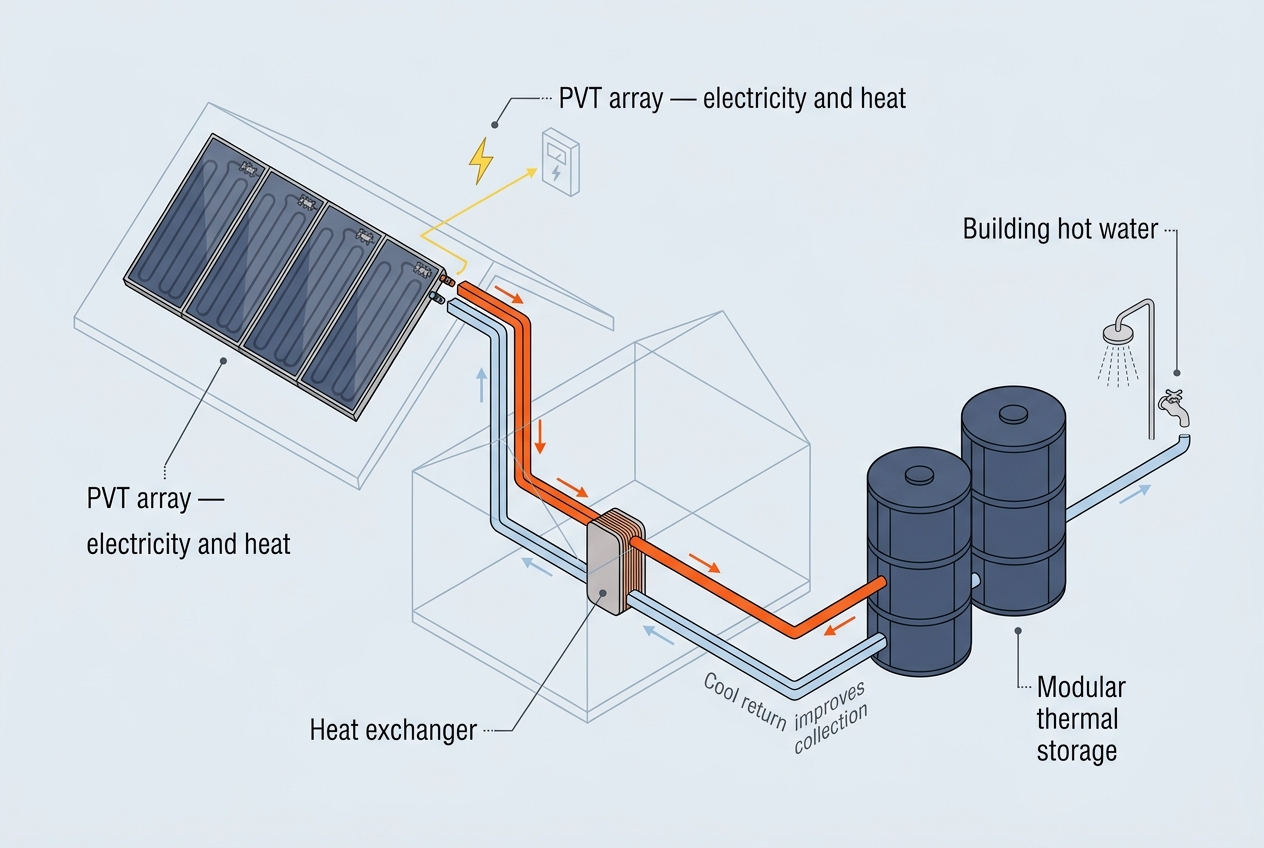
A PVT panel — photovoltaic-thermal, sometimes written PV-T or called a hybrid solar panel — is a single collector that produces electricity and heat at the same time. GSA’s technology evaluation page for photovoltaic-thermal hybrid systems puts the mechanism plainly: these systems increase electricity production by cooling the PV panel and use the removed thermal energy to heat water, in the same footprint as a standard PV system.
The physics behind it is a well-known frustration with plain PV. As the GSA and NREL findings brief sets out, conventional PV panels convert up to about 20 percent of incident solar energy into electricity; most of the remainder becomes heat, and because PV modules are semiconductors, they get less efficient as they warm up. A PVT collector attacks both sides of that at once — the fluid circuit removes heat the cells do not want, and the removed heat becomes a second product.
In this article
How PVT solar panels work
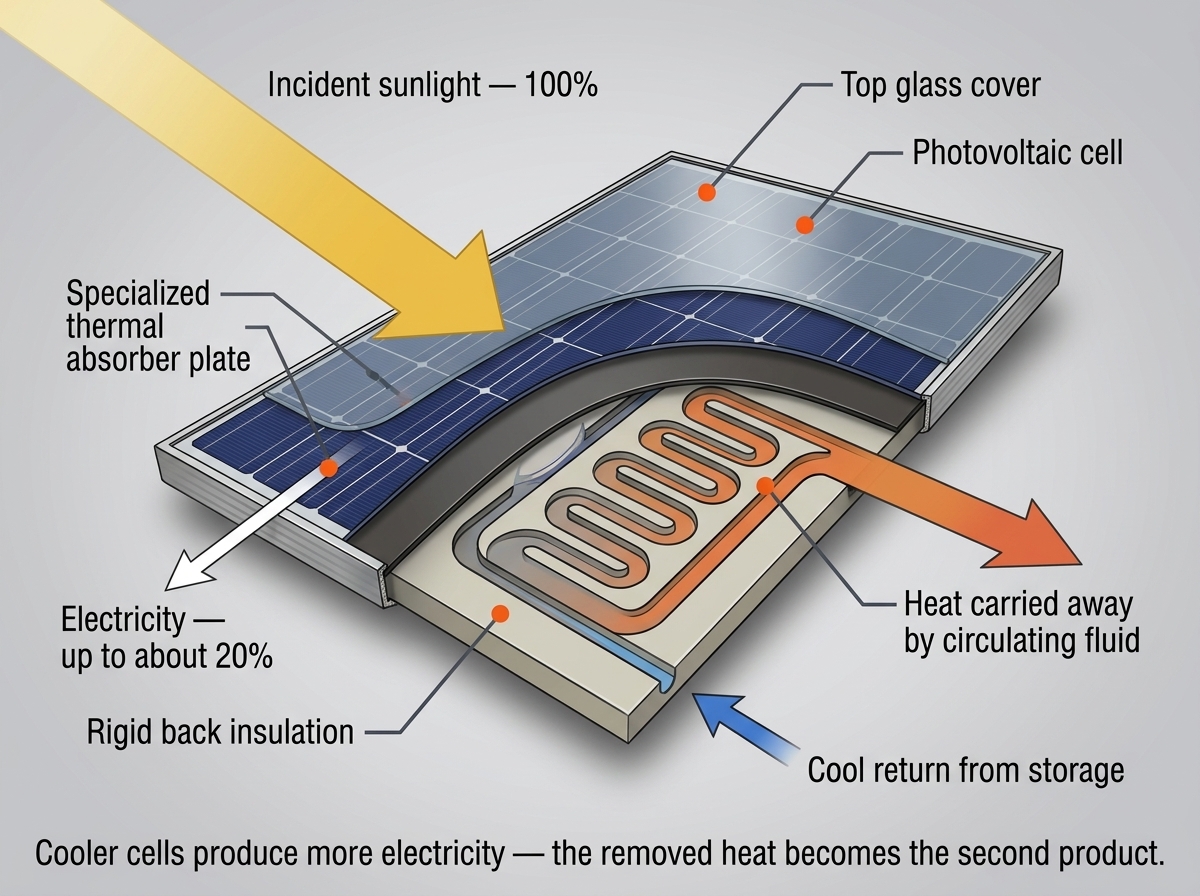
Construction varies more than the acronym suggests. The most common design bonds a thermal absorber to the back of a standard PV laminate; others integrate the fluid path into the module, run air rather than liquid, or add glazing to raise output temperature.
Research designs go further still. Spectral-splitting PVT collectors described in Light: Science & Applications separate the wavelengths the cells use from the rest so the thermal side can run hotter without dragging down electrical efficiency, addressing what that paper identifies as the fundamental thermal coupling limit of conventional designs. Building-integrated versions exist too, including a hybrid PV-thermal window that generated electricity and roughly 50°C water simultaneously in testing.
How much more energy does a hybrid panel actually produce?
Answering this honestly requires separating three different claims that vendors tend to blend.
The electrical gain from cooling is small. Keeping cells cooler recovers a few percent of output that heat would have cost. A 2025 review of PVT advances reports electrical gains in the range of 3–5% across recent designs.
The thermal output is the main event. The same review of recent PVT systems reports total efficiencies — electrical plus thermal — reaching roughly 76% in favorable configurations. The tested O'Neill panel was rated at 33.4% efficiency with a performance intercept of 0.34 and slope of 1.95 at a test flow of 0.0281 gpm per square foot.
Thermal efficiency depends on how you run it. Experimental characterization of a commercial PVT panel found that lower inlet temperatures and higher flow rates consistently improved thermal efficiency — meaning the same panel performs differently depending on what it is plumbed into. A PVT array feeding a large, cool store outperforms the same array feeding a small, already-hot tank.
That last point is the one most often missed in specification, and it is why the collector and the storage decision cannot be made separately. TEHQ's own published figure for the PowerPanel PVT and Thermal Tank configuration is a 20-panel array producing about 12.7 kW of thermal energy alongside about 2.7 kW of electrical — a roughly five-to-one thermal-to-electrical ratio that is typical for liquid PVT and that tells you immediately where the value has to be captured.
What the federal evaluation found
In 2015 GSA's Green Proving Ground program published an evaluation of the nation’s first large-scale unglazed PV-T system, installed at the Thomas P. O'Neill, Jr. Federal Building in Boston, with independent measurement and verification by the National Renewable Energy Laboratory over seven months. The full NREL technical report is public.
The headline finding is unusual for a technology evaluation, and worth quoting in spirit: because of complications in system design and conflicts in installation and commissioning — the brief notes these are not uncommon in early commercial technology deployments — the M&V process did not deliver definitive performance results. What it delivered instead was a set of best practices and a modeled economic picture based on an idealized system design.
That modeled picture is the most useful public number set on PVT economics, and it is blunt. The GSA/NREL GPG-016 findings brief provides the payback table and deployment direction.
GSA/NREL modeled PVT economics by city
CityElectricity rate ($/kWh)Modeled solar production (kWh/yr)Annual savingsInstalled costSimple paybackPayback with 30% credit*
Honolulu, HI0.3410,097$3,488$67,12319 yrs13 yrs
Daggett, CA0.1811,824$2,144$56,99427 yrs19 yrs
Phoenix, AZ0.1011,783$1,237$50,75741 yrs29 yrs
Denver, CO0.1111,063$1,198$53,96145 yrs32 yrs
Boston, MA0.156,331$934$67,06572 yrs50 yrs
Portland, OR0.096,698$581$56,76598 yrs68 yrs
How to read the payback table
*As modeled in the 2015 study under the tax credit regime in effect at the time. Figures are the study's own modeling of an idealized system at 2015 installed costs; they are not current pricing and not a projection for any specific project. Current federal credit treatment should be confirmed with a tax professional.
Two things follow. First, the study's own conclusion: PVT is most cost-effective where electric rates exceed about 30 cents per kWh, or 15–20 cents where federal tax incentives apply. Second, and this cuts against PVT rather than for it, installed PV costs have fallen substantially since 2015 while the thermal half of a PVT panel has not seen the same cost collapse — so the premium a PVT panel commands over plain PV is, if anything, a larger multiple today than when this table was built. Anyone selling PVT on 2015 economics without saying so is not being straight with you.
The six criteria that decide whether PVT fits
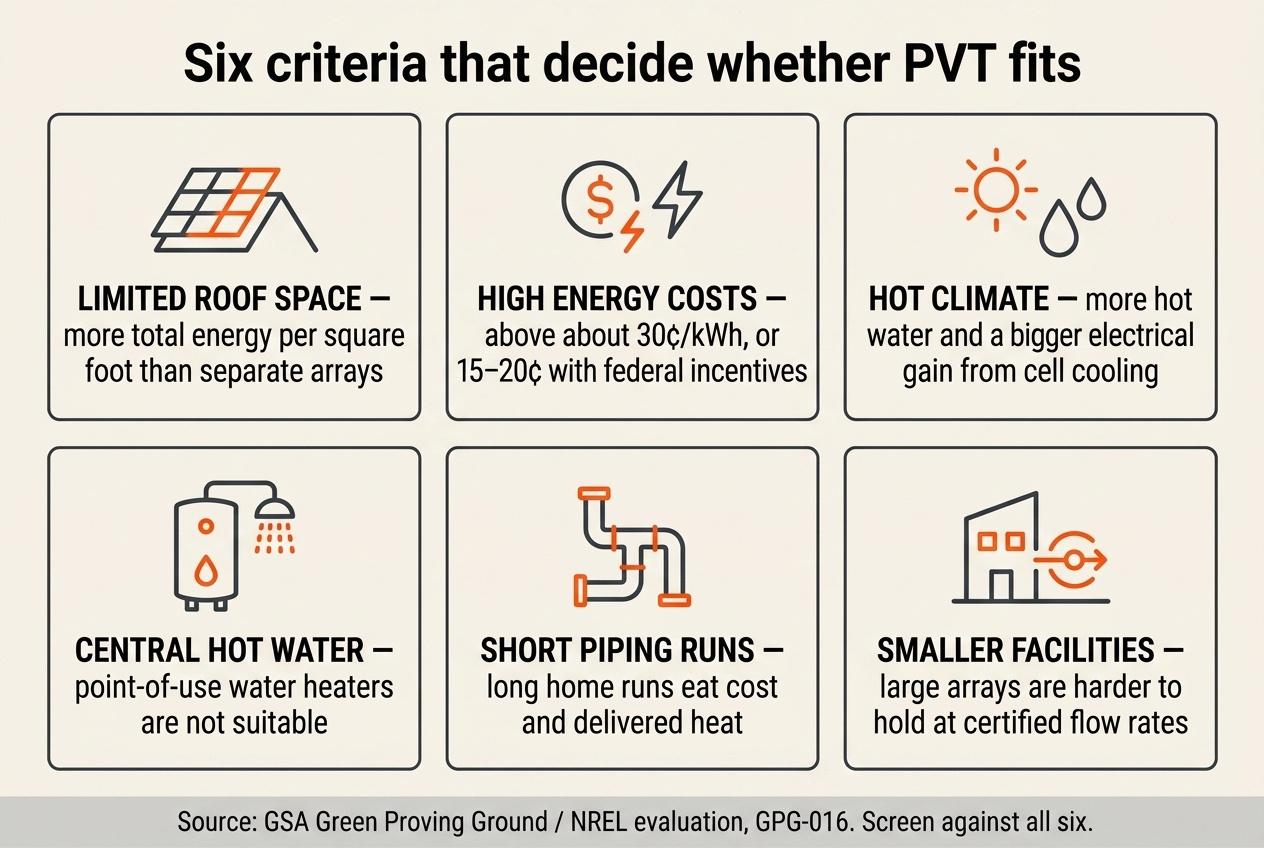
The GSA study closes with deployment direction rather than a verdict, which is the right shape for this technology. Its six criteria are the best screening checklist in public:
Treat the criteria as a filter
Read that list as a filter, not a wish list. A hotel in Honolulu with a compact roof and central hot water is close to an ideal case. A large distribution center in Oregon with point-of-use water heaters is not a PVT project at any price, and no amount of system design will make it one.
Design details that decide performance
The Boston project's lesson was that PVT fails on integration far more often than on physics. The best practices the study produced are specific and are worth treating as requirements.
For system-level modeling, DOE’s on-site commercial solar decision guide covers the screening and procurement side, and NREL's System Advisor Model is the standard free tool for grid-connected renewable project economics.
PVT design practices from the federal evaluation
PracticeWhy it matters
Efficiency and water conservation firstSize the solar thermal system to a reduced load, not the existing one. Cheaper savings come first.
Hourly modeling, not monthlyMonthly analysis tools do not resolve the mismatch between midday collection and morning demand. Use an hourly tool with certified panel performance data.
Design at the certified flow ratePanel ratings are measured at a specific flow per unit area — the Boston panels at 0.0281 gpm/ft². Running off that rate means the rated performance does not apply.
Size the heat exchanger deliberatelyThe exchanger bridging the collection loop and the storage tank is where an under-specified system quietly loses its output.
Match glazing to climateUnglazed collectors are typically less expensive and perform best where summer air is often above 90°F; flat-plate and evacuated-tube designs suit cold climates.
Submeter the thermal sideThermal production is invisible without metering. Compare measured to predicted monthly or nobody will know the system underperformed.
Why PVT needs thermal storage to be worth anything
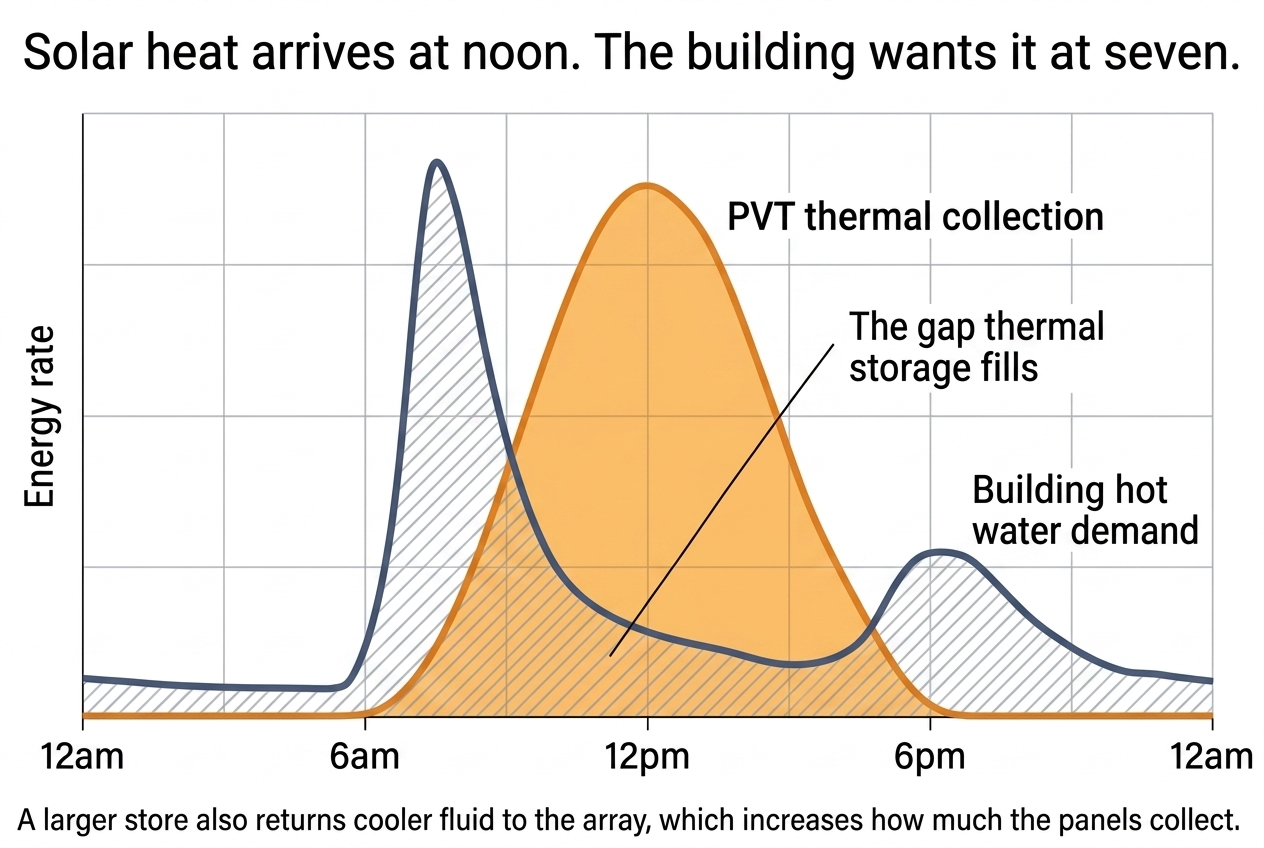
A PVT array collects heat on a solar curve — nothing before dawn, a peak around midday, nothing after dusk. Buildings draw hot water on a completely different curve, with a hard morning peak, a smaller evening peak, and very little at noon. Without something in between, most of the thermal output of a PVT array is collected at the exact hour nobody wants it and is either dumped or never collected at all because the loop has stagnated at temperature.
Thermal storage is the component that resolves the mismatch, and it does more than time-shift. Because PVT thermal efficiency rises as inlet temperature falls, a large store gives the array a cooler return all day and therefore collects more energy than a small one would — the storage decision changes the collector's output, not just its usefulness. DOE’s Better Buildings guidance on thermal energy storage frames the same value in load terms: peak reduction, shifting to cheaper hours, and making electrification cost-effective.
In practice that means the array is sized against the store and the load together. A modular thermal storage tank charged by a PVT array carries solar heat into the evening and overnight; modular construction matters here because solar retrofits usually land on buildings whose mechanical rooms were never sized for a storage vessel.
Water is the medium of choice for this duty for reasons covered in our sensible vs. latent heat storage comparison. For the packaged version of collector, storage, and heat pump together, see the All-In-One thermal energy system and the broader system solutions overview.
PVT vs. separate PV and solar thermal vs. PV plus a heat pump
The third row deserves emphasis because it is the honest competitor. Plain PV plus a heat pump water heater takes cheap electricity and multiplies it three or four times into heat, with no roof-mounted fluid loop, no freeze protection, no stagnation risk, and a supply chain of commodity parts. In most moderate climates with adequate roof space, that combination will beat PVT on cost per delivered Btu. PVT wins where roof area is the binding constraint, where electricity is expensive enough that the electrical half carries real value, and where the site is hot enough that cell cooling and thermal yield are both maximized. Say so plainly during design; a client who discovers this later will not trust anything else you specified.
Comparing PVT with other solar and water-heating approaches
ApproachRoof area neededWhat you getBest fit
PVT hybrid arrayOne arrayElectricity plus hot water from the same footprint; small electrical gain from cell coolingConstrained roofs, high electric rates, hot climates, central hot water
Separate PV + solar thermalTwo arraysEach optimized independently; thermal side can run hotter with glazingAmple roof area; high hot-water load justifying dedicated collectors
PV + heat pump water heaterOne array (PV only)Electricity that drives a heat pump at a COP of 3–4; no thermal loop on the roofMost commercial retrofits — simplest, cheapest per delivered Btu in moderate climates
Incentives and PVT
PVT sits awkwardly across incentive categories because it is two technologies in one enclosure — some programs address the PV side, some the solar thermal side, and a few address neither cleanly.
At the federal level, thermal energy storage paired with a solar array falls within the statutory definition of energy storage technology under 26 U.S.C. §48E, summarized on the IRS Clean Electricity Investment Credit page. How the collector itself is treated, and how a hybrid unit is characterized, depends on configuration and should be confirmed with a tax professional before it appears in a pro forma.
State and utility programs vary widely, and several treat solar thermal collectors under a different program than PV — worth checking both tracks for the same panel.
Frequently Asked Questions
What is a PVT solar panel?
A PVT panel — photovoltaic-thermal, also called a hybrid solar panel — combines photovoltaic cells with a thermal absorber so one collector produces both electricity and heat. Water or air circulating through the absorber removes heat from the cells and carries it to a storage tank or load. Because cooler cells are more efficient, the panel also produces slightly more electricity than an uncooled PV module in the same conditions.
How efficient are hybrid solar panels compared with regular PV?
Conventional PV panels convert up to about 20 percent of incident solar energy into electricity and lose most of the rest as heat. A PVT panel captures a large share of that heat as useful output, so total efficiency — electrical plus thermal — is far higher; recent reviews report combined efficiencies reaching roughly 76 percent in favorable configurations, with electrical gains from cell cooling of about 3 to 5 percent. The thermal output is several times larger than the electrical output in most liquid PVT designs.
What is the payback period on PVT solar panels?
It depends almost entirely on the local electricity rate. A federal evaluation by GSA and NREL modeled simple paybacks of 19 years in Honolulu at $0.34 per kWh, 27 years in Daggett, California, 41 in Phoenix, 45 in Denver, 72 in Boston, and 98 in Portland, based on 2015 installed costs and an idealized system design. The study concluded PVT is most cost-effective where electricity rates exceed about 30 cents per kWh, or 15 to 20 cents where federal tax incentives apply.
When is PVT better than separate PV and solar thermal panels?
When roof area is the binding constraint. A PVT array produces more total energy in a given footprint than separate PV and solar thermal arrays sized to the same loads. If there is ample roof space, separate arrays let each technology be optimized independently and the thermal side can use glazing to reach higher temperatures. PVT also requires a central hot water system; buildings with small point-of-use water heaters are not suitable for solar thermal of any kind.
Do PVT panels need a storage tank?
In practice, yes. A PVT array collects heat on a midday solar curve while buildings draw hot water in the morning and evening, so without thermal storage most of the collected heat has nowhere to go. Storage also improves collection itself: PVT thermal efficiency rises as inlet temperature falls, so a larger store returns cooler fluid to the array and increases how much energy it captures over the day.
Should I choose glazed or unglazed PVT collectors?
Match the construction to the climate. Unglazed collectors are typically less expensive and perform best where summer air temperatures are often above 90°F. Flat-plate and evacuated-tube collectors hold heat better and are better suited to cold climates, where an unglazed collector loses too much to ambient air to deliver useful temperatures.
Conclusion
The bottom line
PVT is real engineering with a narrow economic window. The physics is sound and the space argument is genuinely compelling — one array, two outputs, and cooler cells into the bargain. But the only large-scale federal evaluation of the technology could not measure definitive performance because the system was hard to integrate, and its modeling put payback between 19 and 98 years depending on the city. That is not a reason to dismiss PVT; it is a reason to screen hard against the six criteria, design to certified flow rates, and pair the array with enough storage that the heat it collects has somewhere to go. Where those conditions hold, a hybrid array does something no other rooftop technology does. Where they do not, plain PV and a heat pump will serve the building better and cost less.
The fastest way to find out which case you are in is a short engineering conversation about your roof, your hot water load, and your electricity rate.