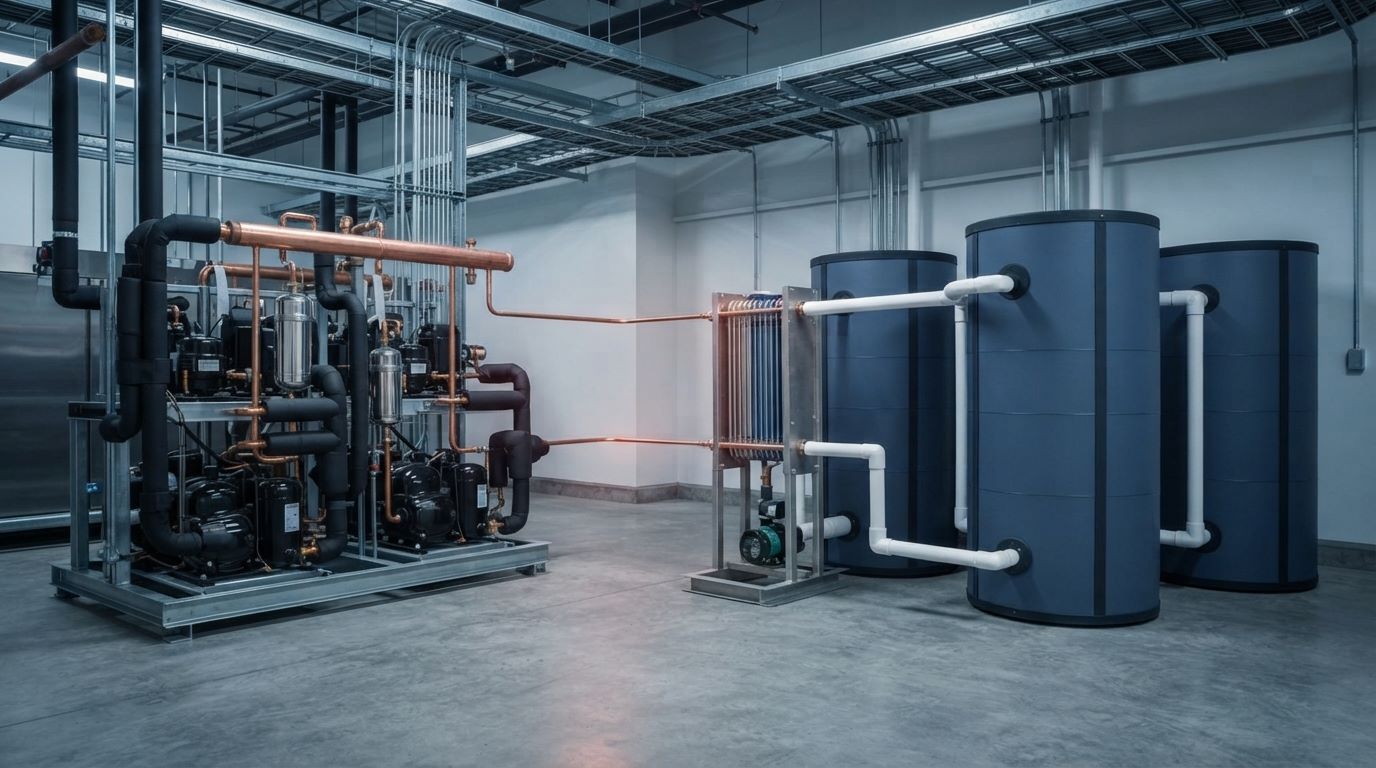
There is a building type that pays twice for the same energy, and it is more common than it should be. A supermarket, a cold storage warehouse, a meat plant, a restaurant with a walk-in—all of them run compressors around the clock to move heat out of refrigerated spaces and dump it into the parking lot through condenser fans. And all of them, usually on a separate meter and a separate gas line, burn fuel to make hot water. The heat leaving through the condenser and the heat being purchased for the water heater are the same commodity, separated by about thirty feet of pipe that nobody ran.
In short: Refrigeration heat reclaim captures heat that a refrigeration system would otherwise reject outdoors and redirects it to building loads—most commonly domestic hot water preheat. Desuperheating captures only the hottest portion of the refrigerant's heat, typically accessing on the order of 20–30% of total rejected heat but at a genuinely useful temperature. Full condensing captures far more energy but at a lower temperature and at a real cost in compressor power. The variable that decides the economics is not which method you pick—it is whether there is a storage tank between the continuous heat supply and the intermittent hot water demand. Without one, a reclaim system captures only what coincides with demand and vents the rest.
Key Takeaways
Refrigeration works by absorbing heat at low temperature and rejecting it at high temperature. The compressor raises refrigerant pressure and temperature; the discharge gas leaves hot and superheated; the condenser sheds that heat to outside air and the refrigerant returns to liquid. Everything the condenser rejects is energy the building already bought—first as the heat that leaked into the refrigerated space, then as the electrical work the compressor did to move it.
The California Energy Design Assistance refrigeration heat reclaim guidance describes the opportunity in exactly those terms: across supermarkets, grocery, cold storage, and similar facilities, refrigeration systems continuously release heat that, absent reclaim, is simply lost to the air.
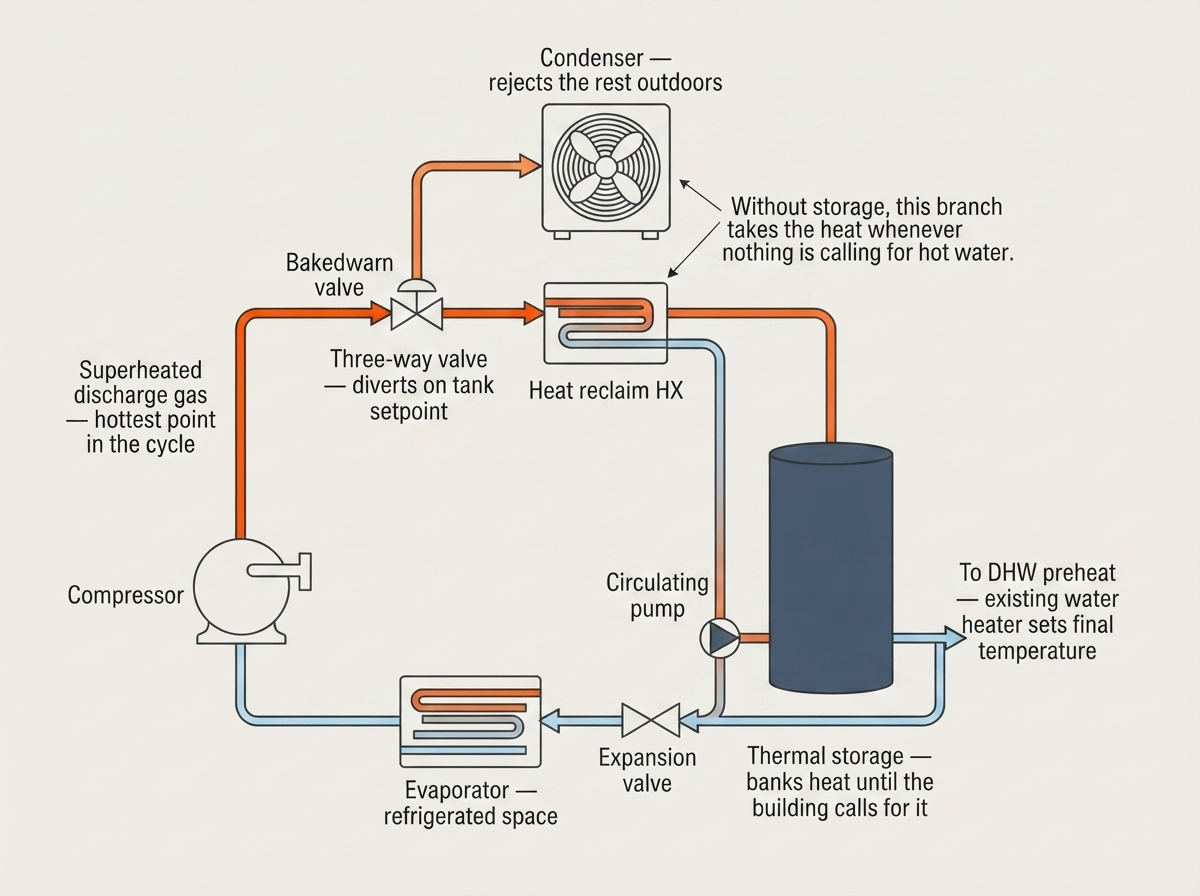
The mechanics are straightforward. Hot refrigerant vapor leaving the compressor rack is routed through a heat reclaim heat exchanger, where it gives up either its superheat alone or superheat plus latent heat, transferring that energy into a separate water loop. A dedicated pump circulates water or a water-glycol mix through the exchanger and carries the captured heat into a storage tank or directly into a domestic hot water or hydronic load. A three-way valve on the discharge line decides whether gas goes to the reclaim coil or straight to the condenser based on whether the tank is calling for heat.
The definitive American technical reference remains the NREL Refrigeration Playbook: Heat Reclaim, published through DOE's Better Buildings program. It provides design-level guidance and calculation procedures for reclaiming refrigeration waste heat into building service hot water and HVAC systems, along with best practices for operations, maintenance, and measurement and verification. The DOE Better Buildings refrigeration technology resources collect the surrounding case studies and tools.
Desuperheating vs. full condensing: grade against quantity
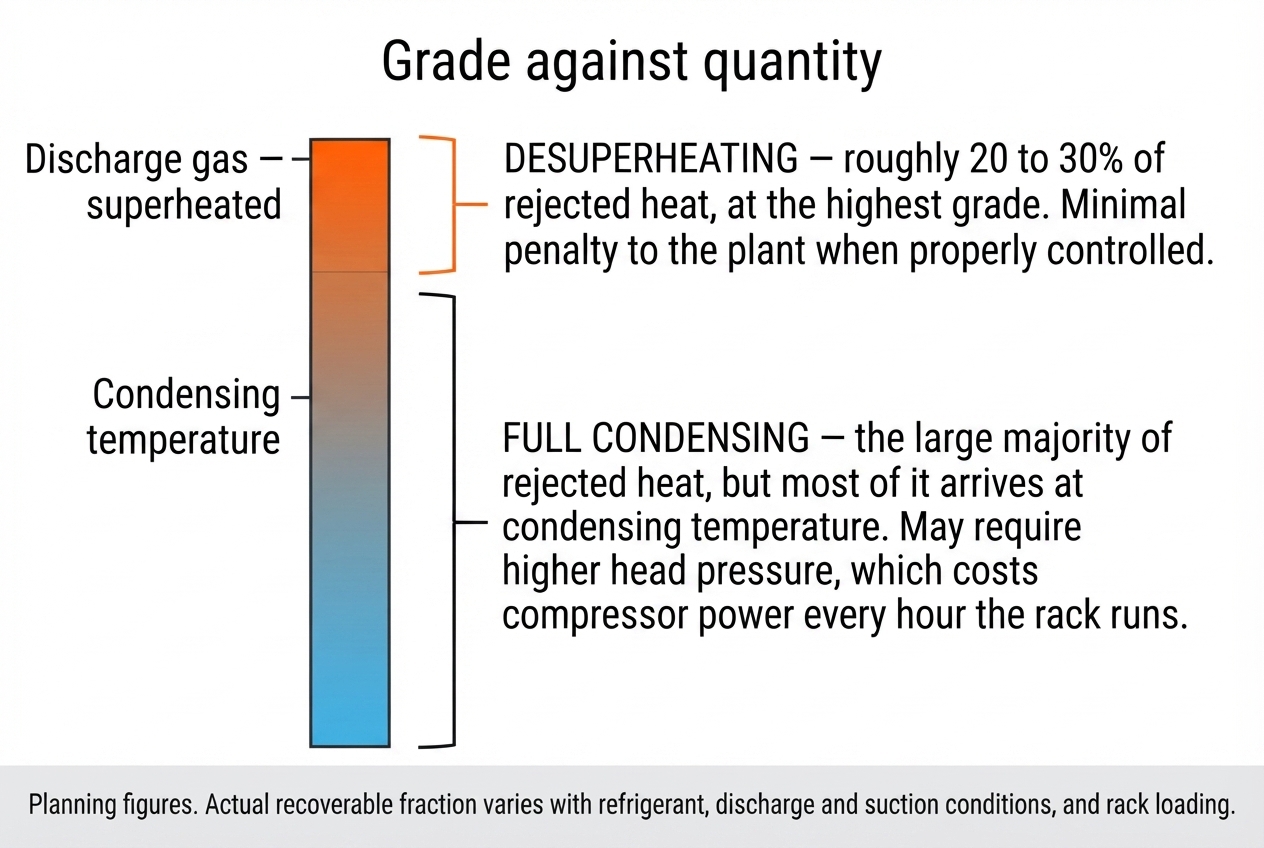
The first real design decision is how deep into the refrigerant's heat you reach.
On the recoverable fraction, LADWP's refrigeration efficiency guidance states that a desuperheater in series with the normal condenser cools refrigerant only to the saturation point, with no condensing, and can remove up to about 30% of the heat the condenser would otherwise reject. The same ceiling shows up in modelling practice: the EnergyPlus refrigeration engineering reference caps a heat reclaim heating coil at a fixed percentage of total rejected energy not exceeding 30%. Treat 20–30% as a planning band, not a guarantee—the real number depends on refrigerant, suction and discharge conditions, and how loaded the rack is.
The penalty nobody puts in the brochure. Engineering discussion of desuperheating heat exchangers makes the trade explicit: with a condensing heat recovery exchanger, most of the energy is recovered at the condensing temperature—which is the temperature you generally want to lower in order to optimize refrigeration plant energy use. Push head pressure up to make the reclaim loop deliver useful water temperature and the compressors work harder every hour they run, whether or not you are harvesting heat that hour. On a plant that runs continuously, a small percentage penalty on compressor power can eat a large share of the notional savings. Any heat reclaim proposal that does not model this is incomplete.
The sizing error the federal playbook calls out
There is a specific, documented failure pattern in this technology, and it is worth naming because it is the difference between a project that performs and one that disappoints. The NREL heat reclaim playbook observes that these systems have frequently been applied in a one-size-fits-all manner—targeting capacity based on the heat rejection of the system at summer design conditions, without considering how the system actually operates across the year.
That matters because summer design is the hour of maximum heat rejection and, in most facilities, close to the hour of minimum heating demand. Size the reclaim exchanger and the tank against that hour and you get equipment that is oversized for the shoulder seasons where the annual savings actually accumulate, and controls tuned for a condition that occurs a handful of hours a year. The playbook's calculation procedures exist to replace that shortcut with an annual analysis, and its measurement and verification guidance exists because the difference between predicted and delivered savings on these systems has historically been large.
Why storage is the component that decides the economics
Here is the structural insight that separates a good heat reclaim project from a mediocre one, and it is the mirror image of the problem solar has.
A solar array produces energy for six or eight hours and the building wants it at other times. A refrigeration rack produces waste heat continuously—through the night, through the weekend, through the hours when the store is closed and nothing is drawing hot water at all. Meanwhile the hot water demand it could serve is intermittent and concentrated: morning prep, wash-down, the sanitation cycle, and the dish line at dinner service.
Without a storage tank, a heat reclaim system can only capture heat during the hours when something happens to be calling for it. Every other hour, the three-way valve sends discharge gas straight to the condenser and the energy goes into the sky. In a facility where the rack runs 8,760 hours a year and the hot water load is concentrated into a few hours a day, that is the difference between capturing a small fraction of the available energy and capturing most of it.
Add a tank and the arithmetic inverts. Now the system captures heat whenever the tank is below setpoint—which, if the tank is sized against the daily draw rather than against the instantaneous one, is most of the time. The rack charges the store overnight; the store serves the morning wash-down; the rack refills it through the day.
DOE Better Buildings guidance on thermal energy storage frames the general value as peak reduction, load shifting, and cost-effective electrification, while the DOE Technology Strategy Assessment on thermal energy storage treats the category as one of the most under-deployed levers available in buildings. Heat reclaim is the case where that under-deployment is most obviously expensive, because the energy is not merely cheap—it is already bought and currently being discarded.
The scale this can reach is worth seeing. A Texas A&M Energy Systems Laboratory case study of a meat processing facility—with tests conducted in October 1979, and savings calculated against #2 fuel oil at $0.80 per gallon, so treat the economics as historical—documented a heat recovery system on a 1,350-ton ammonia refrigeration plant using waste superheat through a shell-and-tube exchanger in the compressor discharge line, with water recirculated at 100 gallons per minute from a 23,000-gallon tempered water storage tank that supplied all makeup water to the plant hot water system.
Recovery varied from 0.5 to 1.0 million Btu per hour against a daily hot water usage of about 147,000 gallons. The storage tank is not incidental in that architecture—it is the buffer that let a variable recovery rate serve a variable draw. A companion Energy Systems Laboratory paper on thermal energy storage and heat recovery in food processing makes the same pairing explicit.
Sizing and specifying the heat reclaim tank
The tank in a heat reclaim system is doing a different job than a solar storage tank, and it is sized differently. The broader modular thermal storage tank guidance covers the architecture, while the high-capacity thermal water tank overview addresses the hot-water application.
Heat reclaim tank sizing sequence
StepWhat you establishNotes
1Available recoverable heat, hour by hourFrom rack capacity, refrigerant, discharge conditions, and annual loading—not from summer design alone
2Hot water demand profileVolume and temperature by hour: wash-down, sanitation, kitchen, and restrooms
3Coincidence between themThe hours where supply and demand overlap without storage. This number is the argument for the tank
4Grade of the recovered heatDesuperheat can reach useful temperatures; condensing heat is preheat. This determines what the backup must still do
5Tank volumeSized to bank a meaningful share of off-peak recovery against the next demand block, not to a fixed multiple of exchanger capacity
6Backup capacity and final temperature controlThe existing water heater must meet full load independently, and it sets delivered temperature
7Controls and interlocksTank setpoint drives the three-way valve; head pressure control must be coordinated with the refrigeration plant, not fought against it
Published modular thermal storage tank list pricing
ModelList price$/kWh storedStorage capacityStanding loss
80 gallon$1,190$9712.0 kWh7–8°F / 24 hr
350 gallon$3,427$6354.6 kWh3.8°F / 24 hr
500 gallon$4,464$5877.0 kWh3.0°F / 24 hr
700 gallon$5,798$54108.0 kWh2.4°F / 24 hr
Two specification points specific to this application
Stratification still matters, for a different reason. The reclaim loop returns to the tank at whatever temperature the exchanger delivers. Preserving a cold bottom layer maximizes the temperature difference across the reclaim exchanger and therefore how much heat it can move—the same physics covered in our solar thermal storage tank guide, applied to a different heat source.
Preheat architecture and water management. Reclaimed heat lands in a temperature band that a building water management program exists to control. The standard arrangement—reclaim preheats, the existing plant sets final storage temperature, the loop is separated from potable water through an exchanger, and preheat volume is sized to turn over—applies here. ANSI/ASHRAE Standard 188 is the framework; the design engineer and the building's water management program govern any specific installation. The commercial hot water guide covers the architecture in full.
Heat reclaim retrofits land in back-of-house plant rooms in operating facilities—a supermarket that cannot close or a processing plant with a fixed sanitation window. That access constraint is what modular panelized tanks exist for, assembling inside the room without a crane and expanding by adding modules as loads or recovery capacity grow.
Tank pricing context
Pricing is current as of August 2026 and the vessel is rated at a 35°C temperature delta. See the full thermal tank comparison and specifications. The vessel only is shown here—a heat reclaim system adds the exchanger, pump, valves, piping, controls, and refrigeration-side work. For a packaged storage-plus-heat-source approach, see the All-In-One thermal energy system; for the wider configuration set, see Thermal Energy HQ's system solutions.
Which facilities are worth evaluating
Heat reclaim rewards a specific overlap: substantial continuous refrigeration and substantial hot water demand, physically close together.
When heat reclaim is a poor fit
The disqualifiers are just as clear: a facility with large refrigeration and negligible hot water demand has nowhere to put the heat, and a facility with point-of-use water heaters scattered across the building has no central system to plumb into. In the first case, look at whether space heating or makeup air is a better sink than DHW, or whether the cooling side is the opportunity instead—see our comparison of ice and chilled water storage. In the second, the piping cost usually kills the project before the thermodynamics get a vote.
Incentives and program treatment
Heat reclaim is well-established in efficiency program terms, which is a real advantage over newer measures. It appears as a defined measure in utility custom and prescriptive programs, and California's design assistance program publishes dedicated technical guidance for it—the kind of documentation that shortens the path through a program application.
The storage vessel's treatment is more variable: some programs count it as part of the heat recovery measure, some evaluate it as thermal energy storage, and some do not have a category for it. At the federal level, thermal energy storage falls within the statutory definition of energy storage technology under 26 U.S.C. §48E, though whether a heat reclaim storage tank qualifies depends on configuration and what it serves, and belongs with a tax professional. No current credit percentage is stated here. Ask the program administrator early which bucket the tank lands in, because it materially changes the incentive stack.
Frequently Asked Questions
What is refrigeration heat reclaim?
Refrigeration heat reclaim, also called refrigeration heat recovery, captures heat that a refrigeration system would otherwise reject outdoors through its condenser and redirects it to a building load, most often domestic hot water preheat or space heating. Hot refrigerant vapor leaving the compressor is routed through a heat reclaim heat exchanger, where it gives up either its superheat alone or superheat plus latent heat into a separate water loop. A pump carries that heat to a storage tank or directly to the load, with a valve on the discharge line deciding whether gas goes to the reclaim exchanger or straight to the condenser.
How much heat can you recover from a refrigeration system?
It depends on the method. Desuperheating, which cools the discharge gas toward saturation without condensing it, is commonly cited as accessing on the order of 20 to 30 percent of the heat the condenser would otherwise reject—the same ceiling used in standard building energy modelling. Full condensing captures the large majority of rejected heat, because it also takes the latent heat released as the refrigerant condenses, but that energy arrives at a lower temperature and may come with a compressor energy penalty. Actual recoverable fractions vary with refrigerant, discharge and suction conditions, and how heavily the rack is loaded.
What is the difference between desuperheating and full condensing heat reclaim?
Desuperheating removes only the hottest portion of the refrigerant's heat, delivering a smaller quantity at a higher temperature with minimal effect on the refrigeration plant when properly controlled. Full condensing removes superheat plus the latent heat of condensation, delivering much more energy at a lower temperature, but requires more equipment and recovers most of that energy at condensing temperature—which is the temperature a plant operator generally wants to keep low for compressor efficiency. Desuperheating is the usual first move for domestic hot water; full condensing suits large continuous heating loads.
Does heat reclaim hurt refrigeration efficiency?
It can, and this is the trade-off most often omitted. Because a condensing heat recovery exchanger recovers most of its energy at the condensing temperature, serving a heat reclaim load may require holding head pressure higher than the refrigeration plant would otherwise run. Higher head pressure means the compressors consume more power every hour they operate, not only during the hours heat is being harvested. Well-controlled desuperheating has a much smaller effect. Any heat reclaim analysis should model the compressor energy penalty alongside the heat recovered.
Do you need a storage tank for refrigeration heat reclaim?
In most facilities, yes, and it usually determines the economics. Refrigeration rejects heat continuously, around the clock, while hot water demand is concentrated into a few periods a day. Without storage, the system can only capture heat during hours when something is actively calling for it and rejects the rest to atmosphere. A storage tank lets the system capture heat whenever the tank is below its setpoint, which converts an intermittent coincidence into near-continuous capture and substantially increases the share of available energy actually recovered.
What facilities are best suited to refrigeration heat reclaim?
Facilities that combine substantial continuous refrigeration with substantial hot water demand in close physical proximity. Food processing and meat plants are the strongest case, pairing large refrigeration loads with large sanitation hot water demand. Supermarkets are the canonical application and the subject of the main federal design guidance. Ice rinks, breweries, dairies, and restaurants with significant walk-in capacity also qualify. Refrigerated warehouses reject a great deal of heat but often have modest hot water demand, so space heating or makeup air may be the better sink. Facilities with only point-of-use water heaters generally are not viable because there is no central system to connect to.
Conclusion
Refrigeration heat reclaim is one of the few measures in commercial buildings where the energy is genuinely free—not cheap, not subsidized, but already purchased and currently being thrown away. That makes the engineering questions unusually clean: how much can you reach, at what grade, at what cost to the refrigeration plant, and how much of it can you actually keep.
The first three are answered by the exchanger and the control strategy. The fourth is answered by the tank, and it is the one most often left out of the scope. A rack that runs 8,760 hours a year against a hot water load that runs a few hours a day will hand you most of its recoverable heat if there is somewhere to put it, and almost none of it if there is not.
The fastest way to find out what your facility can recover is a short engineering conversation about your rack, your hot water profile, and the distance between them.