Most comparisons of single-pass and multi-pass heat pump water heaters stop at the definition: one heats water to temperature in a single trip through the exchanger, the other nudges it up a few degrees at a time. True, and not very useful. The consequential question is what each one does to the rest of the plant—specifically to the storage tank, which in a single-pass system stops being a passive vessel and becomes part of the heat pump’s efficiency. Specify a tank that mixes, and a correctly selected heat pump will underperform its data sheet for twenty years while everyone blames the equipment.
In short: A single-pass heat pump modulates water flow so that water reaches full storage temperature in one trip through the exchanger, and it is more efficient. A multi-pass heat pump raises water roughly 5 to 10°F per trip and returns it to a mixed tank, which tolerates warm inlet water but needs more storage volume and more capacity. The choice is largely dictated by refrigerant: transcritical CO2 equipment is effectively single-pass, because its efficiency depends on receiving cold water. That in turn dictates the tank—single-pass requires stratified vertical storage with a diffused inlet and multi-height sensing; multi-pass will live with a mixed tank but demands more of it.
Key Takeaways
Single-pass and multi-pass are not simply two control strategies. They are different ways of matching a refrigeration cycle to a water-heating load, and the refrigerant largely determines which architecture is appropriate.
The storage consequences are equally important. In a single-pass CO2 system, the vessel must preserve cold entering water and a sharp thermocline. In a multi-pass system, the tank can tolerate mixing, but the project must absorb the resulting requirements for additional storage volume and heat pump capacity.
In this article
The Two Architectures
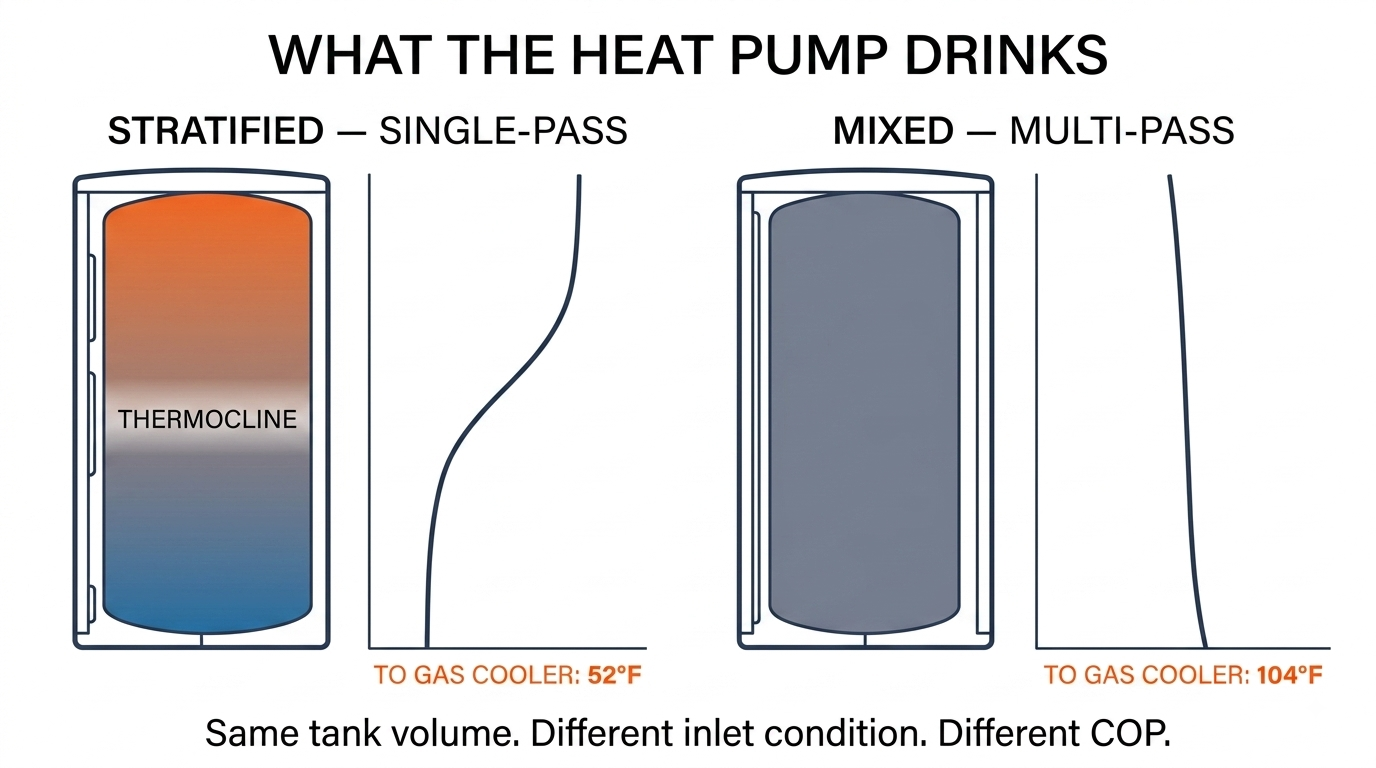
A single-pass heat pump takes cold water from the bottom of storage, passes it through the exchanger once, and delivers it to the top of the tank at full storage temperature. It achieves this by modulating water flow: when inlet water is colder or ambient conditions reduce capacity, flow slows so the water still leaves at target temperature. Because everything entering the top of the tank is fully heated and everything leaving the bottom is cold, the tank develops and holds a sharp boundary between the two—a thermocline—and nearly all of its volume is deliverable at usable temperature.
A multi-pass heat pump circulates water through the exchanger repeatedly, raising it roughly 5 to 10°F each time and returning it to the tank, much as a gas water heater does. The tank contents converge toward a single blended temperature rather than separating into hot and cold layers. That has a cost the specification has to absorb: a mixed tank delivers fewer usable gallons per nominal gallon, so a multi-pass system needs more storage volume and more heat pump capacity than a single-pass system serving the same building.
Why the Refrigerant Decides This
The reason single-pass and multi-pass are not simply two control strategies is thermodynamic, and it explains everything downstream.
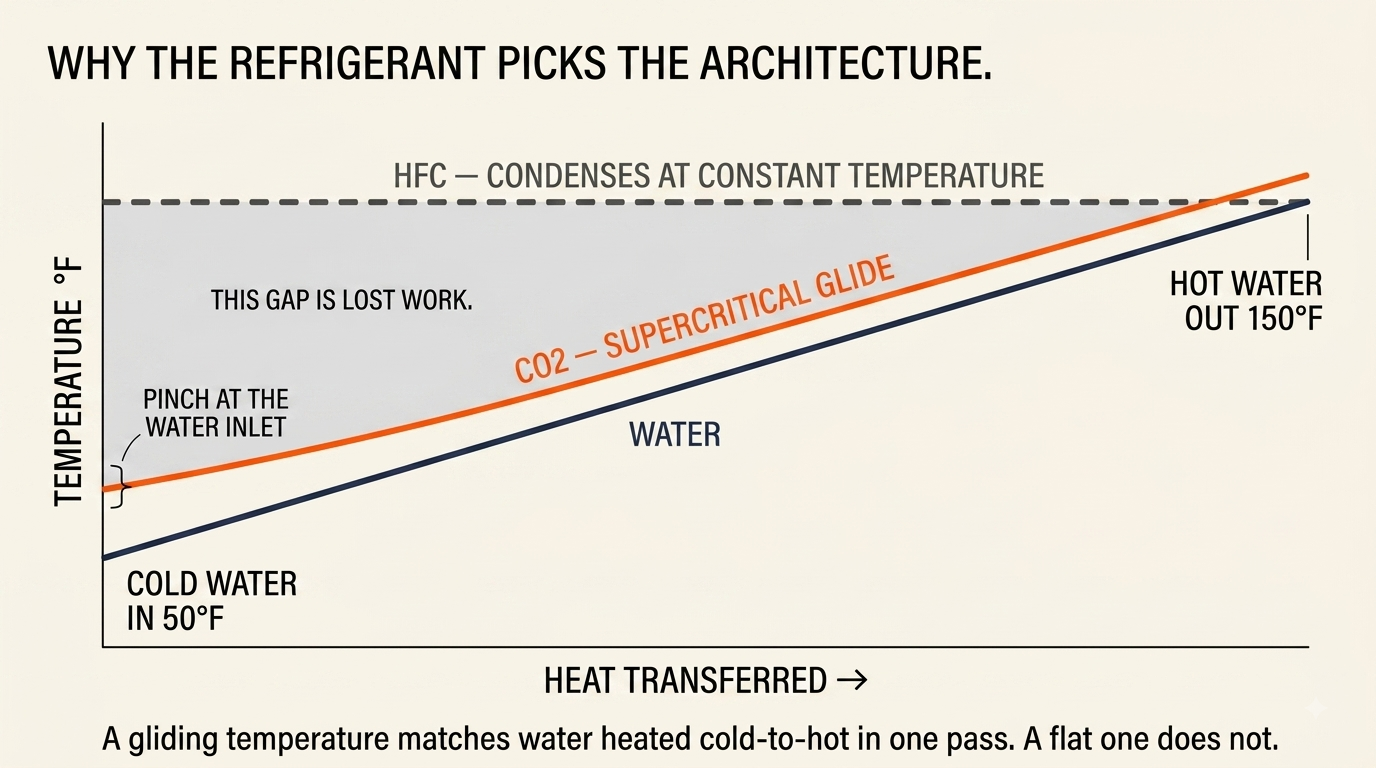
Conventional HFC refrigerants condense. In a standard heat pump, the refrigerant enters the condenser as a hot vapor and rejects heat while changing phase to liquid at an essentially constant saturation temperature. Heat transfer therefore happens across a flat temperature line. Raising cold water a long way against that flat line means the condensing temperature must be high throughout, which is thermodynamically wasteful. Nudging water up a few degrees at a time is a more comfortable match for that behavior.
CO2 above its critical point does not condense. Carbon dioxide has a critical temperature of about 31°C (88°F), which is below the temperature at which we want to make hot water. A CO2 water heating cycle therefore operates transcritically: heat rejection happens above the critical point, where the refrigerant remains a supercritical fluid and simply cools down as it gives up heat. The heat exchanger is called a gas cooler rather than a condenser for exactly this reason.
Instead of a flat temperature line, the refrigerant glides down across a wide temperature range, which matches well against water being heated from cold to hot in one continuous pass. The Energies review of transcritical R744 heat pump systems and a comprehensive review of CO2 heat pump water heaters discuss gas cooler behavior and cycle parameters.
That temperature glide is why CO2 equipment is effectively single-pass. The cycle is built to take water from cold to hot in one trip, and it is at its best when the temperature spread is large.
The Pinch Point, and Why Entering Water Temperature Is the Whole Game
In a gas cooler, the point of closest approach between refrigerant and water—the pinch—occurs at the water inlet. The supercritical CO2 leaving the gas cooler can only be cooled to within a few degrees of whatever water temperature is entering there. Feed it 50°F water and the refrigerant exits cold, having given up a great deal of heat, and the cycle is efficient. Feed it 95°F water and the refrigerant cannot be cooled far enough, less heat is rejected per unit of compressor work, and the coefficient of performance falls away.
This is the mechanism behind several design conventions that otherwise look like folklore.
What Each Architecture Demands From the Storage Tank
The storage requirements are different because the two architectures use the tank differently.
Storage requirements for single-pass and multi-pass heat pump water heaters
Storage attributeSingle-passMulti-pass
OrientationVertical, to maximize stratificationVertical or horizontal; stratification is not relied upon
Inlet treatmentDiffused or baffled inlet to arrest incoming velocity and protect the thermoclineLess critical, since the tank is intended to be mixed
Volume requiredLower for the same peak, because most of the nominal volume is deliverableHigher, because a blended tank delivers fewer usable gallons per nominal gallon
Heat pump capacity requiredLowerHigher, for the same reason
Temperature sensingMultiple thermowells at specified heights so controls can stage from thermocline positionFewer sensing points; a mixed tank has less positional information to read
Piping connectionsDedicated heat pump inlet and outlet connections providing hydraulic separationDedicated connections still recommended, but the system is less sensitive
Loop return handlingMust be kept away from the heat pump—typically a swing tank or parallel loop tankCan often return to the bottom of primary storage and be handled by the same equipment
Consequence of getting it wrongWarm water reaches the gas cooler; COP falls; the efficiency case for the equipment quietly evaporatesUndersized storage; more resistance backup; higher bills
The Practical Specification Consequences
The asymmetry in the final row is the practical takeaway. A multi-pass system specified with a marginal tank runs less efficiently than it should. A single-pass system specified with a mixing tank can fail to deliver the efficiency that justified choosing it, and the failure is invisible—the building has hot water, nothing alarms, and the shortfall appears only as a utility bill nobody traces back to a tank selection made two years earlier.
Practical specification language follows from the table: ask for tested draw-down performance and the conditions it was measured at, ask whether the inlet is diffused or baffled, and confirm the number and height of thermowells before the tank order is released rather than after. Those are the three items that most often get discovered late.
The physical constraints on getting a large tank into a mechanical room—doorway clearance, floor loading, and restraint—are covered in the guide to commercial hot water storage tanks, and the arithmetic for the volume itself is in the guide to heat pump water heater storage tank sizing.
The Honest Case Against Single-Pass CO2
Everything above favors single-pass on efficiency grounds, and an article published by a tank manufacturer arguing that stratified storage matters should be read with that in mind. So here is the other side, stated properly.
Refrigerant Policy and Market Direction
Refrigerant policy adds a further consideration in the other direction: HFCs are subject to phase-down schedules, and specifications increasingly favor low-global-warming-potential refrigerants, of which CO2 is the extreme case at a GWP of 1. Programs such as the NEEA Advanced Water Heating Specification and qualified products list provide a practical way to see which equipment currently meets the performance bar the market is converging on.
How This Interacts With the Rest of the Plant
Choosing an architecture is one input to a larger system decision, not the decision itself. The configuration question—whether the recirculation loop returns to a swing tank, a parallel loop tank, or straight into primary storage—depends on measured loop losses as much as on the equipment, and the capacity-versus-storage tradeoff has to be solved for the building as a whole. Both are covered in the guide to central heat pump water heaters for multifamily buildings, which is the right place to start if the plant is still at concept stage.
Ecotope’s Ecosizer documentation and glossary is also worth reading directly; the terms used in these design conversations—aquastat fraction, temperature maintenance turn-on, and cycle-off time—come from that work and are defined there precisely.
Frequently Asked Questions
What is the difference between a single-pass and a multi-pass heat pump water heater?
A single-pass heat pump modulates water flow through its heat exchanger so that water reaches full storage temperature in one trip, regardless of inlet temperature. A multi-pass heat pump raises water roughly 5 to 10 degrees Fahrenheit per trip and returns it to a mixed storage tank, repeating until the tank reaches temperature. Single-pass is more efficient and preserves tank stratification; multi-pass tolerates warm inlet water and can handle recirculation loop temperature maintenance without dedicated equipment, but requires more storage volume and more heat pump capacity.
Why are CO2 heat pump water heaters single-pass?
Carbon dioxide has a critical temperature of about 31 degrees Celsius, below useful hot water temperatures, so a CO2 water heating cycle operates transcritically. The refrigerant does not condense at a constant temperature; it remains supercritical and glides down across a wide temperature range as it rejects heat in what is called a gas cooler rather than a condenser. That gliding temperature profile matches water being heated from cold to hot in one continuous pass, which is exactly what single-pass operation provides.
Why does entering water temperature matter so much for a CO2 heat pump?
The point of closest approach between refrigerant and water in a gas cooler occurs at the water inlet, so the CO2 leaving the gas cooler can only be cooled to within a few degrees of the entering water temperature. Cold entering water lets the refrigerant reject a great deal of heat per unit of compressor work, producing a high coefficient of performance. Warm entering water prevents adequate cooling and the coefficient of performance falls sharply. This is why tepid recirculation loop return is kept away from the primary heat pump in most central designs.
Does a single-pass heat pump water heater need a stratified storage tank?
Effectively yes. A single-pass system draws cold water from the bottom of storage and returns fully heated water to the top, and its efficiency depends on the water it draws being genuinely cold. If turbulence inside the tank mixes hot and cold layers, the temperature entering the heat pump rises and efficiency falls. Vertical tanks are recommended for single-pass systems specifically to maximize stratification, and a diffused or baffled inlet that arrests incoming water velocity protects the thermocline.
Does a multi-pass system need more storage than a single-pass system?
Yes, and more heat pump capacity as well. A multi-pass system returns partially heated water to the tank continuously, so the contents converge toward one blended temperature rather than separating into hot and cold layers. A blended tank delivers fewer usable gallons per nominal gallon than a stratified one, so a larger nominal volume is required to cover the same peak draw.
Can a multi-pass heat pump handle recirculation loop temperature maintenance?
Often yes, and that is one of its main advantages. Multi-pass equipment is designed to add a small temperature rise per pass and can operate efficiently with inlet water in the range a recirculation loop returns, so it can serve both the primary domestic hot water load and loop temperature maintenance from the same equipment. Single-pass systems, particularly CO2 units, usually require the loop return to be handled separately through a swing tank or a dedicated parallel loop tank.
What are the drawbacks of CO2 heat pump water heaters?
Transcritical CO2 systems operate at high-side pressures several times those of conventional equipment, which raises component cost and changes the service proposition. Service parts are less widely stocked than for conventional equipment and product families are still evolving. Efficiency degrades steeply at very low ambient temperatures and defrost cycles reduce capacity further, so sizing a design day at the extreme low end on heat pump capacity alone may not be the right economic call. Against that, CO2 has a global warming potential of 1 and is not subject to the phase-down schedules affecting HFC refrigerants.
Conclusion
Single-pass and multi-pass are not two settings on the same machine. They are two different ways of matching a refrigeration cycle to a water heating load, and the refrigerant largely decides which one you are working with. Transcritical CO2 wants cold water in and hot water out in one pass; conventional condensing equipment is happier adding a few degrees at a time.
What follows from that choice lands on the storage tank, and this is the part worth carrying into a design meeting: in a single-pass system the tank sets the heat pump’s inlet condition every time it runs. Choose a tank that mixes and the machine you paid a premium for will behave like a cheaper one, quietly, for the life of the building. Ask for tested draw-down performance, ask how the inlet is diffused, and confirm the thermowells before the order goes out.