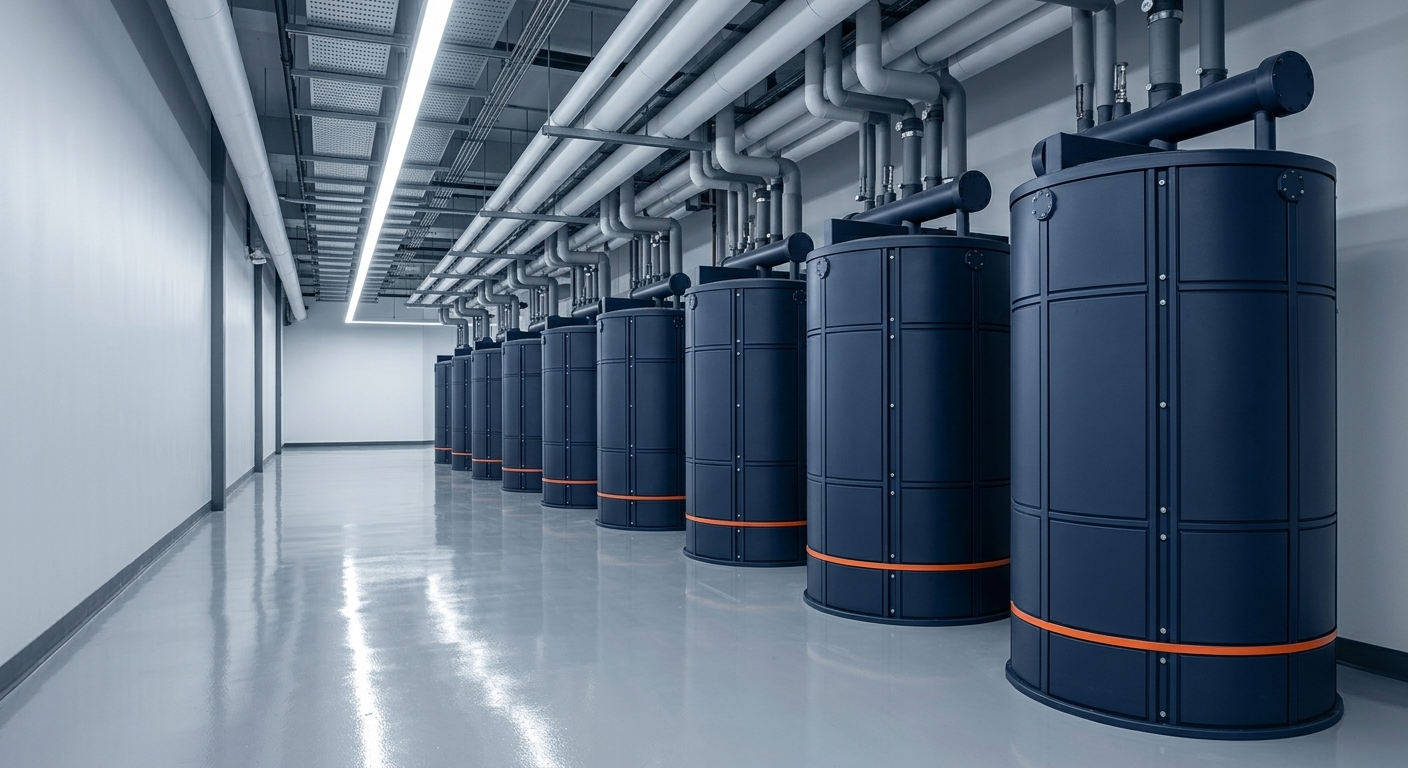
The phrase “thermal battery” is doing a lot of work in building-systems marketing right now, and not all of it is honest. Some vendors use it to describe a genuinely useful piece of hardware. Others use it because “battery” sounds more modern than “tank,” and they would rather you not think too hard about what comes out of the thing.
So let's be direct about it. A thermal battery in a building is a device that stores energy as heat or cold and gives it back as heat or cold. It will not run your lights. It will not carry you through an outage. What it will do—often better and far more cheaply than an electrochemical battery—is move your building's largest loads to the hours when energy is cheapest. This article is the building-specific view; the broader technology is covered in our guide to thermal energy storage.
Key Takeaways
In short: A thermal battery, also called a heat battery, is a building energy storage device that captures thermal energy when electricity is cheap or solar is abundant, holds it in an insulated medium, and releases it as heating or cooling when demand peaks.
In commercial and multifamily buildings the medium is usually water; the device is usually an insulated, stratified storage tank charged by a heat pump, an electric element, or a solar-thermal array. Capacity is measured in kWh of thermal storage. Modular units run from about 12 kWh, or 80 gallons, to 108 kWh, or 700 gallons, per module and interconnect for larger loads.
List pricing works out to roughly $54–$97 per stored kWh, well below installed lithium-ion on an energy basis. The tradeoff is absolute: the energy comes back out as heat, never as electricity.
In this article
What is a thermal battery—and is a “heat battery” the same thing?
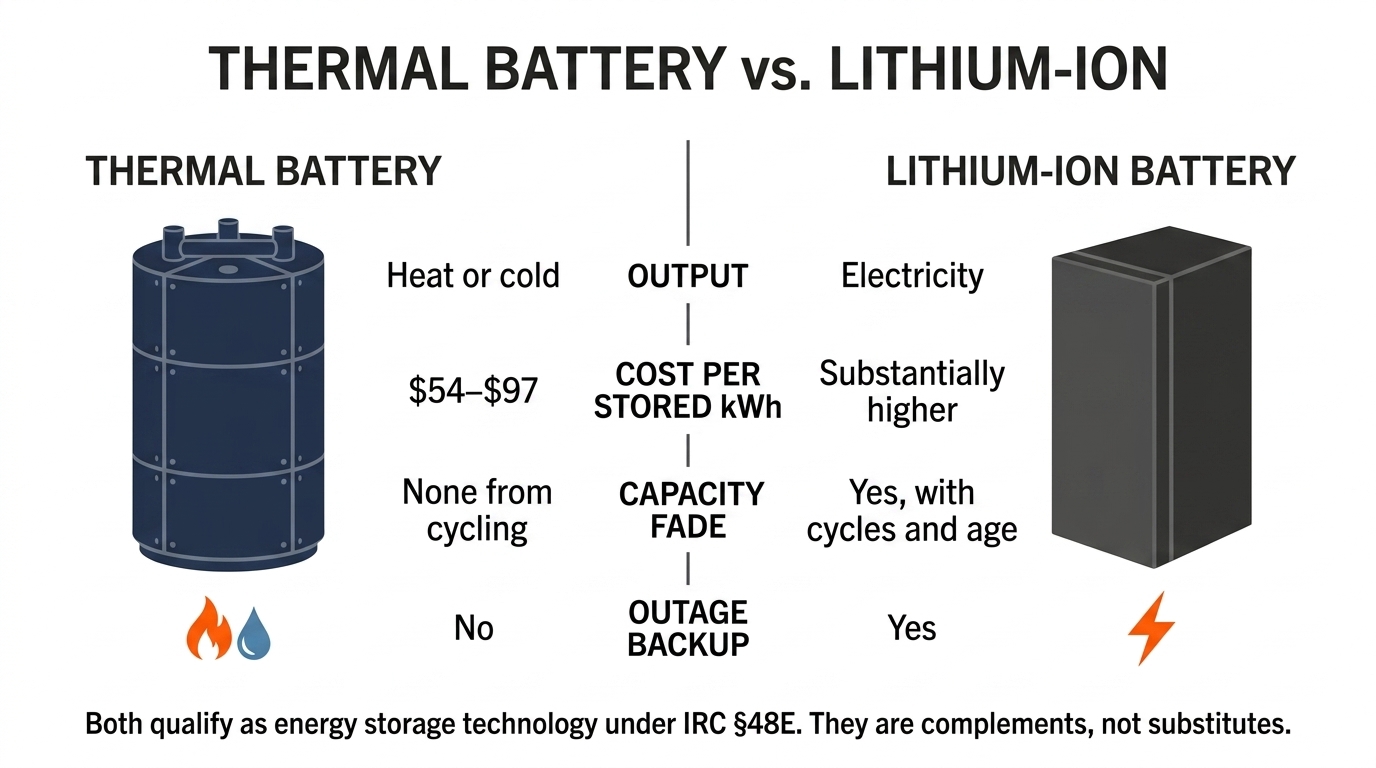
Yes. They are the same category of device, described with two different consumer-friendly names. In the United States “thermal battery” is the more common phrasing; in the UK and parts of Europe “heat battery” is standard, usually attached to compact phase-change units for homes. Underneath either label sits thermal energy storage: a medium, an insulated vessel, a charging source, and controls.
The word “battery” is a reasonable analogy in three respects and misleading in one. It is reasonable because the device has a state of charge, a capacity rated in kilowatt-hours, and a charge/discharge cycle you can schedule. It is misleading because an electrical battery is energy-agnostic on output—it returns electricity, which can become anything—while a thermal battery returns the specific commodity it stored.
A tank charged to 140°F gives you 140°F water. That is enormously valuable if your building needs hot water, and worth nothing if your building needs to run an elevator. We say this plainly because the distinction determines whether the product fits your project, and because every honest comparison in this article rests on it.
How a thermal battery works in a building
The cycle has two halves and one governing constraint.
Why stratification matters
In water-based systems, stratification is what separates a working thermal battery from an expensive lukewarm tank. Hot water is less dense and layers at the top; a well-designed vessel preserves that layering through discharge so delivery temperature holds even as the lower portion cools. Inlet diffuser design is where this is won. A tank that mixes on every draw reports a healthy average temperature while delivering water nobody can use.
Controls and demand flexibility
The control layer is the other half of the value. LBNL research on load-shaping with cost-minimizing heat pump water heater controls and price-responsive controls under highly dynamic tariffs demonstrates how storage lets a device optimize when it consumes electricity without degrading service to occupants. LBNL's broader demand flexibility program covers the same principle across residential, multifamily, and institutional buildings.
The five forms a building thermal battery takes
“Thermal battery” covers a range of hardware. These are the forms you will actually encounter in a commercial or multifamily building, in rough order of how often they get specified.
Common forms of building thermal batteries
FormStoresTypical capacityWhere it fitsHonest caveat
Insulated water tank (stratified)Sensible heat in water~12–108 kWh per module, interconnectableCentral domestic hot water, hydronic heating, low-temperature process heatNeeds mechanical space and floor-loading capacity; temperature ceiling limits high-temperature uses
Ice / chilled water storageLatent or sensible coldSized in ton-hours, typically hundredsCommercial cooling peak shaving in offices, data-adjacent and campus chilled waterCooling only; charging at night costs efficiency because ambient conditions are less favorable than the plant's design point
Phase change material (PCM) unitsLatent heat at a fixed melt temperatureCompact; higher density per liter than waterSpace-constrained retrofits and residential “heat battery” appliancesHigher cost per kWh; long-term cycling stability remains an active research question
Electric thermal storage (ceramic brick)Sensible heat at high temperatureRoom-unit to central-plant scaleOff-peak electric heating where gas is unavailable or being displacedHigh standing losses relative to water at building temperatures; heating only
Building thermal mass (passive)Sensible heat in concrete, slabs, and envelopeEffectively free capacity, poorly controllablePre-cooling and pre-heating strategies via controls aloneNo dedicated hardware means no precise control and comfort risk if pushed too far
Research and the current default
DOE's Building Technologies Office research on thermal energy storage materials covers the emerging end of that list, and Oak Ridge National Laboratory's Stor4Build work has produced heat pump prototypes with integrated storage built from commercially available components. For a practicing engineer specifying this year, water remains the default for a reason: cheapest per kWh, non-toxic, non-flammable, and completely understood.
Thermal battery vs. lithium-ion battery for buildings
This is the comparison most people arrive looking for, so here it is without a thumb on the scale.
Thermal battery compared with lithium-ion storage
CategoryThermal batteryLithium-ion battery
OutputHeat or cold at a usable temperatureElectricity, usable by any load
Cost per stored kWhRoughly $54–$97 for the storage module at list, before source and installationSubstantially higher installed, on an energy basis
Capacity loss over timeAn insulated water vessel does not lose capacity with cycle countCapacity fades with cycles and calendar age; replacement is a budgeted event
LossesStanding loss over time, measured in °F per 24 hours, not conversion lossConversion losses each way; converting stored electricity back into heat adds a further step
Fire and codeWater; no thermal runaway pathway; standard mechanical-room sitingSpacing, ventilation, and fire-code constraints in occupied buildings
Outage backupNone. It holds heat, not power. It cannot energize a panel, run a pump on a dead grid, or keep a life-safety system up.Yes—this is the reason to buy one
Best roleShift the thermal load first. In most buildings it is the largest and cheapest block of shiftable demand.Cover the remaining electrical load and any resilience requirement, sized after the thermal load is handled
The honest framing
These are complements, not competitors. A building that shifts its water heating and space conditioning into thermal storage often finds the battery it then needs is far smaller—and therefore far cheaper—than the one it was originally quoted.
The peer-reviewed literature reaches a similar conclusion. A 2025 state-of-the-art review of energy flexibility in grid-interactive buildings identifies thermal energy storage as an expected dominant storage form in future building applications precisely because so much of a building's load is thermal to begin with.
How many kWh does a building thermal battery hold, and what does it cost?
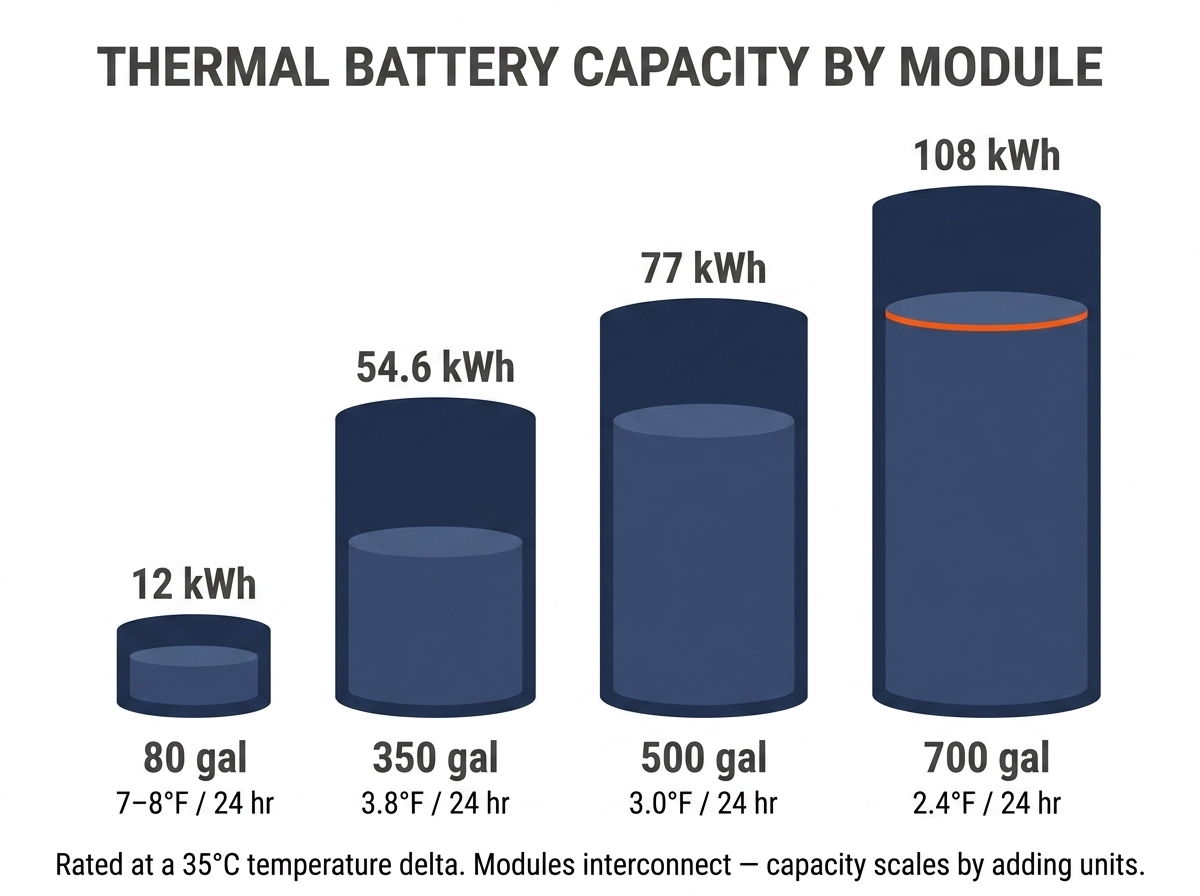
Capacity and price for modular water-based thermal batteries, at current published list pricing:
Published modular water-based thermal battery capacity and pricing
ModuleThermal capacity*List price$/kWh storedStanding loss
80 gallon12.0 kWh$1,190$977–8°F / 24 hr
350 gallon54.6 kWh$3,427$633.8°F / 24 hr
500 gallon77.0 kWh$4,464$583.0°F / 24 hr
700 gallon108.0 kWh$5,798$542.4°F / 24 hr
What the numbers mean
*Rated at a 35°C temperature delta. Pricing is current as of August 2026; see the full thermal tank comparison and specifications for complete data.
Two things in that table drive design decisions. Cost per stored kWh falls about 44% from the smallest module to the largest, so undersizing to protect capital usually raises cost per unit of delivered benefit. Standing loss also improves sharply with size, because surface area grows more slowly than volume. A 700-gallon module losing 2.4°F per day supports overnight and multi-day strategies that an 80-gallon module losing 7–8°F simply does not.
The module price is the storage vessel. A complete installed thermal battery system also includes the heat source, heat exchangers, piping, controls, and labor. For a packaged storage-plus-heat-pump approach rather than a component build, see the All-In-One thermal energy system.
Which buildings get the most out of a heat battery
Three conditions have to overlap: a thermal load with a defined daily peak, an energy price that varies by time of day, and a heat source whose cost scales with capacity. Where all three are present, the building types below tend to pencil.
Thermal batteries and grid-interactive buildings
The broader policy context matters because it is where the money is heading. DOE's Grid-interactive Efficient Buildings initiative was launched to treat buildings as flexible energy resources rather than passive consumers, combining efficiency with demand flexibility, smart controls, and storage. The GEB projects summary shows how consistently HVAC and thermal storage equipment appear across the funded portfolio, and the DOE Better Buildings GEB report lays out the utility-side rationale.
The underlying technical case is documented in DOE's GEB technical report series—both the overview of research challenges and gaps and the HVAC, water heating, appliances, and refrigeration volume identify thermal storage as a priority development area.
On the empirical side, PNNL's laboratory evaluation of controlled heat pump water heaters quantified measurable peak demand reductions from grid-connected units. DOE's summary of that multi-utility field and lab work covers the customer-acceptance side as well as the technical results, while related laboratory estimates of electric water-heater demand address the load-shifting potential.
The practical implication for an owner: a building with dispatchable thermal storage is a building that can participate in demand-response programs, respond to dynamic tariffs, and defend itself against rate structures that are getting less forgiving, not more.
Tax treatment and incentives
The federal definition is the useful part. Under the Clean Electricity Investment Credit, thermal energy storage property sits inside the statutory definition of energy storage technology—see 26 U.S.C. §48E, the IRS overview of the credit, and the implementing regulations at 26 CFR 1.48E-1. A thermal battery and a lithium-ion battery are addressed by the same credit provision.
Credit value depends on project scale, prevailing wage and apprenticeship compliance, domestic content, and post-2025 foreign-entity sourcing restrictions, and the applicable percentages step by construction start year. None of this is tax advice—confirm your position with a tax professional before it reaches a pro forma.
Separately, utility custom commercial and multifamily efficiency rebates tied to measured demand reduction are usually the most productive state-level path, because demand reduction is exactly what a thermal battery produces.
When a thermal battery is the wrong call
We manufacture these. Treat the following as the list we would want handed to us if we were the ones writing the check.
Frequently Asked Questions
What is a thermal battery?
A thermal battery is a device that stores energy as heat or cold and releases it later as heating or cooling. In buildings it is most often an insulated, stratified water tank charged by a heat pump, an electric element, or a solar-thermal array. It has a state of charge and a capacity rated in kilowatt-hours like an electrical battery, but it returns thermal energy rather than electricity.
Is a heat battery the same as a thermal battery?
Yes. They are two names for the same category of device. “Thermal battery” is the more common term in the United States and “heat battery” is more common in the UK, where it usually refers to compact phase change material units for homes. Neither is a standard engineering term; both describe thermal energy storage.
How many kWh does a thermal battery hold?
Modular water-based thermal batteries hold roughly 12 kWh at 80 gallons, 54.6 kWh at 350 gallons, 77 kWh at 500 gallons, and 108 kWh at 700 gallons, rated at a 35°C temperature delta. Modules interconnect, so total capacity scales by adding units rather than replacing the system.
How much does a thermal battery for a building cost?
Modular units list from $1,190 to $5,798 depending on capacity, which works out to roughly $54 to $97 per kWh of thermal storage. Cost per stored kWh falls about 44% from the smallest module to the largest. A complete installed system adds the heat source, heat exchangers, piping, controls, and labor, and varies by site.
Can a thermal battery provide backup power during an outage?
No. A thermal battery stores heat or cold, not electricity. It cannot energize a panel, power lighting or equipment, or support life-safety systems during an outage. Buildings that need outage resilience require an electrical battery or a generator; a thermal battery can reduce how large that electrical system needs to be, but cannot replace it.
Is a thermal battery cheaper than a lithium-ion battery?
Per stored kilowatt-hour, substantially. Thermal storage modules list at roughly $54 to $97 per kWh, well below installed lithium-ion on an energy basis, and an insulated water vessel does not lose capacity with cycling the way a lithium-ion pack does. The comparison is only meaningful for thermal loads, since the two technologies deliver different outputs.
How long does a thermal battery hold its charge?
It depends on insulation and module size. Published standing losses run from about 7–8°F per 24 hours on an 80-gallon module to about 2.4°F per 24 hours on a 700-gallon module, because surface area grows more slowly than volume. Overnight and multi-day cycling are practical at the larger sizes; seasonal storage requires different technology entirely.
Does a thermal battery qualify for federal tax credits?
Thermal energy storage property is within the statutory definition of energy storage technology under the federal §48E Clean Electricity Investment Credit, the same provision that covers electrochemical storage. Credit value depends on project size, prevailing wage and apprenticeship compliance, domestic content, and foreign-entity sourcing restrictions, and the applicable percentage varies by construction start year. Confirm specifics with a tax professional.
Conclusion
A thermal battery is a good product with a bad name. The name oversells in one direction—implying electrical output it does not have—and undersells in another, because the economics on thermal loads are genuinely hard to beat. Twelve to 108 kWh per module, $54 to $97 per stored kWh, no capacity fade, no fire-code fight, and the same federal credit line as lithium-ion.
The right question is not “thermal battery or lithium-ion.” It is “how much of my building's load is thermal, and what happens to the rest of the storage budget once that part is handled cheaply.” For most commercial and multifamily buildings the answer to the first half is: most of it.
Garth Schultz is President of Thermal Energy HQ, where he leads development of modular thermal energy storage systems manufactured in the United States. He is the inventor named on patents covering hybrid photovoltaic-thermal (PVT) solar panels and insulated modular storage tank construction, and has worked in solar-thermal product development since founding the company's technology line in 2007. Connect on LinkedIn.