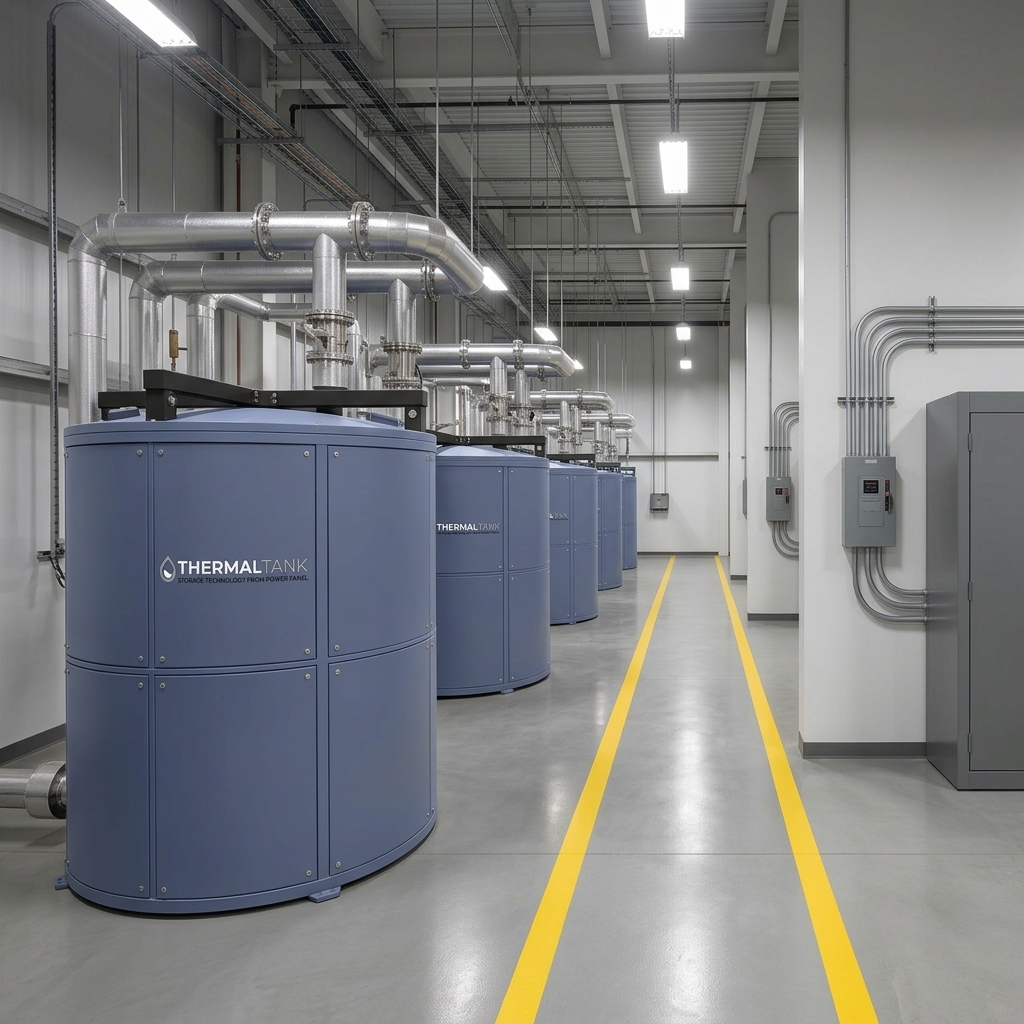
Search for this comparison and you will find a lot of confident numbers that do not mean what they appear to mean. A thermal vendor quotes a tank at $60 per kWh. A battery vendor quotes a system at some multiple of that. The reader concludes thermal is cheaper by a factor of several, and in a narrow sense they are right—but they have just compared two numbers that were calculated on different bases, for different outputs, over different lifetimes.
We manufacture thermal storage, so the surface-level version of this comparison flatters us. We are going to do the careful version anyway, because a buyer who makes a decision on a bad number is a buyer who is unhappy eighteen months later. The broader technology background is in our guide to thermal energy storage; this page is strictly about the money.
In short: “cost per kWh” in energy storage means at least four different things: installed capital cost per rated kWh, cost per usable kWh after depth-of-discharge and temperature limits, levelized cost of storage (LCOS) per kWh of throughput over the asset's life, and cost per kWh of delivered end-use energy. Most published comparisons mix them.
On installed capital cost per rated kWh, modular thermal storage lists at roughly $54–$97 per kWh for the storage vessel, which is a small fraction of installed lithium-ion on the same basis. On LCOS the thermal advantage usually widens further, because an insulated water vessel does not require augmentation or replacement the way a battery pack does. But the comparison is only meaningful for a thermal load. For any load that needs electricity back out, thermal storage has a cost per kWh of infinity, because it cannot do the job at any price.
Key Takeaways
This is the part most comparisons skip, and it is the part that determines whether the rest of the arithmetic means anything.
In this article
Why “cost per kWh” is four different numbers
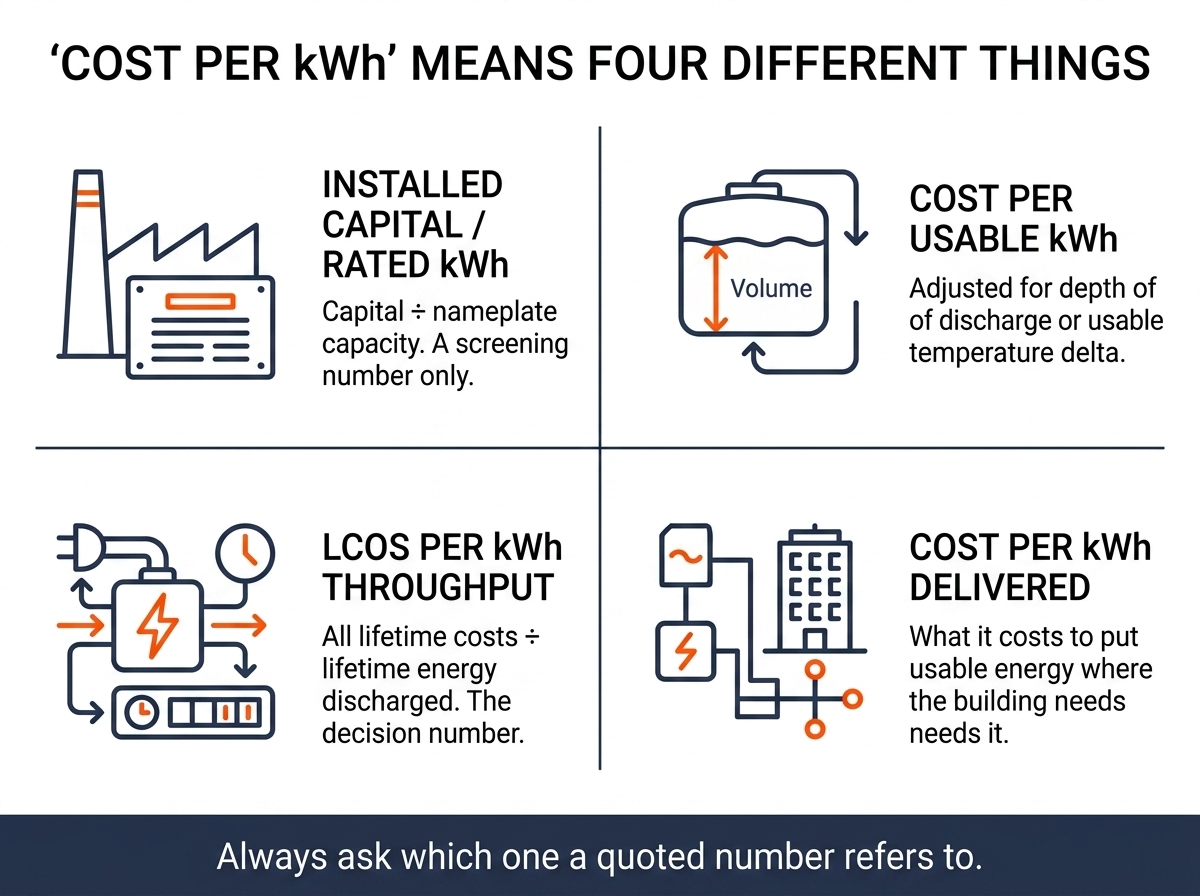
The four metrics below measure different things and should not be treated as interchangeable.
The four meanings of cost per kWh
MetricWhat it measuresWhy it misleadsUse it for
Installed capital cost per rated kWhTotal system capital divided by nameplate energy capacityNameplate is not what you get. Batteries are limited by depth of discharge; thermal tanks are limited by usable temperature delta. Neither delivers 100% of rated capacity in service.First-pass screening and budget ranges only
Cost per usable kWhCapital divided by the energy you can actually withdraw in normal operationRequires honest inputs about DOD limits or usable ΔT, which vendors are not always eager to supplyComparing two systems of the same technology
LCOS—levelized cost of storage per kWh of throughputAll lifetime costs—capital, O&M, augmentation, replacement, financing, and taxes—divided by lifetime energy dischargedSensitive to assumed cycle count and project life; two analysts can produce different answers from the same hardwareThe actual decision. This is the number that should drive capital allocation
Cost per kWh of delivered end-use energyWhat it costs to put a usable unit of heat, cold, or electricity where the building needs itRarely published, because it requires modeling the specific buildingFinal engineering validation on a real project
Why LCOS matters
PNNL's levelized cost of storage methodology explains why LCOS allows technologies with different calendar life, cycle life, depth-of-discharge limits, and maintenance profiles to be compared on a more equal footing than installed cost per rated kWh does.
The LCOS workbook documentation shows the full calculation, including how battery augmentation and replacement schedules enter the math. If you read one external source before making a storage decision, make it that one.
What thermal energy storage costs per kWh
Published list pricing for modular water-based thermal storage, with the derived $/kWh shown explicitly so the arithmetic is checkable:
Published modular thermal storage pricing
ModuleThermal capacityList price$/kWh storedStanding loss
80 gallon12.0 kWh$1,190$977–8°F / 24 hr
350 gallon54.6 kWh$3,427$633.8°F / 24 hr
500 gallon77.0 kWh$4,464$583.0°F / 24 hr
700 gallon108.0 kWh$5,798$542.4°F / 24 hr
Three qualifications to the thermal figures
That is the vessel, not the system. A complete installed thermal storage system adds the heat source—heat pump, electric elements, or PVT array—heat exchangers, piping, controls, and labor. Those vary enough by site that publishing a single installed number would be misleading, and we are not going to invent one.
Rated capacity assumes a 35°C delta. If your process only tolerates a narrower usable temperature swing, usable capacity drops proportionally and your real cost per usable kWh rises. For a packaged system where the delta is engineered end-to-end, see the All-In-One thermal energy system.
Cost per stored kWh falls about 44% from the smallest module to the largest. Any comparison that quotes our cheapest number against a competitor's is quoting the 700-gallon module and should say so. See the thermal tank comparison and specifications for complete data.
What battery storage costs per kWh—and how to source that number
We are not going to publish a lithium-ion price and let it rot on this page. Battery costs move faster than any other input in this comparison, and a competitor figure that is eighteen months stale is worse than no figure at all. Here is where to get a current one instead.
Compare like durations
Battery costs should be pulled from the live PNNL database on the date of analysis rather than copied from a stale article or vendor presentation. A current battery figure and retrieval date belong in the project comparison.
Not every component of a battery system scales with energy capacity. Inverters and much of the balance of plant scale with power, which is why $/kWh figures for batteries are duration-dependent and why a two-hour and a six-hour system with identical chemistry report different $/kWh. Compare like durations, or the number is noise.
When this comparison is valid—and when it is not
A cost-per-kWh comparison between thermal and electrochemical storage is only meaningful under one condition: the load in question is thermal. Inside that boundary the comparison is fair and thermal generally wins by a wide margin. Outside it, the comparison is not close—it is undefined.
We put this table high in the article rather than burying it at the end, because it is the single most common way buyers get this decision wrong. A facility that needs resilience and buys thermal storage because the $/kWh looked better has not saved money. It has bought the wrong asset.
When thermal and battery storage can be compared
ScenarioIs the $/kWh comparison valid?Why
Central domestic hot water peak in a multifamily buildingYesBoth technologies could technically serve the load; thermal does it far more cheaply per kWh, and without a conversion step.
Commercial cooling peak shavingYesIce or chilled water storage and a battery both address the same demand charge; compare on LCOS.
Shifting a mixed electrical loadPartiallyOnly the thermal fraction is addressable by thermal storage. Compare on the thermal fraction, and size the battery for the rest.
Backup power through an outageNoThermal storage cannot energize a panel. There is no price at which it does the job, so there is no meaningful $/kWh comparison to make.
Frequency regulation or other fast grid servicesNoResponse characteristics and market products require electrical output.
High-temperature industrial process heat above the medium's rangeNoWater-based thermal storage cannot reach the temperature; the comparison is against a different thermal technology, not against a battery.
A worked example: sizing the comparison on a real load
Illustrative only. The inputs below are assumptions, not a quote. Rate structures, draw profiles, and installation conditions vary enough that your numbers will differ—sometimes substantially. The point of the exercise is the method, not the result.
Consider a 200-unit multifamily building with central heat pump domestic hot water. The morning peak runs roughly three hours. The question on the table is whether to add storage, and if so, which kind.
The comparison must be sized to the job
Step five is where most published comparisons quietly cheat. They compare the thermal storage capacity against a battery of equal nameplate kWh, when the correct comparison is against the battery required to do the same job.
Because a heat pump delivers several units of heat per unit of electricity, the battery needed to shift a given thermal load is smaller than the thermal tank in nameplate terms. It is still typically more expensive—but the honest margin is narrower than the headline comparison suggests, and you should know that before you quote it to a board.
Why lifetime economics usually widen the gap
Day-one capital is the least interesting part of this comparison. Four lifetime factors do more work:
Lifetime economics of thermal and battery storage
FactorThermal storageBattery storage
Capacity fadeAn insulated water vessel does not lose storage capacity with cycle count.Capacity fades with cycles and calendar age; augmentation or replacement is scheduled, not hypothetical.
LossesStanding loss over time, published in °F lost per 24 hours; no conversion penalty on the thermal path.Round-trip conversion losses each cycle, plus a further step if the end use is heat.
MaintenanceLow. Pumps, controls, and valves are the serviceable items.Thermal management, monitoring, and fire suppression systems carry ongoing cost.
End-of-lifeVessel and insulation; no hazardous material handling.Pack disposal or recycling is a real line item and a real logistics problem.
A favorable $/kWh does not guarantee a favorable NPV
The 2025 Applied Energy study benchmarking thermal energy storage cost for industrial process heat found that TES systems installed today may not yield a positive net present value against natural gas combustion in every ISO region, because the outcome depends heavily on the local spread between electricity and gas prices.
That finding is about thermal storage versus combustion, not versus batteries—but it is a useful reminder that a favorable $/kWh does not by itself produce a favorable NPV.
On the buildings side, the DOE Better Buildings fact sheet on thermal energy storage and its broader energy storage resources cover where each technology fits in a load-management strategy, which is ultimately the frame that matters more than the unit price.
Where batteries win outright
Written by a thermal storage manufacturer, and meant sincerely. In these situations the cost-per-kWh argument does not apply and you should buy the battery.
The strongest position is often a combination
In practice the strongest position for most mixed-use commercial and multifamily buildings is not one or the other. Shift the thermal load with thermal storage first, because it is usually the largest and cheapest block of shiftable demand, then size the battery for whatever electrical requirement remains.
The battery you end up buying is frequently much smaller than the one originally quoted. Our guide to the thermal battery for buildings covers that pairing in more detail.
Does the tax credit change the ranking?
Usually not, because both technologies claim the same provision. Thermal energy storage property is inside the statutory definition of energy storage technology under the Clean Electricity Investment Credit—see the §48E statutory definition, the IRS overview of the credit, and the implementing regulations at 26 CFR 1.48E-1.
Because the applicable percentage is applied to qualified investment, a credit at the same rate scales both paths proportionally and generally preserves the ordering.
Where it can matter: domestic content adders, prevailing wage and apprenticeship compliance, energy community bonuses, and post-2025 foreign-entity sourcing restrictions may apply differently to the two supply chains on a specific project. That is a question for a tax professional with your actual bill of materials in front of them, not for a comparison article.
About the author
Garth Schultz is President of Thermal Energy HQ, where he leads development of modular thermal energy storage systems manufactured in the United States. He is the inventor named on patents covering hybrid photovoltaic-thermal (PVT) solar panels and insulated modular storage tank construction, and has worked in solar-thermal product development since founding the company's technology line in 2007. Connect with Garth Schultz on LinkedIn.
Frequently Asked Questions
Is thermal energy storage cheaper than battery storage?
On installed capital cost per rated kilowatt-hour, yes, by a wide margin: modular thermal storage lists at roughly $54 to $97 per stored kWh for the storage vessel, a fraction of installed lithium-ion on the same basis. On levelized cost of storage the gap usually widens, because an insulated water vessel does not require augmentation or replacement. The comparison is only meaningful for thermal loads, since the two technologies deliver different outputs.
What does thermal energy storage cost per kWh?
Modular water-based thermal storage modules list from $1,190 to $5,798 depending on capacity, which works out to roughly $54 to $97 per kWh of storage at a 35°C temperature delta. Cost per stored kWh falls about 44% from the smallest module to the largest. That figure covers the storage vessel; a complete installed system adds the heat source, heat exchangers, piping, controls, and labor.
What does battery storage cost per kWh?
Battery costs move quickly enough that any figure published in an article goes stale within months. The best neutral source is the DOE-funded PNNL Energy Storage Cost and Performance Database, which publishes installed cost and levelized cost of storage estimates by technology, subsystem, and duration. Compare like durations, because inverters and much of the balance of plant scale with power rather than energy.
What is levelized cost of storage (LCOS)?
LCOS is the cost per kilowatt-hour of energy discharged over a storage asset's entire life, including capital, operations and maintenance, augmentation, replacement, financing, and taxes. It allows technologies with different calendar life, cycle life, and depth-of-discharge limits to be compared on a more equal footing than installed cost per rated kWh does, which is why it should drive the capital decision.
Why do published cost-per-kWh comparisons disagree so much?
Because “cost per kWh” refers to at least four different metrics: installed capital cost per rated kWh, cost per usable kWh after depth-of-discharge or temperature limits, levelized cost of storage per kWh of throughput, and cost per kWh of delivered end-use energy. Comparisons that mix these produce very different numbers from the same hardware.
Can thermal storage replace a battery?
Only for thermal loads. Thermal storage can shift heating and cooling demand, often far more cheaply than a battery can, which frequently reduces the size of battery a building needs. It cannot provide backup power, participate in fast grid-service markets, or serve electrical loads, so it cannot replace a battery bought for those purposes.
Does thermal storage lose capacity over time like a battery?
No. An insulated water storage vessel does not lose storage capacity with cycle count the way a lithium-ion pack does. Its losses are standing losses over time, typically published in degrees Fahrenheit lost per 24 hours, and these are a function of insulation and module size rather than of accumulated cycles.
Do thermal storage and batteries qualify for the same tax credit?
Both are addressed by the federal §48E Clean Electricity Investment Credit, which includes thermal energy storage property within its definition of energy storage technology. Because the credit applies to qualified investment, it generally scales both paths proportionally rather than changing which is cheaper. Domestic content, prevailing wage, and sourcing rules can apply differently by project; confirm with a tax professional.
Conclusion
For the thermal portion of a building's load, thermal energy storage is cheaper than battery storage on installed capital per stored kWh, and usually cheaper still on levelized cost once cycle life and augmentation enter the math. That is a real advantage and we are not going to pretend otherwise.
It is also a bounded advantage. It applies to heating and cooling loads, it depends on a rate structure that pays for shifting, and it disappears entirely the moment the requirement is electricity out.
The right sequence for most buildings is to establish how much of the load is thermal, shift that with thermal storage because it is the cheapest block available, and then size an electrical battery for what is left and for any resilience requirement. Run both paths on LCOS with a current battery figure pulled from the PNNL database, not from a vendor's slide.
If you want that run on your building rather than on a generic example, a short conversation about your load profile and rate structure is the fastest way there.