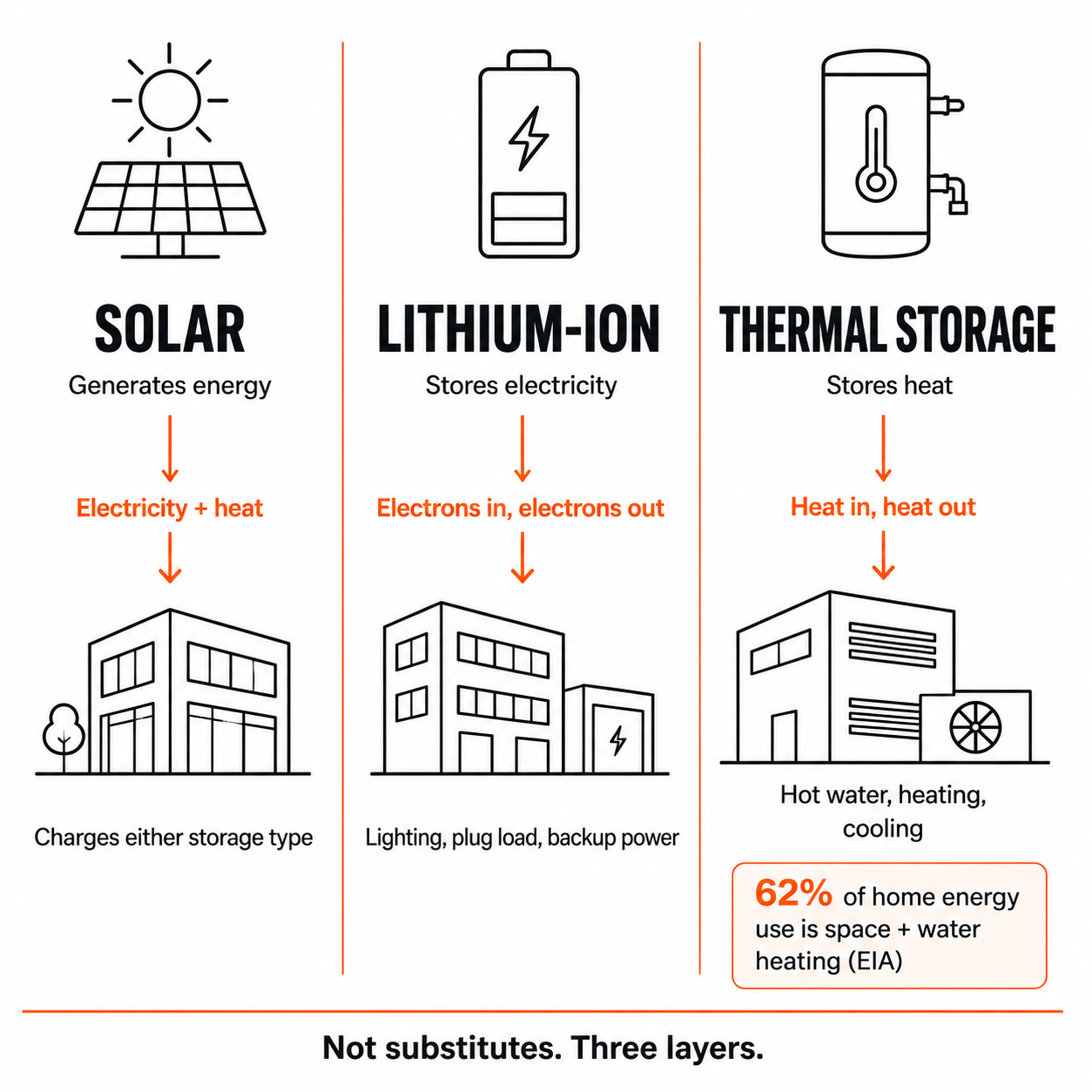
Solar panels generate energy. Lithium-ion batteries store electricity. Thermal storage stores heat. Treating them as direct substitutes creates bad designs because each solves a different problem.
Most buildings route a large share of their energy through heating, cooling, and domestic hot water. For those loads, thermal storage is usually the more economical instrument. It stores useful heat at roughly one-fifth to one-sixth the vessel cost per kilowatt-hour of a utility-scale lithium-ion benchmark, does not lose storage capacity through cycling, avoids the battery fire-code pathway, and may qualify under the same commercial federal storage credit.
Lithium-ion remains the correct choice for electrical loads that need electrons on demand, including backup power, life safety, IT, lighting, and fast demand response. Solar is not storage; it is generation that can charge either system. Strong projects size each layer to the load it actually serves.

Solar is generation. PV converts sunlight into electricity. Solar thermal converts sunlight into heat. Hybrid photovoltaic-thermal, or PVT, produces both from the same roof area. Solar determines how cheaply storage can be charged, but it stores nothing itself.
Lithium-ion is an electricity buffer. It is fast, dispatchable, and able to serve any electrical load. It is the only technology in this comparison that can directly keep lights, IT, elevators, egress systems, and other electrical loads operating during an outage.
Thermal storage is a heat buffer. Heat from a heat pump, PVT array, electric element, or recovered waste heat enters an insulated medium and is used later. TEHQ uses modular water-based tanks because water is inexpensive, non-toxic, abundant, and does not degrade through cycling.

If the final load is thermal, storing electricity chemically and converting it back to heat adds cost and unnecessary conversion steps. If the final load is electrical, a thermal tank cannot serve it. Research comparing batteries and thermal storage in PV-plus-heat-pump buildings reaches the same practical conclusion: batteries provide flexible electrical service, while thermal storage is often more economical for longer-duration thermal loads.
Cost comparisons are most useful when they identify what is actually being priced and what form of output the system provides.

Cost per stored kilowatt-hour comparison
TechnologyStored outputCost basisEfficiency/lossLife
Modular thermal tankHeat$54–$97/kWh vessel list priceStanding loss: 2.4°F–8°F per 24 hrWater does not degrade
4-hour utility lithium-ionElectricityAbout $334/kWh complete-system benchmarkAbout 85%–95% round tripCycle/calendar limited
Commercial in-building lithium-ionElectricityGenerally higher than utility scaleDeclines with degradationReplacement is a planned event
Solar PVNone; generation onlyPriced in $/WdcConversion efficiencyUsually 25–30 years
PVTGenerates electricity and heatProject-specificCombined electrical and thermal outputComparable to PV
Current TEHQ tank list pricing includes an 80-gallon model at $1,190 for 12.0 kWh, a 350-gallon model at $3,427 for 54.6 kWh, a 500-gallon model at $4,464 for 77.0 kWh, and a 700-gallon model at $5,798 for 108.0 kWh.
Capacity is rated at a 35°C temperature delta. Verify pricing before publication. Larger modules have lower cost per stored kWh and lower surface-to-volume standing loss. Modules can be added as a building or portfolio electrifies, allowing capacity to follow actual load rather than a long-range forecast.
For a thermal tank comparison and specifications, review the available modular tanks. The All-In-One thermal energy system provides another configuration for evaluating storage and heat-pump equipment together.
A lithium-ion system is a capacity-limited asset with a warranty. Capacity declines through cycling and calendar age, and a 20-year plan should include at least one replacement event or a clearly documented alternative assumption. Monitoring, balancing, thermal management, and state-of-health management are part of reaching its rated life.
A water-filled insulated tank has no comparable capacity-fade curve. Water does not lose storage capacity. Maintenance instead centers on pumps, valves, controls, insulation, water chemistry, and anodes where applicable. Those components have finite lives, so thermal storage is not maintenance-free. The narrower claim is that the storage medium itself does not require capacity-driven replacement.
This distinction often widens the initial cost gap over a long ownership period. Ask each vendor to show replacement assumptions, maintenance, and residual capacity over the same 20-year horizon.
Lithium-ion typically returns about 85%–95% of stored electricity as electricity. That is excellent and is the right metric for an electrical load.
For a thermal load, heat-to-heat storage does not require electricity to be stored chemically and then reconverted before becoming heat. Its primary loss is heat leaking through insulation, measured as standing loss over time. TEHQ’s published figures range from about 2.4°F to 8°F per 24 hours by model.
Low thermal-storage efficiency figures near 40% usually refer to heat-to-power systems that store heat and later run it through a turbine or engine to regenerate electricity. They do not describe a hot-water tank serving domestic hot water or HVAC. For buildings, the practical design is often to run a heat pump during solar or low-rate hours, store the heat, and use it during peaks. Storage can also allow a smaller heat pump to meet a large short-duration draw.
Lithium-ion stationary storage is governed by adopted fire and product standards, including NFPA 855, UL 9540, and UL 9540A testing. Requirements may include separation distances, hazard analysis, explosion-control provisions, placement limits near habitable space, ventilation, and dedicated rooms. Properly listed and installed battery systems are safe, but these requirements can determine whether a retrofit is feasible.
Water-based thermal tanks do not have a thermal-runaway or deflagration pathway and therefore do not enter the battery ESS fire-code pathway. They are not code-free. Filled tanks create substantial loads and require structural review, seismic restraint, anchorage, plumbing, pressure, and mechanical-code compliance.
TEHQ’s panelized modules assemble on site, allowing larger storage volumes to pass through standard doors and reach existing mechanical rooms that cannot accept a welded tank of equivalent size. Review contractor resources when coordinating installation requirements.
Federal clean-energy credits now include prohibited-foreign-entity and material-assistance restrictions tied to components and critical-mineral supply chains. For cell-based systems, diligence may extend through minerals, cells, modules, electronics, and battery-management equipment.
A thermal tank’s storage medium is water. Its sourcing review centers on the tank, insulation, controls, and balance of plant. TEHQ states that its core products are manufactured in the United States. This does not mean a particular battery fails a sourcing test; eligibility is product- and project-specific and should be reviewed by tax counsel.
Water is non-toxic, abundant, thermally stable, and carries no end-of-life recycling requirement as a storage medium. More information about US manufacturing is available in the company overview.
Policy changed materially. Treat this section as general information, not tax advice.
Public Law 119-21 terminated the §25D Residential Clean Energy Credit for expenditures made after December 31, 2025. IRS guidance treats an expenditure as made when original installation is completed. Reconfirm current guidance before publication.
The technology-neutral §48E Clean Electricity Investment Credit remains available for qualifying commercial and third-party-owned projects, subject to construction timing, wage, apprenticeship, and sourcing rules. The statute expressly includes thermal energy storage in the definition of energy storage technology.
California’s active solar energy property-tax exclusion under §73 may cover qualifying solar systems and related storage completed before January 1, 2027, subject to the law’s requirements and any extension.
SGIP is primarily focused on battery projects and budget availability changes quickly. Verify current availability and waitlist status immediately before publication.
For thermal projects, utility custom commercial and multifamily programs may be more relevant where incentives are based on measured energy or demand savings. Review the utilities and programs page for program considerations.
Start with the load, not the product.
Load-by-load storage decision framework
ObjectiveRecommended tool
Backup power for life safety, elevators, IT, or egress lightingLithium-ion
Fast electrical demand responseLithium-ion
Central domestic-hot-water morning peakThermal storage
Shift heating or cooling away from expensive hoursThermal storage
Thermal load in a crowded mechanical roomThermal storage
Add storage capacity in phasesThermal storage
Reduce energy cost before storageSolar PV or PVT
Maximize useful output from limited roof areaPVT
Reduce cooling energy and peak demandCooling storage /
Remote hot-water independencePVT plus thermal storage
Review the products overview and connect with facility managers and project teams when sizing systems around actual building loads.
A strong multifamily or hospitality configuration may include:
This works because heating and water heating represent a large share of building energy use. Moving thermal loads into a lower-cost thermal medium and preserving electrochemical capacity for electrical service is a sizing decision, not a compromise.
Hybrid PVT collectors may be especially useful where roof area is constrained and the building has a steady, valuable hot-water load. Learn more about a PVT array.
Use these questions to compare proposals on a consistent basis:
For thermal loads, it is often more economical and avoids capacity fade of the storage medium. For electrical loads and backup power, lithium-ion is the correct choice. Many well-designed projects use both.
TEHQ vessel list pricing is about $54–$97 per stored kWh, compared with an NREL benchmark near $334/kWh for a complete four-hour utility lithium-ion system. A complete thermal installation adds heat source, exchangers, piping, controls, and labor, so request installed pricing for both.
Lithium-ion returns about 85%–95% as electricity. Heat-to-heat thermal storage avoids an electrical reconversion loop and is evaluated mainly by standing loss. Heat-to-power thermal systems are a different application and have lower round-trip efficiency.
The water does not lose capacity through cycling. Pumps, valves, controls, insulation, and water chemistry still require maintenance and eventual service.
No. Solar generates energy; storage makes it available later. Solar can charge either a battery or thermal system.
Thermal storage is included in the statutory definition of energy storage under §48E for qualifying commercial projects. Eligibility depends on project facts and current rules. Confirm with a tax professional. The residential §25D credit ended for expenditures after December 31, 2025, subject to current guidance.
Battery installations may trigger NFPA 855 and UL 9540 requirements governing listing, separation, mitigation, and siting. Properly installed systems are safe. Thermal tanks avoid that battery pathway but still require structural, seismic, plumbing, and mechanical review.
Thermal storage is often the best fit because it allows a smaller heat pump to operate longer during low-cost hours while stored heat covers short morning peaks.
Panelized modules assemble on site, which helps them pass through standard access points. Floor loading, seismic anchorage, and service clearance must still be verified.
Thermal storage, solar, and lithium-ion are three layers, not one product category. Solar makes energy. Thermal storage carries heating, cooling, and hot-water loads. Batteries serve electrical loads that need electrons.
For thermal loads, storing heat as heat can provide a much lower vessel cost per stored kilowatt-hour, no capacity fade of the storage medium, and a different code and sourcing profile. For electrical loads, batteries retain decisive advantages. The correct system begins with a load profile and sizes each technology only for the work it performs well.

Tell our team about your building, operating goals, and energy needs.