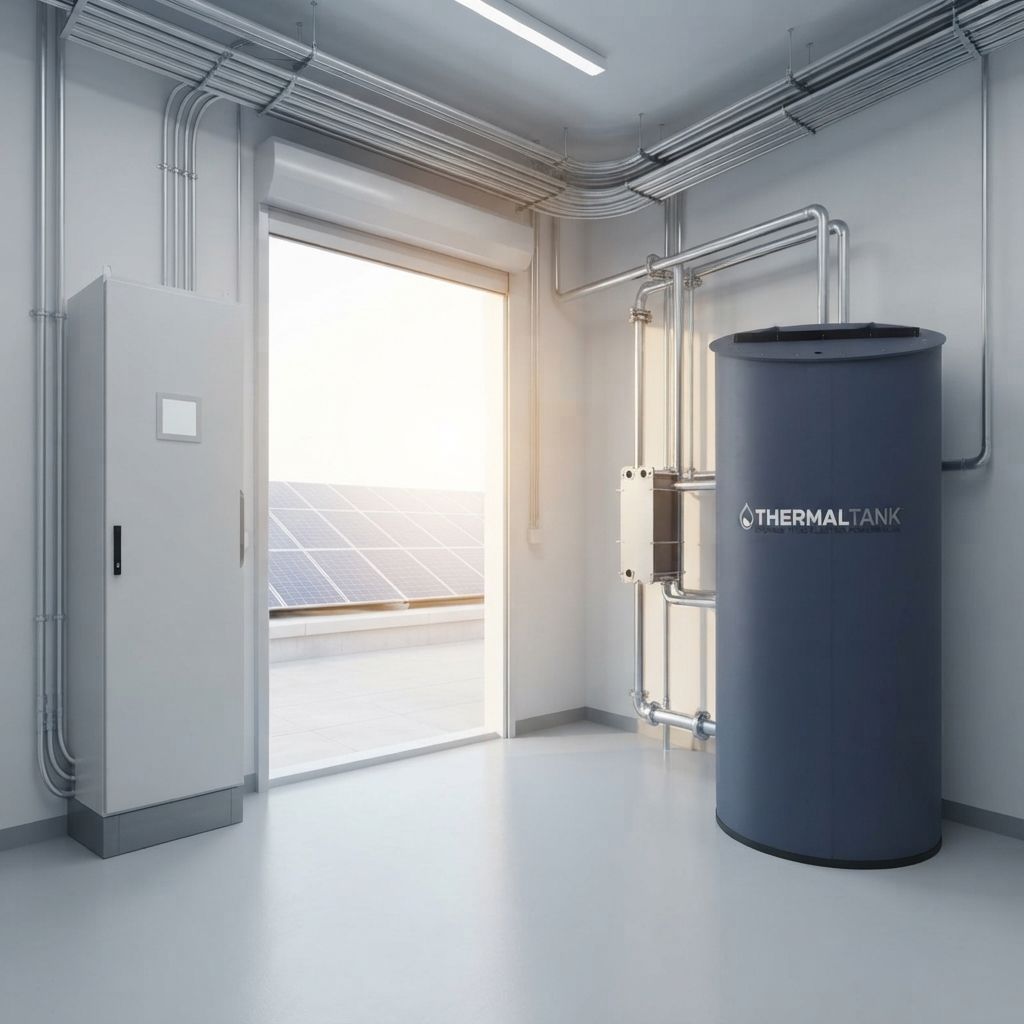
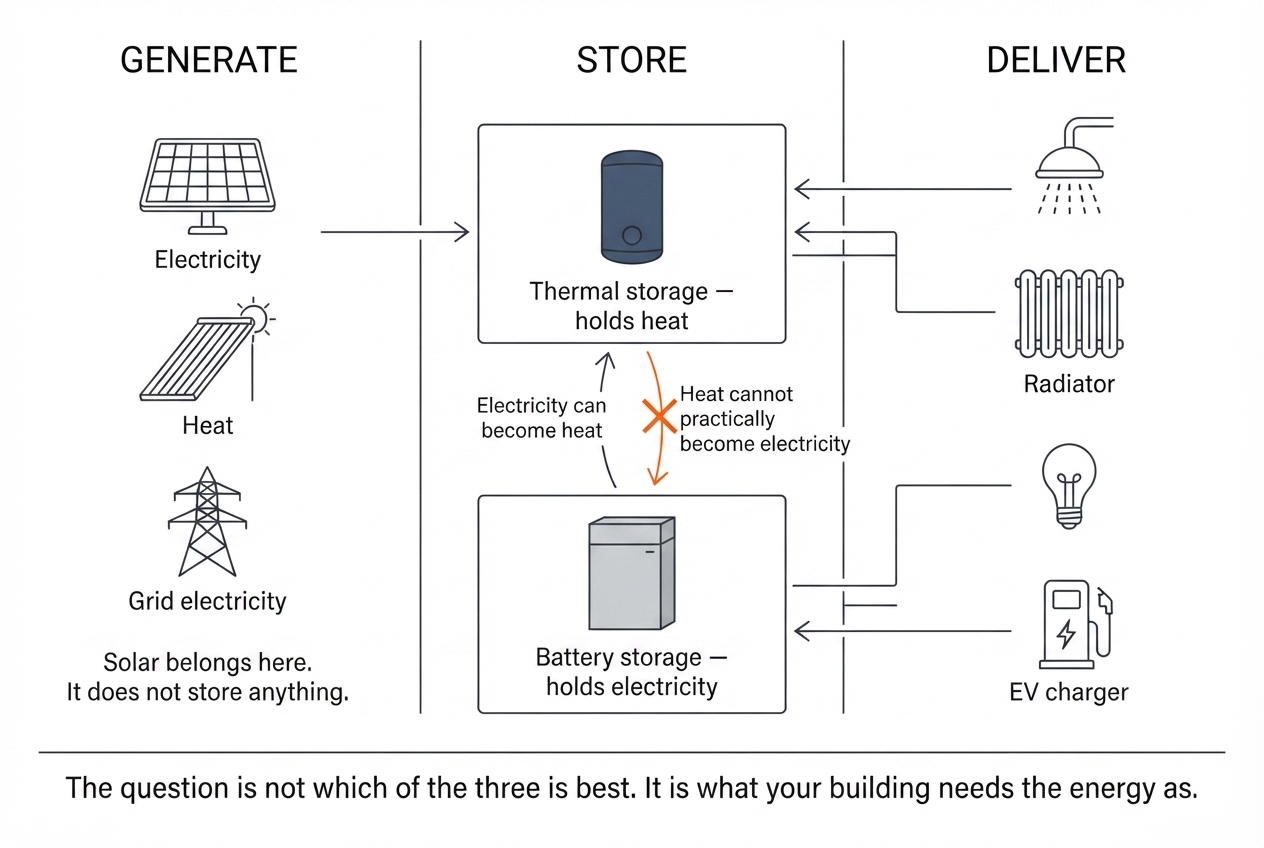
These three get compared constantly, usually in the same sentence, and the comparison is built on a mistake worth clearing up before anything else. Solar is not a storage technology. It is a generation source — it makes energy when the sun is up and makes none when it isn't, which is precisely why storage is in the conversation at all. Thermal storage and lithium-ion batteries are the storage technologies, and they store fundamentally different things: one holds heat, the other holds electricity.
Once the premise is straight, the question gets much easier to answer. It is not “which of these three is best.” It is: solar or grid generates the energy, and then what does your building actually do with it? If the answer is heat — hot water, space heating, process heat — storing it as heat is several times cheaper per kilowatt-hour and lasts roughly twice as long. If the answer is electricity — lights, plugs, elevators, EV charging, backup power — only a battery will do, and no amount of thermal storage substitutes for it.
In short: Solar photovoltaic panels generate electricity; solar thermal collectors generate heat; neither stores anything. Lithium-ion batteries store electricity at commercial installed costs commonly ranging from roughly $180 to $580 per kWh depending on scale, with round-trip efficiency near 90%, service life around 10 to 15 years, gradual capacity fade, and installation governed by NFPA 855 and UL 9540A. Thermal storage holds heat at roughly $54 to $97 per kWh for a modular water tank, with no degradation, a 25 to 30 year service life, and no fire code regime — but it only ever gives back heat. Most commercial buildings that install both discover the loads split cleanly: thermal storage carries the water heating and space conditioning, the battery carries the electrical peak and the backup requirement.
Key Takeaways
Energy systems in a building have three separable functions: generate, store, deliver. Solar sits in the first. A photovoltaic array generates electricity; a solar thermal collector generates heat; a photovoltaic-thermal panel generates both — the subject of our comparison of PVT, solar PV, and solar thermal. None of them holds anything past sunset.
Storage sits in the second function, and this is where the real choice is. The energy arriving from a solar array or from the grid can be stored in two broad ways in a commercial building: electrochemically, in a battery, or thermally, as heat or cold in a physical medium. Sandia’s thermal storage chapter of the DOE Energy Storage Handbook classifies thermal storage alongside the electrochemical technologies as one branch of the same field, distinguished by what the energy is stored as rather than by what it is stored for.
The practical consequence is a conversion question. Electricity can become heat easily — directly, at one-for-one, or through a heat pump at three or four to one. Heat cannot become electricity at building scale in any economic way. So the two storage technologies are not interchangeable in both directions: a battery can serve a thermal load by running a heat pump, but a thermal store can never serve an electrical load. That asymmetry looks like an argument for batteries until you compare what each one costs to store the same kilowatt-hour.
In this article
The like-for-like comparison
The table compares thermal storage and lithium-ion battery storage on the factors that matter most to commercial building owners. Battery cost ranges are 2026 published figures and vary widely by scale, chemistry, duration, and market; NREL's cost projections for utility-scale battery storage put a 4-hour utility-scale system near $334/kWh in the 2025 benchmark while the most competitive project-level figures reported elsewhere run far lower. Verify current pricing at the time of any decision. Thermal figures are TEHQ list pricing for the modular thermal storage tank line, vessel only. See the full thermal tank comparison and specifications.
Thermal storage vs. lithium-ion battery storage
FactorThermal storage (water)Lithium-ion battery storage
What it storesHeat (or cold)Electricity
What it can serveHot water, space heating, process heat, coolingAny electrical load, including backup and resilience
Installed cost per kWh$54–$97/kWh (modular tank, vessel only)$180–$300/kWh for larger containerized systems; $280–$580/kWh for smaller commercial systems (2026 published ranges)
Service life25–30 yearsCommonly planned around 10–15 years
DegradationNone — water's properties don't changeGradual capacity fade with cycles and calendar age
Efficiency metricStanding loss: 2.4–8°F per 24 hours by module sizeRound-trip efficiency typically around 90%
Fire and safety codesNo thermal runaway regimeNFPA 855 installation standard; UL 9540A thermal runaway testing; hazard mitigation analysis, gas detection, suppression, and separation
Siting in occupied buildingsMechanical room; panelized units pass a standard doorStored-energy caps for occupied buildings; separation and fire-rated construction
ExpansionAdd modulesAdd racks or cabinets; mixing new and aged cells is constrained
End of lifeVessel and insulation; no cell chemistryCell recycling and disposal chain
Cost per kWh: the gap and the catch
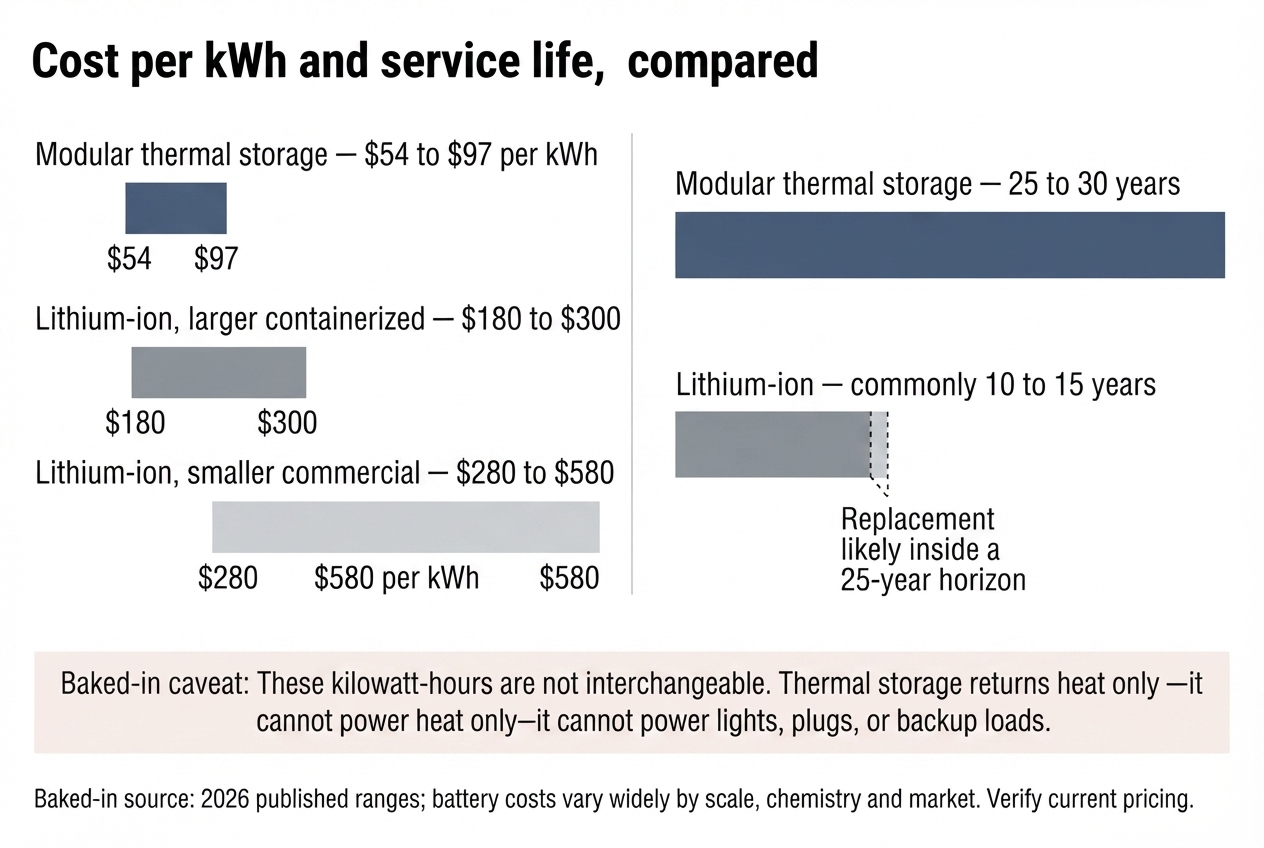
Current published list pricing for modular thermal storage is shown below. Pricing is current as of August 2026. The figures are vessel only — a complete system adds the heat source, exchangers, piping, controls, and labor, just as a battery quote adds the power conversion system, interconnection, and fire protection. See the thermal tank comparison and specifications.
So a kilowatt-hour of thermal storage capacity costs roughly a third to a fifth of a kilowatt-hour of battery capacity, and lasts about twice as long. Over a 25-year horizon the gap widens further, because the battery is likely to be replaced once inside that window while the tank is not.
Now the catch, stated plainly because the argument is worthless without it: those kilowatt-hours are not the same kilowatt-hours. The battery's are universal. The tank's are only useful if you have a heat load to spend them on. A building with no significant hot water or heating demand gets nothing from thermal storage at any price, and a building that needs to keep the lights on through an outage gets nothing from it either. The comparison is only meaningful load by load.
Modular thermal storage list pricing
ModelList price$/kWh storedStorage capacity*Standing loss
80 gallon$1,190$9712.0 kWh7–8°F / 24 hr
350 gallon$3,427$6354.6 kWh3.8°F / 24 hr
500 gallon$4,464$5877.0 kWh3.0°F / 24 hr
700 gallon$5,798$54108.0 kWh2.4°F / 24 hr
Efficiency: two different metrics wearing the same word
Batteries report round-trip efficiency — the fraction of energy put in that comes back out, typically around 90% for lithium-ion systems. It is a clean, standardized, honest number, and on it batteries look excellent.
Thermal stores do not have a directly comparable figure, and pretending otherwise is where a lot of vendor comparison content goes wrong. A water tank does not lose energy on conversion in and conversion out; it loses heat over time, through the insulation, as standing loss. A modular tank losing 2.4°F per 24 hours retains the overwhelming majority of its stored energy across the overnight cycle most buildings actually run — but the loss compounds over multi-day storage, where a battery's calendar losses are far smaller.
Two honest conclusions follow. On the standard round-trip metric, batteries win, and thermal advocates who dodge that are being slippery. On the daily-cycle duty that most commercial storage actually performs — charge during cheap or solar hours, discharge the same evening or next morning — the practical difference between the two is much smaller than the metrics suggest, and the cost and lifespan gap dominates the economics.
Codes, siting, and what each one asks of the building
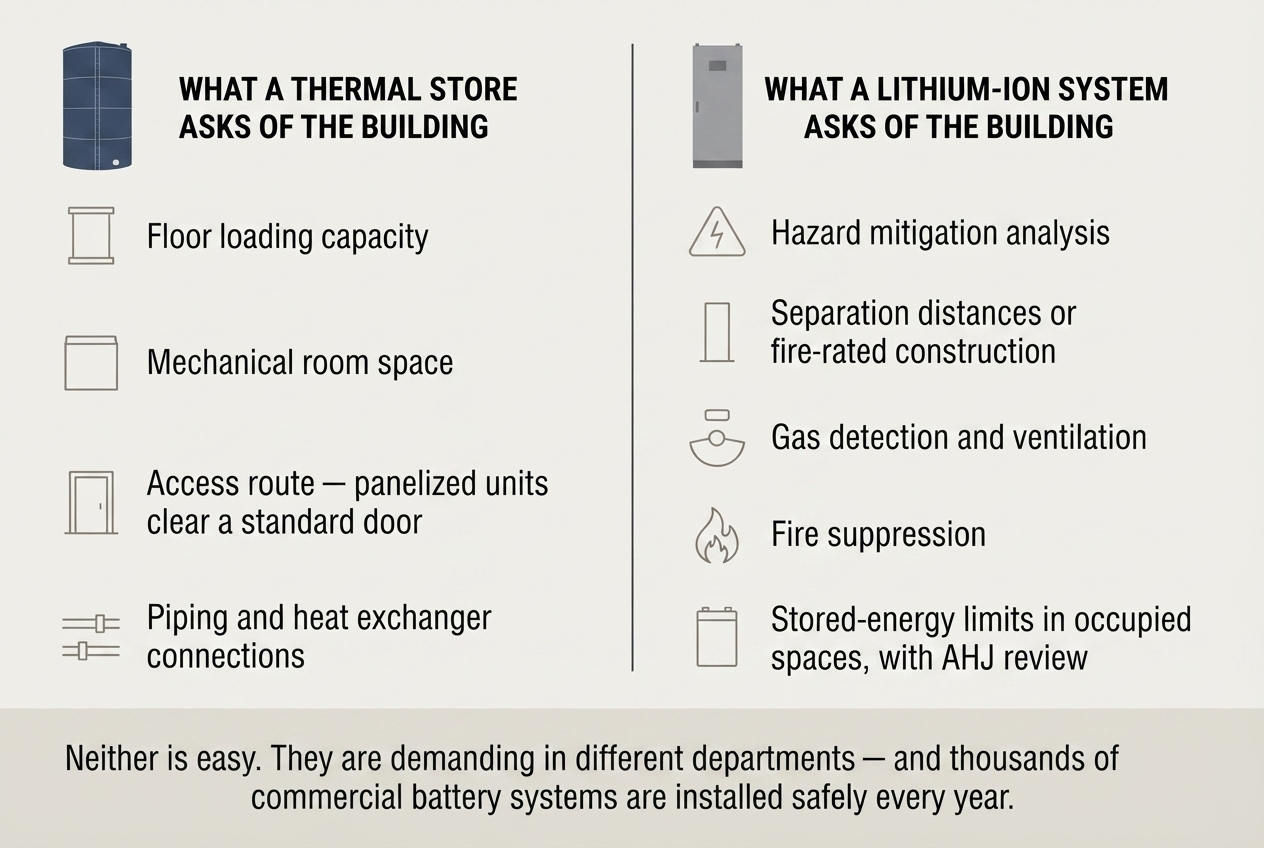
This is a real operational difference and it deserves careful, non-alarmist description. Lithium-ion cells can undergo thermal runaway, and the industry has built a thorough standards regime around that fact — which is a sign of engineering maturity, not of an unmanageable technology. UL’s guidance on NFPA 855 and UL 9540A describes NFPA 855 as the standard for the installation of stationary energy storage systems and UL 9540A as the test method for evaluating thermal runaway fire propagation, with the 2026 edition of NFPA 855 adding expectations around large-scale fire testing and fire spread between systems. UL 9540A testing evaluates propagation at module and installation level, and its results support decisions on separation distances and fire protection. Per UL’s installation-code FAQs, UL 9540A is the fire and explosion test method referenced in the 2026 edition of NFPA 855.
For a building owner, that translates into real project scope: a hazard mitigation analysis, separation distances or fire-rated construction, gas detection, suppression, ventilation sized for worst-case gas release, stored-energy limits in occupied buildings, and an authority-having-jurisdiction review that is a genuine project milestone. None of it is prohibitive — thousands of commercial systems are installed every year — but it is cost, schedule, and floor area that a thermal storage project does not carry.
A water tank asks different things of the building: floor loading, a mechanical room, and access. That last one is often the binding constraint in retrofits, which is the problem modular panelized construction exists to solve — tanks that pass through a standard doorway and assemble in place without a crane. Neither technology is “easy”; they are hard in different departments. Learn more about modular thermal energy storage.
How to decide
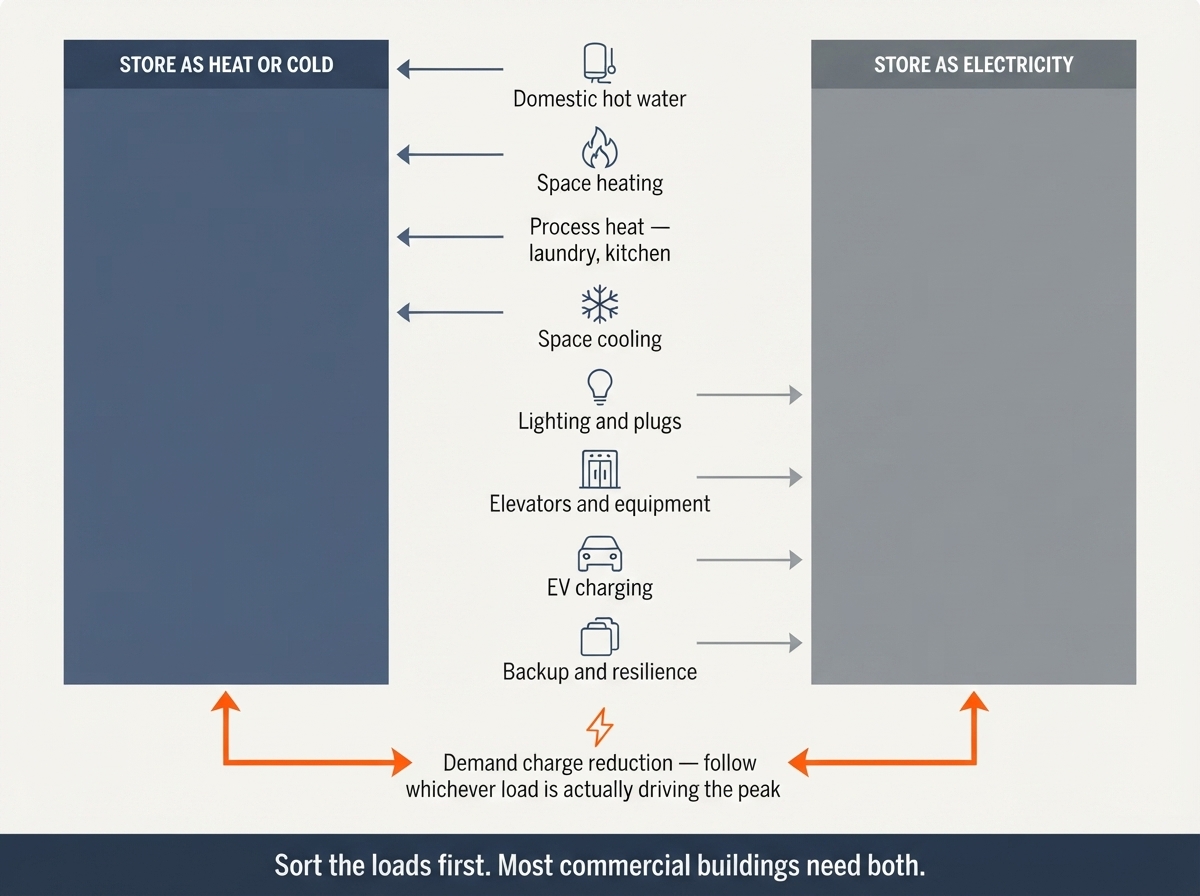
Work it load by load rather than technology by technology.
Match the storage technology to the building load
If the load is…Store it as…Why
Domestic hot waterHeatLarge, predictable, daily-cycling thermal load — the strongest case for thermal storage in commercial buildings
Space heatingHeatThermal load with a natural charge window; pairs with heat pumps and time-of-use rates
Process heat (laundry, kitchen, industrial)HeatOften schedulable, which matches storage to supply almost perfectly
Space coolingColdIce or chilled water storage shifts chiller load off peak
Lighting, plugs, equipmentElectricityOnly a battery serves these
EV chargingElectricityBattery, or grid capacity — thermal storage is irrelevant here
Backup and resilienceElectricityIf the requirement is keeping electrical loads alive through an outage, a battery is the only option
Demand-charge managementDependsWhichever load is actually driving the peak. If it is a large electric water heater or chiller, thermal storage addresses it at a fraction of battery cost
The peak driver determines the answer
Demand charges are driven by whatever the building's biggest coincident electrical draw is. If that draw is a chiller or a bank of electric water heaters, moving it in time with thermal storage costs a fraction of installing a battery big enough to hide it. If the peak is diffuse plug and equipment load, thermal storage cannot touch it and a battery is the answer.
The common outcome in well-designed commercial projects is both technologies, sized to different jobs: thermal storage on hot water and conditioning, a battery on electrical peak and backup, and solar generating into both. See Thermal Energy HQ’s system solutions for thermal configurations, the All-In-One thermal energy system for a packaged approach, and the PowerPanel PVT and Thermal Tank configuration where the generation side serves both outputs.
DOE’s Better Buildings guidance on thermal energy storage frames the value the same way for either medium: peak reduction, load shifting, and cost-effective electrification, and DOE’s Technology Strategy Assessment treats thermal storage as one of the most under-deployed levers in building decarbonization precisely because it is so often left out of a conversation that jumps straight to batteries.
Incentives
A useful point of parity: both technologies appear in the same federal statutory definition. Energy storage technology under 26 U.S.C. §48E — summarized on the IRS Clean Electricity Investment Credit page — encompasses thermal energy storage as well as electrochemical storage. Whether any specific system qualifies depends on its configuration, what it serves, and when it is placed in service, and belongs with a tax professional before it enters a pro forma.
Utility demand-response and efficiency programs likewise pay for kilowatts avoided and kilowatt-hours shifted rather than for a technology, though program rules differ in how they measure a thermal system's contribution versus a battery's. For project modelling, NREL's System Advisor Model and DOE’s on-site commercial solar decision guide are the standard free tools.
About the author
Garth Schultz is President & Inventor of Thermal Energy HQ, where he leads development of modular thermal energy storage systems manufactured in the United States. He is the inventor named on patents covering hybrid photovoltaic-thermal (PVT) solar panels and insulated modular storage tank construction, and has worked in solar-thermal product development since founding the company's technology line in 2007. Connect on LinkedIn.
Frequently Asked Questions
Is solar energy a form of storage?
No. Solar is a generation source. Photovoltaic panels generate electricity and solar thermal collectors generate heat, but neither holds energy after the sun goes down. Storage is a separate function, and the choice is between storing that energy as heat in a thermal store or as electricity in a battery. This distinction is the reason solar is so often discussed alongside storage: the intermittency of generation is what creates the need for storage in the first place.
Is thermal storage cheaper than lithium-ion batteries?
Per kilowatt-hour of storage capacity, substantially. Modular thermal storage tanks list at roughly $54 to $97 per kWh, while published 2026 commercial lithium-ion installed costs commonly range from about $180 to $300 per kWh for larger containerized systems and $280 to $580 per kWh for smaller commercial configurations. Thermal storage also lasts longer, typically 25 to 30 years against 10 to 15 for a battery. The important caveat is that the kilowatt-hours are not interchangeable: thermal storage only returns heat, so it is only cheaper for loads that need heat.
Can thermal storage replace a battery?
No, and it should not be sold as though it can. A thermal store gives back heat, so it can serve hot water, space heating, process heat, or cooling. It cannot power lights, plugs, equipment, elevators, or EV charging, and it cannot provide electrical backup during an outage. If the requirement is electrical resilience, a battery is the only option. Thermal storage and batteries are complements: in many commercial buildings the sensible design uses thermal storage for the heating and cooling loads and a battery for the electrical peak and backup.
What is the round-trip efficiency of thermal storage compared with a battery?
The two are measured differently. Lithium-ion batteries report round-trip efficiency, typically around 90 percent, meaning the share of energy put in that comes back out. A thermal store does not lose energy on conversion; it loses heat over time through its insulation, measured as standing loss — for example 2.4 to 8°F per 24 hours depending on tank size. Over the daily charge-and-discharge cycle most commercial storage actually performs, the practical difference is small. Over multi-day storage, the battery retains its charge better.
What safety codes apply to lithium-ion battery storage in a building?
Stationary lithium-ion energy storage installation in the United States is governed by NFPA 855, the Standard for the Installation of Stationary Energy Storage Systems, supported by UL 9540A, the test method for evaluating thermal runaway fire propagation. Together these drive requirements for hazard mitigation analysis, separation distances or fire-rated construction, gas detection, fire suppression, ventilation, and limits on stored energy in occupied buildings, with authority-having-jurisdiction review. Water-based thermal storage has no equivalent thermal runaway regime, though it carries its own floor loading and access requirements.
Which storage should I choose for demand charge reduction?
It depends on what is driving the peak. If the building's coincident peak is dominated by a chiller or by electric water heating, thermal storage can shift that load in time at a fraction of the cost of a battery sized to hide the same peak. If the peak is diffuse plug, lighting, and equipment load spread across the building, thermal storage cannot address it and a battery is the right tool. Start by identifying the specific loads creating the peak rather than by choosing a technology.
Conclusion
The three-way comparison dissolves once you notice that one of the three is generation and the other two store different products. Solar makes the energy. Then the building decides what to keep it as. Heat is dramatically cheaper to store than electricity and the storage lasts about twice as long with no degradation and no fire-code regime — but it only comes back as heat. Electricity is expensive to store and the hardware wears out, but it comes back able to do anything, including keeping the building alive when the grid fails.
Most commercial buildings have both kinds of load, which is why the sharpest projects install both and size each to the work it is actually good at. The mistake worth avoiding is the default one: jumping to a battery for a load that is fundamentally thermal, and paying three to five times per kilowatt-hour for the privilege of converting heat into electrons and back again.
The fastest way to sort your loads is a short engineering conversation about your demand profile, your peak drivers, and your hot water and conditioning loads.