Sizing a thermal storage tank is a two-variable problem that most people treat as a one-variable problem. The volume you need depends on how much energy you have to store and on how far you are allowed to let the temperature swing. Change the temperature delta and the required gallons change proportionally. That is why “how many gallons do I need” has no answer until someone tells you the delta.
In short: stored energy in a water tank equals volume multiplied by the temperature delta multiplied by a constant. At a 35°C (63°F) delta, a 500-gallon module holds roughly 77 kWh. The calculator runs that math in both directions: give it a load and it returns the volume and module configuration you need, or give it a volume and it returns the capacity you have. What it cannot do is replace an engineered design, because real buildings have draw profiles, recovery capacity, standby losses, and code requirements that a four-field form does not see.
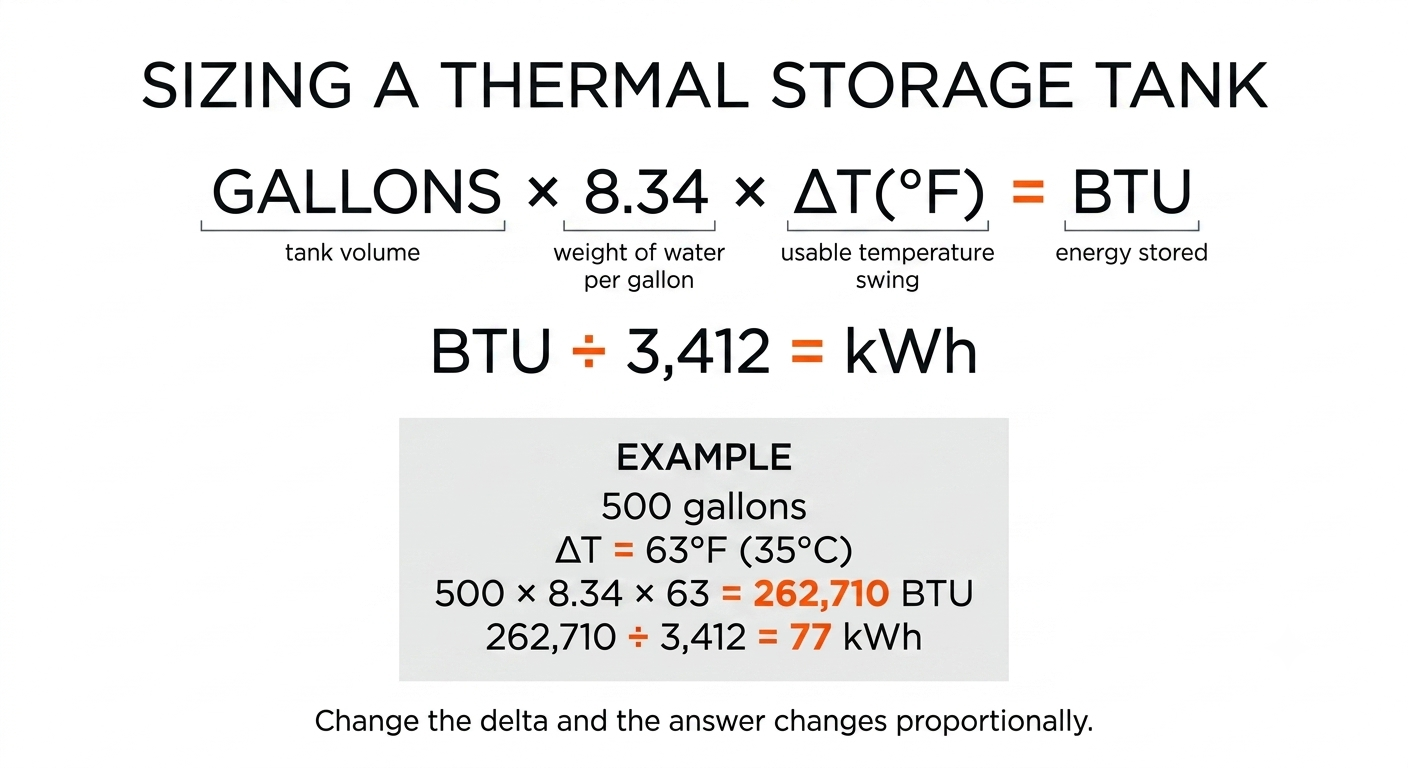
Water storage is sensible heat storage: you are raising the temperature of a mass of water and getting that energy back when you let the temperature fall. The governing relationship is the same one taught in every thermodynamics course.
Q = m × c × ∆T
Energy equals mass multiplied by specific heat capacity multiplied by temperature change. Water's specific heat is the reason this works so well: it takes an unusually large amount of energy to raise water's temperature, which is exactly what you want in a storage medium. Reference values for water's thermodynamic properties are published by NIST.
In the units a US mechanical contractor actually works in, that becomes:
BTU = gallons × 8.34 × ∆T(°F)
kWh = BTU ÷ 3,412
The 8.34 is the approximate weight in pounds of one gallon of water, and water's specific heat is very close to 1 BTU per pound per °F, which is why the constant reduces so cleanly. Worked in reverse, to find the volume you need:
Gallons = (kWh × 3,412) ÷ (8.34 × ∆T(°F))
A worked example. Suppose a building needs to cover 60 kWh of hot water energy during its morning peak, storing at 140°F with 60°F incoming cold water, giving a 80°F delta. Gallons equals 60 multiplied by 3,412, divided by 8.34 multiplied by 80, which is 204,720 divided by 667, or about 307 gallons of usable water. Note the word usable: that is not the tank you buy, for reasons covered in the next section.
If you take one thing from this page, take this: the temperature delta is the single most powerful lever in tank sizing, and it is the variable most often left unstated in a sizing request.
Because energy scales linearly with delta, a system storing at 140°F and delivering usefully down to 100°F has twice the usable capacity per gallon of an otherwise identical system that can only fall to 120°F before it stops being useful. Same tank, same water, twice the delivered energy. Conversely, a designer who quotes a required volume without stating the assumed delta has produced a number that cannot be checked.
This is also why comparing two tanks on gallons alone is meaningless, and why published Thermal Energy HQ capacities state the rating delta explicitly. A tank rated in kWh without a stated delta is not rated at all.
Do not chase delta indefinitely. Raising storage temperature to widen the delta increases standby loss, can push equipment beyond its efficient operating range, and for a heat pump specifically it reduces coefficient of performance. There is an optimum, and it is a design question rather than an arithmetic one. The calculator will let you enter an aggressive delta; that does not mean your equipment will deliver it.
Usable temperature delta and storage capacity examples
Usable ∆TEnergy per 100 galGallons needed for 50 kWhTypical situation
20°F (11°C)4.9 kWh~1,024 galNarrow window; high delivery temperature requirement or poor stratification
40°F (22°C)9.8 kWh~512 galCommon conservative design assumption
63°F (35°C)15.4 kWh~325 galThermal Energy HQ published rating basis
80°F (44°C)19.6 kWh~256 galStoring hot, delivering through a mixing valve
A 500-gallon tank does not deliver 500 gallons of useful hot water, and sizing as though it does is the most common way these calculations go wrong.
Three effects reduce the deliverable fraction. Stratification means the tank holds a hot layer above a cooler layer; good stratification is desirable because it preserves delivery temperature, but it also means the bottom of the tank is not at storage temperature. Minimum delivery temperature sets a floor: once the outlet falls below what the load requires, the remaining energy in the tank is real but unusable for that load. Mixing and turbulence during a heavy draw blend the layers and degrade the delivery temperature faster than the energy balance alone would suggest.
Practically, this means applying a usable-fraction derate to nameplate volume, and the calculator exposes that as an editable field rather than hiding it in the math. Conservative preliminary practice is to treat a meaningful portion of nameplate volume as unavailable and to let a design engineer refine the figure once the tank configuration, inlet and outlet arrangement, and draw profile are known. Configuration details for specific modules are in the technical documentation library.

Two systems can serve the same morning peak. One has a large tank and a small heat source that runs for hours. The other has a small tank and a large heat source that responds on demand. Both work. They cost very differently, both to buy and to operate.
Classical sizing practice, as laid out in ASHRAE service water heating material and summarized in engineering references such as hot water plumbing design courses, pairs a storage capacity with a recovery rate and lets the designer trade one against the other. The traditional bias ran toward recovery, because fuel-fired equipment was cheap to oversize and storage consumed floor space.
Electrification inverts that bias, and this is the part most legacy sizing guidance has not caught up with. A heat pump is expensive per unit of capacity, its efficiency is best at steady moderate output, and on a time-of-use tariff the hours when you would run a large unit hard are the most expensive hours of the day. Storage lets you buy a smaller heat pump, run it longer during cheap hours, and still meet the peak. DOE's Better Buildings thermal storage guidance identifies this pattern, and DOE's Grid-interactive Efficient Buildings work has funded research on the load shifting potential of heat pump water heating. The bill mechanics are covered in peak shaving versus load shifting.
So the sizing question is not purely thermal. It is: what is the cheapest combination of tank and heat source that meets the peak on your rate structure? For most electrified buildings the answer has moved toward more storage and less installed heating capacity than a 1990s rule of thumb would produce.
The calculator asks for the energy you need to cover during the peak. Getting that input right matters more than any refinement in the math downstream, because everything else is multiplication.
Daily total consumption is the wrong input. What sizes storage is the shape of the draw: how much hot water leaves the building during its heaviest hour or two, and how much recovery capacity you have running during that window. A residential building's profile is sharply peaked in the morning; a hotel's peaks later and harder; a building with commercial laundry has a load that looks nothing like either.
Two approaches, with different failure modes. Fixture-count methods assign fixture units and read a peak flow rate off a modified Hunter curve. They are the traditional approach, they are defensible to a plan reviewer, and they are known to run conservative: analyses comparing curve-derived sizing against measured data have found that previous practice routinely overestimated required capacity. Measured-data methods use monitored draw profiles, which is how research on multifamily DHW loads has approached the problem for decades. Where interval or submetered data exists, use it.
Reference tables of hot water demand per fixture by building type from the ASHRAE service water heating chapter are reproduced in code contexts such as UpCodes if you need a starting point. Treat any of these as a first pass. The calculator accepts a load in kWh, BTU, or gallons at a stated delta, so whichever method you use to estimate the peak, you can feed the result in.
Three constraints sit outside the arithmetic and can override its output.

The calculator returns a required volume, then maps it onto real modules, because a number without a configuration is not actionable.
Two things fall out of that table that affect sizing decisions directly. First, cost per stored kilowatt-hour drops about 44 percent from the smallest module to the largest, so consolidating capacity into fewer larger modules is cheaper per unit of storage where space and access allow. Second, standing loss improves with size for the same surface-to-volume reason, which matters if your strategy is an overnight charge held until morning. A tank that loses its charge before the peak has not stored anything.
Because modules interconnect, capacity can be phased. That changes the sizing question from “what will I need in ten years” to “what do I need now, and can I add later,” which is a materially easier capital conversation for a portfolio electrifying building by building. For a packaged storage-plus-heat-source configuration, see the All-In-One thermal energy system; for solar-charged configurations see hybrid PVT collectors; for cooling-side storage see SkyRadiance. Documented deployments with real load profiles are in the case studies.
Thermal Energy HQ module capacities and pricing
ModelList price$/kWh storedStorage capacity*Standing loss
80 gallon$1,190$9712.0 kWh7 to 8°F / 24 hr
350 gallon$3,427$6354.6 kWh3.8°F / 24 hr
500 gallon$4,464$5877.0 kWh3.0°F / 24 hr
700 gallon$5,798$54108.0 kWh2.4°F / 24 hr
Stated plainly, because a sizing tool that oversells itself is worse than no tool.
Start from the sensible heat relationship: energy equals mass times specific heat times temperature change. In US units, BTU equals gallons times 8.34 times the temperature rise in degrees F, and kWh equals BTU divided by 3,412. To find required volume, invert it: gallons equals kWh times 3,412, divided by 8.34 times the temperature delta in degrees F. Then divide by your usable fraction, because stratification and minimum delivery temperature mean nameplate volume is not all deliverable.
About 77 kWh at a 35 degree C temperature delta. The delta is not optional information: the same tank holds roughly half that at half the delta. Capacity in kWh always has to be quoted alongside the temperature delta it assumes, which is why published tank capacities state their rating basis.
It depends on your storage temperature and the minimum temperature your load can still use. Storing hot and delivering through a thermostatic mixing valve widens the usable delta, which reduces required volume, and also satisfies the minimum storage temperature needed to control Legionella risk. Pushing storage temperature higher indefinitely is counterproductive, because standby losses rise and heat pump efficiency falls.
They trade against each other and both can serve the same peak. Traditional practice favored recovery capacity because fuel-fired equipment was cheap to oversize. Electrification reverses that: a heat pump is expensive per unit of capacity and runs most efficiently at steady moderate output, and on a time-of-use rate the hours you would run a large unit hard are the most expensive hours. More storage and a smaller heat source is usually the cheaper answer for an electrified building.
Because of stratification, minimum delivery temperature, and mixing during heavy draws. The tank holds a hot layer above a cooler layer, and once the outlet temperature falls below what your load requires, the remaining energy is real but not usable for that load. Preliminary sizing should apply a usable-fraction derate to nameplate volume and let a design engineer refine it once the tank configuration and draw profile are known.
Peak demand, not daily total. What sizes storage is how much hot water leaves the building during its heaviest hour or two and how much recovery capacity is running during that window. Two buildings with identical daily consumption and different draw profiles need different tanks.
Water alone is roughly 8.34 pounds per gallon, so a 700-gallon module holds about 5,800 pounds of water before counting the vessel and insulation. That is a significant point load, so structural floor capacity, seismic restraint, and anchorage need review by a design professional in every jurisdiction.
With a modular system, yes. Because modules interconnect, capacity can be phased: sized for today's load and expanded as loads grow or as a portfolio electrifies building by building. That changes the sizing question from forecasting ten years ahead to sizing for current load with a documented expansion path.
No, and it should not be submitted as an engineered design. It is a preliminary sizing estimate that tells you whether you are looking at a 300-gallon problem or a 3,000-gallon problem, which is enough to establish feasibility and budget. It does not model your draw profile, recirculation losses, standby loss over your specific hold period, or heat source selection, all of which a design engineer addresses.
Tank sizing is arithmetic wrapped around two judgment calls. The arithmetic is straightforward and the calculator handles it. The judgment calls are what load you are actually trying to cover during the peak, and what temperature delta your system can genuinely deliver. Get those two inputs right and the volume falls out. Get them wrong and no amount of precision downstream saves the result.
The structural point worth carrying into a design conversation is that storage and recovery are solved together, and electrification has moved the optimum toward more storage and less installed heating capacity than legacy rules of thumb assume. A smaller heat pump running longer on cheap power, with storage carrying the peak, is usually cheaper to buy and cheaper to run than the alternative.
The fastest way to turn a preliminary number into a real specification is a short engineering conversation.
Tell our team about your building, operating goals, and energy needs.