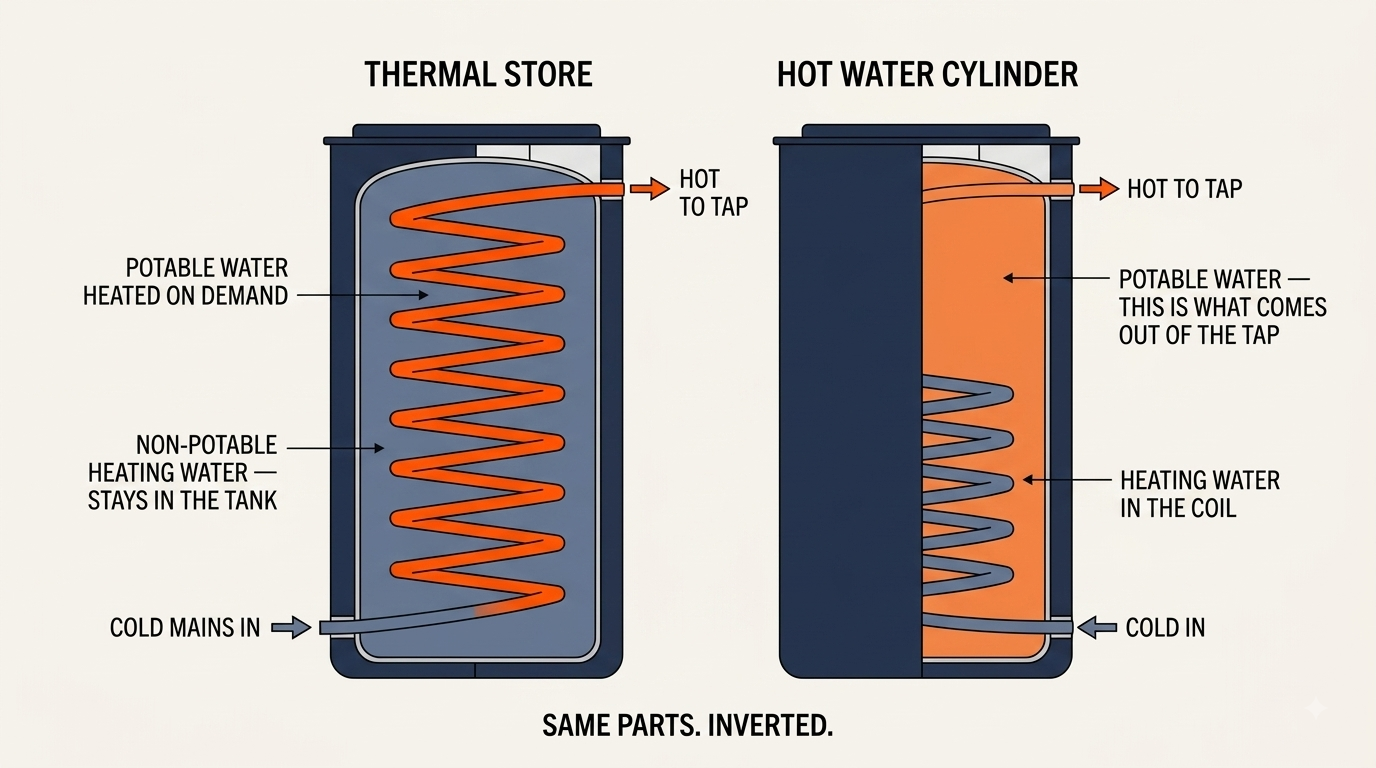
Two insulated tanks stand in a plant room. They are the same height, roughly the same diameter, and both are full of hot water. One of them will scald you if you drink from it, and the other will not, because you cannot drink from it at all. That is the whole difference, and every other difference between a thermal store and a hot water cylinder falls out of it.
In short: A hot water cylinder stores the potable water you actually use. It fills with mains or tank-fed cold water, heats it, holds it, and sends it to the tap. A thermal store stores heat in a body of non-potable water that never leaves the vessel. Cold mains water passes through a heat exchanger inside or alongside that body, picks up heat on the way through, and arrives at the tap hot—made on demand rather than stored. The cylinder stores hot water. The thermal store stores the capacity to make it.
Key Takeaways
Most confusion about this topic is vocabulary rather than engineering. The same hardware carries different names on either side of the Atlantic, and technical literature crosses over freely. The important question is simpler than the terminology: is the water inside the tank the same water that comes out of the tap?
In this article
Thermal store vs. hot water cylinder at a glance
Neither column is a winner. They are different answers to the same problem, and the right one depends on the heat sources available, the draw pattern, and how much peak flow the building actually needs at once.
Thermal store compared with a hot water cylinder
CategoryThermal storeHot water cylinder
What the tank holdsNon-potable heating water, permanently retainedPotable water, drawn off and replaced
How hot water reaches the tapMains water passes through a heat exchanger and is heated on demandStored hot water leaves the tank directly
Peak output limited byHeat exchanger transfer rateStored volume, then recovery rate
Typical operating temperatureHigher—must exceed delivery temperature by the exchanger approachLower—only needs to exceed delivery temperature
Potable water stagnationMinimal—potable volume is only what sits in the exchanger and pipeworkSubstantial—the whole stored volume is potable and sits still between draws
Multiple heat sourcesStraightforward, including uncontrollable sourcesPossible but constrained; usually one or two coils
Can also serve space heatingYes, from the same vesselNo—separate function
Standing lossHigher, because it runs hotterLower at the same insulation level
Installer familiarityLower—fewer trades specify them routinelyVery high—the default in most markets
What these are called in the U.S. and the U.K.
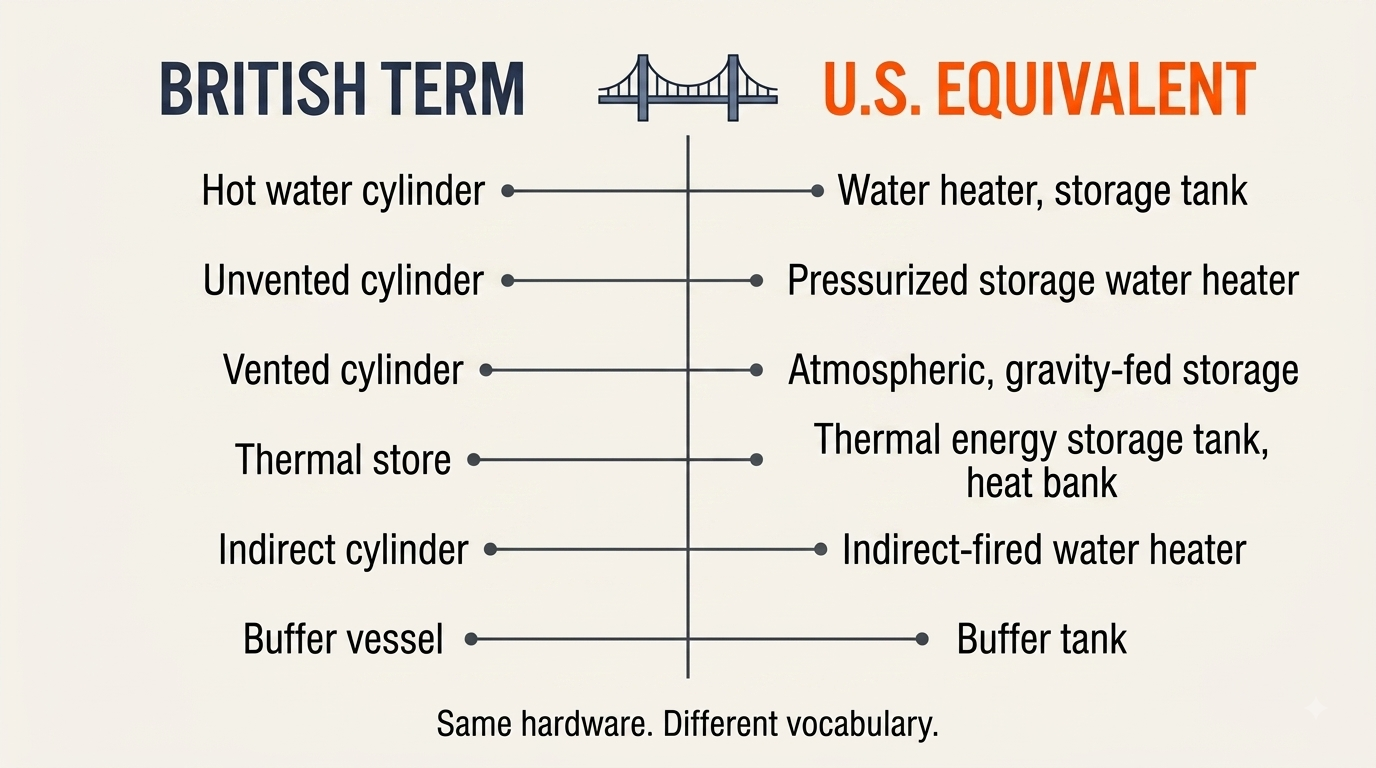
The same hardware carries different names in British and American specifications. This table maps the terms.
British and U.S. terminology
British termU.S. equivalentWhat it is
Hot water cylinderWater heater, storage tank, storage water heaterA vessel holding potable hot water for use
Vented cylinderAtmospheric or gravity-fed storageOpen to atmosphere via a vent pipe, fed from a cold water cistern above it
Unvented cylinderPressurized storage water heaterSealed and fed directly from the cold main, delivering mains-pressure hot water
Thermal store / heat storeThermal energy storage tank, heat bankStores heat in non-potable water; makes hot water through a heat exchanger
Buffer vesselBuffer tankAdds loop volume so a heat pump or chiller does not short-cycle
Indirect cylinderIndirect-fired water heaterPotable storage heated by a coil carrying water from a separate boiler or heat source
Immersion heaterElectric resistance elementAn electric element inside the vessel
Combi boilerCombination boiler / tankless coil boilerHeats water instantaneously with no storage at all
The coil inversion that causes confusion
An indirect cylinder and a thermal store both use a coil, and they are often confused for that reason—but the coil does the opposite job in each. In an indirect cylinder the coil carries the heating water and the tank holds the potable water. In a thermal store the coil carries the potable water and the tank holds the heating water. Same components, inverted.
If you remember nothing else from this article, remember that inversion; it is the single most useful sentence for reading a cutaway drawing correctly.
How a thermal store makes hot water
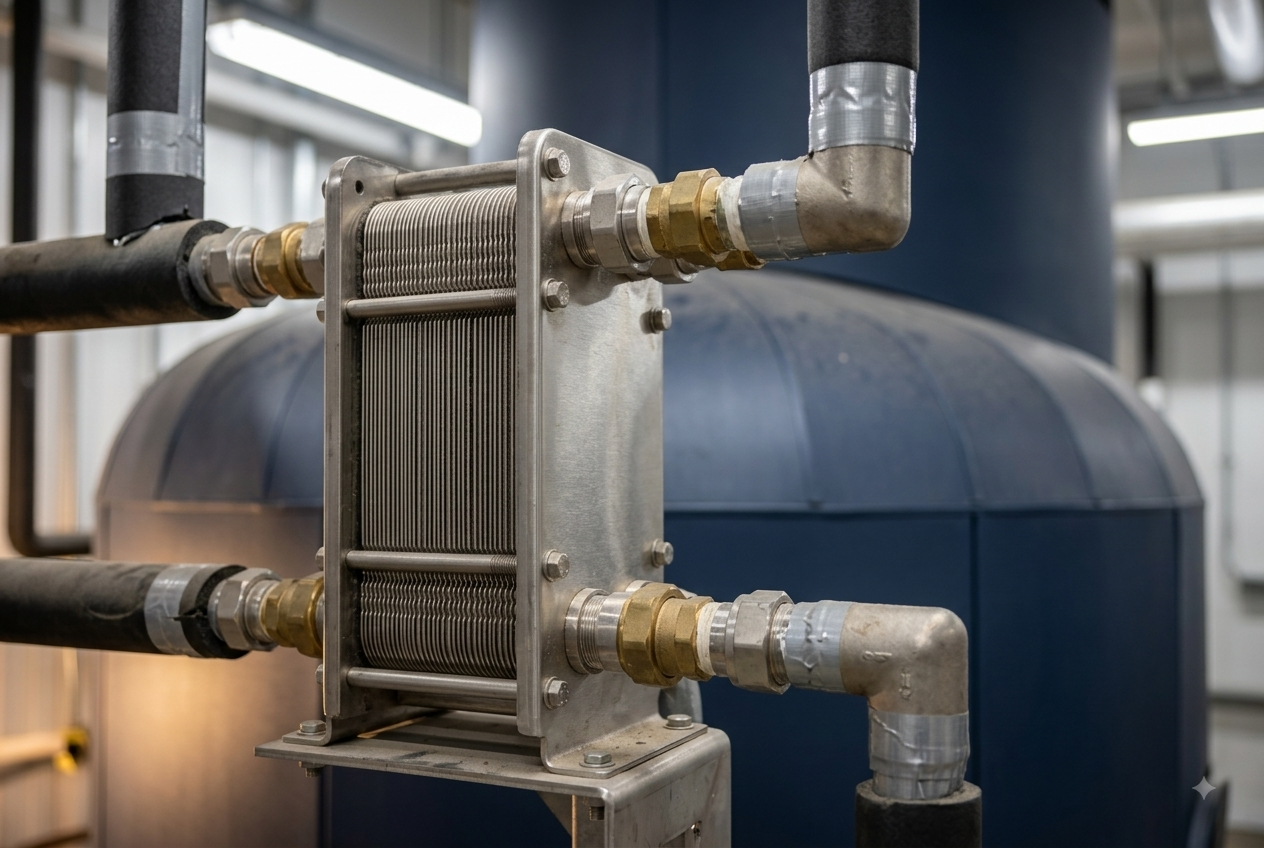
The store holds a large body of water that belongs to the heating system, not to the water supply. Heat goes in from whatever source is available. When someone opens a tap, cold water from the main enters a heat exchanger—either a coil of pipe immersed in the store or an external flat-plate exchanger—and picks up heat during the seconds it spends inside. It leaves hot, passes through a thermostatic blending valve to a safe delivery temperature, and goes to the tap. Nothing that was in the tank goes with it.
Thermal stores can accept mixed heat sources, including configurations using photovoltaic-thermal arrays alongside a heat pump.
The honest limitation: flow rate, not volume
A thermal store’s instantaneous hot water output is set by how much heat the exchanger can transfer per minute, not by how many gallons the tank holds. A large cylinder can dump its entire contents into a bath at whatever rate the pipe allows and then go cold until it recovers. A thermal store delivers a steadier, capped flow that continues for as long as the store stays hot.
For most buildings the second behavior is preferable. For a building with a genuine simultaneous-peak problem—several large baths filling at once—the cap is a real constraint, and the exchanger has to be sized for it deliberately. Ask any vendor for a rated continuous output in gallons per minute at a stated store temperature. A vendor who answers with tank volume has not answered the question.
How a hot water cylinder works, vented and unvented
A cylinder stores the water you use. The engineering question is where its pressure comes from, and there are two answers.
A vented cylinder is open to atmosphere through a vent pipe and fed by gravity from a cold water cistern mounted above it. Pressure at the tap is whatever the height difference provides, which is usually modest. It is a simple, forgiving, low-pressure arrangement.
An unvented cylinder is sealed and fed directly from the cold main, so hot water arrives at the tap at mains pressure. It needs an expansion vessel to absorb the volume increase as water heats, plus pressure and temperature relief valves and a discharge route for them. That safety package is not optional, because a sealed vessel full of water above boiling point is a stored-energy hazard rather than a plumbing inconvenience.
Regulatory differences
In the U.K., Approved Document G covers sanitation, hot water safety, and water efficiency, and its G3 section governs hot water supply and systems. Installing, commissioning, or servicing an unvented storage vessel above 15 liters (about 4 gallons) requires a specific competency qualification, and the work is notifiable to building control unless self-certified through a competent person scheme.
A thermal store, being vented and not a pressurized potable vessel, generally sits outside that requirement. This is a practical advantage in the U.K. market and one reason the architecture is popular there.
The U.S. draws its lines differently but in the same spirit. Pressure vessel construction requirements apply at 120 gallons of nominal capacity, 200,000 Btu/h of input, or 210°F, and federal efficiency standards for storage equipment and unfired storage tanks are set out in 10 CFR Part 431, Subpart G. The thresholds differ; the underlying logic is similar in both jurisdictions.
Hygiene and Legionella: the strongest argument for a thermal store
Legionella bacteria multiply in warm, still water. The growth range runs roughly from 68°F to 113°F (20°C to 45°C). CDC guidance on controlling Legionella in potable water systems recommends storing hot water above 140°F (60°C), keeping circulated hot water from falling below 120°F (49°C), and recirculating continuously where possible.
In the U.K. the equivalent duty sits under the Health and Safety Executive’s Approved Code of Practice L8, which has a special legal status: a duty holder who did not follow it must demonstrate they complied some other way.
A hot water cylinder holds a large volume of potable water that sits still between draws, and its bottom sits cooler than its top. That is the condition the guidance is written about, and it is why cylinder systems get periodic pasteurization cycles.
A thermal store changes the risk profile because there is very little stored potable water to manage. The potable volume is whatever sits in the exchanger and the pipe run, and it is replaced every time a tap opens. Heat pump installations frequently choose a store for this reason alone, since it removes the pasteurization cycle that a heat pump is poorly suited to running.
A store is not a hygiene free pass. A vented store is open to atmosphere, which means debris and sludge accumulate in the heating water over time and the vessel needs servicing. Long dead legs and infrequently used outlets downstream still stagnate regardless of what feeds them. If the store is allowed to drift down into the growth range, the exchanger will happily deliver water at exactly the wrong temperature. Storage architecture reduces one specific risk; it does not replace a water management program.
Efficiency: where the cylinder wins
Heat only moves down a temperature gradient. A heat exchanger therefore cannot deliver water as hot as the store surrounding it—there is always an approach temperature, commonly on the order of 9°F to 18°F (5°C to 10°C) for a well-sized plate exchanger, and more for a modest immersed coil at high flow. To put 131°F (55°C) water at a tap, the store has to sit meaningfully above that.
A cylinder has no such penalty. The water it stores is the water it delivers, so it only needs to be as hot as the delivery temperature requires.
Standing loss scales with the temperature difference between the tank and the room around it. A store held 18°F (10°C) hotter than an equivalent cylinder loses proportionally more every hour of every day.
A heat pump’s coefficient of performance falls as the temperature it has to deliver rises. Charging a store to a higher setpoint than a cylinder would need is therefore a direct efficiency penalty on the heat source, and the single strongest argument for a cylinder in a heat-pump-only house.
The comparison is only fair when the heat sources are identical. Once solar thermal, photovoltaic-thermal, or off-peak electricity is in the picture, the store is charged with energy that is cheap or free at the moment of charging. The Department of Energy’s Better Buildings guidance on thermal energy storage in commercial buildings frames the value of storage in these terms: shifting when energy is bought, not squeezing the last percent out of how it is moved.
So which one should a project use?
The following decision framework shows which conditions should push a project toward each architecture.
Thermal store and cylinder decision framework
If this is trueLean towardWhy
Several heat sources, or a source that cannot be modulated on demandThermal storeOne vessel absorbs everything without a control conflict
Solar thermal or photovoltaic-thermal is present or plannedThermal storeIntermittent, uncontrolled input is what the architecture is for
A heat pump is the only heat source and the tariff is flatCylinderLower storage temperature preserves the heat pump’s efficiency
Large simultaneous peak draws—several baths at onceCylinderStored volume can be released faster than an exchanger transfers
The vessel must also serve a space heating circuitThermal storeThe heating water is already there
Legionella management is onerous, or pasteurization cycles are impracticalThermal storeVery little potable water is stored anywhere
Storage volume needs to grow well beyond potable pressure vessel thresholdsThermal storeVolume is decoupled from potable pressure vessel requirements
Installer familiarity and fast, low-risk replacement matter mostCylinderIt is the default product in nearly every market
Hybrid systems
A hybrid is legitimate and common: a thermal store charged by messy, intermittent sources, feeding a modest cylinder that handles the peak. Anyone who tells you the choice is doctrinal is selling one of the two.
What changes at commercial scale
Move to a hotel, an apartment building, a gym, or a manufacturing facility and the balance shifts.
Volume decouples from pressure vessel requirements. Storing thousands of gallons of potable water at pressure means a code-stamped vessel, a structural review, and a price that scales accordingly. Storing the same energy as heat in a vented body of water, with potable water passing through an exchanger, sidesteps that cost curve. This is why large district and campus systems are almost universally heat stores rather than giant cylinders.
The peak flow objection weakens because commercial exchangers are sized for commercial flow. The residential concern about filling two baths at once has no real analogue when the exchanger is specified for the building’s actual simultaneous demand.
The multi-source argument gets stronger. A commercial plant is more likely to have a heat pump, a solar array, an off-peak tariff, and a legacy boiler at once—the exact conditions a store handles gracefully and a cylinder does not.
Thermal Energy HQ’s modular tanks are thermal stores in the sense used throughout this article: the tank body holds heat, and potable water is served through a heat exchanger. They range from 80 gallons (303 liters) to 700 gallons (2,650 liters) per module and interconnect to reach larger capacities, listing from $1,190 to $5,798 per module, or roughly $54 to $97 per kWh of stored thermal energy.
Published standing loss runs from 7–8°F (about 4°C) per 24 hours on the smallest module to 2.4°F (1.3°C) per 24 hours on the largest—the surface-to-volume economics that make large stores more forgiving than small ones. Full data is on the thermal tank comparison page, and the commercial hot water storage tank guide covers sizing method, ASME thresholds, and floor loading in detail.
For a packaged storage-plus-heat-pump arrangement, see the All-In-One thermal energy system.
Why the architecture scales
At commercial scale, the thermal store architecture can decouple storage volume from potable pressure vessel requirements. That makes it appropriate for buildings with serious storage volumes, multiple heat sources, and a defined simultaneous hot water demand.
Frequently Asked Questions
What is the difference between a thermal store and a hot water cylinder?
A hot water cylinder stores the potable water you use, heats it, and sends it straight to the tap. A thermal store holds non-potable heating water that never leaves the vessel; cold mains water passes through a heat exchanger inside or alongside that water and is heated on demand. The cylinder stores hot water. The thermal store stores heat and makes hot water when it is needed.
Is a thermal store better than a hot water cylinder?
Neither is universally better. A thermal store is better when there are multiple heat sources, when a heat source cannot be switched off on demand such as solar or solid fuel, when the same vessel must also serve space heating, or when storing large volumes of potable water would trigger pressure vessel requirements. A cylinder is better when a heat pump is the only heat source and efficiency is paramount, when large simultaneous peak draws must be met quickly, or when installer familiarity and a fast replacement matter most.
Can you drink the water in a thermal store?
No. The water in a thermal store belongs to the heating system, not to the water supply, and it is never delivered to a tap. Potable water only contacts the inside of the heat exchanger. In a hot water cylinder the opposite is true: the stored water is the potable water.
Does a thermal store reduce Legionella risk?
It changes the risk profile rather than removing the risk. Because almost no potable water is stored, there is very little of the standing warm potable volume that lets bacteria multiply, and pasteurization cycles are generally unnecessary. However, dead legs and infrequently used outlets downstream still stagnate, a vented store accumulates sludge and needs servicing, and a store allowed to cool into the growth range will deliver water at the wrong temperature. Storage architecture supports a water management program; it does not replace one.
Why does a thermal store need to be hotter than a cylinder?
Heat only moves down a temperature gradient, so a heat exchanger cannot deliver water as hot as the store surrounding it. The difference is the approach temperature, commonly around 9°F to 18°F (5°C to 10°C) for a well-sized plate exchanger. The store therefore has to sit above the delivery temperature by at least that margin, which raises standing loss and lowers the coefficient of performance of a heat pump charging it.
How much hot water can a thermal store deliver at once?
Its continuous output is set by the heat exchanger’s transfer rate, not by the volume of the tank, and it continues for as long as the store stays hot. A large thermal store does not release its whole contents at once the way a cylinder can. Ask for a rated continuous output in gallons or liters per minute at a stated store temperature and cold inlet temperature—a specification that answers with tank volume alone has not answered the question.
Do unvented cylinders and thermal stores have different regulatory requirements?
Yes, and the difference is one of the main reasons thermal stores are chosen. In the U.K., installing, commissioning, or servicing an unvented hot water storage vessel above 15 liters requires a specific competency qualification under Approved Document G, and the work is notifiable to building control unless self-certified. A vented thermal store is not a pressurized potable vessel and generally falls outside that requirement. In the U.S. the thresholds differ—pressure vessel construction requirements apply above 120 gallons, 200,000 Btu/h, or 210°F—but the same logic holds.
Is a thermal store the same as a buffer tank?
No, though they are often confused and some vessels do both jobs. A buffer tank exists to add volume to a heating loop so a heat pump or chiller does not short-cycle at low load; it usually has no domestic hot water function at all. A thermal store exists to hold usable heat and serve domestic hot water through an exchanger. A buffer tank sized for cycling protection is almost never large enough to serve a hot water peak.
What is a thermal store called in the United States?
There is no single equivalent term, which is why the concept travels badly. The closest U.S. specification language is “thermal energy storage tank” or “heat bank.” American documents use “water heater” or “storage tank” for what the U.K. calls a hot water cylinder, and “indirect-fired water heater” for an indirect cylinder. Note that an indirect-fired water heater is not a thermal store—in an indirect cylinder the coil carries the heating water and the tank holds potable water, which is the exact inverse of a thermal store.
Conclusion
Ask one question and the rest of the specification follows: is the water in the tank the water that comes out of the tap? If yes, it is a cylinder, it can run cooler, it will deliver its whole volume quickly, and it needs to be managed as a body of stored potable water. If no, it is a thermal store, it has to run hotter, its output is capped by an exchanger, and in exchange it will take heat from almost anything and store as much of it as there is room for.
For a house with a heat pump and a flat tariff, the cylinder is usually the more efficient answer, and the honest advice is to say so. For a house with mixed or intermittent heat sources, and for most commercial buildings storing serious volume, the thermal store is the architecture that scales. The decision is worth making explicitly at design stage, because it is expensive to reverse once the plant room is piped.