
Most guidance about commercial energy costs starts with a measure — install this control, buy that equipment, enrol in this program — and works backwards to justify it. That order is why so many energy projects underperform. The measure that pays in one building loses money in another two miles away, on a different rate schedule, with the same equipment and the same load.
Rate structure comes first. It decides which physical measures are worth anything at all.
Key Takeaways
In short: A commercial time-of-use tariff prices electricity differently by hour and season, and usually bills at least two separate things: energy consumed, in $/kWh, priced by period; and peak demand, in $/kW, based on your highest measured interval.
Six variables in your rate schedule determine strategy — the peak windows, the seasonal definitions, the size of the price spread, the demand charge components, whether demand is coincident or non-coincident, and whether a ratchet applies. A wide price spread rewards moving load through time. A large demand charge rewards lowering its peak. Those are different projects. Read the schedule before choosing.
In this article
What a commercial time-of-use bill is actually made of
Three components, billed on different logic. Confusing them is the single most common reason a project misses its modelled savings.
Some tariffs add a coincident demand component, where the charge is based on your demand during the system peak rather than your own. That is a materially different problem, because you cannot observe the system peak in advance and must predict it. The mechanics of demand billing — including ratchets, which can hold a single bad interval against you for up to a year — are covered in depth in our guide to reducing peak demand charges in a commercial building.
For orientation on scale, EIA publishes average commercial consumption and billing by state and tracks average revenue per kWh in its Electricity Monthly Update. Those are blended averages across all customers and rate classes. They are useful for benchmarking and useless as a substitute for your own schedule, which is the next section for a reason.
Commercial electricity bill components
ComponentUnitWhat it measuresWhat moves it
Fixed charges$/meter or $/monthAccount and metering costs.Almost nothing you do operationally.
Energy charge$/kWhTotal volume consumed, priced differently by period and season under a TOU schedule.Using less, or using it in cheaper hours. This is what load shifting attacks.
Demand charge$/kWYour highest measured demand interval — commonly 15 minutes — during the period.Lowering the height of the peak. This is what peak shaving attacks, and it is indifferent to total consumption.
Why the expensive hours moved to the evening
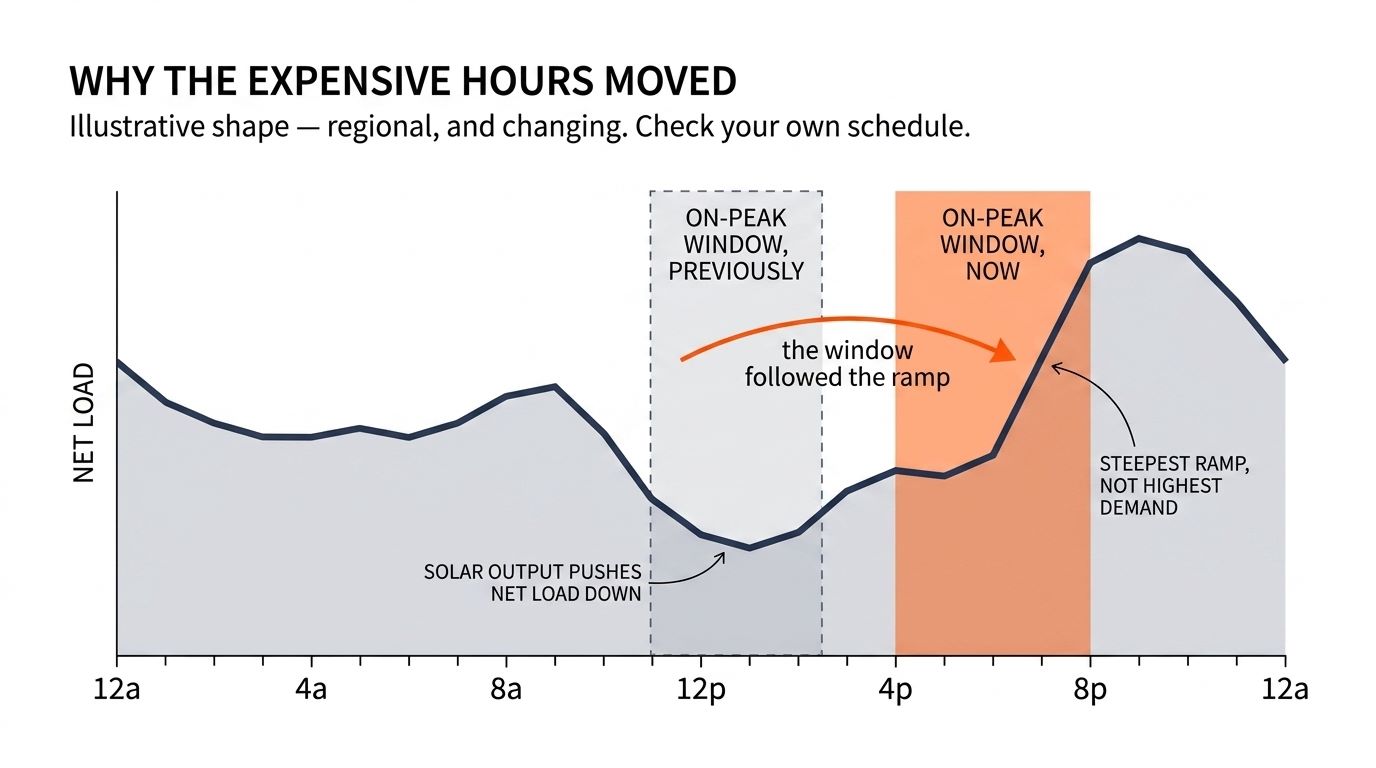
For most of the history of electricity pricing, the expensive hours were the hot afternoon hours when air conditioning peaked. In regions that have added large amounts of solar, that is no longer where the system is under strain.
EIA describes the pattern directly: as solar capacity grows, net load — total demand minus variable renewable generation — dips in the middle of the day when solar output is highest, then rises steeply in the evening as solar generation falls away while demand remains high. The resulting shape is widely called the duck curve, and the midday dip has deepened as more solar has come online. Grid operators face the steepest challenge not at the moment of maximum demand but at the moment of maximum ramp.
Rate structures followed. In high-solar regions, on-peak pricing windows have been moved later — into the late afternoon and evening — specifically to send a price signal into the hours where the ramp is steepest. Midday, once the most expensive time to consume, has in some schedules become one of the cheapest.
Three consequences for a commercial building. First, the intuition that “peak means hot afternoon” is now wrong in some territories and right in others; check, do not assume. Second, on-site solar becomes less valuable as an export and more valuable as something to consume or store on site, because the hours it produces in are no longer the expensive ones. Third — and this is the strategic point — tariff windows are policy artefacts, and policy changes. A building whose energy strategy is a schedule written into a controller in 2019 is running a strategy calibrated to a grid that no longer exists.
This is not confined to California. Texas is currently reconsidering how transmission costs are allocated in ERCOT: following the 2025 legislative session, the Public Utility Commission of Texas opened a proceeding on transmission cost allocation and in July 2026 approved publication of a proposed rule that would replace the long-standing four-coincident-peak method with a twelve-coincident-peak approach measured over longer intervals, with a decision expected in December 2026. That would convert a seasonal avoidance exercise into a year-round operating requirement. Regional detail is on our Texas thermal energy storage page. Verify current status before relying on it.
Six variables to extract from your rate schedule

Utilities publish these. Ask your commercial account representative for your current schedule by name, and find the following. This costs an afternoon and routinely changes the answer.
And one question most buildings never ask: are you on the right schedule? Utilities typically publish several rates applicable to a given service class, and customers are frequently on whichever one they were assigned years ago. A building whose load shape has changed — through a tenant change, an equipment replacement, an electrification project, or the addition of solar — may now be a better fit for a different published rate. Rate switching often carries eligibility rules and lock-in periods, so it is a decision to make deliberately, but it costs nothing to evaluate and it is free money when it works.
Variables that determine commercial TOU strategy
#VariableWhy it decides strategy
1Peak window definitionsThe hours and days on-peak pricing applies. Determines when you must avoid consuming and when you can charge storage.
2Seasonal definitionsMost schedules define summer and winter differently, sometimes with different windows and very different prices. A strategy tuned to summer may be worthless in winter.
3The size of the spreadThe actual differential between on-peak and off-peak $/kWh. A narrow spread makes load shifting marginal regardless of how well it is executed. Check the number, not the existence of TOU.
4Demand charge componentsWhether there is a $/kW charge, how large, and whether it applies in all periods or only on-peak. An on-peak-only demand charge can sometimes be avoided by moving load rather than reducing it.
5Coincident or non-coincidentNon-coincident bills your own peak, which you can observe and control. Coincident bills your demand during the system peak, which you must predict. Entirely different problems.
6Ratchet provisionsWhether a prior peak sets a floor under future billed demand. Where one applies, reliability of a shave matters more than its average size, and savings can lag up to a year.
Matching strategy to structure

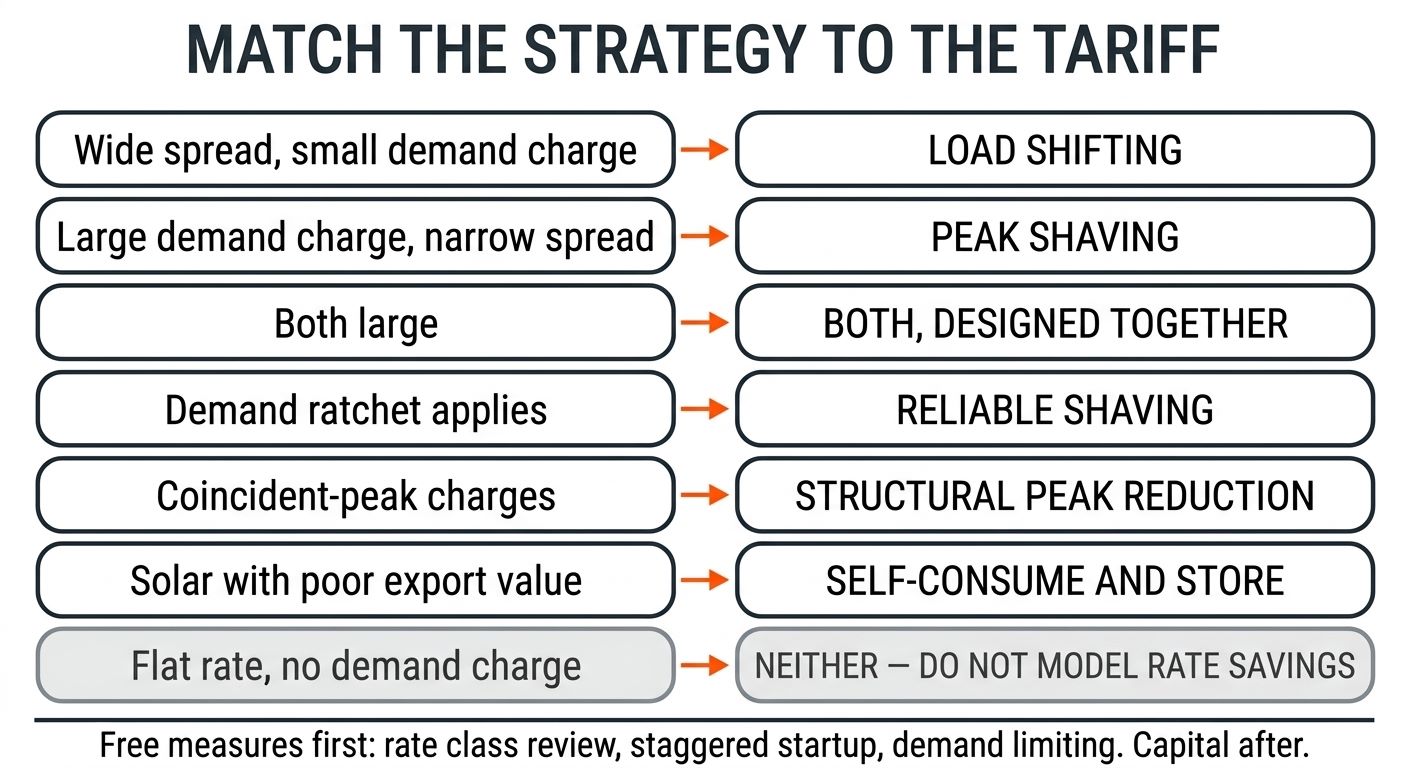
This is the practical output of everything above. Find the row that describes your schedule.
Before any of those rows, though: the cheapest measures are not on this table because they are not structural. Reviewing your rate class, staggering equipment startup so simultaneous starts do not stack into one interval, and configuring demand limiting in an existing building automation system are free or near-free and routinely deliver the first meaningful result. Capital comes after that work, not before it.
Commercial rate structure strategy routing table
If your tariff has…PrioritiseBecauseRead next
Wide price spread, small or no demand chargeLoad shiftingThe money is in the energy charge. Move consumption into cheap hours; the height of the peak barely matters.
Large demand charge, narrow spreadPeak shavingThe money is in the $/kW line. Lowering the peak is what pays; moving energy around achieves little.
Both a large demand charge and a wide spreadBoth, designed togetherCommon in commercial tariffs. Base the design on levelling the load, add a demand ceiling, and bias charging into cheap hours.
A demand ratchetReliable shaving above allOne missed interval sets a floor under up to twelve bills. Consistency is worth more than average performance.
Coincident-peak demand chargesStructural peak reduction over curtailmentYou cannot reliably predict the system peak. Assets that lower your peak permanently outperform strategies that require someone to guess correctly.
On-site solar with poor export valueSelf-consumption and midday chargingExported energy is worth little; the same energy stored and used in the evening window is worth the on-peak rate.PVT collectors and thermal storage tanks
A flat rate with no demand chargeNeither. Do not model rate savings.There is no time-based price signal to arbitrage and no peak to shave. Storage may still justify itself on plant downsizing, resilience, or an avoided service upgrade — but not on rate arbitrage that the tariff cannot produce.
What changes when you electrify
Every load moved from gas to electricity moves onto the tariff. A building that electrifies water heating without considering rate structure has taken a load that was billed at a flat commodity price and placed it onto a schedule that charges by hour and penalises peaks — and has often added it to the interval that sets the demand charge.
EIA's commercial buildings data shows natural gas in commercial buildings is used principally for space and water heating, which is precisely the load electrification projects target. That makes rate strategy and electrification design the same conversation rather than sequential ones. The practical implication: size the plant and the storage against the tariff you will be on afterwards, not the gas bill you have now. Our guide to domestic hot water electrification retrofits covers the physical constraints; the rate exposure is the other half of the same decision.
Buildings as flexible resources
The framing that ties this together is not a product category but a capability. DOE's grid-interactive efficient buildings work describes four modes a building can operate in — efficiency, load shed, load shift, and modulate — and the national roadmap led by Lawrence Berkeley National Laboratory treats demand flexibility as a portfolio rather than a single purchase. The technical overview is worth reading if you are building an internal case: efficiency reduces consumption without necessarily reducing peak, while shed and shift are the modes that actually respond to a rate structure.
Storage is the mechanism that gives a thermal load flexibility it does not naturally have, by separating when energy is bought from when it is used — DOE's Better Buildings brief on thermal energy storage identifies peak reduction and shifting to cheaper periods as the strongest case in buildings on time-varying rates. Whether that is worth doing in your building is a rate structure question first and an equipment question second, which is where this page started.
What this guide does not cover
We are a thermal storage manufacturer, not an energy broker, a rate consultant, or a tax advisor. This guide covers rate structure as an input to physical design decisions. It deliberately does not advise on:
A note on vendor advice
If a vendor of physical equipment offers you confident advice on all of the above, treat that as information about the vendor.
Frequently Asked Questions
What is a time-of-use electricity rate for a commercial building?
A time-of-use rate prices electricity differently depending on the hour and the season, so the same kilowatt-hour costs more during defined on-peak periods than off-peak. Commercial TOU tariffs usually also bill a separate demand charge based on the highest measured demand interval in the period, which is a different unit and a different strategy. The energy charge responds to moving load through time; the demand charge responds to lowering the peak.
Why did peak electricity hours move to the evening?
In regions with large amounts of solar generation, net load dips during the middle of the day when solar output is highest and then rises steeply in the evening as solar falls away while demand stays high. Because the system is most stressed during that evening ramp rather than at midday, on-peak pricing windows in those regions were moved later to send a price signal into those hours. The effect is regional, so the timing on your own schedule has to be checked rather than assumed.
Should I shift load or reduce my peak?
It depends on which bill line carries the money. A wide difference between on-peak and off-peak energy prices rewards moving consumption into cheaper hours. A large demand charge rewards lowering the highest interval, regardless of total consumption. Many commercial tariffs bill both meaningfully, in which case the design should serve both, and where a demand ratchet applies the reliability of the peak reduction matters more than its average size.
Can I change my commercial rate schedule?
Often yes. Utilities generally publish several rate schedules applicable to a given service class, and many customers remain on whichever one they were originally assigned even after their load shape has changed through a tenant change, an equipment replacement, or a solar installation. Schedules carry eligibility rules and sometimes lock-in periods, so switching is a deliberate decision, but comparing your consumption against the alternatives available to you costs nothing.
Do time-of-use rates make on-site solar less valuable?
They change where its value comes from. Where peak pricing windows moved into the evening, solar produces most of its energy in hours that are no longer the expensive ones, which reduces the value of exporting it. The same generation becomes more valuable when consumed on site or stored for use during the evening window, which is why storage and solar are increasingly evaluated together rather than separately.
How often do time-of-use windows change?
There is no fixed cycle. Windows and seasonal definitions are revised by utilities and regulators in response to changing grid conditions, and several regions have made significant changes in recent years. The practical implication is that a strategy hard-coded to one version of a schedule will drift out of alignment. Favour approaches that can be re-tuned through controls rather than ones that require replacing equipment when the tariff changes.
Conclusion
Rate structure is the first input, not the last check. It determines whether the money in your building sits on the energy line or the demand line, and therefore whether the right project is a scheduling change, a controls change, storage, a battery, or nothing at all. The buildings that get this right read the schedule first, pull the interval data second, and buy equipment third.
They also build in the assumption that the schedule will change again, because it will.