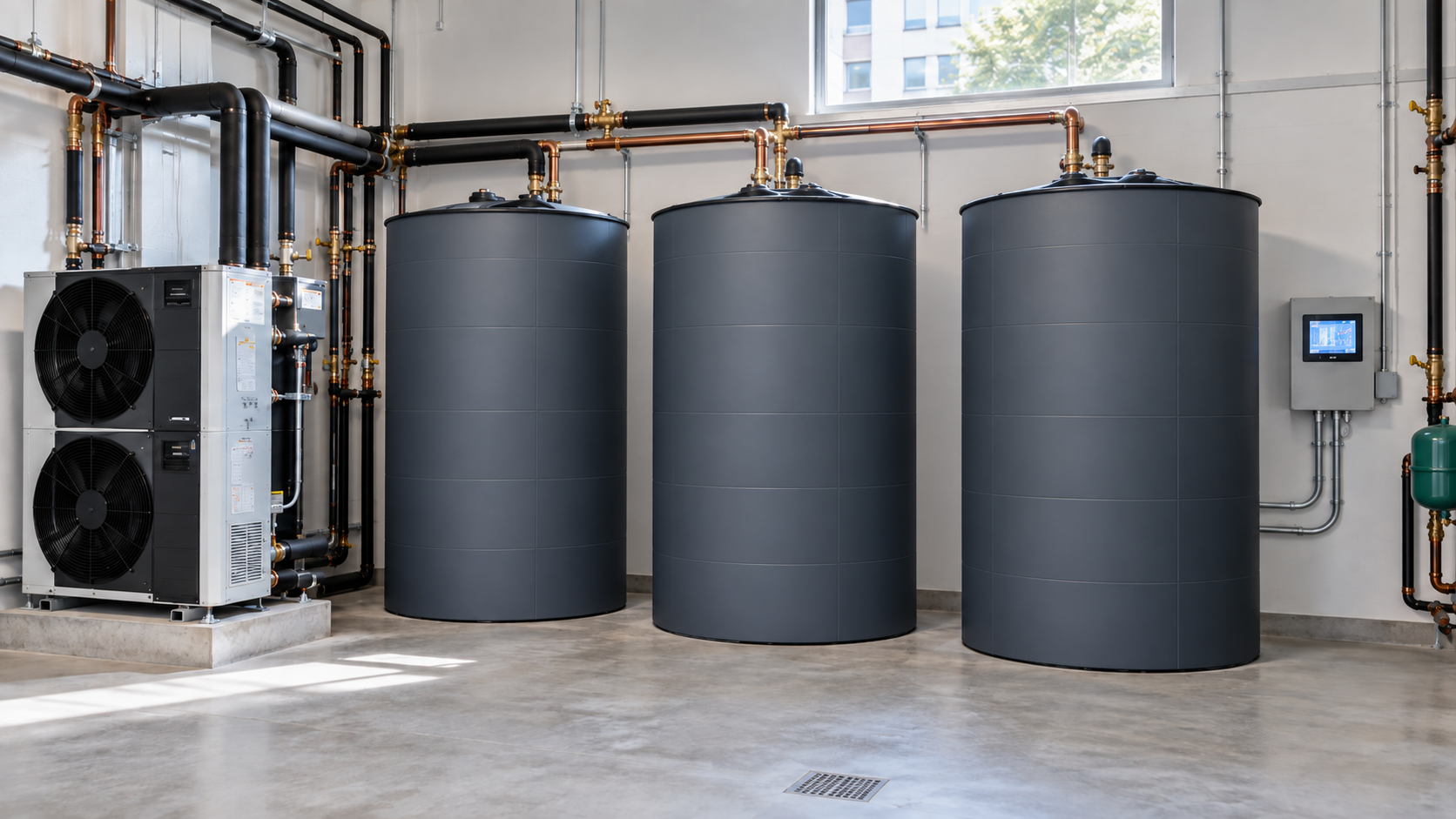
Batteries Aren’t the Only Storage Hiding in Buildings
Any tank holding heated or chilled water is an energy storage device.
Domestic hot water tanks, hydronic buffer tanks, and chilled-water storage systems all separate the time energy is produced from the time the building requires it. Most buildings already operate some form of thermal storage. The issue is that this storage is usually sized for equipment operation, hydraulic stability, or occupant demand rather than for the electrical rate schedule.
When storage volume and controls are designed deliberately, that same equipment can move real electrical load away from utility peak periods.
Thermal storage does not replace electrical batteries. It cannot export electricity, and it cannot provide backup power to lighting, elevators, IT systems, or other non-thermal loads. Its application is the thermal portion of the building load.
Where that thermal load is significant, thermal energy storage can provide a lower-cost method of shifting electrical consumption and reducing peak demand.
Storage Should Be Evaluated as Grid Infrastructure
Jigar Shah has made a useful argument about the role of energy storage: storage should not be treated only as a cost required to make renewable generation work. It improves utilization across the electrical system.
Generation, transmission, distribution, and customer-sited assets can all benefit when energy production and energy consumption no longer have to occur at exactly the same time.
That same principle applies behind the customer meter.
The U.S. Department of Energy’s Pathways to Commercial Liftoff analysis of virtual power plants identifies distributed flexibility as an important part of serving future U.S. electricity demand.
DOE estimates that 80 to 160 GW of virtual power plant capacity by 2030 could address approximately 10 to 20 percent of national peak demand while reducing grid costs.
DOE also projects approximately 5 to 6 GW per year of flexible demand from smart thermostats, smart water heaters, and non-residential distributed resources between 2025 and 2030.
A substantial portion of this flexible demand is thermal.
A water heater that raises tank temperature before the utility peak and then operates at reduced power through the peak period has shifted electrical consumption. Electricity was consumed earlier, converted to thermal energy, stored in water, and used later.
The same principle applies to hydronic heating systems and chilled-water plants.
The storage medium is different from a battery, but the load-shifting function is real.
Thermal Storage Is Already Present in the Building
Utility control of water-heating load is not new.
Pacific Northwest National Laboratory has documented the use of large-capacity electric water heaters in thermal storage and utility load-management programs. What has changed is the control capability available around the equipment.
Modern interval metering, building automation systems, connected heat pumps, temperature sensors, and two-way communications allow thermal loads to be scheduled much more precisely than older timer-based systems.
This matters in commercial and multifamily buildings because thermal loads can represent a substantial portion of total electrical demand.
Water heating is particularly important in multifamily buildings. Shared walls can reduce envelope-driven heating demand, but occupant hot-water consumption does not disappear. In an electrified multifamily building, the domestic hot water plant can become one of the largest controllable electrical loads on the property.
The useful part is that this load normally already has a storage vessel attached to it.
The opportunity is to determine whether that vessel has enough capacity, and enough control capability, to serve a second function.
Three Common Forms of Building Thermal Storage
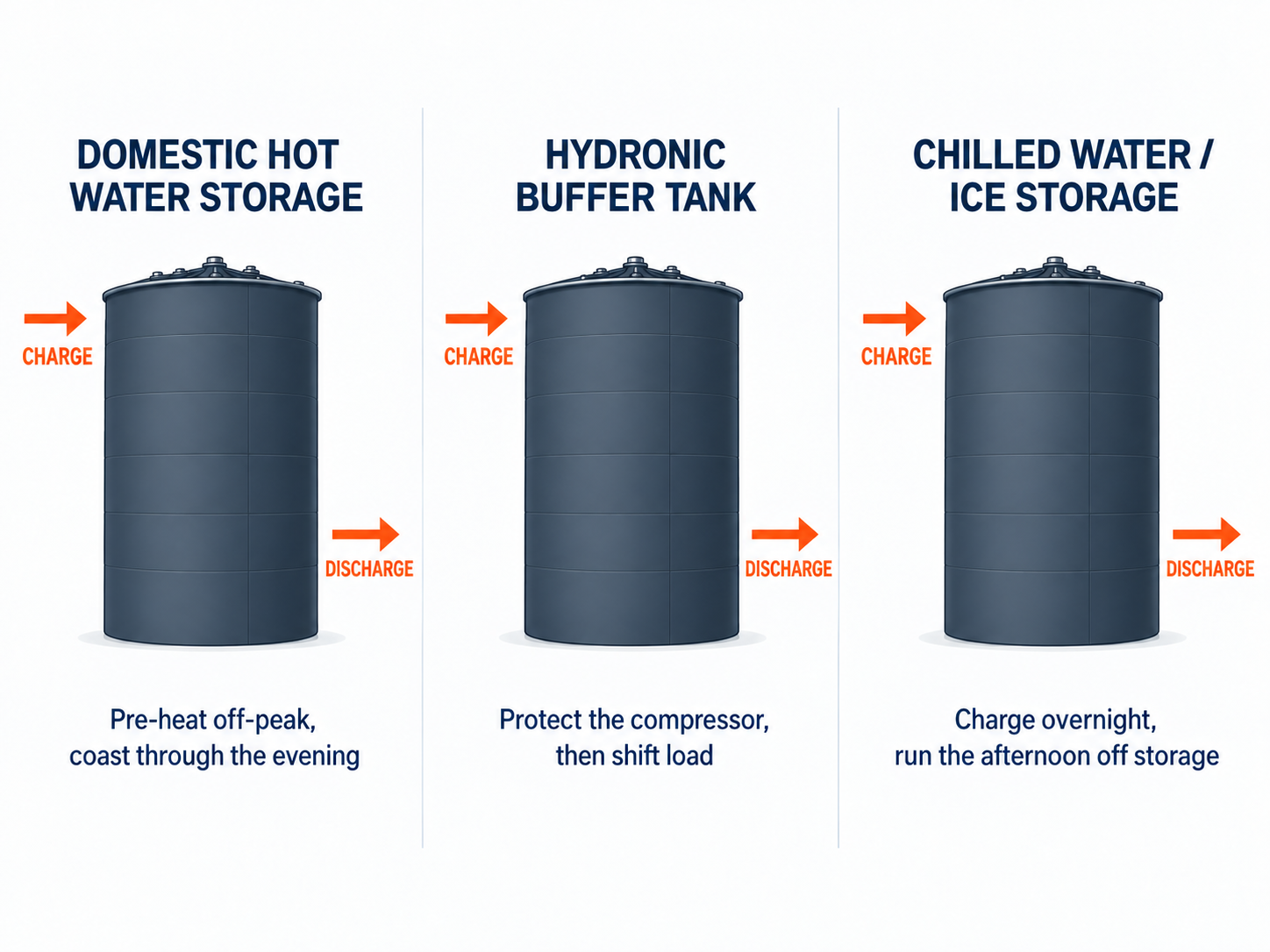
Domestic Hot Water Storage
Domestic hot water storage contains sensible heat in water.
The system can charge before a utility peak period, then use stored thermal energy while heat pump operation is reduced during the more expensive period.
The storage can also allow the heat pump to produce energy over a longer period instead of being sized only around the building’s maximum short-duration hot water demand.
Hydronic Buffer and Storage Tanks
A hydronic buffer tank is often installed to provide minimum system volume, maintain stable flow, and prevent a heat pump compressor from short-cycling.
That is the minimum mechanical requirement.
Additional usable volume above that minimum can become thermal storage.
The distinction between a buffer tank and a storage tank is therefore not necessarily the product itself. It is the sizing objective and the control strategy.
A tank sized only for minimum compressor runtime protects the equipment.
A tank sized for the required peak-shifting event can protect the equipment and shift load.
Chilled-Water and Ice Storage
Cooling systems can use the same strategy in the opposite thermal direction.
A chiller can produce chilled water, or freeze ice, during a lower-cost charging period. Stored cooling is then used later to reduce compressor operation during the building’s afternoon cooling peak.
The underlying concept is the same in all three cases:
Produce thermal energy when electrical conditions are favorable and use it when electrical conditions are not.
The Minimum Buffer Volume Comes First
For a hydronic heat pump system, storage sizing should not begin with the utility tariff.
The minimum system volume required for stable equipment operation must be established first.
A simplified minimum buffer volume relationship is:
V = t × (Qmin,output − Qmin,load) ÷ (ΔT × 500)
Where:
V = required active system volume in gallons
t = target minimum compressor runtime in minutes
Qmin,output = heat pump output at minimum modulation in Btu/h
Qmin,load = smallest load the system can present in Btu/h
ΔT = allowable tank temperature change in °F
The constant 500 represents the approximate relationship between water density, heat capacity, and minutes per hour.
This calculation establishes the minimum required system volume.
It does not establish the optimum storage volume for load shifting.
Every gallon above the minimum can then be evaluated against the building’s thermal load, peak period, available charging time, and utility rate structure.
Calculating Stored Thermal Capacity
For sensible heat storage in water, the basic calculation is straightforward:
Qth = m × cp × ΔT
In IP units:
Qth [Btu] = V [gal] × 8.33 [lb/gal] × 1.0 [Btu/lb°F] × ΔT [°F]
To convert Btu to kWh:
Qth [kWh] = Qth [Btu] ÷ 3,412.14
This relationship is useful because water storage capacity is primarily a function of usable water volume and usable temperature difference.
Example: 700-Gallon Thermal Storage Module
A 35°C usable temperature difference is approximately 63°F.
For a 700-gallon tank:
Qth = 700 × 8.33 × 63
Qth = 367,353 Btu
Converting to kWh:
367,353 ÷ 3,412.14 = approximately 107.7 kWh thermal
The published rating for the 700-gallon ThermalTank is 108.0 kWh of thermal storage at a 35°C temperature difference.
The calculated value and published value are effectively the same.
That is what we should expect from sensible heat storage in water.
Published ThermalTank Storage Capacity
The current modular tank line includes 350-, 500-, and 700-gallon models.
350-Gallon Module
Stored thermal energy at a 35°C temperature difference:
54.6 kWh thermal
Published temperature loss over 24 hours:
3.8°F
Filled weight:
3,089 lb
500-Gallon Module
Stored thermal energy at a 35°C temperature difference:
77.0 kWh thermal
Published temperature loss over 24 hours:
3.0°F
Filled weight:
4,351 lb
700-Gallon Module
Stored thermal energy at a 35°C temperature difference:
108.0 kWh thermal
Published temperature loss over 24 hours:
2.4°F
Filled weight:
6,046 lb
Multiple modules can be interconnected when larger storage volumes are required. The modular construction also allows the vessels to be assembled in mechanical spaces that may be difficult to access with a conventional welded tank.
Thermal kWh and Electrical kWh Are Different
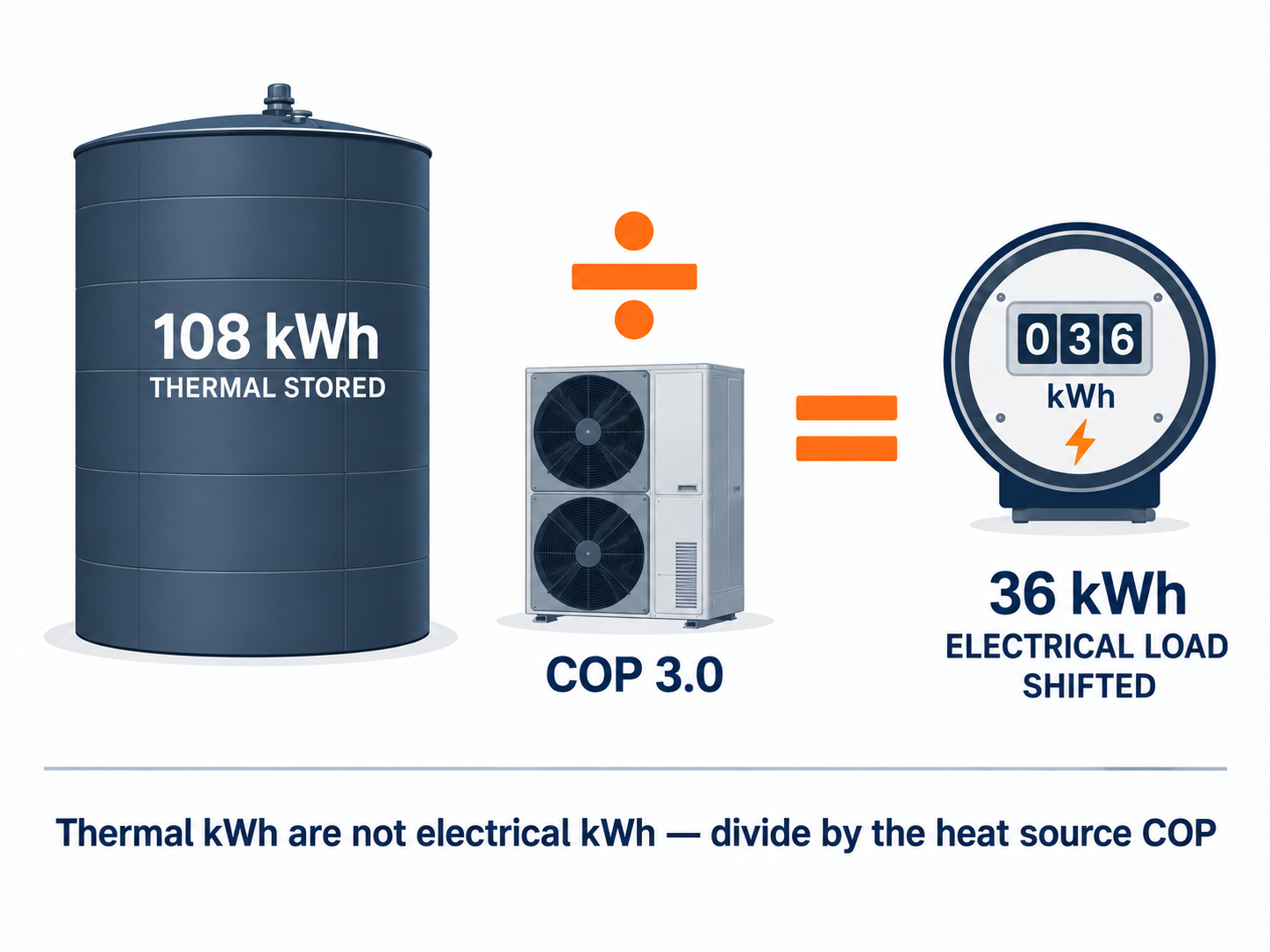
This is one of the most important points in comparing thermal storage with electrical storage.
A stored thermal kWh is not the same thing as a stored electrical kWh.
If a heat pump charges the tank, the heat pump coefficient of performance must be included when determining how much electrical consumption was actually shifted.
The relationship is:
Eshift = (Qth × ηdelivery) ÷ COP
Where:
Eshift = electrical energy removed from the peak period
Qth = stored thermal energy
ηdelivery = usable delivery efficiency after storage and distribution losses
COP = heat pump coefficient of performance during charging
Example: 700-Gallon Module at COP 3.0
Using:
108.0 kWh thermal storage
95 percent delivery efficiency
COP of 3.0
The electrical load shift is:
Eshift = (108 × 0.95) ÷ 3.0
Eshift = 34.2 kWh electrical
Under these assumptions, one fully utilized 700-gallon module can move approximately 34.2 kWh of electrical consumption out of the peak period per cycle.
COP has a direct effect on the calculation.
At COP 2.5:
Approximately 41.0 kWh electrical shifted
At COP 3.5:
Approximately 29.3 kWh electrical shifted
That may initially seem backward. A more efficient heat pump requires less electricity to produce the same amount of stored heat, so the amount of electrical consumption represented by that thermal storage is smaller.
This is why comparisons should use the heat pump COP at the actual charging conditions rather than a general nameplate number.
Ambient temperature, entering water temperature, leaving water temperature, and operating point all matter.
Comparing Thermal Storage With a Battery
There are two useful ways to discuss thermal storage cost.
The first is cost per stored thermal kWh.
The second is cost per kWh of electrical load that can be shifted.
Only the second provides a reasonable basis for comparison with an electrical battery.
For the 700-gallon module:
Reference tank price:
$5,798
Stored thermal capacity:
108 kWh thermal
On a raw thermal-storage basis:
$5,798 ÷ 108 = approximately $54 per stored thermal kWh
That number should not be directly compared with the cost per kWh of a battery.
Using the COP-adjusted electrical-load-shift calculation:
$5,798 ÷ 34.2 kWh electrical
The result is approximately:
$169 per kWh of electrical load-shift capability
That is the more useful number.
700-Gallon Thermal Storage Module
Stored capacity:
108 kWh thermal
Electrical load shifted at 95 percent delivery efficiency and COP 3.0:
Approximately 34.2 kWh per cycle
Reference tank price:
$5,798
Reference cost per electrical kWh of load-shift capability:
Approximately $169/kWh
Tesla Powerwall 3 Reference Comparison
The comparison used in this analysis uses a Tesla Powerwall 3 with:
Usable electrical capacity:
13.5 kWh
Reference 2026 installed cost:
$13,473
Reference installed cost per usable electrical kWh:
Approximately $998/kWh
On this specific load-shifting basis, the thermal-storage example is approximately 5.9 times lower in capital cost per kWh of shift capability.
That figure needs context.
The thermal storage figure is the list price of a commercial storage module. Site-specific piping, controls, pumps, labor, and installation are not included in that number.
The Powerwall figure is an installed residential battery price.
More importantly, the technologies do different jobs.
The comparison does not establish that thermal storage is a replacement for a battery.
It establishes that when the load being shifted is thermal, storing heat directly can be considerably less expensive than storing electricity first and later converting that electricity back into heat.
That distinction should drive the equipment decision.
What Thermal Storage Does Well
Thermal storage is well suited for:
- Moving domestic hot water production outside utility peak periods
- Shifting hydronic heating load
- Shifting chilled-water production
- Reducing heat pump or chiller operation during peak hours
- Reducing connected electrical demand
- Increasing the number of hours available for heat production
- Supporting daily charge and discharge cycles
- Reducing the generation capacity required to serve short-duration thermal peaks
What Thermal Storage Does Not Do
Thermal storage has clear boundaries.
It Cannot Export Electricity
A charged thermal storage tank can reduce future electrical consumption.
It cannot convert the stored heat back into electrical power and export that power to the grid.
It Cannot Back Up General Electrical Loads
Thermal storage can continue serving stored hot water or hydronic energy.
It cannot supply:
- Lighting
- Receptacle loads
- Elevators
- IT equipment
- Life safety systems
- General electrical equipment
A building that requires electrical resilience still needs an electrical battery, generator, or another appropriate source.
It Is Primarily a Daily-Cycle Asset
Published ThermalTank temperature loss ranges from approximately 2.4°F to 3.8°F per 24 hours for the 350-, 500-, and 700-gallon models.
That supports daily charging and discharging.
It should not be treated as multi-day electrical-equivalent storage without a separate thermal-loss analysis.
It Only Addresses the Thermal Load
The total building electrical load is not the addressable load.
Only the portion associated with water heating, hydronic heating, cooling, or another thermal process can be shifted through thermal storage.
The thermal fraction should therefore be established from interval data and equipment operation before storage is sized.
The Financial Value Comes From the Utility Tariff
For a building owner, thermal storage usually creates value by changing when electrical equipment operates.
Two primary mechanisms can be calculated directly from the utility rate schedule:
Demand charge reduction
and
Time-of-use energy savings
They are different calculations and should be treated separately.
Demand Charge Reduction
Assume the 700-gallon example shifts:
34.2 kWh of electrical consumption
across a:
5-hour utility peak window
The average demand reduction across that window is:
34.2 kWh ÷ 5 hours = 6.84 kW
If the applicable demand charge is:
$20/kW-month
Then the annual demand-charge value would be:
6.84 kW × $20/kW-month × 12 months
= approximately $1,642 per year
This calculation only produces real savings if the storage reduces the interval that actually establishes the billing demand.
That means the project team must review:
- Billing interval length
- Peak period
- Seasonal schedule
- Demand ratchets
- Previous monthly peaks
- The next-highest demand interval
Removing 6.84 kW from one interval is only worth 6.84 kW of billing reduction if another interval does not immediately replace it as the monthly maximum.
Time-of-Use Energy Savings
Now assume:
On-peak electricity:
$0.30/kWh
Off-peak electricity:
$0.14/kWh
Rate difference:
$0.16/kWh
Using the same 34.2 kWh shifted per cycle and assuming 300 applicable cycles per year:
34.2 kWh × $0.16/kWh × 300
= approximately $1,642 per year
Under these example assumptions, the demand-charge savings and energy-arbitrage savings happen to be equal.
That is coincidence.
On some commercial tariffs, demand reduction will be the larger value.
On others, the energy spread will dominate.
The actual tariff should be used in every project calculation.
Example Combined Savings
Using the assumptions above:
Demand-charge reduction:
Approximately $1,642 per year
Time-of-use savings:
Approximately $1,642 per year
Combined example:
Approximately $3,284 per year
This is an example of the calculation method, not a universal savings figure.
Actual project economics depend on the utility tariff, thermal load profile, controls, installed cost, charging schedule, heat pump performance, and available incentives.
Storage Can Reduce Required Heat Pump Capacity
Thermal storage also has a value that does not always appear directly on the utility bill.
Storage capacity and heat-generation capacity can be traded against each other.
Without sufficient storage, a heat pump must produce thermal energy close to the time the building consumes it.
If the building experiences a short but large hot-water demand, the heat pump may need to be sized around that event.
Additional storage changes the timing.
The heat pump can operate for more hours before the peak, place that energy into storage, and allow the tank to satisfy part of the peak demand later.
The same building load can therefore be served with a smaller heat pump in some applications.
That can reduce:
- Heat pump capacity
- Connected electrical load
- Breaker and feeder requirements
- Electrical panel requirements
- Transformer demand
- Potential utility service upgrades
This becomes especially important when an existing building is being electrified and the electrical service has limited available capacity.
In that situation, the important comparison may not be thermal storage versus a battery.
It may be additional thermal storage versus a larger electrical service.
That can change the project economics substantially.
Thermal Storage Can Also Reduce Equipment Cycling
Load shifting is not the only function of the tank.
A properly sized hydronic buffer tank can improve heat pump operating behavior by providing sufficient system volume for minimum compressor runtime.
This is especially important with variable-capacity heat pumps when the minimum heat pump output is greater than the smallest active building load.
Without sufficient system volume, the heat pump can quickly satisfy the available load, shut down, restart, and repeat the process.
The tank adds thermal mass and gives the system somewhere to place that minimum output.
The first portion of the tank volume may therefore be required for equipment stability.
The additional volume is where deliberate load shifting begins.
The two functions should be designed together.
Thermal Loss Needs to Match the Charging Strategy
Not every project should charge storage at the same time.
Some buildings may benefit from overnight charging.
Others may have a midday solar surplus or a utility super-off-peak period.
A midday charging strategy can be particularly useful when the building needs to discharge during a late-afternoon or evening utility peak.
The storage hold period may only be a few hours.
Published temperature losses for the larger modular tanks are relatively small over that duration.
For example, a 700-gallon module with a published loss of 2.4°F over 24 hours would lose only a fraction of that temperature during a two- to five-hour hold.
An overnight charge held until the following afternoon represents a much longer storage period and therefore a larger thermal loss.
The charging window should be evaluated against:
- Utility rates
- Available solar production
- Outdoor temperature
- Heat pump COP
- Required storage duration
- Building demand profile
The lowest electricity price does not automatically produce the lowest operating cost if the heat pump efficiency is substantially worse during that charging period.
FERC Order 2222 and Distributed Thermal Loads
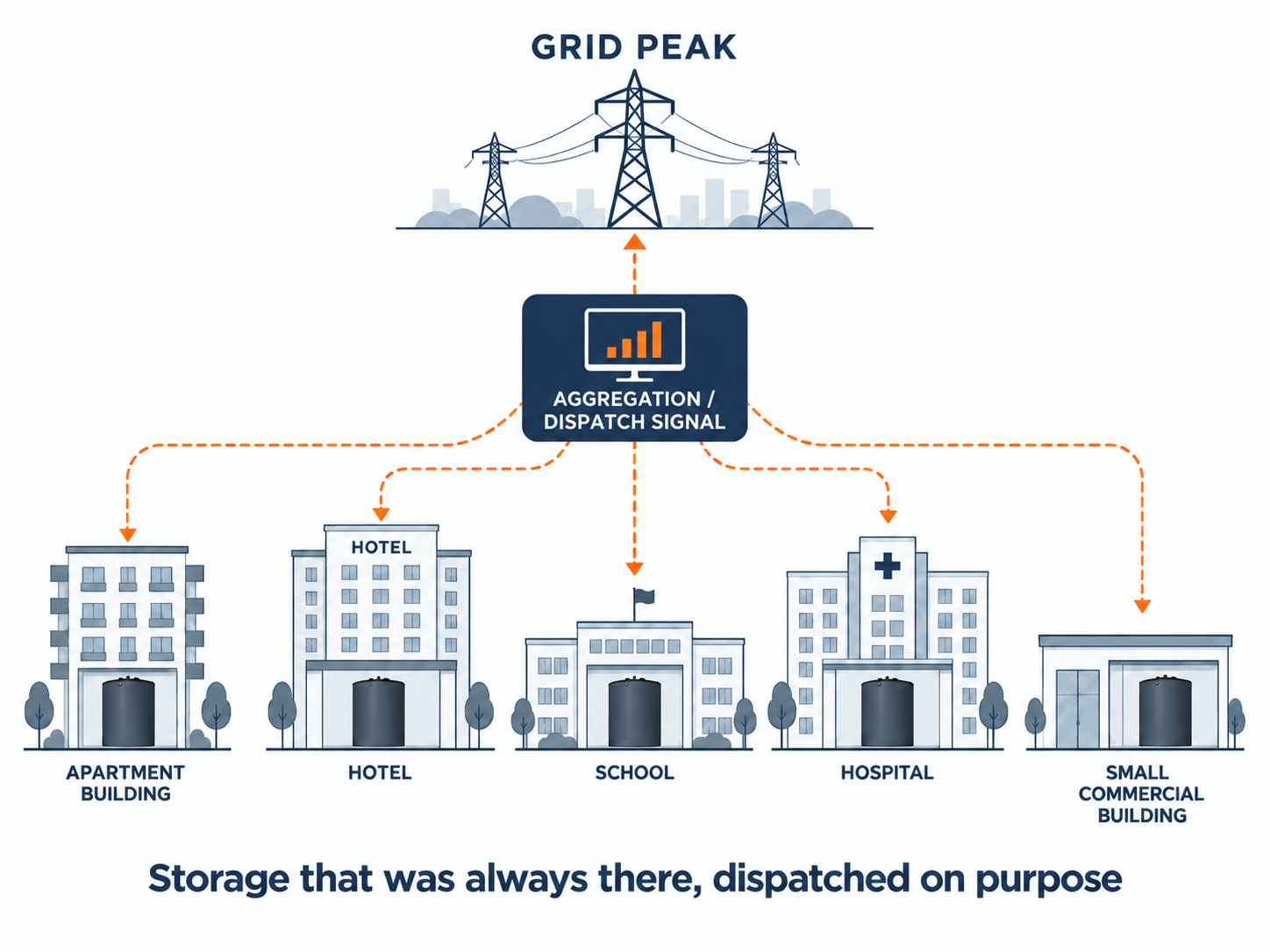
FERC Order 2222 requires regional transmission organizations and independent system operators to provide pathways for aggregations of distributed energy resources to participate in wholesale electricity markets.
This is important for the long-term value of controllable building loads.
A large number of individually small thermal assets can become meaningful when aggregated.
Water heaters, heat pumps, chilled-water plants, and other controllable equipment do not have to behave independently.
An aggregator can coordinate many distributed loads to respond to grid conditions.
However, the practical implementation of Order 2222 differs by region and continues to develop.
For a building owner, future wholesale-market participation should not be the primary financial justification for a current thermal-storage project.
The project should first work against the tariff and programs available today.
That includes:
- Demand-charge reduction
- Time-of-use savings
- Existing demand-response programs
- Utility load-flexibility programs
- Avoided electrical infrastructure
- Available incentives
Future aggregation or wholesale participation can then become an additional value channel.
Utilities and program administrators evaluating thermal storage as a flexible grid resource can review the Thermal Energy HQ utility program overview.
How Thermal Storage Should Be Evaluated During Design
The equipment should not be selected first.
The building and tariff should be evaluated first.
1. Establish the Thermal Load
Separate domestic hot water, space-heating, cooling, and other thermal demand from the building’s non-thermal electrical load.
This establishes how much of the electrical profile is actually addressable through thermal storage.
2. Pull the Utility Rate Schedule
Document:
- Peak hours
- Seasonal periods
- Demand-charge rates
- Billing intervals
- Ratchet provisions
- Off-peak periods
- Super-off-peak periods
- Weekend rules
- Holiday rules
The storage design should respond to the actual tariff.
3. Calculate Minimum Required System Volume
For hydronic systems, establish the buffer volume required for stable equipment operation and minimum compressor runtime.
That is the starting point.
4. Calculate the Required Load Shift
Determine how much thermal energy must be stored to carry the building through the required peak event.
The important variables include:
- Thermal demand during the peak
- Peak duration
- Available storage temperature difference
- Heat pump COP
- Storage losses
- Distribution losses
5. Verify Charging Capacity
The heat pump must have enough available capacity and enough time to recharge the storage before the next required discharge event.
Storage volume and heat pump capacity should therefore be modeled together.
6. Evaluate the Electrical Service
Determine whether additional storage can reduce:
- Heat pump size
- Connected demand
- Panel capacity
- Feeder size
- Transformer loading
- Utility service requirements
For some retrofit projects, this is one of the largest financial benefits.
7. Verify Mechanical Access and Structural Capacity
A tank still has to fit in the building.
Review:
- Door openings
- Corridors
- Stairs
- Elevators
- Mechanical room dimensions
- Tank diameter
- Tank height
- Filled weight
- Floor loading
- Service clearance
The current modular ThermalTank line is designed for assembly in place, which can simplify installation in existing mechanical rooms where access for a conventional welded vessel would be difficult.
8. Specify the Controls
A vessel containing hot or chilled water is thermal mass.
A vessel that can be measured, scheduled, and dispatched becomes an energy storage asset.
At minimum, the control strategy needs appropriate:
- Temperature sensing
- Charge control
- Discharge logic
- Equipment enable/disable signals
- Scheduling
- Safety limits
For grid-interactive applications, additional communications capability may be required.
Frequently Asked Questions
Is Thermal Energy Storage Really a Grid Asset?
Yes, when it is deliberately controlled to change electrical demand.
A tank can allow electricity to be consumed at one time, converted into thermal energy, stored, and used later.
That changes the building’s electrical load profile.
Thermal storage does not generate electricity, so its grid value comes from reducing or shifting consumption rather than exporting power.
How Much Does Thermal Energy Storage Cost per kWh?
The answer depends on which kWh is being measured.
For the 700-gallon module, the reference tank price of $5,798 divided by 108 kWh of stored thermal energy equals approximately:
$54 per stored thermal kWh
Using 95 percent delivery efficiency and a charging heat pump COP of 3.0, the same tank represents approximately 34.2 kWh of shifted electrical consumption.
On that basis:
Approximately $169 per kWh of electrical load-shift capability
The distinction matters.
Why Do We Divide by Heat Pump COP?
Because a heat pump produces more thermal energy than the electrical energy it consumes.
At COP 3.0, approximately one kWh of electricity produces three kWh of thermal energy.
Therefore, 108 kWh of thermal storage does not represent 108 kWh of shifted electrical consumption.
After applying a 95 percent delivery efficiency and COP 3.0, it represents approximately 34.2 kWh of electrical load shift.
Does More Storage Require a Larger Heat Pump?
Not necessarily.
In many applications, the opposite is true.
Additional storage allows the heat pump to produce thermal energy over a longer period before the building needs it.
That can reduce the heat pump output required during the actual demand peak.
Storage capacity and generation capacity should be optimized together.
How Long Does the Stored Heat Last?
The current ThermalTank specification lists 24-hour temperature losses of approximately:
3.8°F for the 350-gallon model
3.0°F for the 500-gallon model
2.4°F for the 700-gallon model
Those values support daily charging and discharging strategies.
Actual system losses also depend on piping, distribution, ambient conditions, operating temperature, and installation.
Can Thermal Storage Replace a Battery?
Not for every application.
Thermal storage can only serve thermal loads.
A battery can serve general electrical loads, provide backup power, and potentially export electricity.
When the objective is shifting a heat pump, water heater, or cooling load, thermal storage should be evaluated before electrical battery capacity is assigned to that same load.
When the objective is electrical resilience or support for non-thermal loads, an electrical battery remains the appropriate technology.
Can a Building Save Money With Thermal Storage Today?
Yes, where the tariff and building load support it.
Potential value can come from:
- Time-of-use energy savings
- Demand-charge reduction
- Utility demand-response programs
- Load-flexibility programs
- Avoided electrical service upgrades
- Reduced heat pump capacity
- Available incentives
The amount depends on the specific building and utility tariff.
Behind the Meter Is Part of the Grid
The distributed storage market is often described primarily as an electrical battery market.
That leaves out a large amount of storage that is already installed in buildings.
Water heaters, hydronic buffer tanks, chilled-water systems, and other thermal storage vessels already separate energy production from energy use.
The opportunity is to design that storage deliberately.
For a heat pump water-heating or hydronic project, the first step is establishing the minimum volume required for stable equipment operation.
The next question is whether additional volume can reduce peak electrical demand, lower operating cost, reduce heat pump capacity, or avoid electrical infrastructure upgrades.
For the 700-gallon example used here, 108 kWh of stored thermal energy represents approximately 34.2 kWh of shifted electrical consumption at a COP of 3.0 and 95 percent delivery efficiency.
Using the current reference tank price, that equates to approximately $169 per kWh of electrical load-shift capability.
That does not mean thermal storage replaces batteries.
It means batteries should not automatically be asked to store energy for a thermal load when the building can store the thermal energy directly.
The right solution depends on the load.
For thermal loads, start with the tank.
For non-thermal loads and resilience, evaluate electrical storage.
For many buildings, the final answer may include both.
Sizing a specific thermal storage system requires the building load profile, utility tariff, available electrical service, heat pump operating conditions, and mechanical constraints.
Contact Thermal Energy HQ to evaluate the thermal storage opportunity for your building.