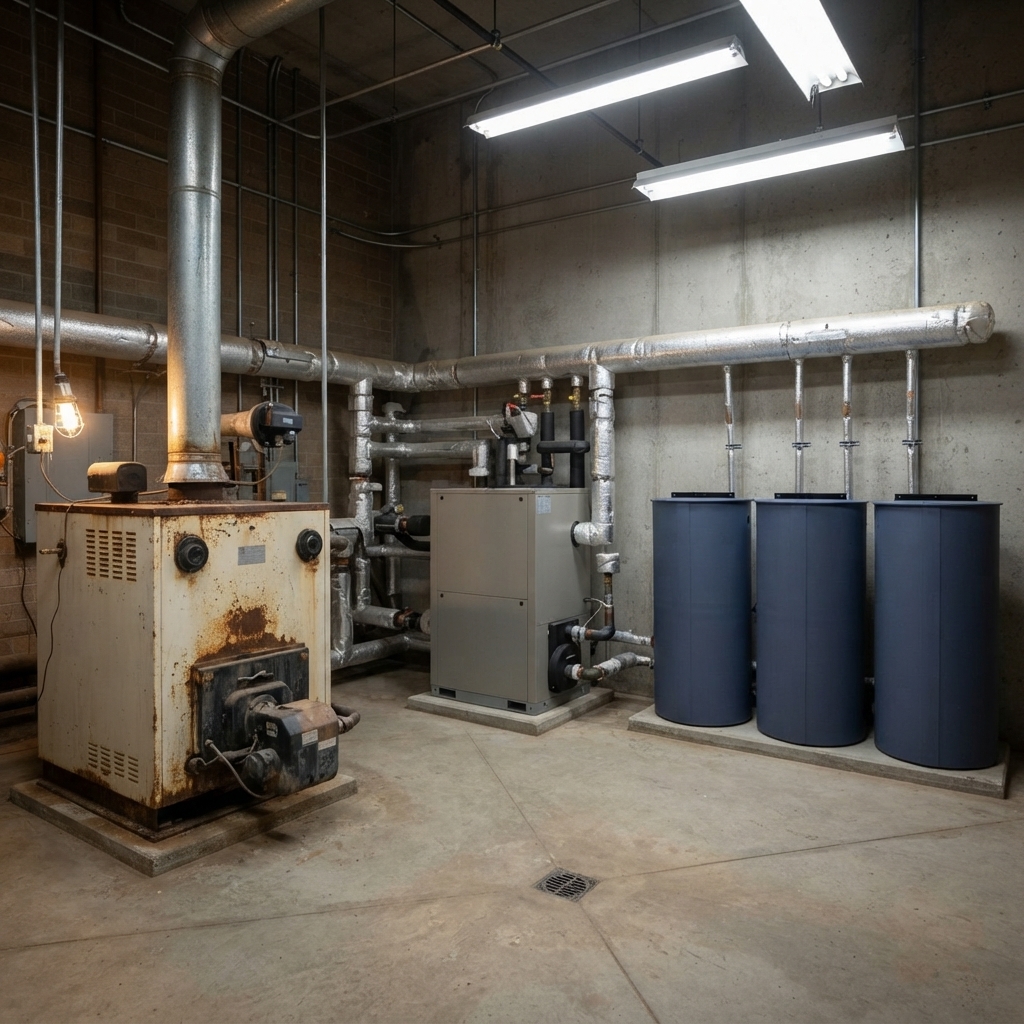
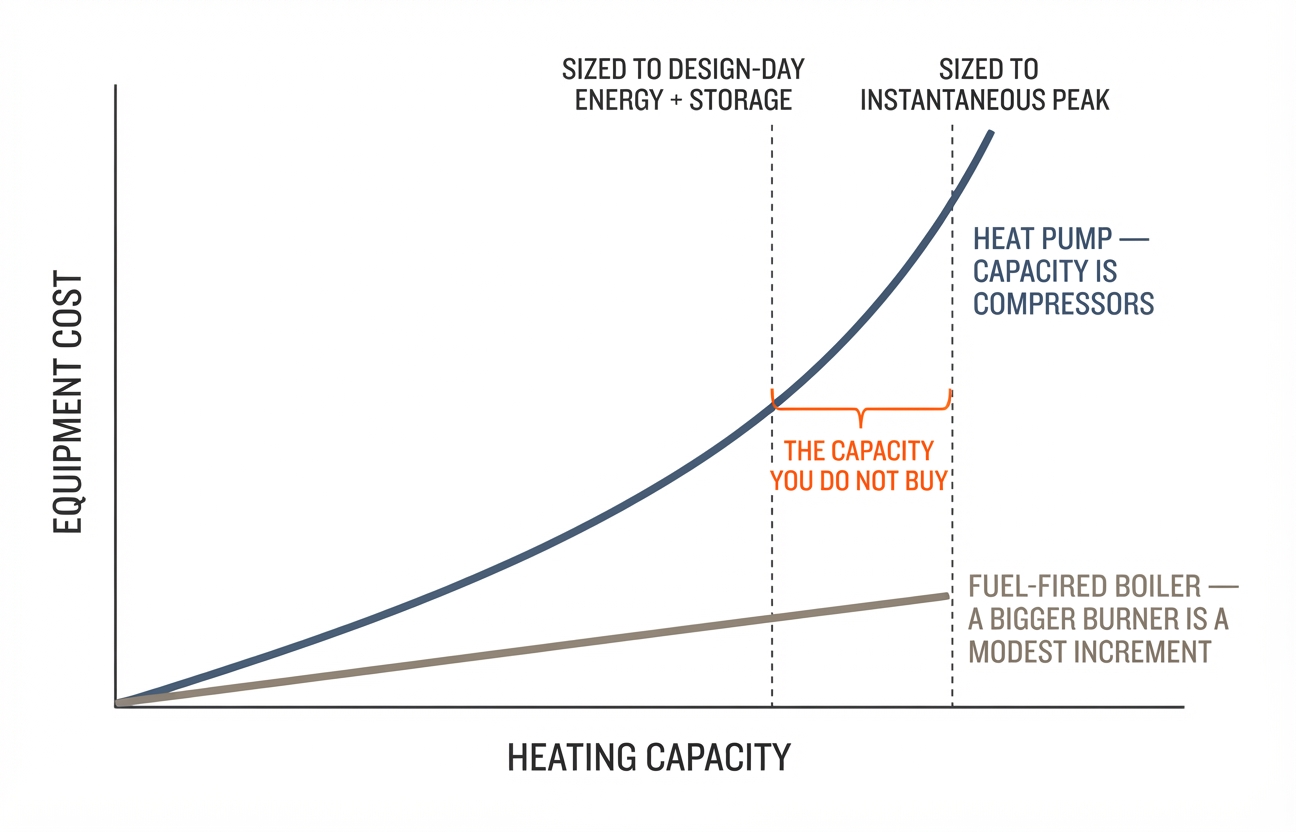
A gas boiler sized for the coldest hour of the year is barely more expensive than one sized for the average. Burner capacity is cheap. That single economic fact shaped how every commercial hydronic system in the country was designed — and it stops being true the moment the heat source becomes a compressor.
Boilers heat roughly 30% of U.S. commercial floorspace, and replacing one is not a like-for-like swap. Heat pumps produce lower water temperatures than boilers, cost far more per unit of capacity, and add electrical load to a service that was sized for a gas-heated building. DOE’s guidance is explicit that large peak heat demands require high-capacity heat pumps that are capital intensive, and that electrical infrastructure upgrades can become a limiting factor on feasibility.
The argument of this article — ours, not DOE’s — is that a building does not need heat pump capacity equal to its instantaneous heating peak. It needs enough capacity to meet the energy the design day requires, plus enough storage to carry the short-duration peaks. That trade moves cost from expensive compressor capacity and expensive electrical service into comparatively cheap insulated water volume.
Key Takeaways
Why a boiler and a heat pump are not the same purchase
Three differences make one-for-one replacement a poor model, and all three point the same direction.
DOE’s guidance reports the first constraint with a useful qualification: several design consultants told the authors that temperatures in the range of 120–150°F can often provide sufficient heating instead of the traditional 180°F, and the recommended approach is to incrementally lower supply temperature and test building comfort to find what the building actually requires. Many buildings turn out to be running hotter than they need to.
The second and third constraints are where this article lives. DOE states the problem plainly: large buildings with large peak heat demands require high-capacity heat pumps, which are capital intensive; and electrical infrastructure upgrades required to switch from a gas or steam system to an electric one could become a limiting factor on the feasibility of the project — especially in colder climates where peak heating load exceeds peak cooling load.
Key Differences Between Fuel-Fired Boilers and Hydronic Heat Pumps
Output Temperature
Fuel-Fired Boiler:
Typically supplies water at 160–180°F, with steam common in older boiler plants.
Hydronic Heat Pump:
Air-to-water heat pumps typically supply water around 120–130°F.
Retrofit Consequence:
Heating emitters designed for 180°F water may not provide the same output at 130°F. Radiators, coils, or other terminal equipment may need to be resized, upgraded, or supplemented.
Cost of Peak Capacity
Fuel-Fired Boiler:
Adding peak capacity is relatively inexpensive. A larger burner usually represents only a modest increase in equipment cost.
Hydronic Heat Pump:
Additional capacity requires more compressor capacity, and compressors are a major cost driver.
Retrofit Consequence:
Sizing a heat pump system around the building’s instantaneous peak heating load can significantly increase project cost. Strategies such as thermal storage, staged capacity, or supplemental heating may help reduce required heat pump capacity.
Electrical Demand
Fuel-Fired Boiler:
Electrical demand is relatively low because combustion provides most of the thermal energy.
Hydronic Heat Pump:
Electrical demand is substantially higher, particularly when electric resistance backup heat is included.
Retrofit Consequence:
Existing electrical service, panels, transformers, and switchgear may become limiting factors. Required electrical upgrades can materially affect project cost and, in some cases, determine whether the retrofit is practical.
Why This Matters
Replacing a boiler with a hydronic heat pump is rarely a simple one-for-one equipment swap. Boilers can provide high-temperature water and are relatively inexpensive to oversize. Heat pump systems are much more sensitive to supply temperature, peak heating load, emitter performance, and available electrical capacity.
A successful retrofit should therefore evaluate the entire heating system, not just the equipment being replaced.
What DOE actually recommends
This is worth reporting accurately, because it is the baseline any storage argument has to improve on. The Large Commercial Building Boiler Electrification Guide, prepared for DOE’s Commercial Buildings Integration program and published April 2024, lists four key strategies.
Read row two carefully, because it is the whole argument in DOE’s own words. The recommended way to avoid buying heat pump capacity for the peak is to have something else cover the peak. DOE’s something else is the existing fossil boiler, and the reasoning is sound: the supplemental system runs only a small portion of the heating season, so significant emissions reduction is achieved even though the boiler stays.
Row four matters too, and it should come first in any real project. DOE is unambiguous that efficiency work belongs before equipment sizing — insulation and air-sealing investments reduce HVAC capacity needs and system costs, with cascading effects on project economics, because smaller heating loads allow downsizing of heat pump equipment, which requires less physical space and less electrical infrastructure.
The underlying full DOE guidance document provides the detailed source for these findings.
DOE’s Four Key Strategies for Commercial Boiler Electrification
Lower the Building Water Temperature
What it does:
Operate the hydronic loop at approximately 120–150°F instead of 180°F, where the building and existing heat emitters allow.
Effect on Heat Pump Capacity:
Lower water temperatures improve heat pump efficiency and can make hydronic heat pumps practical in buildings that would otherwise require higher-temperature equipment.
Use the Boiler for Supplemental Heating
What it does:
Retain the existing boiler and operate it only during outages, extreme weather, or periods of unusually high heating demand.
Effect on Heat Pump Capacity:
This can directly reduce the amount of heat pump capacity that must be installed. Instead of sizing the heat pump for the absolute peak heating load, the boiler can cover those relatively infrequent peak conditions.
Retrofit Incrementally
What it does:
Convert the heating system in stages over several years rather than completing the entire electrification project at once.
Effect on Heat Pump Capacity:
Incremental retrofits primarily help spread capital costs and simplify project implementation. They do not necessarily reduce the building’s eventual heating capacity requirement on their own.
Reduce the Building Heating Load
What it does:
Complete building-efficiency improvements first, including insulation, air sealing, envelope upgrades, and heat recovery.
Effect on Heat Pump Capacity:
Reducing the heating load lowers the amount of heat pump capacity required. It can also reduce electrical demand, potentially limiting the size and cost of electrical service, transformer, or panel upgrades.
Why These Strategies Matter
Commercial boiler electrification does not have to mean replacing the entire boiler plant with enough heat pump capacity to meet the building’s worst-case heating load on day one.
By lowering system temperatures, retaining boilers for peak conditions, phasing the retrofit, and reducing the building load first, projects can significantly improve heat pump performance while controlling both equipment cost and electrical infrastructure requirements.
The argument this article makes
If the peak can be covered by a retained fossil boiler, it can also be covered by stored thermal energy. That is the extension, and it is ours rather than DOE’s — DOE does not list storage among its strategies, and its remarks on storage are cautionary. But the physics is the same physics, and the outcome is better on two counts.
The reason this trade is worth making comes down to what each thing costs. Compressor capacity is expensive and insulated water volume is comparatively cheap — the same asymmetry that governs central heat pump water heater design, applied to space heating. Buying peak coverage as tank volume instead of as compressor tonnage moves cost out of the most expensive part of the plant.
It also moves cost out of a second expensive place. Because the peak electrical draw of a smaller plant running longer is lower than that of a plant sized to the instantaneous peak, storage can be the difference between a project that fits the existing electrical service and one that triggers a service upgrade — the constraint DOE names as potentially decisive for feasibility.
How the sizing logic changes
The method is the same one that governs central hot water plants, applied to a heating season instead of a morning shower peak.
The honest limit on this argument
Space heating peaks are longer than hot water peaks, and that matters. A morning shower peak lasts two or three hours. A cold snap can last days. Storage sized to carry a three-hour block is a very different vessel from storage sized to carry a genuine multi-day design event.
This is why the realistic position is reduced heat pump capacity rather than minimal heat pump capacity, and why most projects will still carry some form of backup — whether that is a retained boiler during a staged transition, a modest electric resistance element, or additional heat pump capacity accepted for the extreme days. Storage shaves the peak; it does not abolish the design day.
Any vendor claiming storage lets a building electrify heating with a token heat pump is selling something that will not survive a cold week.
The electrical service question
For many commercial retrofits this is the constraint that decides feasibility, and DOE says so directly: the electrical infrastructure upgrades required to switch from a gas or steam-based system could become a limiting factor on the project’s feasibility, particularly in colder climates and in dense urban areas where upgrading utility service is difficult and expensive.
Tariffs and demand charges
Tariff mechanics — including whether a shaved load actually reduces a billed demand charge — are covered in Peak Shaving vs Load Shifting.
Where the tank physically goes
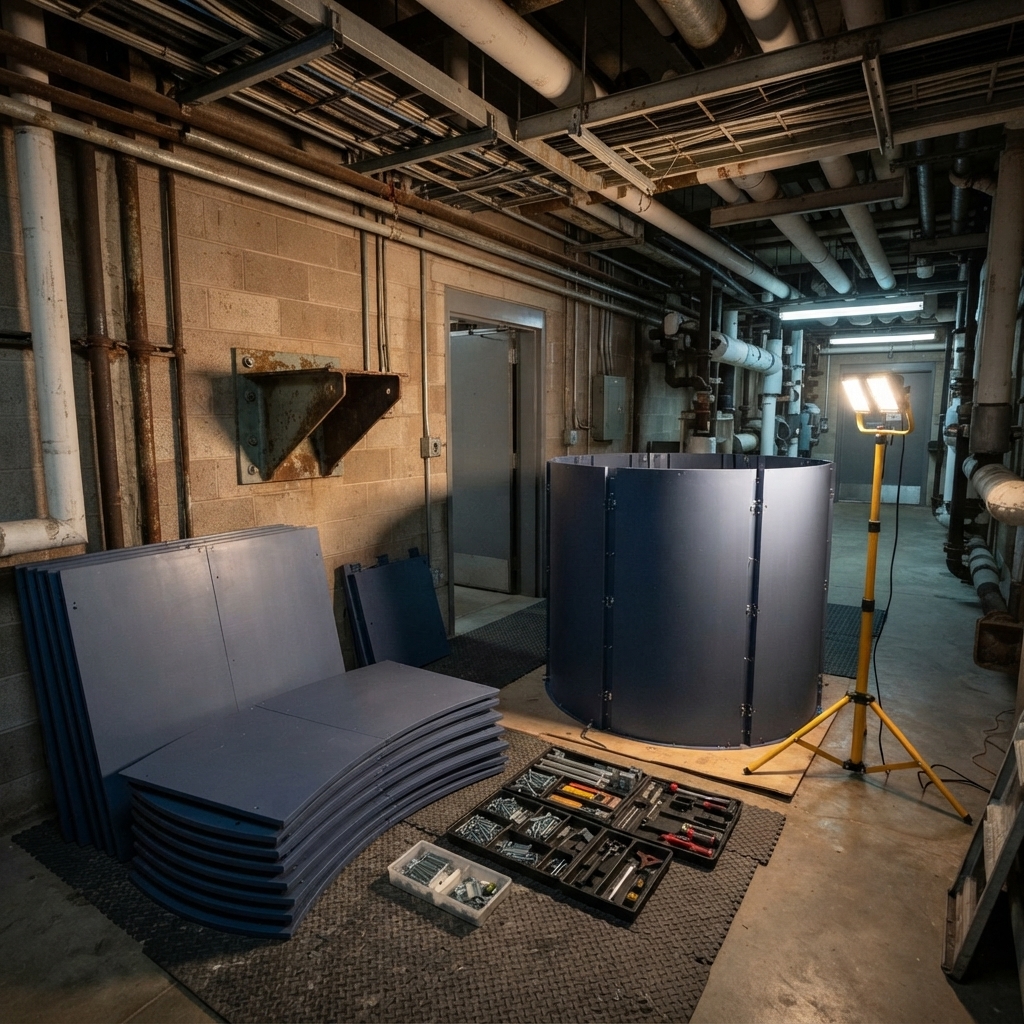
This is the objection DOE actually raises about storage, and it deserves a direct answer rather than a dismissal. DOE notes that advanced solutions with thermal storage may be prohibited by a lack of available space, and separately that underground thermal storage is constrained by space for the storage medium and by capital intensity.
Both observations are fair, and one of DOE’s own case studies makes the point sharper. In the East Palo Alto Government Center project — a 50,000 square foot county building converting two gas systems to air-to-water heat pumps — the lessons learned include this: water storage (buffer tank) is needed in the event of quick changes to building temperature settings, and this can be a structural challenge to fit on existing rooftops.
That is a federally documented project reporting that storage was necessary and that fitting it was the difficulty. Which locates the real problem precisely: not whether storage helps, but whether it can be installed in a building that was never designed to receive it.
Applications and Best-Fit Situations
Large Buildings With Sharp, Short-Duration Winter Peaks
Fit: Strongest
Why:
These projects benefit most from thermal storage because a relatively small amount of stored heat can offset a large amount of expensive peak heat pump capacity.
Shifting investment away from additional compressors and electrical service upgrades and into thermal storage can materially improve project economics.
Buildings With Demand Charges or Wide Time-of-Use Rate Spreads
Fit: Strong
Why:
Thermal storage can provide two benefits at the same time: reducing the heat pump capacity needed to meet peak demand and shifting electrical consumption away from expensive utility periods.
Both savings mechanisms can be achieved with the same storage system.
Staged Retrofits With the Existing Boiler Retained
Fit: Strong
Why:
During a phased electrification project, the existing boiler can continue covering peak heating loads while heat pump capacity is added incrementally.
Thermal storage can eventually replace much of that peak-support function, helping the building retire the boiler instead of keeping it indefinitely as backup.
Projects With an All-Electric Mandate or Funding Requirement
Fit: Strong
Why:
Retaining a fossil-fuel boiler for supplemental heating may not satisfy programs or policies requiring full building electrification.
Thermal storage provides another way to manage peak heating loads without relying on continued combustion.
Mild or Cooling-Dominated Climates
Fit: Moderate
Why:
In buildings where peak cooling demand is greater than peak heating demand, the existing electrical service may already be capable of supporting the heating system.
In those cases, the electrical-capacity problem is smaller, so thermal storage may provide less value strictly as an infrastructure-avoidance strategy.
Buildings With Multi-Day Extreme Cold Events
Fit: Limited
Why:
Thermal storage is primarily a peak-shaving tool, not a source of heat for prolonged extreme weather.
It can reduce demand during short-duration peaks, but it generally cannot carry a building through several consecutive days of unusually cold conditions. A separate backup or supplemental heating strategy may still be required.
Buildings With Limited Mechanical or Structural Space
Fit: Poor
Why:
Thermal storage requires physical space, access for installation, and adequate structural capacity.
Buildings without sufficient mechanical-room space or suitable locations for storage tanks may not be good candidates. Site access and structural feasibility should therefore be evaluated early in the project.
Where Thermal Storage Creates the Most Value
Thermal storage is generally most effective when a building has short-duration heating peaks, expensive peak electrical demand, constrained electrical infrastructure, or a requirement to fully eliminate fossil-fuel backup.
Its value is lower when heating peaks last for several days or when the building lacks sufficient space for storage equipment.
What it costs
DOE’s guidance carries one cost data point, and it comes with the authors’ own caveat attached: a stakeholder reported that upgrading to new technologies can cost $20–50 per square foot to convert a system, which for a 50,000 square foot building implies $1 million to $2.5 million. DOE footnotes that no point of comparison was provided for that figure, so treat it as an order-of-magnitude orientation rather than a benchmark.
Against numbers of that size, storage is a small line. Pricing is current as of August 2026; verify against the live thermal tank comparison and specifications. Vessel prices, not installed system prices, are shown. Because modules interconnect, volume can be added in phases as a staged retrofit progresses. Packaged assemblies that reduce on-site work are available in the All-In-One thermal energy system, with full cost structure covered in How Much Does Thermal Energy Storage Cost?.
The comparison that matters is not tank cost against nothing. It is tank cost against the compressor capacity and electrical service the tank makes unnecessary. Run that comparison explicitly, because it is the only one that shows the trade.
Thermal Storage Vessel Pricing and Capacity
80-Gallon Thermal Storage Vessel
List Price: $1,190
Storage Capacity: 12.0 kWh
Cost per kWh Stored: $97/kWh
Standing Loss: 7–8°F per 24 hours
The 80-gallon model has the lowest upfront cost but the highest cost per unit of stored energy and the highest relative standing heat loss.
350-Gallon Thermal Storage Vessel
List Price: $3,427
Storage Capacity: 54.6 kWh
Cost per kWh Stored: $63/kWh
Standing Loss: 3.8°F per 24 hours
The 350-gallon model offers substantially better storage economics than the smaller vessel, while also reducing relative standing losses.
500-Gallon Thermal Storage Vessel
List Price: $4,464
Storage Capacity: 77.0 kWh
Cost per kWh Stored: $58/kWh
Standing Loss: 3.0°F per 24 hours
At 77 kWh of thermal storage, the 500-gallon vessel further reduces the cost per kWh while improving heat retention.
700-Gallon Thermal Storage Vessel
List Price: $5,798
Storage Capacity: 108.0 kWh
Cost per kWh Stored: $54/kWh
Standing Loss: 2.4°F per 24 hours
The 700-gallon vessel provides the lowest cost per kWh of stored thermal energy and the lowest standing loss among the four models.
Storage Economics Improve With Scale
Larger thermal storage vessels become progressively more economical on a stored-energy basis. The cost declines from approximately $97/kWh for the 80-gallon model to $54/kWh for the 700-gallon model, while standing heat losses also decrease significantly.
For commercial boiler electrification projects requiring meaningful peak-load reduction, larger vessels can therefore provide substantially better storage economics than smaller tanks.
Storage capacity is based on the stated usable temperature range and thermal storage assumptions for these vessels.
A feasibility screen
A commercial boiler electrification project should answer these questions before equipment is sized.
Reframe the project around energy
Question three is the one that reframes the project. A building sized on peak rate buys a plant for the worst instant of the year. A building sized on design-day energy plus storage buys a plant for the day. Those are materially different purchases. Built examples are in the case studies and specification sheets in the technical documentation library.
Frequently Asked Questions
Can thermal storage reduce the heat pump capacity needed to replace a commercial boiler?
In principle yes, and this is an engineering argument rather than a Department of Energy recommendation. DOE's guidance does not list thermal storage among its key strategies for boiler electrification. What it does recommend is retaining the existing boiler as a supplemental source used only during outages and high peak periods, which reduces the heat pump capacity required by having something else cover the peak. Storage can perform that same peak-coverage role without retaining a fossil asset, which is the case this article makes.
How much U.S. commercial floorspace is heated by boilers?
DOE reports that boilers are used as a space heating technology in approximately 703,000 commercial buildings, which is roughly 12 percent of all buildings in the sector. Because boilers are more prevalent in larger buildings, they account for heating about 30 percent of total commercial floorspace and about 32 percent of total commercial energy consumption.
Why can't you replace a commercial boiler with a heat pump one-for-one?
Three reasons. Boilers typically produce 160 to 180 degree water while air-to-water heat pumps typically produce 120 to 130 degrees, so emitters may not deliver the same heat without changes. Heat pump capacity costs far more per unit than burner capacity, so sizing to the instantaneous peak becomes the dominant capital driver. And heat pumps add substantial electrical load to a service sized for a gas-heated building. DOE interviewees stated directly that a one-to-one swap is unlikely to provide required comfort heating and will likely not be the best financial solution.
What does DOE recommend for electrifying commercial boilers?
Four key strategies. Lower the building hot water temperature, since design consultants report 120 to 150 degrees often provides sufficient heating instead of the traditional 180. Use the existing boiler as a supplemental source during outages and peak periods. Retrofit incrementally to spread capital over a manageable timeframe. And reduce the building load through envelope, insulation, and heat recovery upgrades before sizing equipment, because smaller loads allow smaller heat pumps and smaller electrical upgrades.
Will electrifying a boiler require an electrical service upgrade?
Often, and DOE identifies this as potentially decisive. Electric heat pump systems have higher electrical requirements than the building was designed for with fossil heating, especially if electric resistance backup is installed, and DOE states the required infrastructure upgrades could become a limiting factor on project feasibility. This is most acute in cold climates where peak heating load exceeds peak cooling load, and in dense urban areas where utility service upgrades are difficult. A smaller plant running longer against storage draws less peak power, so the calculation is worth running explicitly.
Does storage let you avoid backup heating entirely?
Generally no, and any vendor claiming otherwise should be treated with caution. Space heating peaks are longer than domestic hot water peaks — a cold snap can last days where a shower peak lasts hours — so storage sized for a multi-hour block will not carry a genuine multi-day design event. The realistic outcome is reduced heat pump capacity rather than minimal capacity, with most projects retaining some backup strategy.
What does DOE say about thermal storage for boiler electrification?
Very little, and what it says is cautionary. Storage is not among DOE's four key strategies. The guidance notes that underground thermal storage can contribute significantly to lowering energy bills but is constrained by available space for the storage medium and by capital intensity, and separately that advanced solutions with thermal storage may be prohibited by a lack of available space. One DOE case study, the East Palo Alto Government Center, does report that a buffer tank was needed and that fitting it was a structural challenge on an existing roof.
What hot water temperature do hydronic heat pumps produce?
DOE reports current air-to-water heat pump technologies provide output in the range of 120 to 130 degrees Fahrenheit, which is lower than the roughly 180 degrees typical of a boiler. The hydronic distribution infrastructure may need upgrading to match, though DOE notes there may be sufficient radiator area already to accommodate lower temperatures. The recommended approach is incrementally lowering supply temperature and testing building comfort to establish what the building actually requires.
Conclusion
Commercial hydronic systems were designed around a heat source that sold peak capacity cheaply. Replacing that source with one where capacity is the expensive component, and then sizing it the same way, produces exactly the outcome DOE describes: high-capacity heat pumps that are capital intensive, and electrical upgrades that can decide whether the project happens.
DOE’s answer is to have something other than the heat pump cover the peak, and its suggestion is the boiler you already own. That works, and for a staged retrofit it is often the right first move. But it leaves a fossil asset in the building indefinitely, and it does not satisfy a mandate or a funder that requires full electrification.
Storage does the same job with a different asset. It is not a way to install a token heat pump — space heating peaks are long and the design day is real — but it moves a meaningful share of peak coverage out of compressor capacity and electrical service and into insulated water volume, which is the cheapest part of the plant. Size on the design day’s energy rather than its worst instant, and see what the plant actually needs to be.