California is investing nearly half a billion dollars in no-cost electrification and efficiency upgrades for eligible low-income households in under-resourced communities. The California Energy Commission (CEC) Equitable Building Decarbonization (EBD) Statewide Direct Install Program is designed to help qualifying homes and buildings replace fossil-fuel equipment and improve energy performance.
For California multifamily owners, the program may create an opportunity to plan central heat pump water heating alongside other building upgrades. Thermal energy storage can support that transition, but its eligibility as an EBD-related upgrade must be confirmed with the applicable regional administrator during project design.
In this guide
- What is the CEC Equitable Building Decarbonization Program?
- How much funding does the EBD Program have, and who runs it?
- Who qualifies for the EBD Statewide Direct Install Program?
- How contractors and property owners participate
- Where thermal energy storage fits in EBD-funded electrification
- How much does a thermal energy storage system cost?
- The California incentive stack beyond EBD
- Can thermal storage take California hot water off-grid?
- Frequently asked questions
- The bottom line
Key Takeaways
The EBD Statewide Direct Install Program is a CEC initiative intended to deliver no-cost building decarbonization upgrades to qualifying households and communities. The program focuses on replacing fossil-fuel equipment with efficient electric alternatives and may include related energy-efficiency improvements.
Program requirements, service areas, application procedures, and available measures are administered regionally. Project teams should confirm current requirements before relying on EBD funding in a design, procurement plan, or financial model.
What is the CEC Equitable Building Decarbonization Program?
The CEC Equitable Building Decarbonization Program supports building electrification and energy-efficiency improvements for eligible low-income households in under-resourced communities. The Statewide Direct Install Program is the program's no-cost direct-install pathway for qualifying single-family homes, multifamily buildings, and manufactured or mobile homes.
for current program information.
How much funding does the EBD Program have, and who runs it?
The EBD Statewide Direct Install Program budget is $493.5 million. It includes $339.25 million in State of California funding and $154.25 million in federal Inflation Reduction Act HOMES funding.
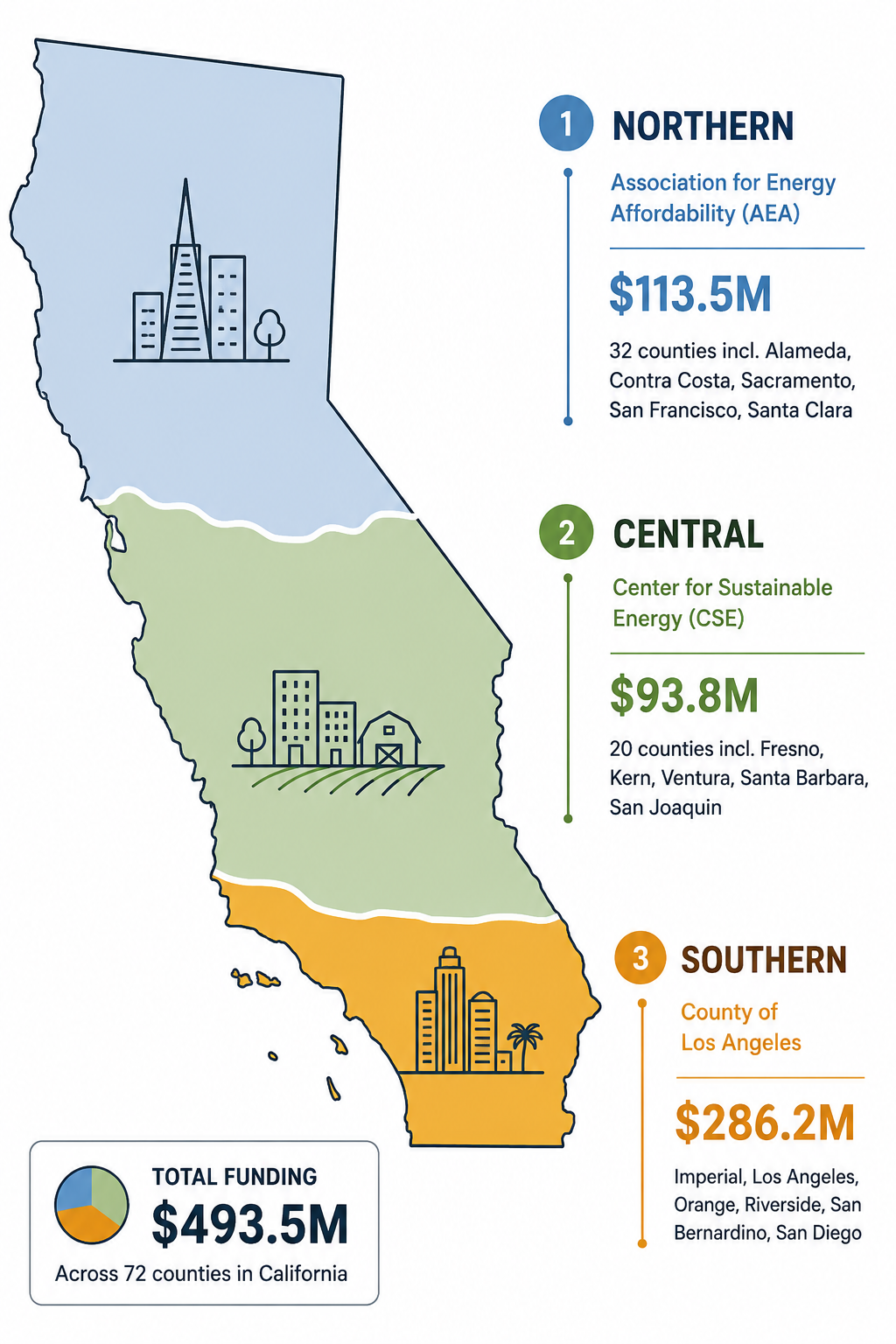
Three regional administrators deliver the program across Northern, Central, and Southern California. The regional allocation and coverage highlights are summarized below.
EBD Statewide Direct Install Regional Funding
The EBD Statewide Direct Install Program is divided among three regional administrators across California.
Northern California is administered by the Association for Energy Affordability, with $113.5 million allocated to projects in the region.
Central California is administered by the Center for Sustainable Energy, with $93.8 million in program funding.
Southern California is administered by the County of Los Angeles and receives the largest share of funding at $286.2 million.
Together, these regional allocations make up the program’s $493.5 million statewide budget.
Regional program information is available from the Northern California administrator, the Central California administrator, and the Southern California administrator.
Who qualifies for the EBD Statewide Direct Install Program?
Qualifying buildings must satisfy the program's building, location, age, fuel-use, and household-income requirements. In general, a project must meet all of the following conditions:
How contractors and property owners participate
Property owners and their representatives should begin by identifying the applicable regional administrator and confirming whether the property is in an eligible community focus area. The administrator can explain the current intake process, eligible measures, income documentation, building requirements, and available contractor pathways.
Contractors may need to participate through a regional program network or meet program-specific qualifications before performing EBD work. Contractor availability and enrollment can change. Teams should review the current regional requirements and the TECH Clean California contractor information when evaluating potential partners.
For multifamily projects, early coordination matters. Owners, engineers, contractors, administrators, and residents may need to align on site access, domestic hot water continuity, electrical capacity, equipment locations, income eligibility, and documentation before construction begins.
Where thermal energy storage fits in EBD-funded electrification
Central multifamily heat pump water heating can benefit from thermal storage. A system designed only around peak morning demand may require a larger heat pump and experience heavier cycling. Storage can allow a smaller heat pump to run longer during off-peak or solar-producing hours while stored thermal energy serves morning or simultaneous hot-water peaks.
Thermal Energy HQ modular tanks can pass through standard doorways and assemble inside mechanical rooms where large welded tanks may be difficult or impossible to install. See the thermal tank overview and all-in-one system information for additional product context.
Thermal storage is not automatically funded by EBD. Whether a tank, controls, heat exchanger, or other storage-related component qualifies as a related upgrade must be confirmed with the applicable regional administrator during project design. Do not include assumed EBD funding for storage until that determination is documented.
Thermal Energy HQ Modular Tank Pricing and Performance
Thermal Energy HQ offers modular thermal storage tanks in several sizes to support residential, commercial, and multifamily applications.
The 80-gallon tank is priced at $1,190 and provides 12.0 kWh of thermal storage, with a standing loss of approximately 7–8°F over 24 hours.
The 350-gallon tank is priced at $3,427 and provides 54.6 kWh of thermal storage, with a standing loss of approximately 3.8°F over 24 hours.
The 500-gallon tank is priced at $4,464 and provides 77.0 kWh of thermal storage, with a standing loss of approximately 3.0°F over 24 hours.
The 700-gallon tank is priced at $5,798 and provides 108.0 kWh of thermal storage, with a standing loss of approximately 2.4°F over 24 hours.
Storage capacity is rated using a 35°C temperature difference. These prices cover the storage vessel only. Complete system costs may also include the heat source, heat exchangers, piping, controls, electrical work, installation labor, and site-specific engineering.
The California incentive stack beyond EBD
EBD may be one part of a broader project-financing strategy. Depending on the building, equipment, applicant, utility territory, and program rules, project teams may also investigate the following programs and provisions:
Verify each incentive before committing project funds
Useful starting points include HEEHRA multifamily rebates, TECH Clean California incentives, the active solar energy system property tax exclusion, related California guidance, the Clean Electricity Investment Credit, Section 48E, and the CEC EPIC program.
Program status, funding, and eligibility can change and must be verified during project development. This article does not provide tax advice, and no incentive or tax treatment is guaranteed.
Can thermal storage take California hot water off-grid?
Thermal storage can reduce the need for a heat pump water-heating system to match every short-duration demand spike, but it does not by itself make a central domestic hot water system independent of the electric grid. The heat pump, controls, pumps, backup equipment where applicable, and building distribution system still require an appropriately engineered energy supply.
Storage can shift when electricity is used. A heat pump may operate during off-peak or solar-producing hours, charge the tank, and use stored hot water during morning or simultaneous demand. The result depends on water-use patterns, tank volume, temperature requirements, recovery rate, control strategy, utility tariffs, and available electrical capacity.
Thermal storage and solar thermal or photovoltaic systems should be evaluated as an integrated design question rather than assumed to be interchangeable. The thermal energy storage resource provides additional background for project teams.
Frequently Asked Questions
What is the CEC Equitable Building Decarbonization Program?
The CEC Equitable Building Decarbonization Program is a California initiative supporting electrification and energy-efficiency upgrades for eligible low-income households in under-resourced communities. Its Statewide Direct Install Program provides no-cost upgrades for qualifying homes and buildings.
Who qualifies for the EBD Statewide Direct Install Program?
Qualifying buildings must generally be a single-family home, multifamily building, or manufactured or mobile home; be in an initial or later-selected community focus area; have been built before January 1, 2020; and use natural gas, propane, or another fossil fuel as the primary fuel for space or water heating. Single-family and manufactured homes must be occupied by a household up to 80% of area median income. At least two-thirds of multifamily units must be occupied by low-income households.
How much funding does the EBD Program have?
The EBD Statewide Direct Install Program budget is $493.5 million, including $339.25 million in State of California funding and $154.25 million in federal Inflation Reduction Act HOMES funding.
How much does a thermal energy storage system cost in California?
Thermal Energy HQ list prices for the storage vessel range from $1,190 for an 80-gallon tank to $5,798 for a 700-gallon tank. A complete installed system costs more because it also includes the heat source, heat exchangers, piping, controls, electrical work, labor, and engineering.
Does California offer incentives for thermal energy storage?
California projects may be able to evaluate EBD, HEEHRA, TECH Clean California, utility efficiency or demand-reduction programs, EPIC, and other incentives. Eligibility and whether thermal storage is an eligible measure vary by program and project. Funding, status, and requirements must be verified before relying on an incentive.
Can thermal storage work with an EBD or HEEHRA heat pump water heater project?
Thermal storage can work with a central heat pump water heating project by allowing the heat pump to run longer during off-peak or solar-producing hours while stored energy serves demand peaks. Whether storage qualifies for EBD or HEEHRA support is not automatic and must be confirmed with the applicable administrator or program provider.