
Cool thermal energy storage has two mature options: freeze water into ice at night and melt it during the day, or chill water at night and hold it in a stratified tank. Ice-on-coil manufacturers have spent decades making the case for ice, and at the scale of a school or an office tower they are often right. But the choice is not as settled as the ice literature suggests. This guide puts the two side by side on the five variables that decide real projects—storage density, chiller efficiency, cost per ton-hour, siting, and discharge rate—and then looks at the gap neither traditional option serves well.
In short: Ice storage stores cooling as latent heat at 32°F and needs roughly 2–4 cubic feet per ton-hour; chilled water storage stores cooling as sensible heat across a 10–20°F delta and needs roughly 15 cubic feet per ton-hour. Ice wins on footprint and can be installed on roofs and in basements, but making ice derates the chiller by about 30–40% and lowers its COP. Chilled water keeps the chiller at normal efficiency, discharges as fast as it can be pumped, and becomes cheaper per ton-hour than ice above roughly 10,000 ton-hours—but conventional chilled-water tanks are monolithic, outdoor, atmospheric vessels that need civil works. Modular insulated water tanks are an emerging third option for small-to-mid loads, subject to confirmed chilled-service ratings.
Key Takeaways
Both are forms of cool thermal energy storage: the chiller runs when electricity is cheap or ambient temperatures are low, stores the cooling, and the building draws on the store during the afternoon peak. DOE’s Better Buildings guidance on thermal energy storage frames the value the same way for either medium—lower peak demand, shift load to cheaper periods, and avoid oversizing chillers for a peak that lasts a few hours.
In this article
How ice storage and chilled water storage work
Ice storage is latent storage. A chiller cools a 25–30% glycol solution to about 22–26°F and circulates it through coils inside water-filled tanks, freezing the water around the coils. During discharge, warm return glycol—or in some designs, water—passes back through the coils or over the ice and melts it. Trane’s technical introduction to cool thermal storage, the CALMAC Ice Bank literature, describes chiller-priority and ice-priority control strategies and notes that eutectic salts can lower the freeze point to 12°F for process loads.
Pacific Northwest National Laboratory’s Thermal Energy Storage System test bed uses this architecture: an 80-ton chiller, three ice canisters, and glycol circulation to study how building cooling can support the grid.
Chilled water storage is sensible storage. The chiller produces 39–42°F water that is stored in an insulated, atmospheric tank; warm return water at 54–60°F is returned to the top. Because cold water is denser, the tank stratifies naturally, with a thin thermocline separating the two layers. The physics is the same one that makes hot-water tanks work, run in reverse—see our comparison of sensible and latent heat storage for the underlying numbers. A 2025 CFD and experimental study of a stratified chilled-water tank shows that diffuser design and inlet flow rate control how much of the tank’s theoretical capacity survives mixing.
Storage density: 2–4 vs. 15 cubic feet per ton-hour
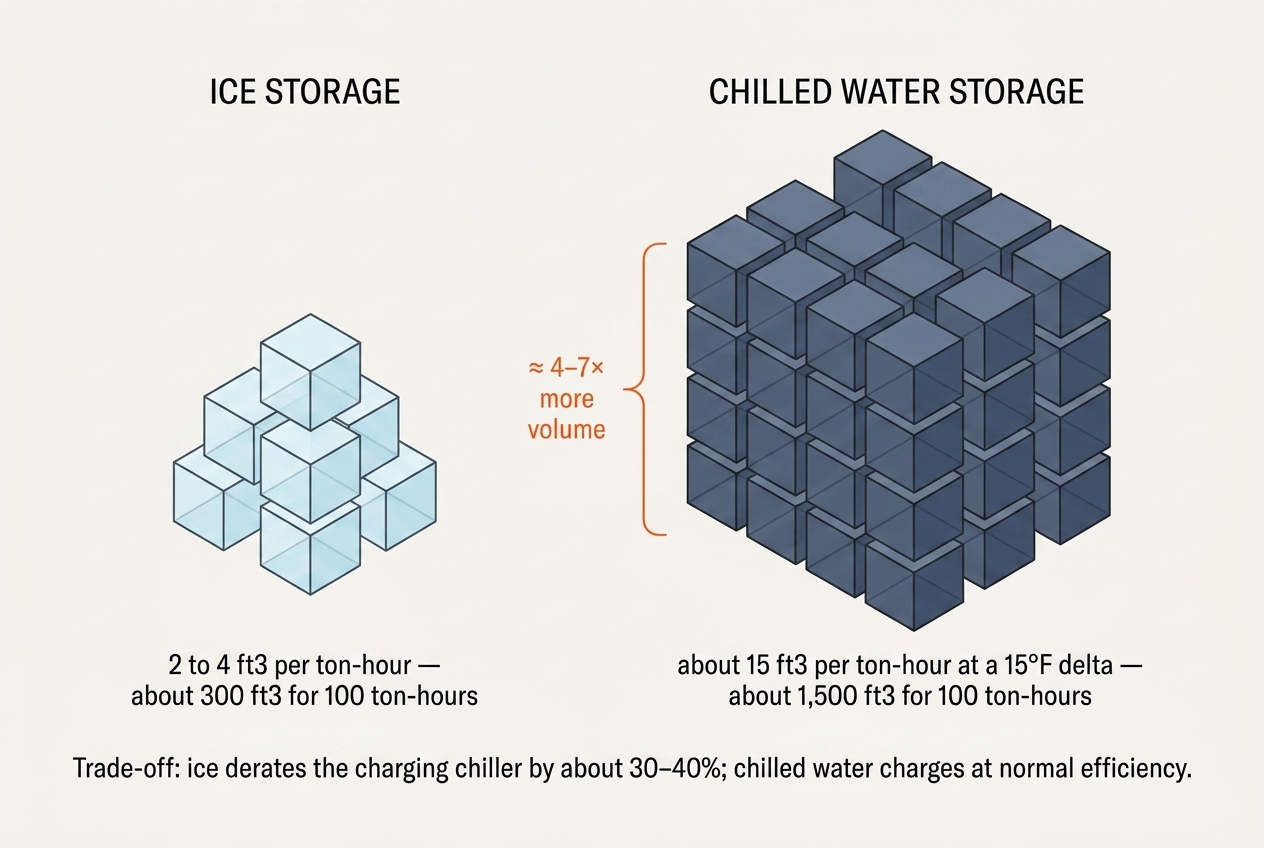
Ice’s heat of fusion is 144 Btu per pound. Chilling water across a 15°F delta captures 15 Btu per pound—about one-tenth as much. In practice ice-on-coil tanks are not solid ice, so the industry rule of thumb is 2–4 ft3 per ton-hour for ice and about 15 ft3 per ton-hour for chilled water at a 15°F delta, a figure used in Daikin’s engineering overview and HPAC Engineering’s district-cooling sizing walkthrough. A wider chilled-water delta helps: HPAC’s worked example uses a 13°F delta and a 90% storage efficiency factor and lands at nearly five million gallons for 40,000 ton-hours.
Ice storage compared with chilled water storage
MetricIce storage (ice-on-coil)Chilled water storage (stratified)
Storage mechanismLatent heat of fusion at 32°F (144 Btu/lb)Sensible heat across a 10–20°F delta (10–20 Btu/lb)
Volume per ton-hour≈ 2–4 ft3≈ 15 ft3 at 15°F delta (≈ 11 ft3 at 20°F)
Volumetric density≈ 30–60 kWh/m3 effective≈ 8–10 kWh/m3 at 15°F delta
Chiller leaving temperature during charge22–26°F glycol39–42°F water
Chiller capacity during chargeDerated ≈ 30–40% (rule of thumb ≈ 35% for air-cooled)Nominal
Discharge rateLimited by melt rate at coil / heat exchangerPump-limited; suits 30 min–2 hr peaks
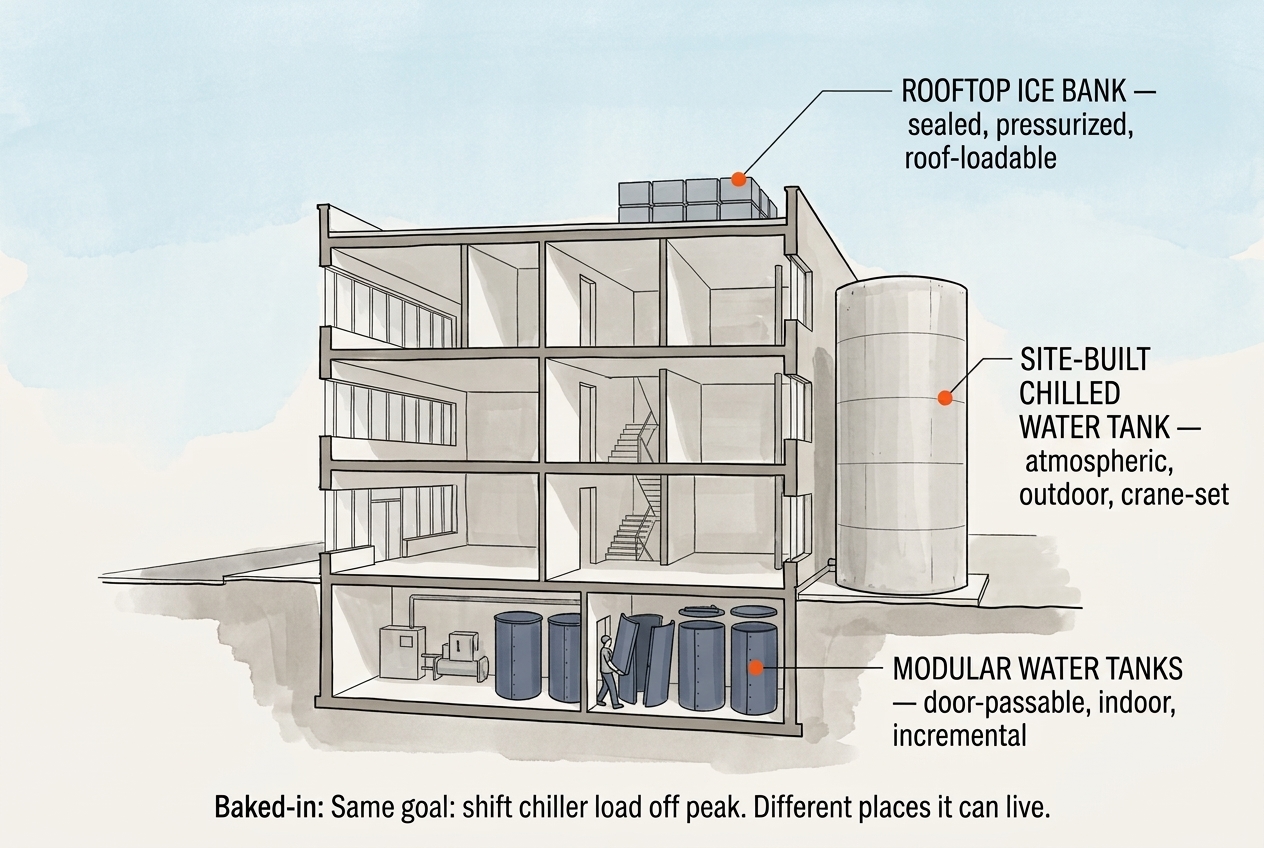
SitingRoof, indoor, basement, buried, outdoorMostly outdoor, atmospheric; not on roofs
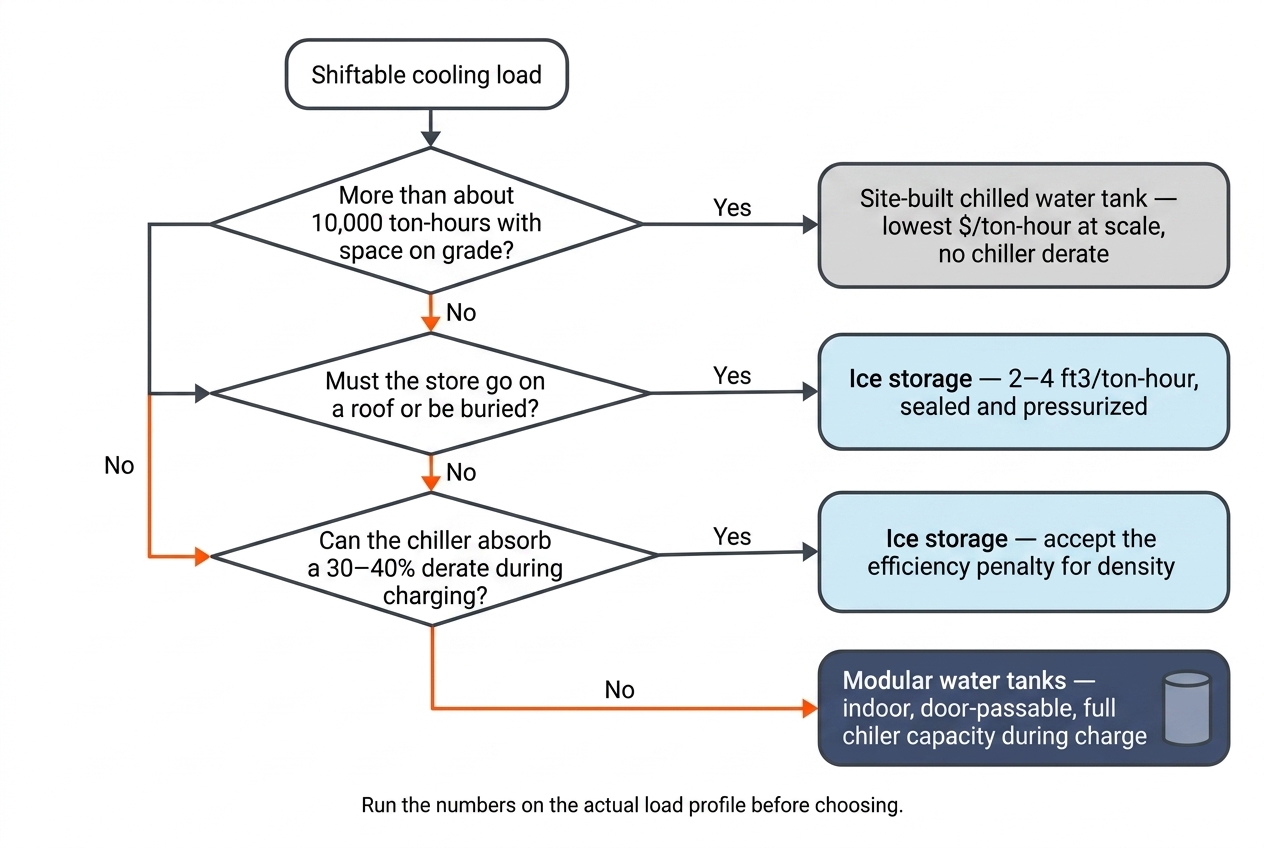
Cost per ton-hour installedLower below ≈ 10,000 ton-hoursLower above ≈ 10,000 ton-hours; $2–3/gal at 100k–250k gal
Glycol requiredYes (25–30%)No
Loop interfaceClosed, pressurized glycol loopAtmospheric tank; heat exchanger or pressure-sustaining valves
The chiller efficiency penalty for ice—and what it costs
Every ton-hour of ice is made at a lower evaporator temperature than a ton-hour of chilled water. EVAPCO’s thermal ice storage application and design guide gives the rule of thumb directly: derate an air-cooled chiller’s nominal capacity by about 35% for ice-build duty at 22°F leaving glycol. Water-cooled machines take a similar hit. That means the ice-making chiller is either oversized for its daytime job or takes longer to charge, and it draws more kW per ton while charging. Night-time ambient temperatures claw some of this back for air-cooled units, and DOE’s FEMP chiller procurement guidance notes that part-load and full-load efficiency both matter.
Chilled water storage charges at the chiller’s normal design point. The trade is simple: ice spends efficiency to buy density; water spends space to keep efficiency. Which is the better trade depends entirely on what your site has more of—square feet or cheap off-peak kWh.
Cost per ton-hour: where the crossover sits
Ice banks are factory-built and modular, so their cost per ton-hour is roughly flat with size. Chilled-water tanks are site-built, so their cost per ton-hour falls steeply with size. Chiller & Cooling Best Practices’ comparison of ice and water storage, drawing on Trane’s guidance, places the crossover near 10,000 ton-hours: below it ice is usually cheaper to install per ton-hour, above it water is.
Buildings.com’s interview with TES consultant John Andrepont puts a number on the small end: a 1,000–2,000 ton-hour school needs a 100,000–200,000-gallon tank at about $2–3 per gallon installed—roughly $200–300 per ton-hour—which he calls the unfavorable side of the economy of scale.
That is the structural reason ice owns the small-commercial market: not because ice is better, but because a small monolithic chilled-water tank is expensive and awkward. At the other end, DOE’s FEMP case study of the Dallas VA Medical Center describes a 3.3-million-gallon stratified water tank that both shifts peak load and doubles the hospital’s central plant capacity—the scale at which water is unbeatable.
Siting and discharge: the practical constraints
Ice tanks are short, some under 9 feet, sealed, and pressurized, so they can be buried, placed on roofs, or set in basements, and they connect to the building loop like any other closed component. Conventional chilled-water tanks are atmospheric vessels often approaching 30 feet tall; they are almost always sited outdoors, cannot go on roofs, and need heat exchangers or pressure-sustaining valves to interface with a pressurized loop—points the Cooling Best Practices comparison makes explicitly.
On discharge the picture flips: for short, sharp loads of 30 minutes to two hours, chilled water may be the better choice because it releases cooling as fast as it can be pumped, while ice releases it as fast as the coils can melt it.
The gap: small and mid-size loads that can’t fit a monolithic tank
Put the constraints together and a gap appears. A hotel, hospital wing, laboratory, data room, or campus building with a few hundred to a few thousand ton-hours of shiftable cooling, an indoor or constrained plant room, and no appetite for civil works has, until recently, had one realistic option: ice. Ice fits, ice is factory-built, ice is priced for that scale—and ice costs a third of the chiller’s capacity to make.
Thermal Energy HQ’s modular tank changes the arithmetic on siting. The patented modular tank ships as lightweight panels that pass through a standard door and assembles in a mechanical room in about an hour, with EPP insulation rated R18–R27; see the modular tank installation and insulation details.
In chilled-water service, modular insulated water tanks may provide an indoor stratified water store that can be built incrementally, module by module, without a crane, a foundation, or an outdoor pad, subject to the manufacturer’s chilled-service rating and confirmed insulation, liner, condensation-control, diffuser, and seasonal-duty requirements. Charged by the building’s existing chiller at its normal design point, it may avoid the ice derate; charged overnight by a radiative sky-cooling array, it could shift load without the chiller running at all.
Be clear-eyed about what water does not fix: at a 15°F delta a 700-gallon module holds about 6 ton-hours, so a 1,500 ton-hour load is a bank of modules, not one tank, and the vessel cost per ton-hour at list price is higher than an ice bank’s. The case for modular water in this gap rests on three things ice cannot offer: full chiller capacity during charge, pump-rate discharge, and the ability to grow the store in place. Whether those outweigh ice’s density is a project-level calculation—which is why the right next step is a load profile, not a brochure.
For hybrid and heat-pump configurations that pair the same tank with heating loads, see Thermal Energy HQ’s system solutions; for the broader landscape of storage types, see the thermal energy storage guide.
Thermal storage incentives
Both media are thermal energy storage in the eyes of incentive programs and, at the statutory level, the federal Clean Electricity Investment Credit’s definition of energy storage technology in 26 U.S.C. §48E; qualification of any specific configuration is a question for a tax professional. Sandia’s DOE Energy Storage Handbook classifies both under the same thermal-storage umbrella, differing only in whether the energy is held as sensible or latent heat.
Frequently Asked Questions
What is the difference between ice storage and chilled water storage?
Ice storage freezes water at night using a chiller running 22–26°F glycol and melts it during the day, storing cooling as latent heat at 32°F. Chilled water storage cools water to 39–42°F and holds it in an insulated stratified tank, storing cooling as sensible heat across a 10–20°F temperature delta. Ice is 4–7 times denser per cubic foot; chilled water charges at the chiller’s normal efficiency and discharges faster.
How much space does ice storage need compared to chilled water storage?
Ice storage needs roughly 2 to 4 cubic feet per ton-hour. Chilled water storage needs roughly 15 cubic feet per ton-hour at a 15°F delta, or about 11 cubic feet at a 20°F delta. For the same ton-hours, a chilled water tank is typically 4 to 8 times larger than an ice bank.
Does ice storage reduce chiller efficiency?
Yes. To build ice the chiller must produce glycol at about 22–26°F instead of water at 42–44°F. Manufacturer design guides derate nominal air-cooled chiller capacity by about 35% for ice-build duty, and COP falls with the lower evaporator temperature. Cooler night-time ambient temperatures recover part of the loss for air-cooled chillers. Chilled water storage charges at the chiller’s normal design point with no derate.
Which is cheaper, ice storage or chilled water storage?
It depends on size. Below roughly 10,000 ton-hours, factory-built ice banks are usually cheaper per ton-hour to install. Above that, site-built chilled water tanks are cheaper because their cost per gallon falls with scale. Small chilled water tanks of 100,000–200,000 gallons have historically cost about $2–3 per gallon installed, which is the unfavorable end of the curve.
Can chilled water storage be installed indoors or on a roof?
Conventional site-built chilled water tanks are atmospheric vessels, often 30 feet tall, and are almost always installed outdoors on grade; they cannot go on roofs. Ice tanks are sealed and short, so they can be placed on roofs, indoors, in basements, or buried. Modular insulated water tanks that pass through standard doors are an emerging option for indoor chilled water storage at small to mid-size loads, subject to the manufacturer’s chilled-service rating.
Do thermal storage incentives apply to both ice and chilled water?
Generally yes. Utility demand-response, peak-reduction, and efficiency programs pay for ton-hours shifted and kilowatts reduced, not for the storage medium. At the federal level, thermal energy storage is within the statutory definition of energy storage technology under 26 U.S.C. §48E; whether a specific system qualifies depends on configuration and should be confirmed with a tax professional.
Conclusion
Ice storage earned its market by packing cooling into small, sealed tanks that go anywhere—and it pays for that with a third of the chiller’s capacity every night. Chilled water storage keeps the chiller honest and discharges on demand, but the industry has only ever built it at a scale that needs a crane and a civil contractor. The interesting engineering is in between: small and mid-size loads, indoor plant rooms, incremental growth. Modular water storage is a credible answer there, and the way to find out whether it is the right one for your building is to run the numbers on your actual load.
Garth Schultz is President & Inventor of Thermal Energy HQ, where he leads development of modular thermal energy storage systems manufactured in the United States. He is the inventor named on patents covering hybrid photovoltaic-thermal (PVT) solar panels and insulated modular storage tank construction, and has worked in solar-thermal product development since founding the company’s technology line in 2007. Connect on LinkedIn.