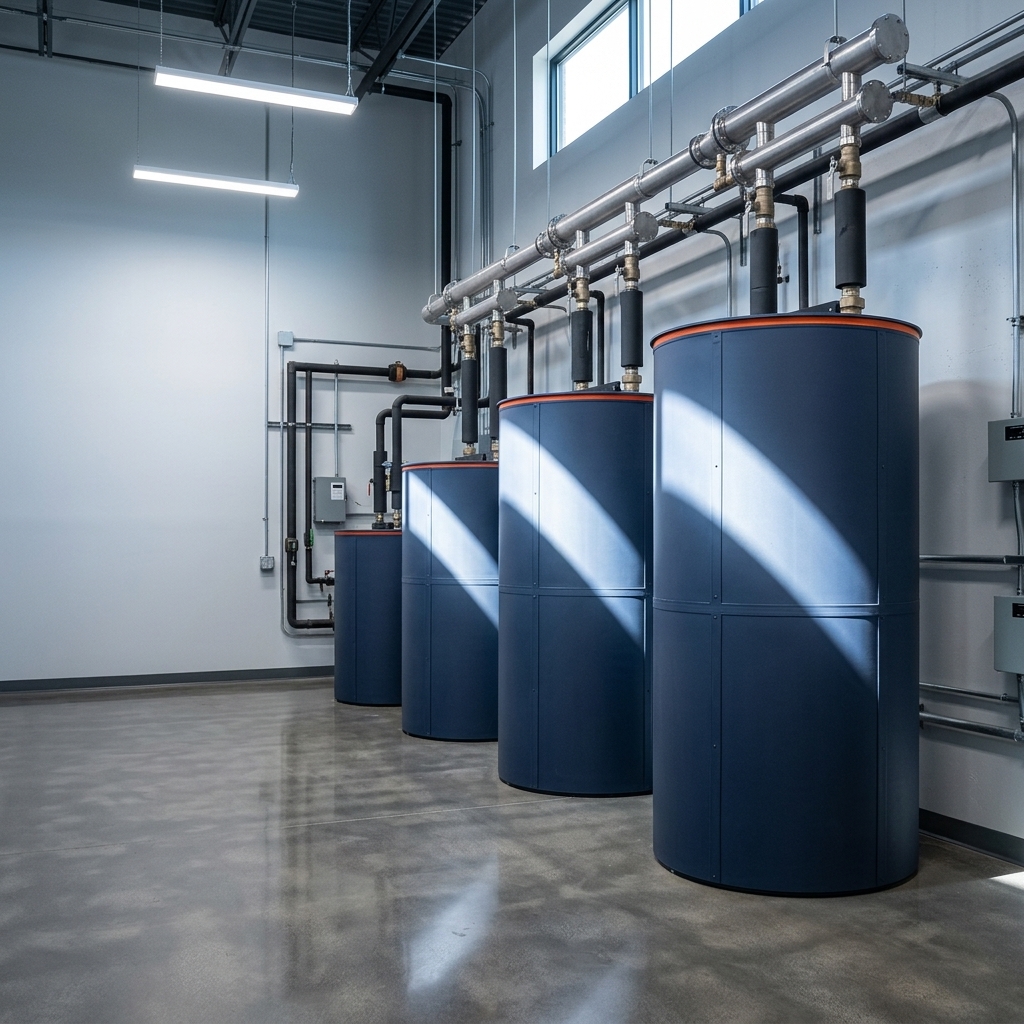
Every building and every plant that heats or cools something has a timing problem. The energy is cheapest at one hour and the demand arrives at another, and the gap between those two facts is where money leaks out of the operating budget—in demand charges, in oversized equipment, in gas burned at whatever price the meter says that morning. Thermal energy storage closes that gap by storing the heat or the cold itself rather than storing the electricity to make it later.
This is the reference page for the topic. It covers what thermal energy storage is, the three physical mechanisms it uses, what a system costs at real published prices, how engineers size one, where it beats batteries, and—just as usefully—the situations where it is the wrong tool.
Key Takeaways
In short: Thermal energy storage (TES) is the practice of capturing thermal energy—heat or cold—when it is cheap or abundant, holding it in a storage medium, and releasing it when it is needed. Most systems store energy as sensible heat by raising the temperature of water, rock, molten salt, or concrete. Some store it as latent heat by melting or freezing a phase change material, and a small research-stage category stores thermochemical energy in reversible reactions.
Water-based sensible storage dominates commercial and industrial buildings because water is cheap, non-toxic, and holds roughly 1.16 kWh per cubic meter per °C. Modular tanks list from $1,190 for an 80-gallon, 12 kWh tank to $5,798 for a 700-gallon, 108 kWh tank, which works out to roughly $54–$97 per stored kWh—an order of magnitude below installed lithium-ion on an energy basis. The tradeoff is that the stored energy comes back out as heat, not electricity.
In this article
What is thermal energy storage?
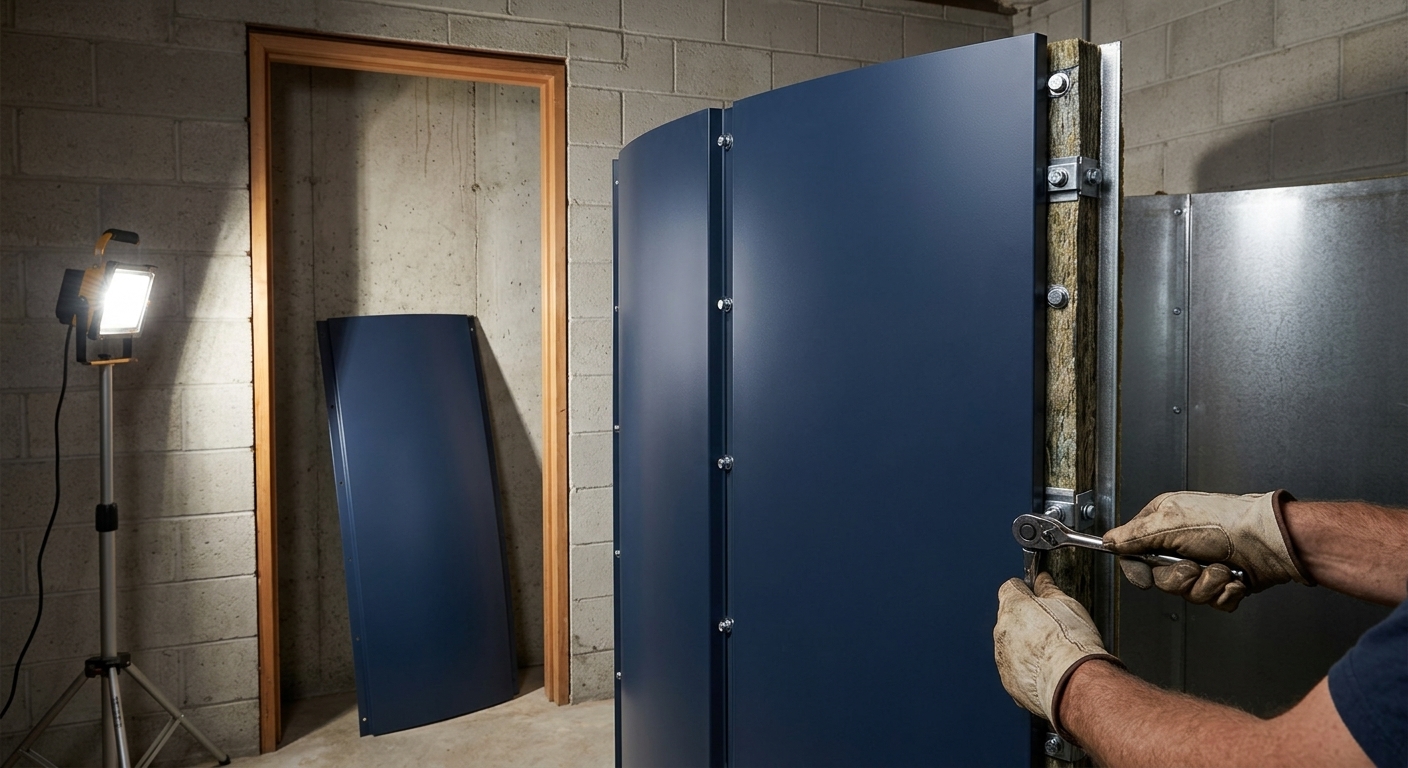
Thermal energy storage is a system that adds, holds, and later withdraws thermal energy from a storage medium so that the time you make heat or cold no longer has to be the time you use it. A hot water tank charged overnight and drawn down at 7 a.m. is thermal energy storage. So is an ice bank that freezes at 2 a.m. and cools an office at 2 p.m., and so is a molten salt field that holds solar heat past sunset.
The scale of the opportunity comes from how much of our energy use is thermal in the first place. Space heating and cooling account for a large share of commercial building energy use, and thermal loads are major drivers of system peaks on the grid. The DOE Better Buildings fact sheet on thermal energy storage in commercial buildings makes the case for treating thermal storage as a first-class storage technology rather than an afterthought to batteries. The broader DOE Better Buildings energy storage resource hub covers how storage of either kind fits a load-management strategy.
On the industrial side, EIA data on manufacturing energy use shows natural gas as the largest single fuel input, most of it burned to make heat. Anything that stores heat directly is operating on the biggest slice of the pie.
Two federal national laboratories co-lead the DOE Stor4Build consortium specifically to advance building-sited thermal storage. Oak Ridge National Laboratory has published prototype work on heat pumps integrated with TES that shift electricity demand using commercially available components. The technology is not speculative. The engineering question is sizing and integration, not viability.
How does thermal energy storage work?
Every TES system has four parts, and every design conversation is really about these four:
The charge and discharge cycle
During the charge window—overnight off-peak hours, a midday solar surplus, or a period of low real-time prices—the source runs and raises the medium's stored energy. During discharge, the load draws from storage instead of from the source. The source can therefore be sized for the average load rather than the peak load, which is the entire economic point.
In water-based sensible storage, stratification is the quiet variable that decides whether a tank performs. Hot water is less dense and sits on top; a well-designed tank preserves that layering so the top of the tank stays at usable delivery temperature even as the bottom cools. Poor inlet design mixes the tank, and a mixed tank delivers lukewarm water while the meter says it is still charged. Ask any vendor how their diffusers preserve stratification; the answer tells you how much engineering is actually in the product.
The three types of thermal energy storage
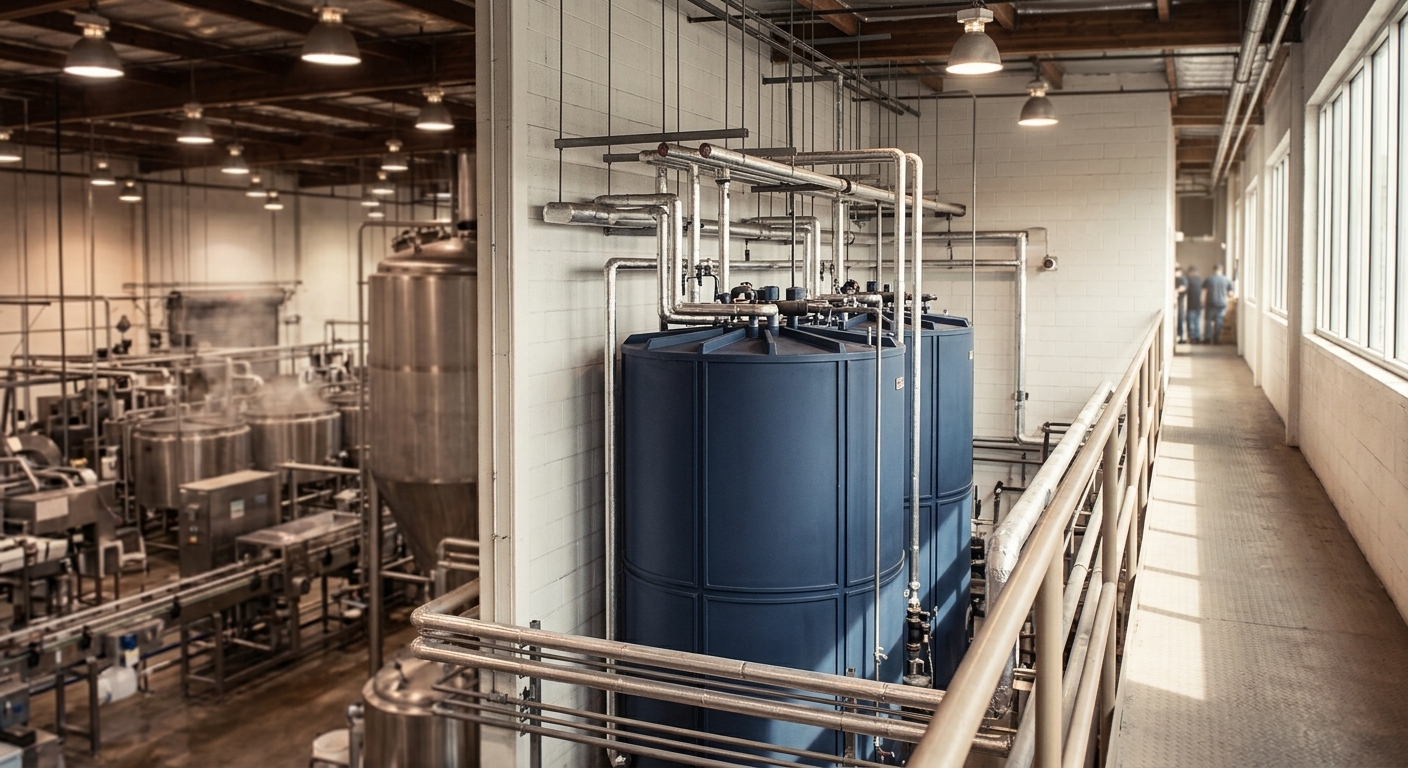
Thermal storage is classified by the physics of how the medium holds energy. The distinction matters commercially because it determines energy density, cost, temperature range, and how mature the supply chain is.
The 2021 DOE workshop report on thermal energy storage systems for buildings lays out the research agenda across all three categories and is worth reading if you want the national-lab view of where the field is heading. The DOE Building Technologies Office TES webinar series on novel materials also covers ongoing work. For a practicing engineer specifying a project this year, the honest summary is: use sensible water storage unless you have a specific reason not to.
The three physical mechanisms of thermal energy storage
TypeMechanismTypical mediaEnergy densityMaturity and where it fits
SensibleThe medium changes temperature; energy stored = mass × specific heat × ΔT.Water, rock or gravel, concrete, ceramic brick, molten salt, soil in a borehole.Low to moderate. Water stores approximately 1.16 kWh/m³·°C.Fully commercial. The default for building hot water, chilled water, district energy, and low-to-medium-temperature process heat. Cheapest per kWh and most forgiving to operate.
LatentThe medium changes phase at a fixed temperature; energy is stored in the latent heat of fusion.Ice, salt hydrates, paraffins, sugar alcohols, and metal alloys.Higher than sensible storage for the same volume, at a fixed temperature.Commercial in cooling, especially ice storage, and emerging elsewhere. DOE-funded work on salt hydrates and PCM ceiling panels continues; long-term cycling stability and cost remain constraints.
ThermochemicalEnergy is stored in a reversible chemical reaction or sorption process and released on recombination.Salt hydrates, metal hydrides, and sorption pairs.Highest of the three; near-lossless long-duration storage in principle.Research and pilot stage. Very attractive for seasonal storage, but not something to specify on a 2026 commercial project.
Thermal energy storage vs. battery storage
This comparison gets distorted in both directions. Battery vendors treat TES as a niche; thermal vendors imply TES replaces batteries. Neither is true. They store different things and solve different problems, and a sophisticated facility often wants both.
The peer-reviewed literature is appropriately measured about this. A 2025 Applied Energy benchmarking study on TES cost for industrial process heat found that systems installed today may not yield positive net present value against natural gas combustion in every ISO region. The economics depend heavily on the spread between electricity and gas prices where you operate. If the arbitrage spread in your market is thin, storage will not rescue the business case, and you should know that before you spend money on a feasibility study.
Thermal energy storage compared with lithium-ion battery storage
ComparisonThermal energy storageLithium-ion battery storage
What comes outHeat or cold, at a usable temperature.Electricity, at any time, for any load.
Cost per stored kWhRoughly $54–$97 per kWh for the tank at list price, before heat source and installation.Substantially higher on an installed energy basis; the gap is the main TES argument.
Round-trip efficiencyHigh for the thermal path; losses are standing losses over time, not conversion losses.High electrical round-trip efficiency, but converting stored electricity back into heat adds another step.
DegradationAn insulated water tank does not lose capacity with cycle count.Capacity fades with cycles and calendar age; replacement is a real line item.
Siting and safetyWater is non-toxic and non-flammable, with no thermal runaway risk; mechanical-room siting is required.Fire code, spacing, and permitting constraints may apply in occupied buildings.
Where batteries clearly winTES cannot power a server, motor, or light. It cannot provide backup electricity during an outage.Any application needing electricity back out, including resilience, frequency response, and electrical load shifting.
Best combined useShift the thermal load off-peak with TES first; it is usually the largest and cheapest block of shiftable demand.Size the battery for what remains after the thermal load is handled, which is often much smaller and cheaper.
How much does thermal energy storage cost?
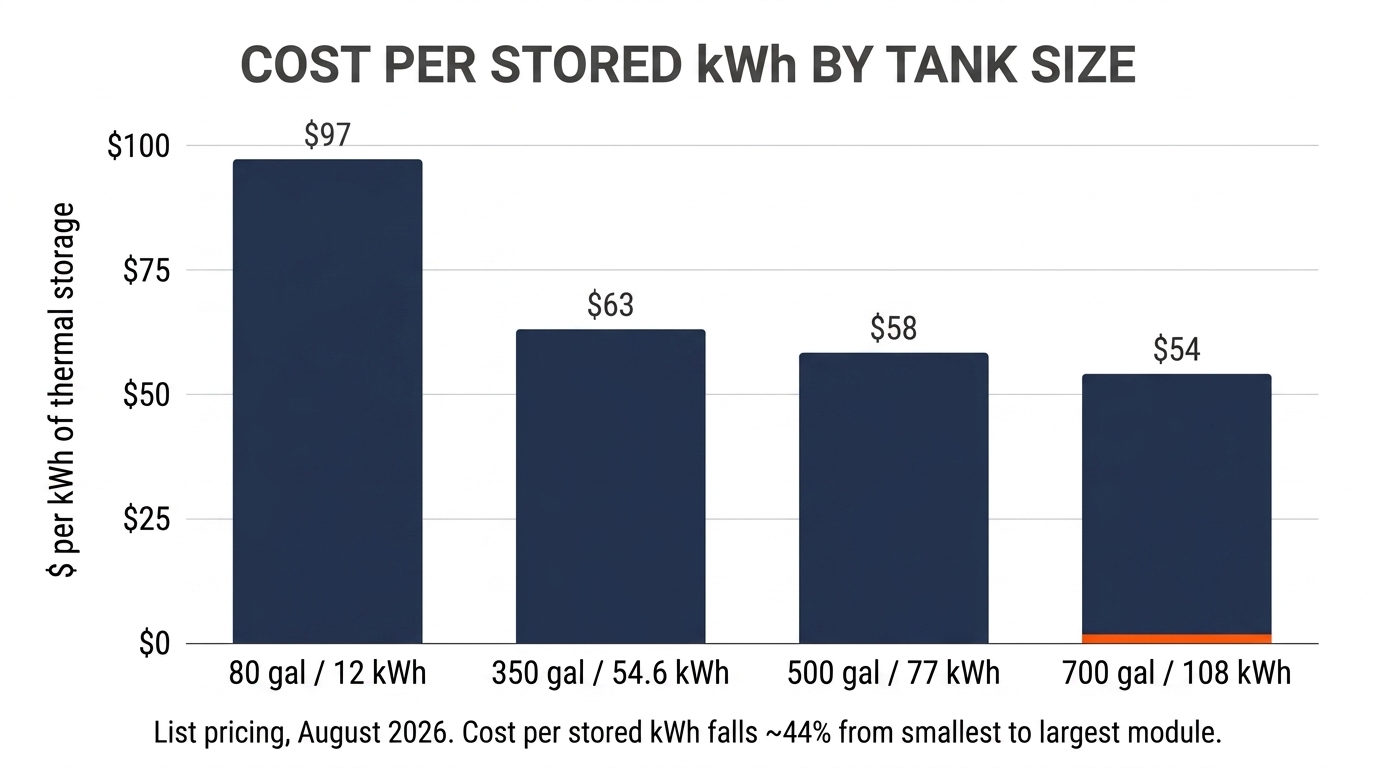
A modular thermal energy storage tank costs between roughly $1,200 and $5,800 per tank at list price, depending on capacity—equivalent to $54–$97 per kWh of thermal storage. That is the storage vessel itself. A complete installed system adds the heat source, such as a heat pump, PVT array, or electric elements, as well as heat exchangers, piping, controls, and labor, all of which vary by site.
The following thermal tank comparison and specifications provide the complete data.
Thermal Energy HQ modular tank list pricing, current as of August 2026
ModelList price$/kWh storedStorage capacity*Standing loss
80 gallon$1,190$9712.0 kWh7–8°F / 24 hr
350 gallon$3,427$6354.6 kWh3.8°F / 24 hr
500 gallon$4,464$5877.0 kWh3.0°F / 24 hr
700 gallon$5,798$54108.0 kWh2.4°F / 24 hr
What the pricing shows
*Rated at a 35°C temperature delta. Cost per stored kWh drops about 44% from the smallest tank to the largest—storage rewards volume, and undersizing to save capital usually costs more per unit of delivered benefit. Standing loss also improves sharply with size because surface area grows more slowly than volume. A 700-gallon module losing 2.4°F per day is a genuinely different asset from an 80-gallon module losing 7–8°F, and multi-day autonomy only becomes practical at the larger sizes.
Because modules interconnect, capacity can be phased: sized for today's load, expanded as a portfolio or a plant grows. For a packaged storage-plus-heat-pump skid rather than a component build, see the All-In-One thermal energy system.
Where thermal energy storage pays off
TES earns its keep wherever three conditions overlap: a thermal load with a defined peak, an energy price that varies by time, and a heat source whose capital cost scales with size. Here is where those conditions actually show up.
Commercial buildings on demand charges
The DOE Better Buildings fact sheet on thermal energy storage in commercial buildings is the clearest public summary of the mechanism: combining on-site renewable generation with thermal storage reduces both carbon emissions and operating cost, primarily by moving thermal load away from peak periods. Where a utility bills demand charges on a 15-minute peak, shaving that peak with stored thermal energy affects the bill every month for the life of the asset. The broader Better Buildings energy storage resources cover how storage of either kind fits a load-management strategy.
Central domestic hot water in multifamily and hospitality
A central heat pump water heater plant sized to meet a building's peak morning draw directly must be large, expensive, and heavily cycled. Add insulated storage and the same load is met by a smaller heat pump running longer during off-peak or solar hours, with stored hot water carrying the 6–9 a.m. spike. This is the single most reliable TES business case in buildings today, and it is why storage keeps appearing in electrification program design—see our guide to the CEC Equitable Building Decarbonization program for how that plays out inside a specific incentive structure.
Industrial and agricultural process heat
Process heat is where the volume is. Roughly half of industrial energy demand goes to process heat, and the overwhelming majority of it is still produced by combustion. Research published in Environmental Research Letters on facility-level industrial process heat demand shows how much of that demand sits at low and medium temperatures—precisely the band where hot water and steam storage paired with electric or solar-thermal input is technically straightforward.
Food and beverage, dairy, breweries, greenhouses, laundries, and car washes are the practical near-term targets. The IEA analysis of renewable heat tracks the same shift toward electrified process heat.
Solar-charged systems and PVT
Solar production and hot water demand are misaligned by several hours almost everywhere. Storage is what makes solar thermal or photovoltaic-thermal (PVT) input usable rather than merely available. Paired with a PVT array producing both electricity and heat, most or all of a facility's hot water energy can come from on-site solar, with the grid as backup rather than primary source. That is usually what people mean when they ask whether hot water can go off-grid. Full electrical islanding is a different and much larger project.
How to size a thermal energy storage system
Sizing is a four-step exercise. It is not complicated, but skipping any step produces a system that either does not cover the peak or costs more than it saves.
Check the recharge source
Then size the heat source to recharge the full storage volume within the available charge window, and check that the resulting source capacity is genuinely smaller than the unstored peak. If it is not, storage is not buying you anything on the capital side and the case has to stand on energy arbitrage alone.
When thermal energy storage is the wrong answer
We manufacture these tanks, so treat the following as the list we would want to read if we were on the buying side.
Tax treatment and incentives for thermal energy storage
The single most useful federal fact is a definitional one. Under the Clean Electricity Investment Credit, thermal energy storage property is explicitly inside the statutory definition of energy storage technology—see 26 U.S.C. §48E and the current statutory text at the U.S. House Office of the Law Revision Counsel. The IRS overview of the Clean Electricity Investment Credit and the implementing regulations at 26 CFR 1.48E-1 govern how the credit is computed.
Credit value depends on project scale, prevailing wage and apprenticeship compliance, domestic content, and post-2025 foreign-entity sourcing restrictions. The applicable percentages step up by construction start year, so timing matters. The accelerated termination provisions that apply to wind and solar facilities do not, on their face, apply the same way to energy storage technology. None of this is tax advice; confirm your specific position with a tax professional before it lands in a pro forma.
State and utility programs sit on top of the federal credit and change constantly. Custom commercial and multifamily efficiency rebates tied to demand reduction are the most common path for a thermal storage project, because the measured savings are exactly what those programs pay for. Check with the utility during design rather than assuming.
What to look for in a thermal energy storage tank
Once the concept is settled, the procurement questions narrow to five:
Frequently Asked Questions
What is thermal energy storage?
Thermal energy storage is a system that captures thermal energy—heat or cold—when it is cheap or abundant, holds it in a storage medium such as water, ice, rock, or a phase change material, and releases it when it is needed. It decouples the time energy is produced from the time it is consumed, allowing a smaller heat source to serve a larger peak load and allowing energy to be bought during low-cost hours.
How does thermal energy storage work?
A heat source charges a storage medium during a chosen window—overnight off-peak hours, a midday solar surplus, or a low-price period. The energy is held in an insulated vessel, where the only loss is standing loss over time. When demand arrives, the load draws from storage rather than from the source. In water-based systems, stratification keeps hot water layered at the top of the tank so delivery temperature stays usable throughout discharge.
What are the three types of thermal energy storage?
Sensible heat storage raises or lowers the temperature of a medium such as water, rock, concrete, or molten salt. Latent heat storage uses a phase change—melting or freezing—to store energy at a fixed temperature, as in ice storage or phase change materials. Thermochemical storage holds energy in a reversible chemical or sorption reaction and offers the highest energy density, but remains at research and pilot stage.
How much does thermal energy storage cost?
Modular thermal storage tanks list from $1,190 for an 80-gallon, 12 kWh tank to $5,798 for a 700-gallon, 108 kWh tank—roughly $54 to $97 per kWh of storage capacity. Cost per stored kWh falls about 44% from the smallest tank to the largest. A complete installed system costs more once the heat source, heat exchangers, piping, controls, and labor are included, and varies by site.
Is thermal energy storage better than batteries?
They solve different problems. Thermal storage is far cheaper per stored kWh and does not degrade with cycling, but it returns heat or cold rather than electricity, so it cannot power electrical loads or provide outage backup. Batteries do that and cost more per stored kWh. Facilities with large thermal loads usually get the most value from shifting the thermal load with TES first, then sizing a battery for what remains.
How long can thermal energy storage hold heat?
It depends on insulation quality and tank size. Published standing losses for modular tanks range from about 7–8°F per 24 hours on an 80-gallon module to about 2.4°F per 24 hours on a 700-gallon module, because surface area grows more slowly than volume. Daily and multi-day cycling are practical at the larger sizes; seasonal storage requires different technology, typically borehole or thermochemical.
Does thermal energy storage qualify for federal tax credits?
Thermal energy storage property is inside the statutory definition of energy storage technology under the federal §48E Clean Electricity Investment Credit. Credit value depends on project size, prevailing wage and apprenticeship compliance, domestic content, and foreign-entity sourcing restrictions, and the applicable percentage varies by construction start year. Confirm specifics with a tax professional.
What size thermal storage tank do I need?
Size against the hourly load profile, not the daily total. Determine the peak block storage must carry unaided, compute usable stored energy as mass × specific heat × the usable temperature delta—not the nominal rated delta—and subtract standing losses across the hold period. Then confirm the heat source can fully recharge that volume within the available charge window.
Conclusion
Thermal energy storage is the cheapest form of energy storage available to any facility whose load is already thermal—which is most facilities. It works by letting a smaller heat source serve a larger peak, and it pays in three currencies: capital avoided on equipment, demand charges shaved, and energy bought at the hour it is cheapest instead of the hour it is needed. The technology is mature, the tax treatment puts it on the same statutory footing as batteries, and the published cost per stored kWh is a fraction of the electrochemical alternative.
It is also not universal. Flat rates, flat loads, high-temperature processes, and resilience requirements are real disqualifiers, and we would rather tell you that now than after a feasibility study. The fastest way to find out which side of that line your facility is on is a short conversation about your actual load profile.