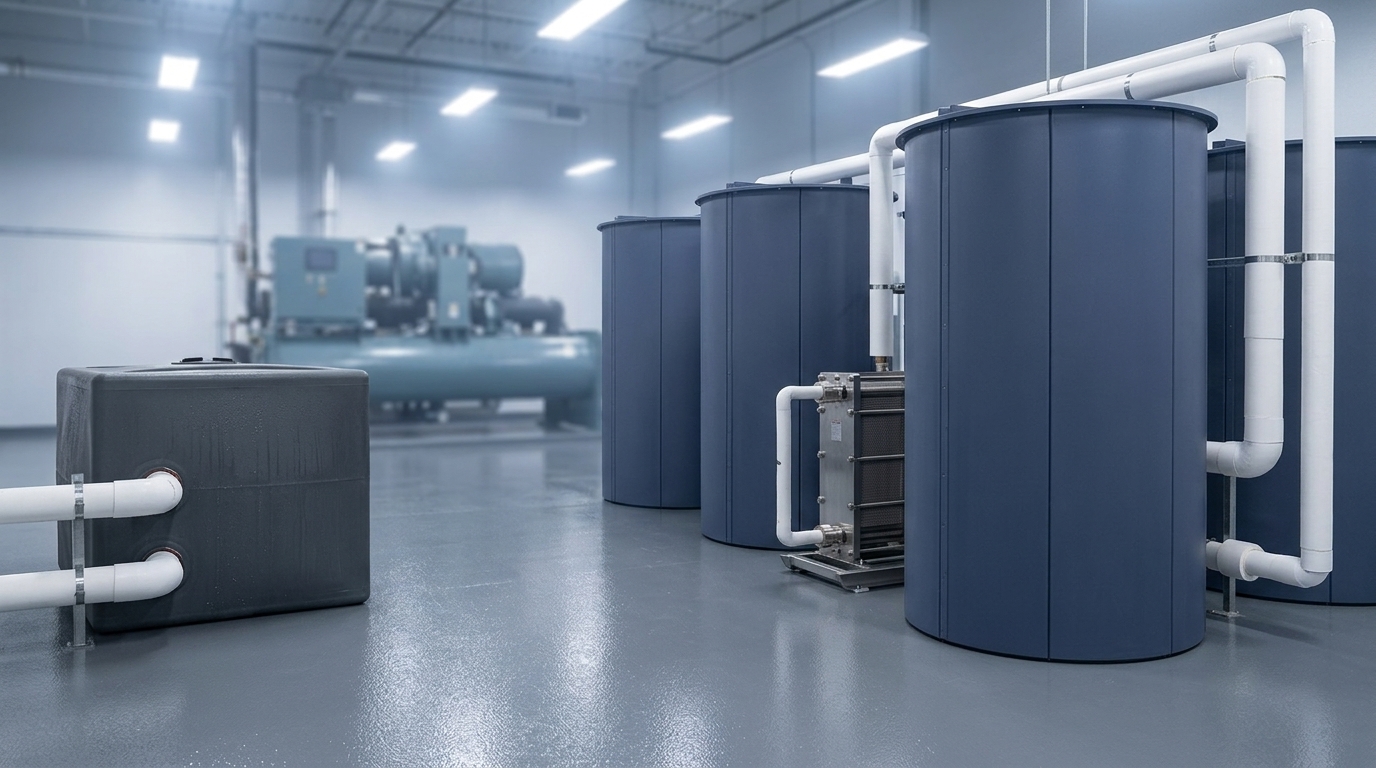
“Modular” has become one of the least precise words in energy storage. It gets applied to shipping containers full of concrete, to swappable ice cells, to plug-and-play boxes of phase change material, and to the thing this article is actually about: a storage tank whose pressure vessel is not a vessel at all, but a ring of interlocking insulating panels that a two-person crew carries through a doorway and assembles on the floor. The distinction matters, because those architectures solve completely different problems.
In short: Modular thermal energy storage is thermal storage built from repeatable units that ship flat or small, assemble on site, and scale by addition rather than by resizing. In the panelized form, a cylindrical wall of rigid insulating panels supports a flexible inner liner, an outer support jacket holds the ring in hoop tension, and an insulated lid carries the plumbing and controls — an architecture set out in the granted patent behind the tank. The practical result is a 350- to 700-gallon store that passes through a 34-inch door, needs no crane, no welding, and no ASME vessel, and can be expanded module by module as a building or portfolio electrifies. List pricing runs $1,190 to $5,798 per tank, or roughly $54–$97 per kWh of thermal storage.
Key Takeaways
In this article
What is modular thermal energy storage?
Modular thermal energy storage is thermal storage assembled on site from repeatable units, sized by adding or removing units rather than by specifying a different vessel. The storage physics is unchanged — sensible heat in water, rock, or concrete, or latent heat in a phase change material, as classified in Sandia’s chapter of the DOE Energy Storage Handbook. What modularity changes is delivery, installation, and growth: how the thing gets into the building, how long it takes to stand up, and whether capacity can follow load.
Three genuinely different architectures use the word, and conflating them is the most common source of confusion in specification.
Research funding follows the same split: the U.S. Department of Energy's buildings program is funding a modular plug-and-play cross-media thermal storage system using salt-based phase change material for residential heating and cooling, while the DOE Technology Strategy Assessment on thermal energy storage treats the whole category as one of the most under-deployed levers in building decarbonization. This article is about the third row — panelized liquid storage — because that is where the engineering is specific and the retrofit problem is real.
Three architectures described as modular thermal energy storage
ArchitectureWhat the module isTypical dutyWhere it goes
Containerized heat batteryA shipping-container-sized block of concrete, ceramic, or refractory with embedded tubingIndustrial process heat and steam, 200–600°COutdoor pad, craned into place
Encapsulated cell arrayA sealed cell of ice or phase change material, racked in quantityChiller load shifting and cooling peaksPlant room, roof, or outdoors; racked
Panelized liquid tankAn insulating panel — one of five to a cylinder — plus liner, jacket, and lidDomestic hot water, heating buffer, and load shifting, 4–90°CIndoor mechanical room; hand-carried through a door
How a panelized modular tank is built
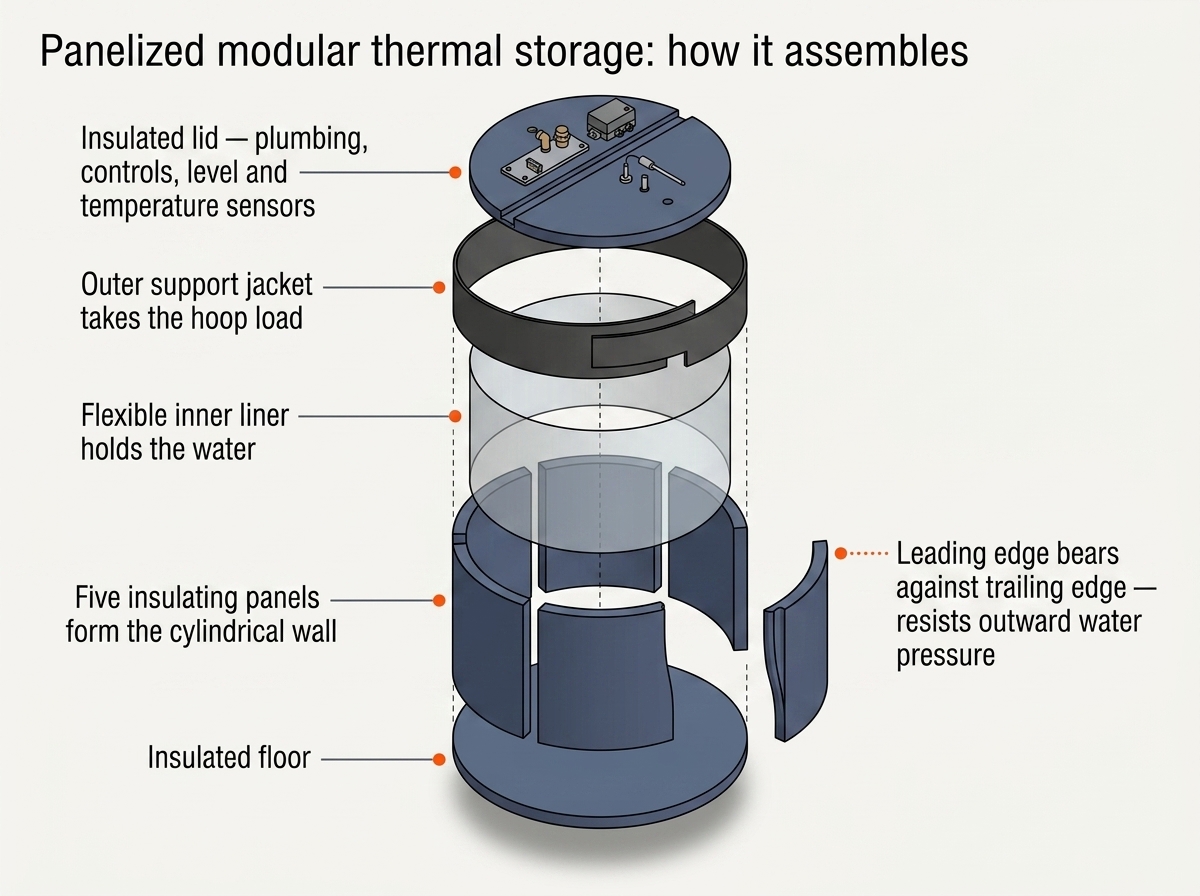
The architecture is set out in US Patent 8,381,939, “Insulated storage tank” (filed February 2010, granted February 2013, priority to a provisional filed February 2009; inventors Garth J. Schultz, Ken Buttery, and Scott Leslie), with counterparts including EP 2398719 B1 and the WO 2010/096667 international application. The patent behind the tank describes four elements that do the work:
The insulating panels: Rigid foam panels — expanded polypropylene is the preferred material — are arranged in a circumferential pattern so that each panel touches two others, forming a self-supporting cylindrical wall. Each panel has a shaped leading edge and an offset trailing edge; positioning one panel's leading edge in direct contact with the next panel's trailing edge is what resists the outward radial force of the water. Five panels form a complete cylinder in the described embodiment, and the arc length of each panel is varied to produce different tank diameters and capacities.
The inner liner: A flexible polymeric liner conforms to the cylinder and holds the liquid, bearing against the panels' inner faces. The liner is specified for liquids across a wide temperature band, and because it is the only wetted surface, the panels never contact water.
The outer support jacket: A thin polymer jacket — thermoplastic polyolefin on the order of 1–2 mm — wraps the panel ring and takes the hoop load. The patent works the numbers: for a 60-inch outside diameter, 350-gallon tank with 4.4-inch panels and a 1 mm jacket, the calculated jacket stress is around 1,084 psi against a tensile yield near 3,100 psi.
The insulated lid: The lid seals the liner and carries the working hardware — plumbing board with inlet and outlet ports, control unit, water level sensor, and temperature sensor. It splits along its midline so half can be opened for service without disturbing the instrumentation.
Assembly follows the same order every time: set the insulated floor, slot the panels around it one at a time until the ring closes, drop in the liner, wrap and join the jacket, and fit the lid. The whole kit ships flat on a pallet. In the field this is routinely a sub-hour job for a small crew with no lifting equipment — see the modular tank installation and insulation details.
The problem modularity actually solves
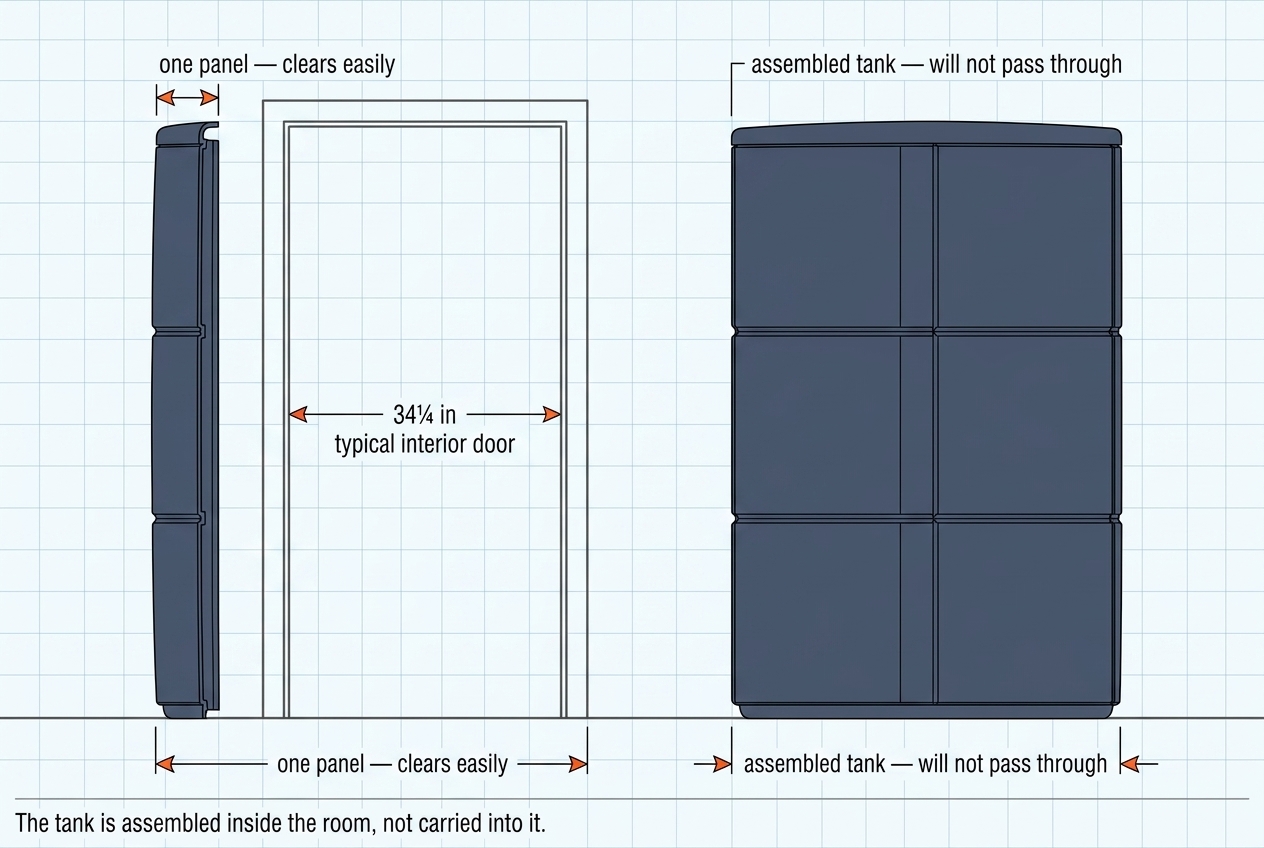
The patent states its own motivation more bluntly than most marketing does: prefabricated storage tanks of several hundred to several thousand gallons are awkward to handle, average interior door widths run roughly 34¼ to 36¼ inches — narrower than the tanks — and once such a tank is set in a basement or plant room, it is very difficult to move. That is the whole retrofit problem in two sentences.
It compounds in the buildings that most need storage. Occupied multifamily, hotels, hospitals, and laboratories have mechanical rooms that were sized for a gas boiler and a couple of pumps, sit below grade or behind two door swings, and cannot be opened up without taking the building offline. DOE’s Better Buildings guidance on thermal energy storage identifies peak reduction, load shifting, and cost-effective electrification as the value of storage in exactly these buildings — value that is unrealizable if the vessel cannot physically reach the room. At the other extreme, when there is space and scale, monolithic works fine: DOE’s FEMP case study of a 3.3-million-gallon stratified tank at a VA medical center is a good example of what a site-built vessel does well.
Modularity also changes the shape of the investment. A welded tank is a one-time capacity decision made years before the load is known. Modules interconnect, so a portfolio can install for today's draw and add capacity building by building as equipment is electrified — capital that follows load instead of preceding it.
What modular thermal storage costs
Current published list pricing for the modular thermal storage tank line:
Published modular thermal storage tank pricing and performance
ModelList price$/kWh storedStorage capacity*Standing loss
80 gallon$1,190$9712.0 kWh7–8°F / 24 hr
350 gallon$3,427$6354.6 kWh3.8°F / 24 hr
500 gallon$4,464$5877.0 kWh3.0°F / 24 hr
700 gallon$5,798$54108.0 kWh2.4°F / 24 hr
Putting the pricing in context
*Rated at a 35°C temperature delta. Pricing current as of August 2026; see the full thermal tank comparison and specifications for complete data. That is the storage vessel; an installed system adds the heat source, heat exchangers, piping, controls, and labor. For a packaged storage-plus-heat-pump skid, see the All-In-One thermal energy system.
Against packaged latent-heat devices, NREL’s thermal battery cost-scaling analysis models PCM thermal batteries at roughly $69–$155 per kWh depending on conductivity enhancement — modular water sits below that range on a per-kWh basis, with the trade-off in volume covered in our sensible vs. latent heat storage comparison.
Against a welded steel tank of similar volume, the vessel price is broadly comparable; the savings that matter show up in the line items nobody quotes — no crane, no rigging, no door or wall demolition, no structural pad, and a delivery that fits on one pallet.
Modular vs. welded: an honest comparison
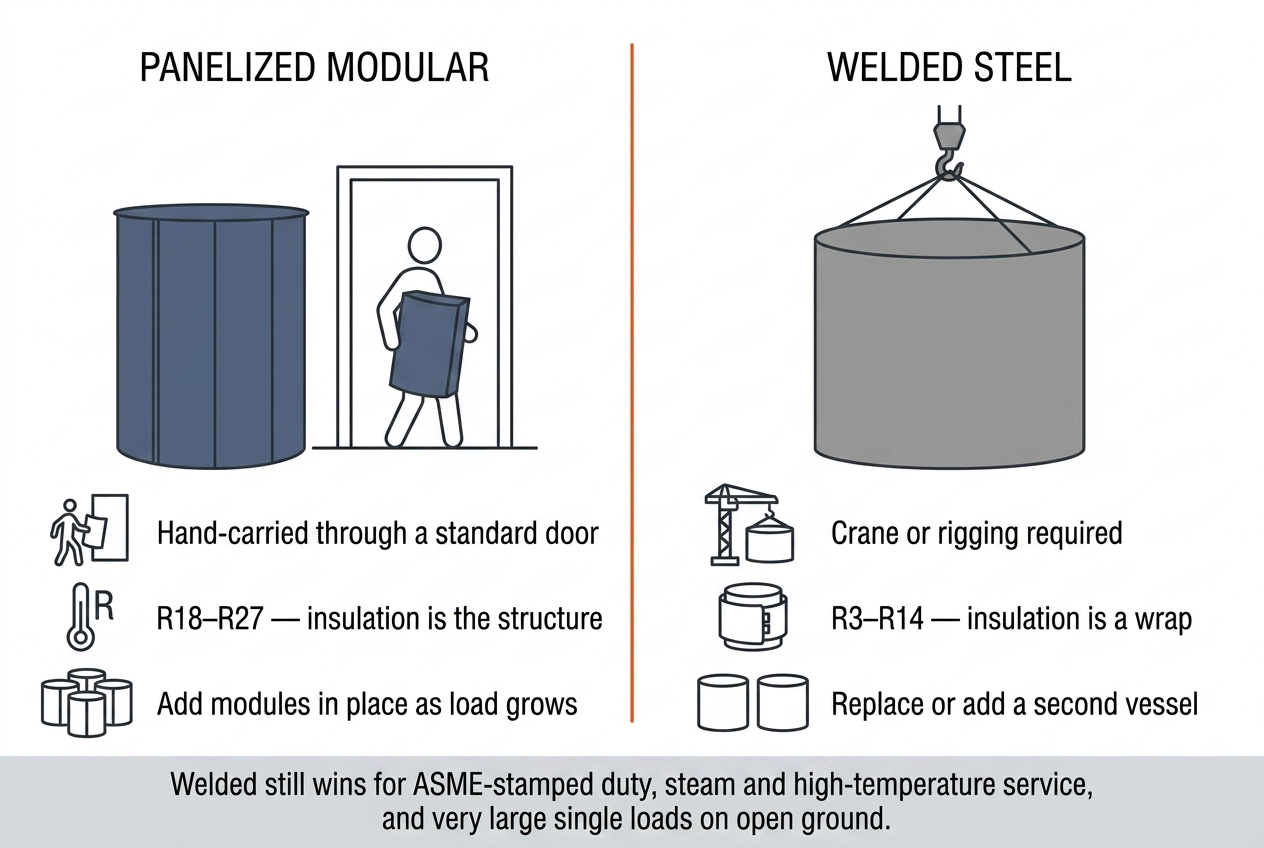
Be direct about the losing cases. If the specification calls for an ASME-stamped pressure vessel, a panelized atmospheric tank is not a substitute. If the duty is steam or high-temperature process heat, this is the wrong architecture entirely — that is what containerized industrial heat batteries are for. And if a single load needs tens of thousands of gallons on an outdoor pad with crane access, a site-built tank will win on cost per gallon every time. Modular earns its place when access, disruption, and phasing are the expensive parts of the project — which, in occupied buildings, they usually are.
Panelized modular tank compared with a welded steel tank
FactorPanelized modular tankWelded steel tank
Largest piece to moveOne insulating panel, hand-carriedThe whole vessel
Access requiredStandard doorway, no craneCrane, rigging, or wall opening
InsulationR18–R27 typical; rigid foam is the structureR3–R14 typical; insulation is a wrap
Corrosion / scaleUnpressurized water, never leaves the tankWetted steel; corrosion and scaling are lifecycle items
Pressure ratingAtmospheric; heat exchanger interfaces the loopPressurized options; ASME stamp available
Temperature rangeSuited to hot-water and heating dutyWider, including high-temperature service
ExpansionAdd modules in placeReplace or add a second vessel
RelocationDisassemble and moveEffectively permanent
Best fitRetrofit, constrained rooms, phased capacityNew construction, large single loads, code-mandated vessels
Where modular thermal storage is used
Sizing questions are the same across applications: draw profile, available charge window, heat source capacity, and how much floor space the room can spare.
Related thermal storage systems and comparisons
See how modular storage pairs with heat pumps, PVT, and hybrid configurations in Thermal Energy HQ’s system solutions, and how it compares with other storage media in the thermal energy storage guide and the ice vs. chilled water storage comparison.
Incentives and modular storage
Incentive programs evaluate performance, not architecture: kWh shifted, kW of peak avoided, and therms displaced. Modular construction does not create or forfeit eligibility. At the federal level, thermal energy storage falls within the statutory definition of energy storage technology under 26 U.S.C. §48E, summarized on the IRS Clean Electricity Investment Credit page; whether a particular configuration qualifies depends on what it serves and how it is placed in service, and should be confirmed with a tax professional. Where modularity does help is in documentation: because capacity is a transparent function of volume and temperature delta, and because modules are identical, measurement and verification for a phased installation is straightforward to model.
Frequently Asked Questions
What is modular thermal energy storage?
Modular thermal energy storage is thermal storage assembled on site from repeatable units, where capacity is set by adding or removing units rather than by specifying a different vessel. Three architectures use the term: containerized industrial heat batteries for process heat, encapsulated ice or phase change material cells for cooling, and panelized liquid tanks for building hot water and heating. In the panelized form, rigid insulating panels form a self-supporting cylindrical wall around a flexible liner, held by a thin outer support jacket and closed by an insulated lid.
How does a modular thermal storage tank fit through a doorway?
The tank has no pre-formed vessel. It ships as a flat pallet of rigid insulating panels, a folded liner, an outer jacket, a floor, and a lid — each piece small and light enough to hand-carry. On site the panels are slotted around the insulated floor in a circle until the ring closes, the liner is dropped in, and the jacket is wrapped around the outside. The patent behind the design cites average interior door widths of about 34¼ to 36¼ inches as the constraint it was created to solve.
Is a modular thermal storage tank as well insulated as a steel tank?
Typically better. In a panelized tank the insulation is the structure, so wall thickness is measured in inches of rigid foam rather than in a wrap. Common configurations deliver R18 to R27, compared with roughly R3 to R14 for most insulated steel tanks, with measured standing losses of about 2.4°F per 24 hours for a 700-gallon module and 7–8°F for an 80-gallon module.
How much does modular thermal energy storage cost?
Modular thermal storage tanks list from $1,190 for an 80-gallon module, about 12 kWh, to $5,798 for a 700-gallon module, about 108 kWh, which works out to roughly $54 to $97 per kWh of storage capacity. Cost per stored kWh drops about 44% from the smallest module to the largest. Those figures are for the storage vessel; a complete installed system adds the heat source, heat exchangers, piping, controls, and labor.
Can modular thermal storage be expanded later?
Yes — that is the main reason to choose it. Modules interconnect, so a system can be sized for today's load and expanded by adding modules as loads grow or as a portfolio electrifies building by building. Because the tanks assemble and disassemble in place, they can also be relocated, which a welded vessel effectively cannot.
When is a welded tank the better choice?
When the specification requires an ASME-stamped pressure vessel, when the duty involves steam or high-temperature process heat, or when a single very large load can be served on an outdoor pad with crane access. Panelized modular tanks are atmospheric, interface with pressurized loops through a heat exchanger, and are aimed at hot-water and heating duty in constrained indoor spaces.
Conclusion
Modular thermal energy storage is not a marketing adjective for “comes in three sizes.” In its panelized form it is a specific architecture — insulating panels as structure, a liner as the vessel, a jacket in hoop tension, and a lid carrying the controls — designed around the fact that the buildings that most need storage have the doors least willing to accept it.
It is the wrong answer for steam, for ASME-stamped duty, and for very large single loads on open ground. It is the right answer when the storage has to get into a working building, stand up in an afternoon, and grow later.
The fastest way to know which you need is a short engineering conversation about your draw profile, heat source, and the actual dimensions of the room.