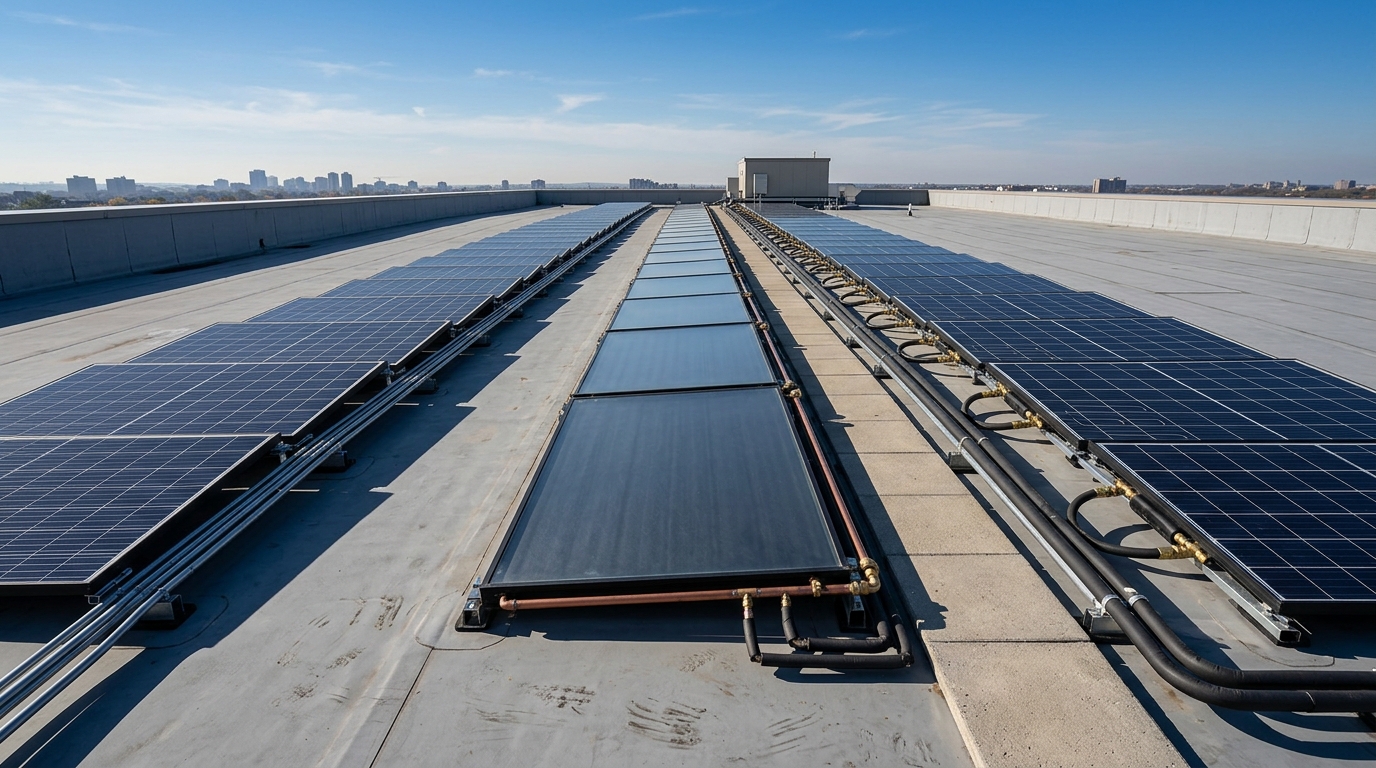
Three technologies compete for the same square feet of roof, and they do not make the same product. A photovoltaic module makes electricity. A solar thermal collector makes hot water. A PVT hybrid makes both.
Choosing between them is not a question of which is most efficient—solar thermal wins that comparison easily and always has—but of which output your building actually needs, how much roof you have, and what a unit of each output is worth to you. The answer has changed considerably in the last decade, and most of the comparison content online has not caught up.
In short: Solar thermal converts roughly 40–70% of incident solar energy into usable heat, several times what PV converts into electricity, but heat is the less valuable and less flexible product. PV modules convert roughly 20–23% into electricity, which can run a heat pump water heater at a coefficient of performance of 3–4 and therefore deliver more heat per rooftop dollar than a thermal collector in most moderate climates. PVT delivers both from one footprint, with each side slightly compromised, and earns its premium where roof area is the binding constraint and electricity rates are high.
For most commercial retrofits with adequate roof space, PV plus a heat pump is now the default; thermal and hybrid collectors win on constrained roofs, in hot climates, at high electricity rates, and where high delivery temperatures or process heat are required.
Key Takeaways
Start with the product each technology makes. Most comparison articles skip that step and go straight to efficiency percentages that are not comparable to one another.
In this article
What each technology actually produces
Solar PV converts photons directly to electricity through a semiconductor junction. Output is electrical, dispatchable to any load, exportable to the grid in many markets, and storable in batteries. Modules degrade slowly and have no moving parts or fluids.
Solar thermal absorbs solar radiation as heat in a dark absorber and transfers it to a circulating fluid. Output is heat at a temperature set by the collector type and operating conditions. It cannot be converted to electricity at building scale, cannot be exported, and must be used or stored as heat.
PVT (photovoltaic-thermal) bonds a thermal absorber behind PV cells so one collector produces both. The fluid cools the cells, which raises electrical output slightly, and carries away heat that would otherwise be wasted. See our guide to PVT solar panels for more detail.
The three outputs are not interchangeable, and that asymmetry drives everything that follows. A kilowatt-hour of electricity can become a kilowatt-hour of heat—or, through a heat pump, three to four kilowatt-hours of heat. A kilowatt-hour of heat can only ever be a kilowatt-hour of heat, at or below the temperature it was collected.
Energy per meter foot: the comparison that favors thermal
If the question is how much of the sun's energy a collector captures, solar thermal wins by a wide margin and it is not close.
The delivery-temperature column is the one that gets left out of vendor comparisons, and it matters more than the headline efficiency. A thermal collector's efficiency is not a constant; it falls as the difference between fluid temperature and ambient grows. A modelling study comparing evacuated flat plate collectors with conventional thermal, PVT, and PV panels found annual output for every collector modelled to be a quadratic function of delivery temperature. Asking “which collector is more efficient?” without stating the temperature is not a well-formed question.
is a useful reference point for how far the flat-plate side has been pushed.
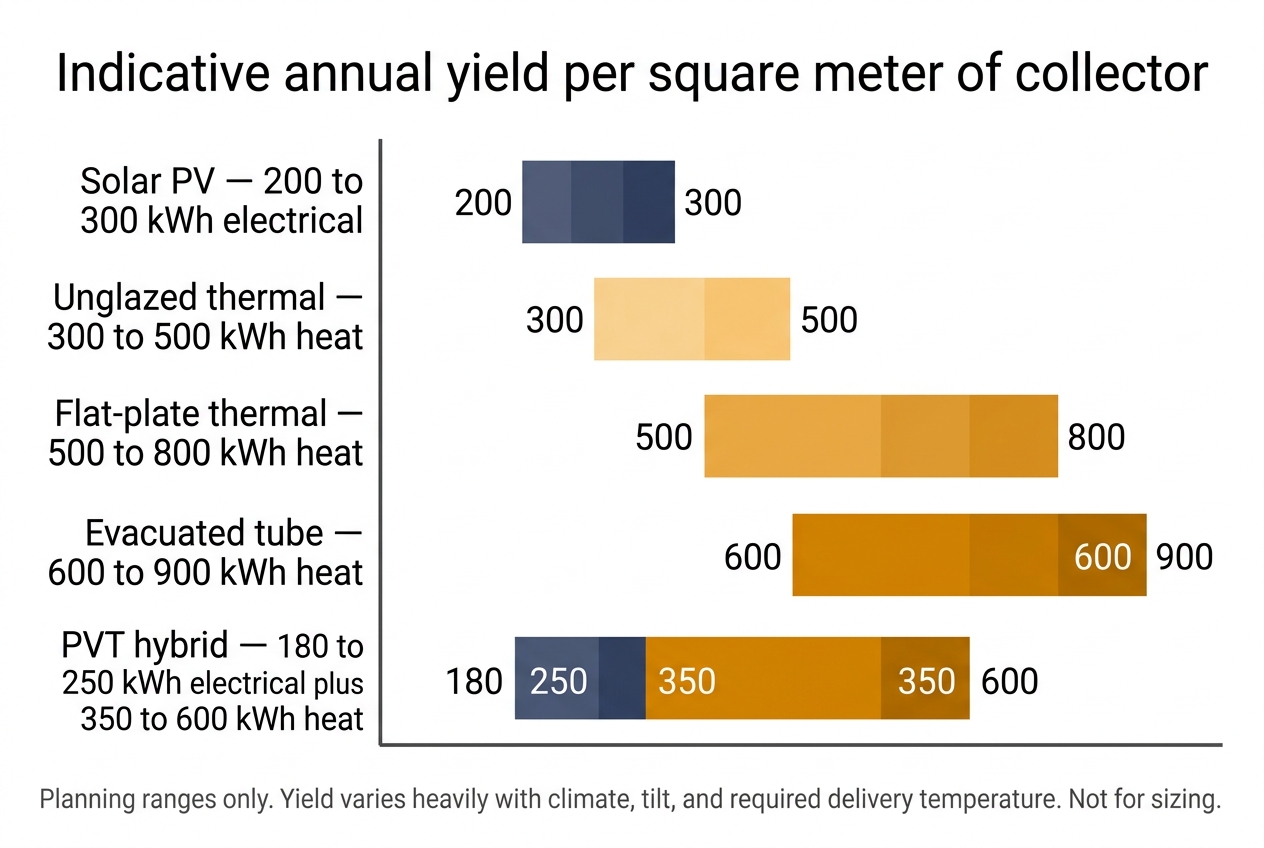
Indicative annual yield and delivery characteristics by technology. Planning ranges only, drawn from the cited literature; actual yield varies enormously by climate, tilt, orientation, and—for thermal rows—the temperature the system must deliver. Do not use these for sizing.
TechnologyConversion efficiencyIndicative annual yield per m² of collector*Output formDelivery temperature
Solar PV~20–23% electrical~200–300 kWh electricalElectricityn/a
Unglazed thermal~30–50% thermal (low delta-T only)~300–500 kWh thermalHeatLow; pools and preheat
Flat-plate thermal~45–65% thermal~500–800 kWh thermalHeatGood to ~60°C, falls off sharply above
Evacuated tube thermal~50–70% thermal~600–900 kWh thermalHeatHolds efficiency to 70–90°C
PVT hybrid~15–20% electrical + ~40–55% thermal~180–250 kWh electrical plus ~350–600 kWh thermalBothModest; rises with glazing, at a cost to electrical output
Why cheap PV changed the answer
Here is the argument that most comparison content has not absorbed. A solar thermal collector might capture two to three times as much energy per square foot as a PV module. But the PV module's electricity can drive a heat pump water heater, and a heat pump does not convert electricity to heat one-for-one—it moves heat, delivering three to four units for every unit consumed.
Run that arithmetic on a square meter of roof. Two hundred and fifty kilowatt-hours of PV electricity, through a heat pump at COP 3.5, becomes roughly 875 kilowatt-hours of delivered heat—comfortably more than the same square meter of flat-plate collector would have produced directly. That is before accounting for the fact that the PV array can do something else entirely with its output whenever hot water demand is satisfied.
Add the second-order effects and the gap widens: no roof-mounted fluid loop, no glycol, no freeze protection, no stagnation risk on a hot day with no draw, no annual collector-loop maintenance, and a supply chain of commodity parts installed by electricians rather than by a specialty solar-thermal contractor. This is why solar thermal has lost share in markets where it once dominated, and any comparison that does not say so is selling something.
Where solar thermal and PVT still win
The default is not universal, and treating it as one is its own error. Five conditions flip the answer:
These criteria are close to the deployment direction produced by the GSA Green Proving Ground evaluation of PV-T technology, following NREL's measurement and verification at the O'Neill Federal Building in Boston. The evaluation was candid that the measurement and verification did not deliver definitive results because of design and commissioning conflicts. The full NREL technical report and the GSA/NREL GPG-016 findings brief are public.
PVT vs. separate PV and thermal arrays
If a building genuinely needs both outputs, the next question is whether to hybridize or to install two arrays.
The thermal-coupling compromise is structural rather than a manufacturing shortfall. As research on spectral-splitting PVT collectors explains, conventional designs put the absorber in good thermal contact with the cells, so the cells and absorber run at similar temperatures. Pursuing a higher-temperature thermal output therefore necessarily compromises electrical efficiency. Spectral splitting is the research answer; it is not yet a commodity product.
Meanwhile, a 2025 review of PVT configurations reports total efficiencies reaching roughly 76% in favorable setups with 3–5% electrical gain, and experimental characterization of a commercial PVT panel shows thermal efficiency rising as inlet temperature falls. What the array is plumbed into changes what the array produces.
PVT hybrid arrays compared with separate PV and solar thermal arrays
ConsiderationPVT hybrid arraySeparate PV + solar thermal arrays
Roof areaOne array serves both loads—the decisive advantageTwo arrays, each sized to its own load
OptimizationCompromised: raising thermal output costs electrical outputEach technology optimized independently
Delivery temperatureModest; glazing raises it at a cost to the cellsThermal side free to use evacuated tubes for high temperature
ComplexityOne array, one racking system, one roof penetration setTwo systems, two contractors, two maintenance regimes
Failure couplingA thermal loop fault can affect the electrical assetIndependent—one can fail without the other
Cost per unit outputPremium over plain PV, and the premium has grown as PV prices fellThermal side carries its own cost; PV side is commodity
Whatever you choose, storage decides whether it works
All three technologies share one problem: solar energy arrives at midday and buildings want hot water in the morning and the evening. For a thermal or PVT array, storage is the only thing standing between collected heat and wasted heat. For a PV-plus-heat-pump system, storage is what lets the heat pump run during solar hours instead of chasing demand at 7 a.m. on grid power.
DOE Better Buildings guidance on thermal energy storage frames the value identically in all three cases: peak reduction, shifting load to cheaper hours, and making electrification cost-effective.
Storage also changes what the collectors produce. Because thermal collector efficiency falls as delivery temperature rises, a larger store returning cooler fluid to the array increases how much energy the array captures over the day. Sizing the store and the array together is not an optimization—it is the design.
In practice that means modular thermal storage tanks sized in kilowatt-hours against the load, with modular construction mattering because solar retrofits land on buildings whose mechanical rooms were never sized for a vessel. See Thermal Energy HQ's system solutions, the PowerPanel PVT and Thermal Tank configuration, and the All-In-One thermal energy system. For storage fundamentals, see the thermal tank overview, modular thermal storage article, and thermal energy storage guide.
How to decide, in order
Work the questions in this sequence. Answering them out of order is how projects end up with the wrong collector on the roof.
For screening and procurement, the DOE on-site commercial solar decision guide covers the process side, and NREL's System Advisor Model remains the standard free tool for modelling project economics. Whatever the technology, model hourly rather than monthly—the mismatch between collection and demand is invisible at monthly resolution.
Seven questions for selecting a rooftop solar technology
#QuestionWhat the answer rules in or out
1What does the building actually need—electricity, heat, or both?Electricity only → PV. Heat only, high temperature → solar thermal. Both, and both material → PVT is a candidate.
2Is there enough roof for a PV array sized to both loads?Yes → PV plus heat pump is the default. No → thermal or PVT density starts to win.
3What is the electricity rate?Under ~$0.15/kWh → solar paybacks stretch badly for every technology. Over ~$0.30 → PVT and thermal become genuinely competitive.
4What delivery temperature does the load require?Under ~60°C → flat plate, PVT, or heat pump all viable. 70–90°C → evacuated tube. Above that → outside rooftop solar entirely.
5Is the hot water central or point-of-use?Point-of-use → no solar thermal or PVT project exists here at any price.
6What is the climate?Hot → favors unglazed and PVT. Cold → favors evacuated tube; unglazed loses too much to ambient.
7How much storage can the mechanical room take?Determines how much of any array's output is actually usable.
Incentives across the three
Incentive treatment is genuinely uneven, and it is worth checking all three tracks for the same project. PV is the best-served category in nearly every jurisdiction. Solar thermal is often handled under a separate program with different rules and a smaller budget, and in some markets is not covered at all. PVT sits awkwardly across both because it is two technologies in one enclosure.
At the federal level, thermal energy storage falls within the statutory definition of energy storage technology under 26 U.S.C. §48E; how collectors and hybrid units are characterized depends on configuration and belongs with a tax professional before it reaches a pro forma.
Frequently Asked Questions
What is the difference between solar thermal and solar PV?
Solar PV converts sunlight directly into electricity through semiconductor cells, at roughly 20 to 23 percent efficiency. Solar thermal absorbs sunlight as heat in a dark absorber and transfers it to a circulating fluid, at roughly 40 to 70 percent efficiency depending on collector type and delivery temperature. Thermal captures far more of the sun's energy, but heat can only be used as heat, while electricity can run any load, be exported, or drive a heat pump.
Which is better for hot water, solar thermal or solar panels?
For most commercial buildings in moderate climates with adequate roof area, PV panels driving a heat pump water heater now deliver hot water at a lower cost per Btu than a solar thermal array. A heat pump produces roughly three to four units of heat per unit of electricity, which more than compensates for PV's lower collection efficiency, and there is no rooftop fluid loop to freeze, stagnate, or maintain. Solar thermal remains the better answer where roof area is constrained, where delivery temperatures above about 70°C are required, or where electricity is very expensive.
How does PVT compare with PV and solar thermal?
A PVT hybrid panel produces both electricity and heat from one collector, so it yields more total energy per square foot than either technology alone. The trade-off is that neither output is optimized: raising the thermal output temperature compromises electrical efficiency because the absorber and cells run at similar temperatures. PVT is worth its premium mainly where roof area is the binding constraint and electricity rates are high enough that both outputs carry real value.
Which solar technology produces the most energy per square foot?
Solar thermal, by a wide margin, if the measure is raw energy captured. Evacuated tube collectors can deliver on the order of 600 to 900 kWh of heat per square meter annually, flat plates roughly 500 to 800, compared with roughly 200 to 300 kWh of electricity per square meter from PV. These are planning ranges that vary heavily with climate, tilt, and the temperature the system must deliver. The higher figure does not settle the decision, because a kilowatt-hour of electricity is worth more and can be converted to several kilowatt-hours of heat through a heat pump.
Should I choose flat plate or evacuated tube solar collectors?
Match the collector to the delivery temperature and the climate. Flat-plate collectors are less expensive and perform well up to about 60°C, above which their output falls off sharply. Evacuated tube collectors suppress convective and conductive losses through a vacuum enclosure, so they hold efficiency at 70 to 90°C and perform better in cold climates, at the cost of higher price and more gross roof area for the same absorber area.
Do all three technologies need thermal storage?
For hot water, effectively yes. Solar energy arrives around midday while buildings draw hot water in the morning and evening, so without storage most collected heat has nowhere to go. With a PV and heat pump system, storage is what allows the heat pump to run during cheap or solar hours rather than chasing demand at peak. Storage also improves collection itself, because thermal collector efficiency rises as the fluid returning to the array gets cooler.
Conclusion
Solar thermal is the most efficient way to capture solar energy and has been losing anyway, because efficiency was never the metric that decided anything. Cheap PV modules and good heat pumps reframed the comparison: a low-efficiency collector making a high-value, flexible product, multiplied three or four times by a heat pump, beats a high-efficiency collector making a low-value, inflexible one—in most buildings, in most climates, most of the time.
The exceptions are real and specific: constrained roofs, high delivery temperatures, expensive electricity, hot climates, and central loads. In those buildings a thermal or hybrid array is the better engineering answer and the arithmetic supports it. In the rest, it does not, and a specifier who says so early earns the right to be believed about everything else.
Whichever technology fits, the store is what turns collected energy into delivered energy. The fastest way to size both is a short engineering conversation about your roof, your load profile, and your electricity rate.
Garth Schultz is President & Inventor of Thermal Energy HQ, where he leads development of modular thermal energy storage systems manufactured in the United States. He is the inventor named on patents covering hybrid photovoltaic-thermal (PVT) solar panels and insulated modular storage tank construction, and has worked in solar-thermal product development since founding the company's technology line in 2007. Connect on LinkedIn.