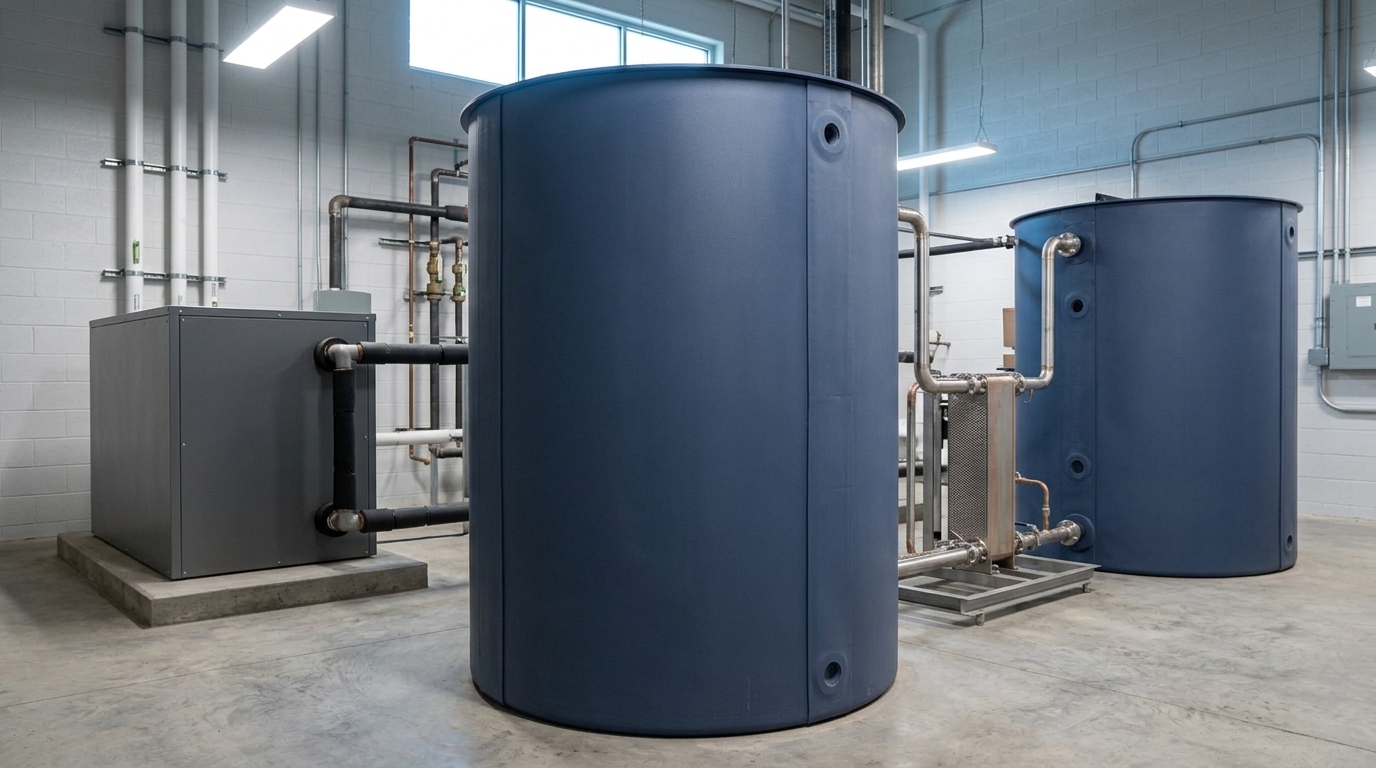
Every thermal storage decision comes down to one physics question first: do you want to store heat by making a material hotter, or by making it change phase? The first is sensible heat storage, and its workhorse medium is water. The second is latent heat storage, and its workhorse media are phase change materials (PCMs)—salt hydrates, paraffins, and fatty acids that melt and freeze at a chosen temperature. Vendors on both sides oversimplify. This guide lays out the numbers engineers actually use, concedes where each technology wins, and gives you a framework for choosing.
In short: Sensible heat storage (water) stores energy in proportion to its temperature rise—about 40 kWh per cubic meter at a 35°C (63°F) delta—at near-zero material cost, with the heat transfer physics of the working fluid itself. Latent heat storage (PCM) stores energy in a phase change at a nearly constant temperature, reaching 50–130 kWh per cubic meter for salt hydrates, which is why PCM wins when space is tight or the usable temperature window is narrow. For commercial domestic hot water, load shifting, and heat pump electrification, an insulated water tank usually delivers the lowest installed cost per kWh and the longest service life; PCM earns its premium in volume-constrained retrofits, tight temperature bands, and cooling applications.
Key Takeaways
What is the difference between sensible and latent heat storage?
Sensible heat storage raises the temperature of a storage material. The energy stored equals mass × specific heat × temperature change—so capacity depends on how much material you have, its heat capacity, and how far you can swing its temperature. Sandia National Laboratories’ thermal storage chapter of the DOE Energy Storage Handbook describes it as the most mature category, with water, rock, concrete, and molten salt as the common media.
Latent heat storage holds energy in a phase transition—most often solid-to-liquid—at a nearly constant temperature. As a PCM melts it absorbs its heat of fusion (typically 100–290 kJ/kg for salt hydrates); as it freezes it releases that heat back. The U.S. Department of Energy’s Technology Strategy Assessment on thermal energy storage notes that both latent and sensible contributions count toward a PCM device's capacity, and that PCMs span applications from building heating and cooling to industrial process heat.
Thermochemical storage is the third category—reversible chemical reactions with the highest theoretical density and near-zero standing loss—but it remains largely pre-commercial for buildings, so this article focuses on the two options you can actually specify today. For the broader landscape, see our guide to thermal energy storage types, cost, and applications.
In this article
Energy density: how much heat does water actually store vs. PCM?
Energy density is where PCM marketing lives, so it deserves careful numbers. Water's specific heat is 4.186 kJ/kg·K. At a 35°C temperature delta—the rating basis for commercial hot-water storage—one cubic meter of water holds about 40.7 kWh. Widen the delta to 50°C and it holds about 58 kWh; narrow it to 20°C and it drops to about 23 kWh. Sensible storage is only as dense as the temperature swing you can use.
Oak Ridge National Laboratory’s review of low-cost PCMs between 0°C and 65°C reports volumetric storage densities of 50–130 kWh/m3 for inorganic salt hydrates, with fatty alcohols as low as 43–55 kWh/m3. Paraffin waxes generally land in the 45–60 kWh/m3 range because their lower density offsets a respectable heat of fusion. So the honest comparison at a hot-water delta is roughly 1× to 3× water, not the 5–10× figures quoted from high-temperature molten-salt literature.
The gap widens dramatically when the usable window is narrow. A latent heat storage primer published through IntechOpen compares water with lauric acid (melting point 42°C): across a 40°C operating range the PCM stores about 70% more energy than water, but across a 10°C range it stores about 400% more. That single fact explains most PCM wins in the field—when the source can only lift temperature a little, or the load can only accept a narrow band, phase change is the only way to get density.
Typical thermal storage energy density and material cost
Storage mediumMechanismTypical density (kWh/m3)Material cost ($/kWh, before packaging)Notes
Water, delta-T 20°CSensible~23≈ $0Narrow-delta case; where PCM's advantage is largest
Water, delta-T 35°CSensible~41≈ $0Commercial DHW rating basis used in tank tables below
Water, delta-T 50°CSensible~58≈ $0High-delta heat-pump or solar-thermal charging
Salt-hydrate PCMLatent50–130$0.90–$40Highest density; supercooling and cycle stability need engineering (ORNL)
Paraffin PCMLatent~45–60$7–$30 (generic blends); $15–$500 (single-chain)Stable and non-corrosive; low conductivity; flammable (ORNL)
Fatty acid PCMLatent~45–55$6.50–$40Lowest cost in the 8–17°C range (ORNL)
Ice / waterLatent (cold)~93 (latent only)≈ $0Cooling storage; requires sub-0°C chiller operation
Charging and discharging: why heat-transfer rate decides real-world performance
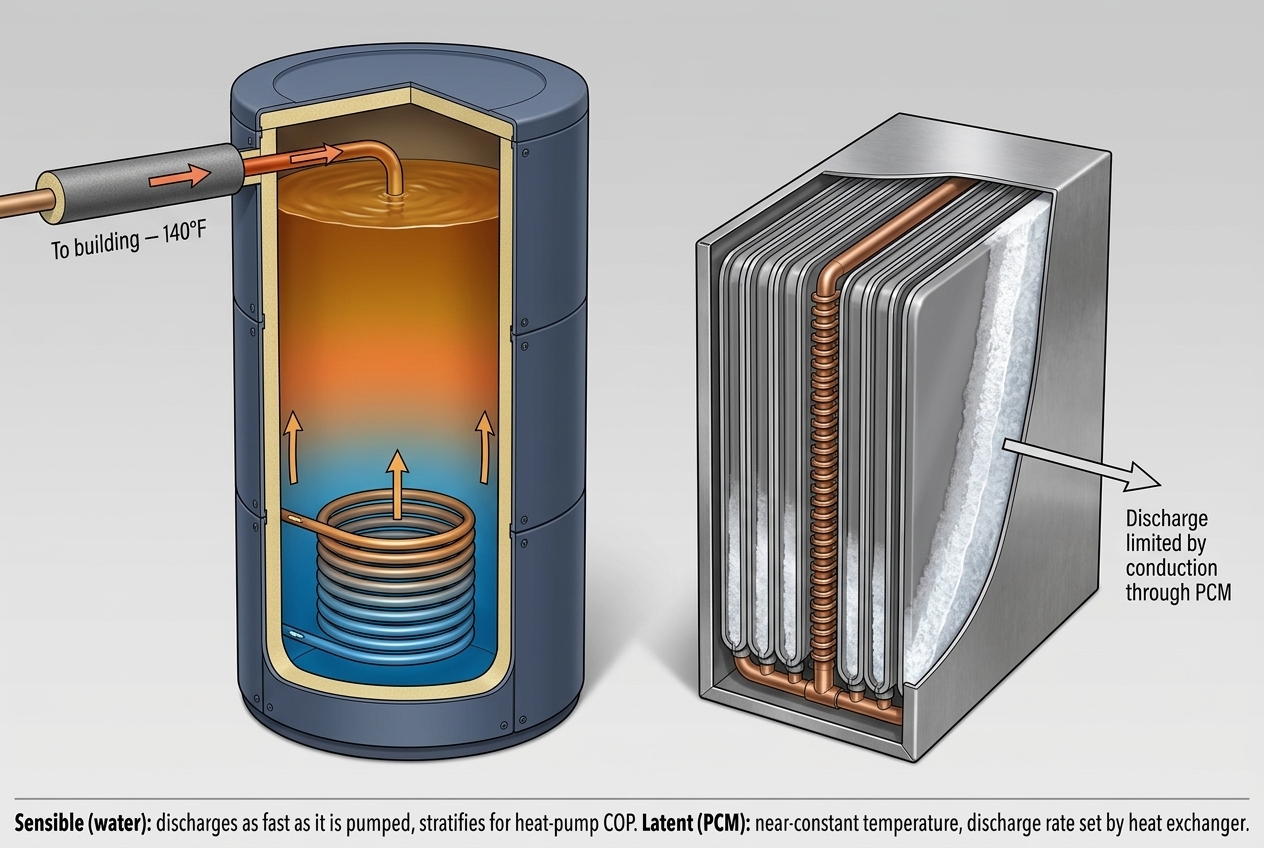
Energy capacity tells you how much a store can hold; power tells you how fast you can get it in and out. This is where water has a structural advantage. In a water tank the storage medium is the heat transfer fluid—nothing sits between the stored energy and the load except a heat exchanger or, in a direct system, nothing at all. A Scientific Reports study of a laboratory-scale latent heat store notes that water's availability, favorable thermal properties, and its dual role as heat transfer fluid are exactly why it remains the most common short-term storage medium, while its drawback is the need for a large temperature difference to reach good density.
PCMs, by contrast, are poor conductors—paraffins and fatty acids especially—so every kWh must pass through encapsulation, fins, or graphite additives. Numerical work comparing water and paraffin PCM in a finned-tube store found that charge duration scales very differently: lengthening the tube 6.6× roughly doubled charging time for water but increased it only ~1.5× for PCM, because PCM charging is limited by conduction into the material rather than by fluid flow. The same research group shows water's outlet temperature responding faster on discharge—helpful when a shower load needs 140°F now, less helpful when you want a flat delivery temperature.
Cost per kWh: material cost vs. installed device cost
Raw PCM cost is seductive. ORNL's review shows some salt hydrates under $1 per kWh of material. But nobody buys PCM by the kilogram; they buy a packaged thermal battery. NREL’s thermal battery cost-scaling analysis models the whole device—storage material plus heat exchangers plus insulation—and finds a baseline n-tetradecane PCM battery at about $155 per kWh, dropping to about $69 per kWh with graphite conductivity enhancement, and reaching a $24 per kWh DOE aspirational target only if density and latent heat both improve. Those are modeled costs at a C/4 rate, not quotes.
Water-tank cost is dominated by the vessel and insulation, and it scales favorably with size. Current published list pricing for Thermal Energy HQ's modular thermal storage tank line:
Thermal Energy HQ modular water tank pricing
ModelList price$/kWh storedStorage capacity*Standing loss
80 gallon$1,190$9712.0 kWh [see source specification]7–8°F / 24 hr
350 gallon$3,427$6354.6 kWh3.8°F / 24 hr
500 gallon$4,464$5877.0 kWh3.0°F / 24 hr
700 gallon$5,798$54108.0 kWh2.4°F / 24 hr
Pricing context
*Rated at a 35°C temperature delta. Pricing current as of August 2026; see the full thermal tank comparison and specifications for complete data. Cost per stored kWh falls about 44% from the smallest to the largest module, and modules interconnect, so capacity can be phased. For a packaged storage-plus-heat-pump skid, see the All-In-One thermal energy system.
The comparison that matters is therefore $54–$97/kWh for a water vessel against $69–$155/kWh modeled for a PCM device—before either side adds heat source, piping, controls, and labor. On a cost-per-kWh basis water usually wins. On a cost-per-square-foot basis, when the mechanical room is the constraint, PCM can win even at a higher $/kWh.
Lifespan, cycling, and maintenance
Water does not degrade. An unpressurized, non-potable water store that charges and discharges through a heat exchanger has no chemistry to wear out; the limiting components are the vessel, insulation, and exchanger. Thermal Energy HQ's modular EPP-insulated tanks are rated for R18–R27 insulation and a 25–30-year service life, with standing losses of 2.4–8°F per day depending on module size. See the modular thermal storage tank specifications and service-life information.
PCM durability is material-specific. ORNL's review flags supercooling and cyclic instability as the main limits on salt hydrates—the material may fail to freeze at its rated temperature, or separate into phases over hundreds of cycles, unless nucleating agents and thickeners are engineered in. Organic PCMs are more stable but flammable and low-conductivity. NREL’s PCM-enhanced building-envelope cost analysis summarizes the trade-off: salt hydrates are nontoxic, nonflammable, and more conductive than organics, but need formulation work to cycle reliably.
Commercial PCM heat batteries have solved much of this—several are rated for tens of thousands of cycles—but the buyer is trusting a proprietary formulation rather than the properties of water.
When PCM is the right choice (and when water is)
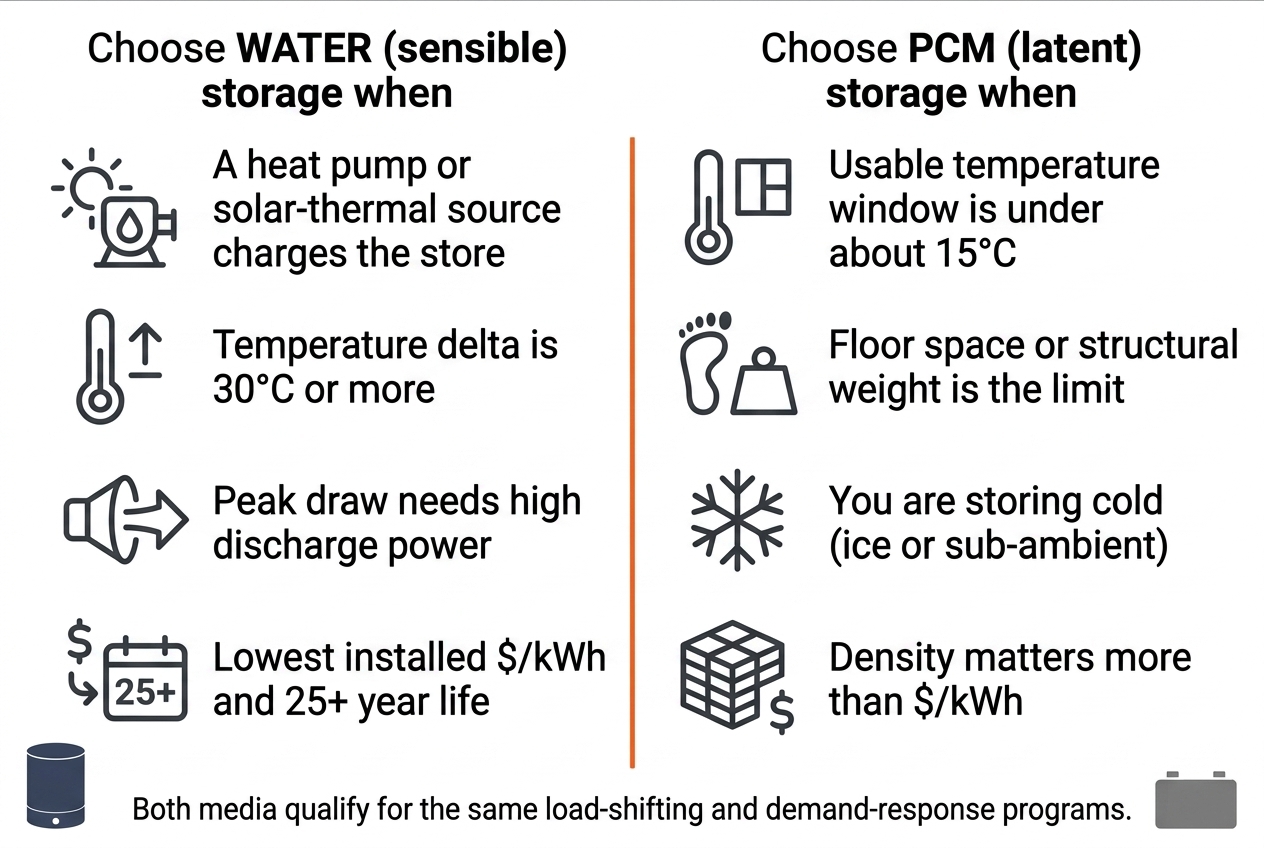
Choose latent (PCM) storage when
Choose sensible (water) storage when
Hybrid water-plus-PCM stores: best of both, or worst of both?
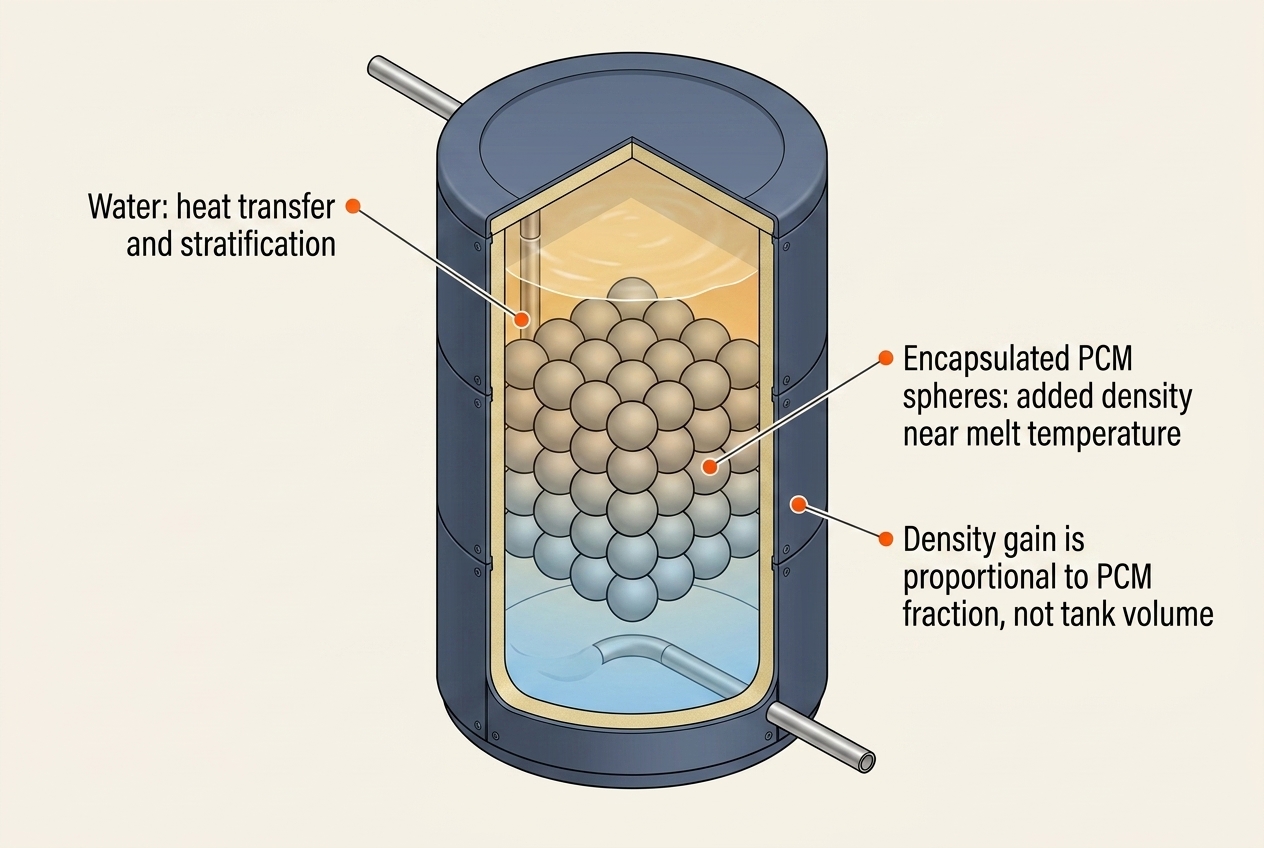
A growing body of research places encapsulated PCM modules inside a water tank so the water handles heat transfer and stratification while the PCM adds density near a target temperature. The IntechOpen latent-storage review reports that spherical and cylindrical encapsulations outperform rectangular ones and that heat-exchanger configuration is decisive—which is also the catch: a hybrid inherits PCM's conductivity limits and adds complexity, and the density gain is proportional to the PCM fraction, not the tank volume. Hybrids are worth modeling when you need water's discharge power but are 20–30% short on space. They are rarely the cheapest way to add kWh.
Do incentives treat water and PCM storage differently?
Generally no—incentive programs care about kWh shifted, demand reduced, and fuel displaced, not about the storage medium. The federal Clean Electricity Investment Credit's statutory definition of energy storage technology in 26 U.S.C. §48E includes thermal energy storage property, as summarized on the IRS §48E page; whether a specific configuration qualifies depends on what it serves and how it is placed in service, so confirm with a tax professional.
Utility demand-response and load-shifting programs likewise measure performance, not chemistry. Where the medium does matter is in the engineering submittal: a water store's capacity is a transparent calculation from volume and delta, while a PCM device's rated kWh depends on the manufacturer's test conditions.
DOE’s Better Buildings guidance on thermal energy storage in commercial buildings frames the value of any TES the same way regardless of medium: lower peak demand, shift load to cheaper periods, and enable cost-effective electrification. Pick the medium that does that at the lowest lifetime cost for your load profile—see how each option maps to Thermal Energy HQ’s heat pump, PVT, and hybrid solutions.
Frequently Asked Questions
What is the difference between sensible and latent heat storage?
Sensible heat storage stores energy by raising the temperature of a material such as water, rock, or concrete; capacity equals mass times specific heat times temperature change. Latent heat storage stores energy in a phase change—usually a phase change material (PCM) melting and freezing—at a nearly constant temperature. Water is the most common sensible medium; salt hydrates, paraffins, and fatty acids are the most common PCMs.
Is water a good thermal storage medium?
Yes, for most heating applications. Water has one of the highest specific heats of any common material (4.186 kJ/kg·K), is non-toxic, costs almost nothing, and serves as its own heat transfer fluid. Its limitation is that energy density depends on temperature swing: about 41 kWh per cubic meter at a 35°C delta, but only about 23 kWh per cubic meter at a 20°C delta.
How much more energy does PCM store than water?
It depends on the temperature window. Salt-hydrate PCMs store roughly 50–130 kWh per cubic meter and paraffins roughly 45–60 kWh per cubic meter, compared with about 41 kWh per cubic meter for water at a 35°C delta—a 1× to 3× advantage. Over a narrow 10°C window the PCM advantage can reach 4× or more, because water's sensible capacity shrinks with the delta while a PCM's latent capacity does not.
What does thermal storage cost per kWh, water vs. PCM?
Modular water thermal storage tanks list from $1,190 (80 gallons) to $5,798 (700 gallons), or about $54–$97 per kWh for the vessel. National-laboratory modeling of packaged PCM thermal batteries ranges from about $69 to $155 per kWh depending on conductivity enhancement, with a $24 per kWh long-term target. Both figures exclude the heat source, piping, controls, and installation.
When should I choose PCM over a hot water tank?
Choose PCM when the usable temperature window is narrow (under about 15°C), when floor space or structural weight is the binding constraint, or when you are storing cold rather than heat. Choose a water tank when a heat pump or solar-thermal source charges the store, when the delta is 30°C or more, when high discharge power is needed for peak draws, or when installed cost per kWh and long service life are the deciding factors.
Can water and PCM be combined in one thermal store?
Yes. Hybrid stores place encapsulated PCM modules inside a water tank so the water provides heat transfer and stratification while the PCM adds energy density near its melt temperature. Research shows spherical and cylindrical encapsulation and heat-exchanger design are critical. Hybrids can help when a project is modestly short on space, but they inherit PCM's conductivity limits and are rarely the lowest-cost way to add capacity.
Conclusion
The bottom line
Sensible and latent storage are not competitors so much as tools for different constraints. Water gives you transparent capacity math, unmatched cost per kWh, fast discharge, stratification for heat pumps, and a medium that never wears out. PCM gives you density when temperature or space is scarce, and it owns the cold-storage market. For commercial hot water, load shifting, and electrification at a 30°C-plus delta, an insulated modular water store is the default; PCM is the exception you reach for when the default doesn't fit the room.
The fastest way to find out which one fits your building is a short engineering conversation about your draw profile, heat source, and mechanical space.