Hotels are the textbook application for solar water heating. The demand is enormous, it runs every day of the year, it is concentrated in a plant room rather than scattered across point-of-use heaters, and water heating is one of the largest single line items on the energy bill. Every solar collector manufacturer knows this, which is why the internet is full of pages that open with the same sentence about thousands of gallons per day and end with a request for your contact details. Almost none of them discuss the two things that actually decide whether a hospitality solar project succeeds: how the load is characterized, and how the system stays inside Legionella risk management.
In short: A hotel's hot water load is not one load—guest rooms, laundry, kitchen, and pool each want a different temperature on a different daily curve, and occupancy can swing the total by half between seasons. Solar water heating is sized to a target solar fraction of that load, which for most commercial projects means preheating incoming cold water rather than replacing the existing plant. That preheat architecture is also where the compliance question lives: solar preheat delivers water into the temperature range where Legionella amplifies, so the storage, exchanger, and control design must sit inside the building's water management program under ASHRAE 188. Get load characterization and preheat architecture right and the collector choice becomes a straightforward downstream decision.
Key Takeaways
The design sequence matters. Start with the actual hot water load, account for occupancy and daily timing, establish the solar fraction, and then design storage and controls around the building's water management program. Collector selection comes after those decisions.
In this article
Characterizing a Hotel Hot Water Load
Water heating is a major share of hospitality energy use—one study of hot water consumption in hotels notes that water heating accounts for roughly a third of the energy used by the U.S. lodging industry, and that solar thermal systems can supply a substantial share of it when the draw profile is properly understood. That last clause is the whole job. See the study on monitoring and modeling hot water consumption in hotels for the underlying research.
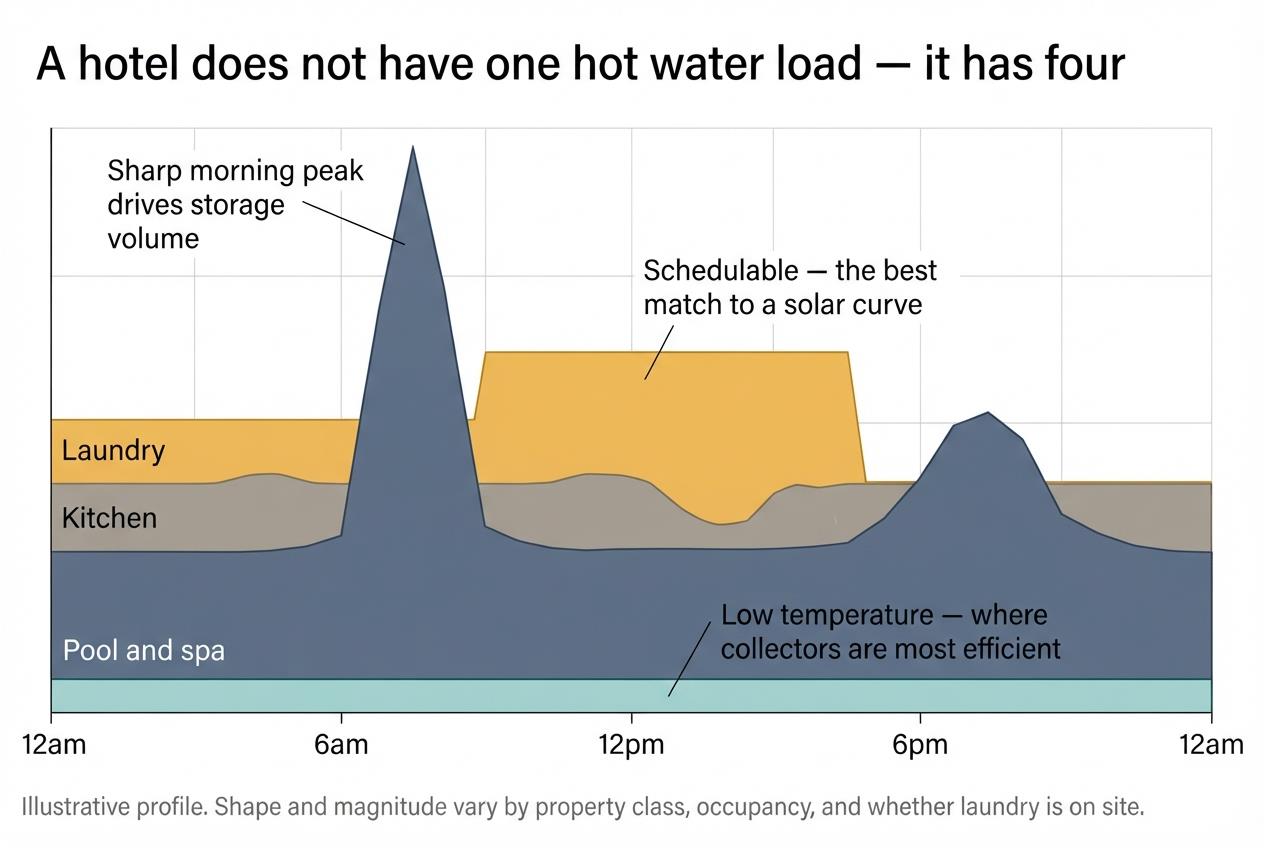
A hotel does not have a hot water load. It has four, and they behave differently:
Hotel hot water load categories and planning implications
LoadIndicative volume*Typical temperatureDaily profileDesign implication
Guest rooms~30–40 gal (110–150 L) per occupied room per dayDelivered ~105–110°F, stored hotterSharp morning peak, smaller evening peakPeak-hour draw drives storage volume and recirculation design
LaundryCan rival or exceed guest room volume in properties with on-site laundry140°F+ for sanitation cyclesScheduled, batched, often mid-day or overnightSchedulable—the best possible match to a solar curve
KitchenModerate volume140°F+ for warewashing and sanitationMeal-service peaksTemperature requirement usually exceeds solar preheat output
Pool and spaLarge thermal load, low temperature80–104°FContinuous, seasonalIdeal solar match—low delivery temperature means high collector efficiency
The Occupancy Problem Nobody Sizes For
This is the hospitality-specific failure mode. A hotel at 95% occupancy in August and 45% in February has two completely different hot water loads, and a solar array is a fixed asset sized once. Size the collector field to peak-season demand and it will be badly oversized in shoulder season. An oversized thermal array with nowhere to dump heat stagnates, and stagnation is hard on glycol, seals, and collectors. Size to average demand and the system underperforms exactly when the property is fullest and the bill is highest.
Three design responses work in order of preference:
Legionella: The Constraint That Shapes the Whole Design
Legionella pneumophila proliferates in warm water, is suppressed at higher storage temperatures, and is a serious risk in exactly the kind of building this article is about—large, occupied, with showers, spas, and long recirculation loops. A solar preheat system, by design, takes cold incoming water and warms it partway. That partway is inside the range where the organism is happiest.
This is not a reason to avoid solar water heating in hotels. It is the reason the storage and control architecture must be designed deliberately rather than assembled from a collector catalogue. ANSI/ASHRAE Standard 188, Legionellosis: Risk Management for Building Water Systems, sets out minimum risk-management requirements for the design, operation, and maintenance of building water systems and applies to commercial, institutional, and multiunit residential buildings.
As the Environmental Law Institute summary of ASHRAE 188 requirements describes, the standard requires a building survey and a written water management program covering systems that can aerosolize contaminated water, with the owner determining the detailed control measures inside that framework. ASHRAE 188 guidance on its voluntary-standard status notes that it is a voluntary consensus standard unless a local code adopts it, although many jurisdictions and payers now effectively require it.
Design guidance in the same territory generally converges on storing service hot water hot enough to suppress the organism and then tempering downstream at the point of use with a mixing valve so nobody is scalded. Federal facility criteria for sizing hot water systems is a representative published example, and it points to ASHRAE Guideline 12 and Standard 188 for the risk-management framework. Requirements vary by jurisdiction and occupancy type, and healthcare facilities are governed more strictly than hotels.
What that means architecturally for a solar preheat system:
Why the Storage Vessel's Construction Matters
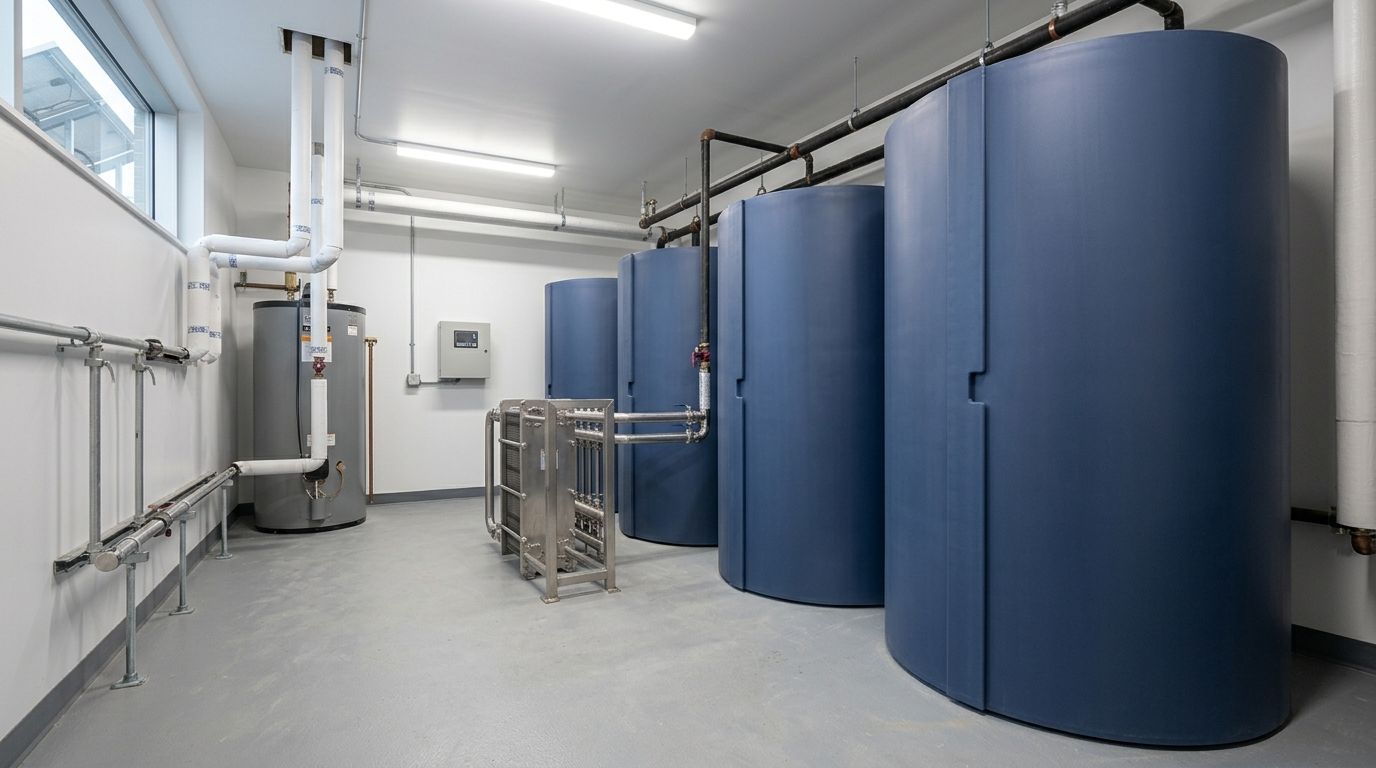
A modular thermal storage tank of the kind TEHQ builds stores unpressurized, non-potable water that never leaves the tank and transfers heat to the domestic side through an exchanger—see the high-capacity thermal water tank overview and the thermal tank overview.
That separation is a design feature with a compliance consequence: the stored volume is a thermal buffer, not part of the potable system. None of this substitutes for the judgment of the design engineer and the building's water management program, and nothing here should be read as a compliance determination for any specific property.
Sizing: The Calculation Every Proposal Should Show
Commercial solar water heating sizing runs in a fixed order, and a proposal that skips to collector count without showing the first three steps is not a proposal.
Seven-step commercial solar water heating sizing sequence
StepWhat you calculateNotes
1Daily hot water volume by load categoryFrom meter data, fuel bills, laundry schedules, and occupancy records—not from a per-room rule of thumb
2Cold water inlet temperature and target temperatureInlet varies seasonally and by region; it drives the temperature rise and therefore the whole energy figure
3Daily useful heat demandVolume × temperature rise × the specific heat of water. This number, in kWh or Btu per day, is the basis for everything downstream
4Target solar fractionThe share of annual demand solar will carry. Commercial preheat systems commonly target a minority share for stagnation and economic reasons
5Collector areaUseful output per unit area per day for the chosen collector type and delivery temperature, derated for the real system
6Storage volumeSized against daily draw and the peak-hour profile, not as a fixed multiple of collector area
7Backup capacity and controlsThe existing plant must meet full load on the worst cloudy day at full occupancy, independent of solar
Why Storage Decides Whether the Project Works
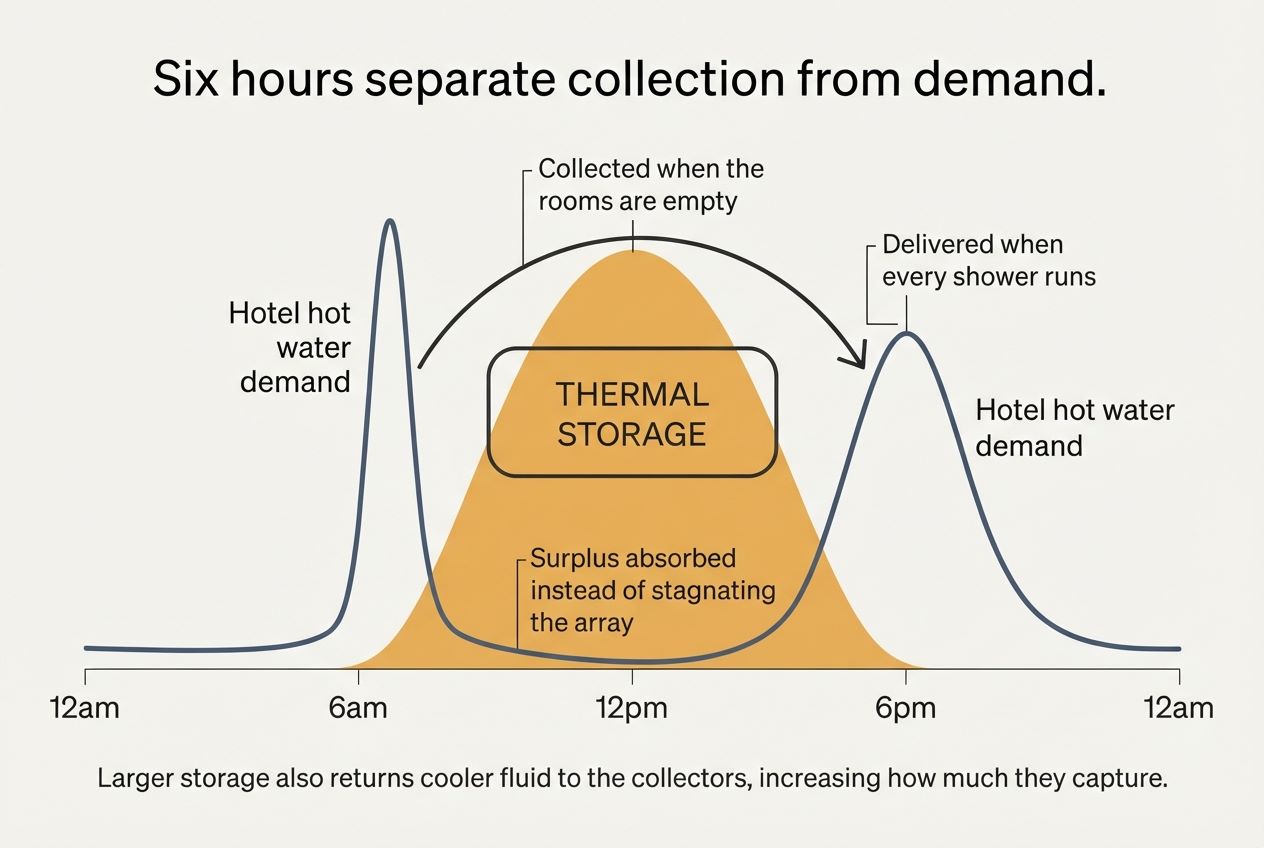
A hotel's guest-room draw spikes between roughly six and nine in the morning, when the sun is barely up, and again in the evening, when it is going down. Solar collection peaks at noon, when the rooms are empty. Without storage between them, a solar array collects heat at the hour of minimum demand and the building buys gas at the hour of maximum demand.
Storage does three jobs at once here. It time-shifts collection to the morning peak. It absorbs shoulder-season surplus that would otherwise stagnate the array. And because thermal collector efficiency rises as the fluid returning to the array gets cooler, a larger store increases how much energy the collectors capture in the first place—the storage decision changes collector output, not just its usefulness. DOE Better Buildings guidance on thermal energy storage frames the same value in load terms: peak reduction, shifting to cheaper hours, and cost-effective electrification.
The practical constraint in hospitality retrofits is that the plant room was sized for a boiler and two pumps decades ago, and it is in a basement behind two door swings, in a building that cannot close. That is the case modular thermal storage exists for: panelized tanks that pass through a standard doorway, assemble in place without a crane, and expand by adding modules as the property phases work across wings or seasons. See the modular thermal energy storage article, the thermal energy storage guide, and Thermal Energy HQ's system solutions for more on the storage approach.
Size storage in kilowatt-hours against the load, using the property's daily draw and peak-hour profile.
What It Costs, and What Actually Pays
Be careful with payback claims in this category, because the honest answer depends on three things a vendor cannot know from a website form: the fuel being displaced and its price, the climate, and how much of the load the system can realistically carry.
Gas price volatility is the argument hoteliers actually respond to—a water heating plant is a twenty-to-twenty-five-year asset and gas prices over that horizon are not predictable. On the hybrid side, a GSA Green Proving Ground evaluation with NREL measurement and verification modeled PV-T paybacks ranging from 19 years in Honolulu at $0.34/kWh to 98 years in Portland at $0.09/kWh. The full NREL technical report is public. Solar water heating economics follow the same logic: the technology does not change, the energy price does.
Where hospitality solar water heating genuinely pays:
Where It Usually Does Not Pay
Solar water heating usually does not pay for limited-service properties with cheap natural gas, moderate climates with ample roof area, or properties with decentralized point-of-use water heaters. In the first two cases, a heat pump water heater with storage will typically deliver hot water at a lower cost per Btu, for reasons laid out in the comparison of PVT, solar PV, and solar thermal. In the third, there is no central system to plumb into and no project exists at any price.
Collector Choice, Briefly
Collector selection is genuinely downstream of load characterization and architecture, which is why it appears this far into the article. Flat-plate collectors are less expensive and perform well up to about 60°C; evacuated tube collectors suppress convective and conductive losses through a vacuum enclosure and hold efficiency at higher temperatures and in colder climates, at higher cost and more gross roof area. See the review of evacuated tube collector performance for more detail.
Unglazed collectors are the cheapest and are well matched to pool heating and low-temperature preheat. PVT hybrid panels produce electricity alongside heat from one footprint and are worth evaluating where roof area is the binding constraint and electricity rates are high. Learn more about PVT solar panels, the PowerPanel PVT and Thermal Tank configuration, and the All-In-One thermal energy system.
For the modelling itself, use an hourly tool with certified collector performance data. The ICC-SRCC OG-300 system certification program provides objective, consistently modeled energy ratings for solar water heating systems across roughly two hundred North American locations and is referenced by building codes, ENERGY STAR, the California Energy Code, and many incentive programs; OG-100 covers individual collectors. Using certified ratings rather than manufacturer marketing figures is what makes competing proposals comparable. NREL's field evaluation of a high-performance flat-plate collector is a useful reference on how collector selection is validated. For project economics, use NREL's System Advisor Model and consult the DOE on-site commercial solar decision guide for screening and procurement.
Frequently Asked Questions
How much hot water does a hotel use per room per day?
Published hospitality benchmarks commonly fall in the range of roughly 30 to 40 gallons, or about 110 to 150 liters, per occupied room per day for guest room use alone. On-site laundry can add a volume that rivals or exceeds the guest room total, and kitchen and pool loads add more. These figures are useful for screening a project but not for sizing one—actual demand varies widely with property class, room mix, fixture flow rates, and occupancy, so size from water meter data and fuel bills.
How do you size a commercial solar water heating system?
In order: establish daily hot water volume by load category from metered data; record cold water inlet and target temperatures; calculate daily useful heat demand as volume times temperature rise times the specific heat of water; choose a target solar fraction; convert that to collector area using certified performance data for the chosen collector type at the required delivery temperature; size storage against daily draw and the peak-hour profile; and size backup capacity to meet full load on a cloudy day at full occupancy independent of solar.
Does solar water heating create a Legionella risk in hotels?
Solar preheat warms incoming cold water partway, which places it in the temperature range where Legionella can proliferate, so the storage and control architecture has to be designed deliberately. The standard approach is that solar preheats while the existing water heater or boiler sets final storage temperature, the collector loop is separated from potable water by a heat exchanger, preheat storage is sized so the volume turns over rather than sitting stagnant, and the solar loop is written into the building's water management program. ANSI/ASHRAE Standard 188 sets out the risk management framework. Requirements vary by jurisdiction and occupancy type, and the design engineer and the building's water management program govern any specific installation.
What solar fraction should a hotel system target?
Most commercial solar water heating systems are designed to carry a share of the annual load as preheat rather than to replace the existing plant. Targeting a minority share keeps the array from stagnating during low-occupancy or shoulder seasons when there is not enough draw to absorb collection, and it keeps the capital cost proportionate. The right number for a specific property depends on the occupancy calendar, the climate, and whether there are absorbing loads like a pool or a schedulable laundry.
Is solar water heating still worth it for hotels?
It depends mainly on the fuel being displaced and the climate. Solar water heating pays best where the displaced fuel is expensive—propane, oil, electric resistance, or high commercial gas rates—where the load is large and year-round, where the climate is hot and sunny, and where roof area is constrained relative to demand. In moderate climates with cheap natural gas and ample roof space, a heat pump water heater with thermal storage will often deliver hot water at a lower cost per Btu.
What certifications should a commercial solar water heating system have?
ICC-SRCC certification is the reference point in North America: OG-100 covers individual solar collectors and OG-300 covers complete solar water heating systems. Both are referenced by building codes, ENERGY STAR, the California Energy Code, and many incentive programs, and OG-300 provides consistently modeled energy ratings across roughly two hundred North American locations so different systems can be compared on the same basis. Ask for certified ratings rather than marketing performance figures when comparing proposals.
Conclusion
Hotels really are the best commercial application for solar water heating, and the reason projects still disappoint has almost nothing to do with the collectors. It has to do with sizing a fixed asset against a load that swings with occupancy, with collecting energy six hours before the building wants it, and with the fact that preheating water is also, unavoidably, warming it into the range a water management program exists to control.
Solve load characterization, storage, and preheat architecture and the collector decision is straightforward. Skip them and no collector on the market will save the project.
The fastest way to know what your property can actually support is a short engineering conversation about your metered draw, your occupancy calendar, and your existing plant.