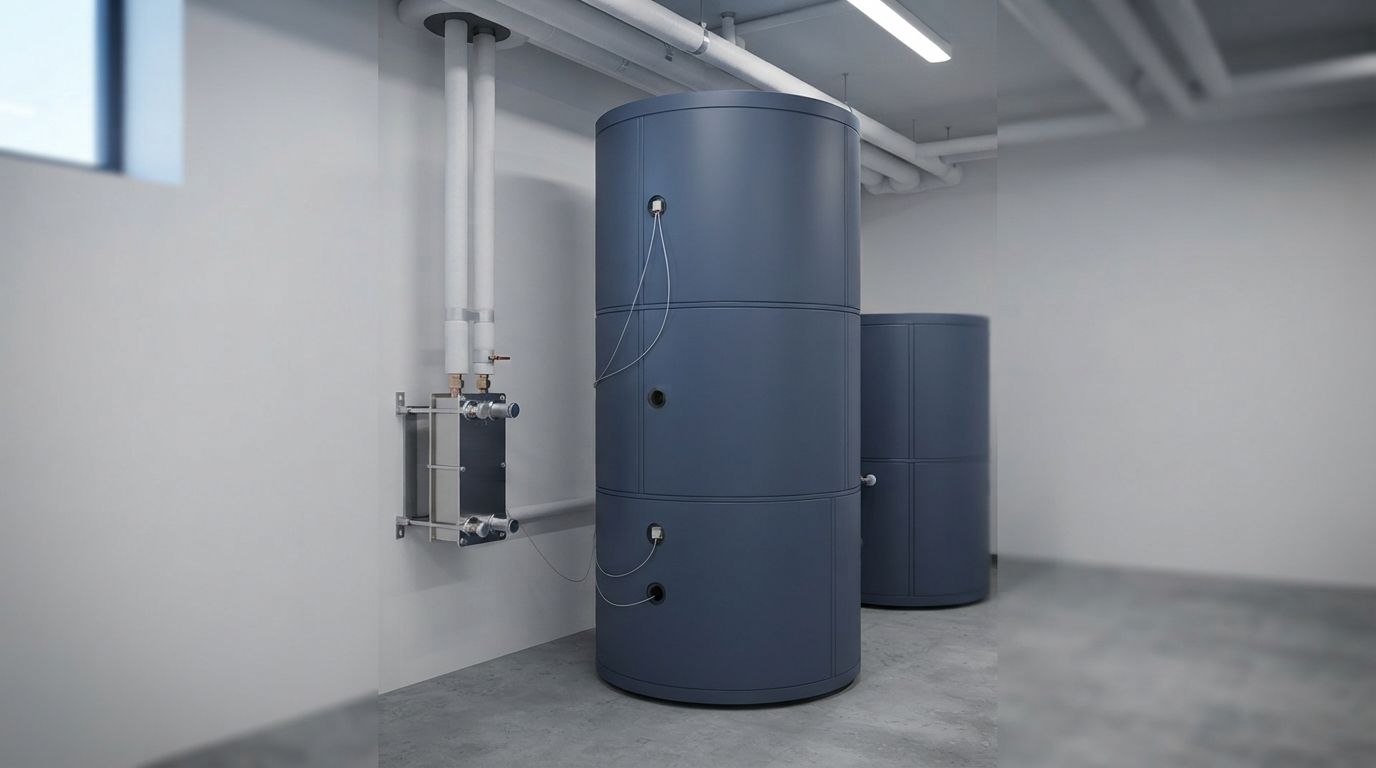
Most people specify the collectors first and treat the tank as a volume to be filled in afterward. That is backwards. In a solar thermal system the storage tank is not a passive container — it is a component that directly determines how much energy the collectors capture, because the temperature of the fluid the tank returns to the array sets the collection rate. A well-designed tank makes an ordinary collector field perform. A badly designed one turns a good collector field into an overheating, stagnating liability.
In short: A solar thermal storage tank holds the heat a collector array gathers at midday until the building draws it in the evening and the following morning. Its defining property is stratification — hot water at the top, cold at the bottom — because the array draws from the cold bottom, and collector efficiency rises as that return temperature falls.
Sizing follows industry ratios of roughly 1 to 2.5 gallons of storage per square foot of collector depending on collector type, load temperature, and climate; undersizing causes overheating and stagnation, oversizing costs money for little gain. Beyond volume, the specification covers direct versus indirect, drainback versus pressurized, exchanger configuration, stagnation and high-limit protection, insulation, and how backup heat enters the tank without destroying the stratification you just paid for.
Key Takeaways
In this article
Why stratification decides collector output
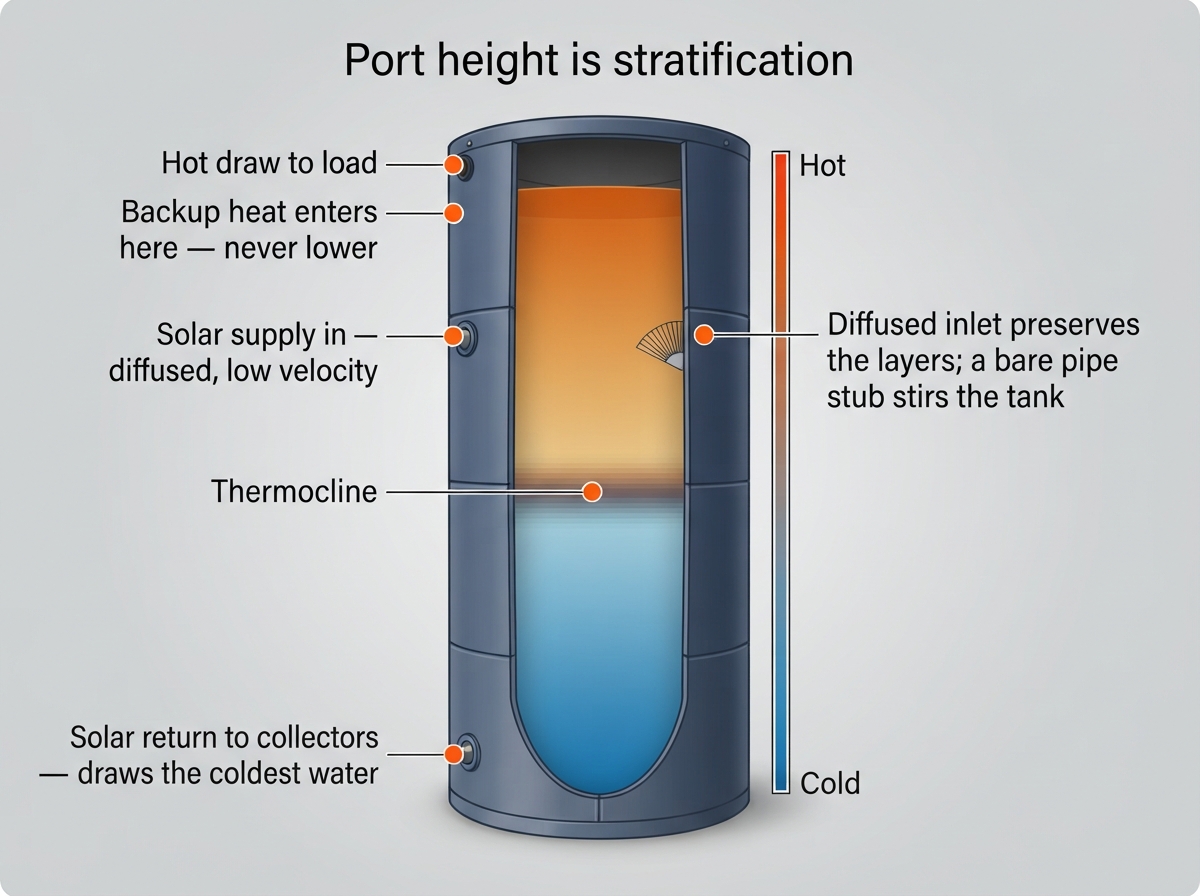
Water is denser when it is cooler, so in an undisturbed tank the cold water settles to the bottom and the hot floats on top, separated by a relatively thin transition layer called the thermocline. This is not a curiosity. It is the mechanism that makes a solar system work, for one reason: the collector loop draws from the bottom of the tank.
Every thermal collector's efficiency falls as the temperature of the fluid it must heat rises above ambient. Feed the array 90°F water and it collects well; feed it 140°F water and it collects poorly. A stratified tank keeps feeding the array the coldest water in the building even while the top of the tank is fully charged and serving showers. A mixed tank feeds the array the tank average, which is warmer, so the same collectors on the same roof on the same day capture less. This is why experimental characterization of a commercial solar collector finds thermal efficiency rising consistently as inlet temperature falls — the tank is upstream of that result, not downstream of it.
Stratification is fragile and is destroyed by turbulence. A 2025 CFD and experimental study of a stratified storage tank shows that inlet diffuser design and incoming flow rate govern how much of a tank's theoretical capacity survives mixing — a well-designed inlet spreads incoming flow gently across the tank cross-section, while a bare pipe stub jets into the tank and stirs it.
For the underlying storage physics, see the thermal energy storage guide. Sandia’s chapter of the DOE Energy Storage Handbook places liquid sensible storage in the wider context.
Sizing: gallons per square foot of collector
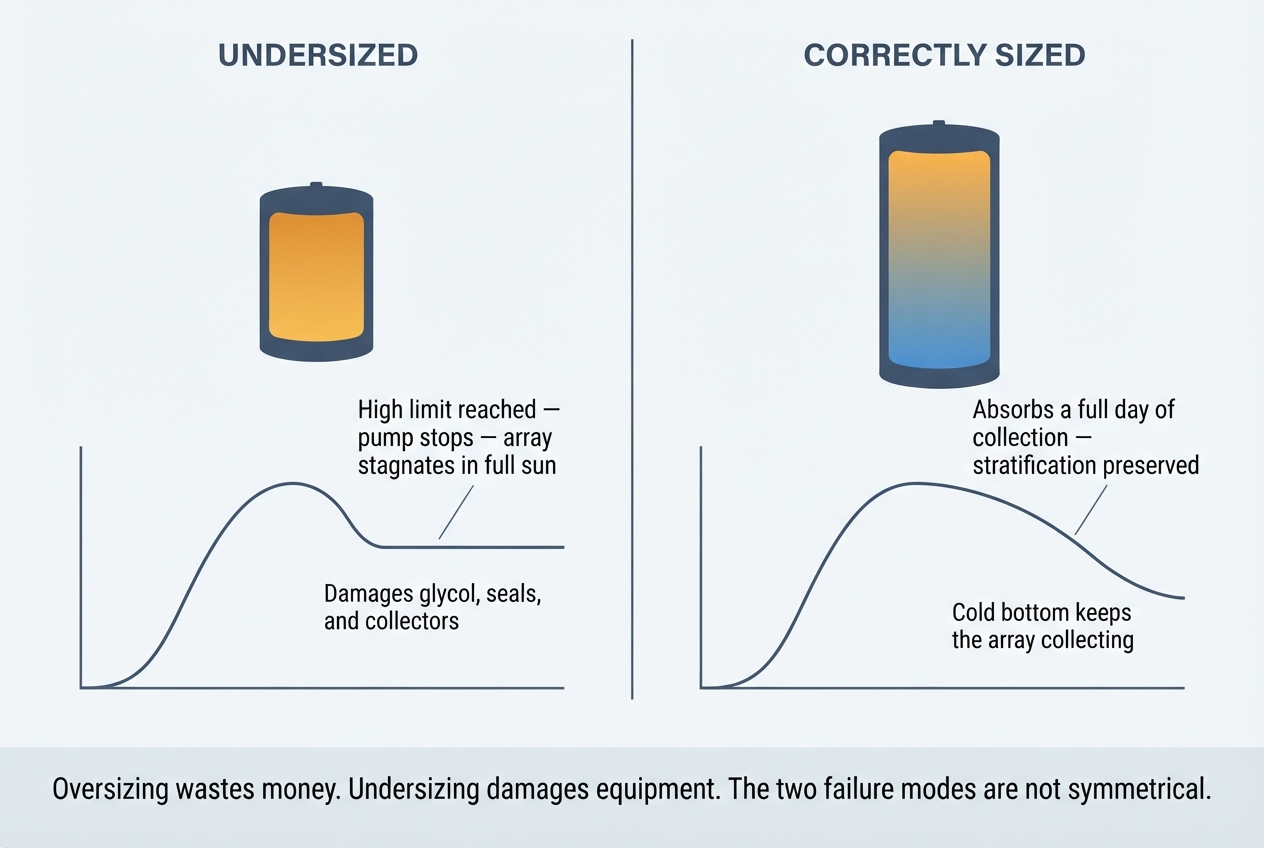
The industry convention sizes storage against collector area rather than against load, because the binding constraint is absorbing a full day's collection without overheating. The ratio varies with how much energy a square foot of collector produces and how hot the load needs the water.
Sources include published collector-manufacturer engineering guidance and DOE consumer guidance, which cites roughly 1.5 gallons per square foot of collector as typical for active systems to prevent overheating. Treat these as screening ratios. A commercial project should be modelled hourly against a real draw profile — see the commercial and hospitality sizing method for the full sequence.
Screening storage ratios by collector type, load, and climate
ApplicationStorage per ft² of collectorReasoning
Flat plate, high-temperature load, northern climate~1.0 gal/ft²Less collection per unit area; load absorbs high temperatures
Flat plate, typical or medium-temperature load~1.5 gal/ft²The most commonly cited general-purpose figure
Flat plate, low-temperature load, or evacuated tube with high-temperature load~2.0 gal/ft²More usable collection or less temperature headroom in the load
Evacuated tube, medium-temperature load~2.5 gal/ft²Highest collection per unit area needs the most volume to absorb it
Climate adjustmentSunbelt ~1.5–2.0; Mountain/South ~1.25–1.75; Midwest/Atlantic ~1.0–1.25; Northwest/New England ~0.75–1.0More solar resource means more energy per square foot to absorb
System architecture: what the tank has to interface with
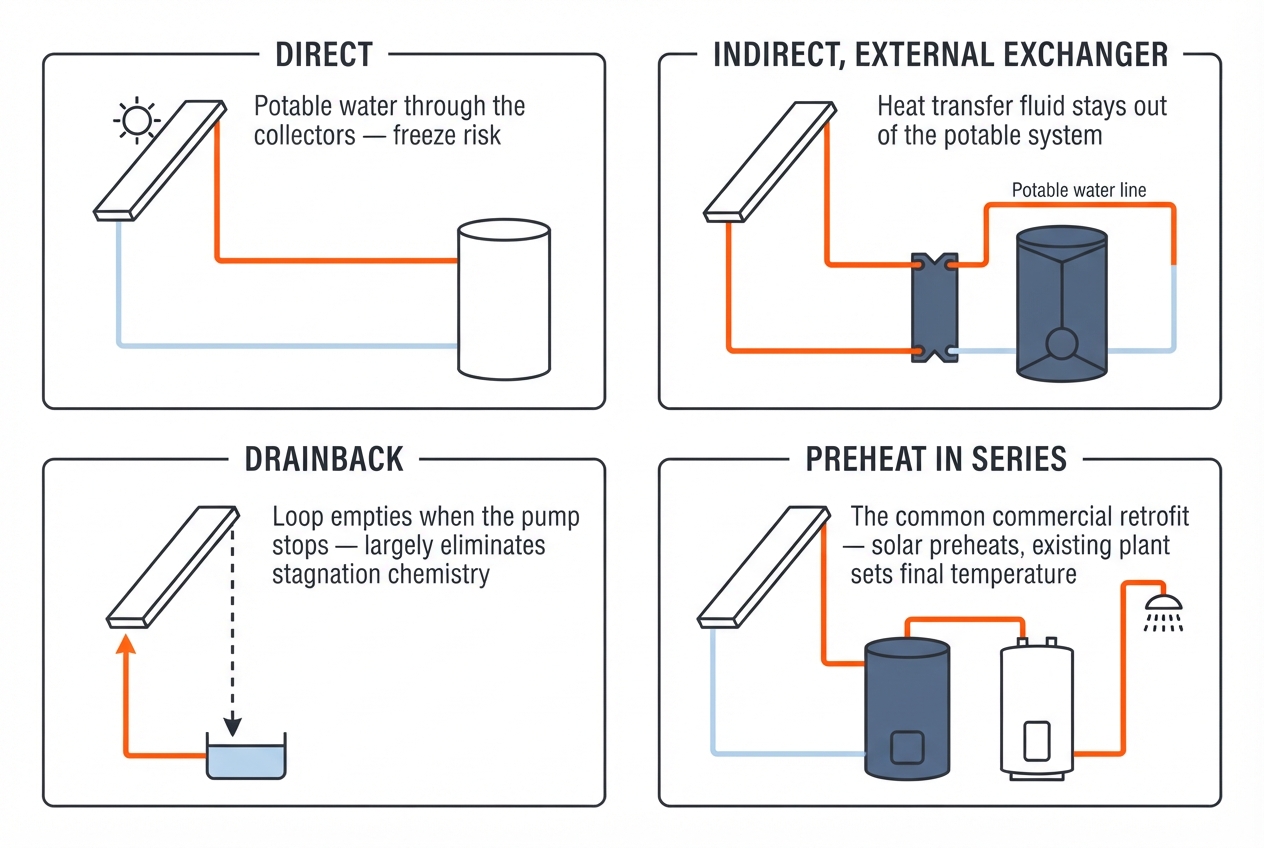
A solar storage tank is specified against the loop it serves, so the architecture decisions come first.
For most commercial retrofits the answer is an indirect, preheat architecture: a separate solar loop, an exchanger, a preheat store, and the existing plant setting final temperature. That arrangement is also what keeps the solar loop out of the potable system, which matters for water management under ANSI/ASHRAE Standard 188 in occupied commercial buildings — covered in detail in the hospitality solar hot water guide. Certification is worth asking about at the same time: ICC-SRCC OG-100 covers collectors and OG-300 covers complete systems, and both are referenced by building codes and incentive programs across North America.
Solar storage tank architecture decisions
DecisionOptionsWhat it means for the tank
Direct or indirectPotable water through the collectors, or a separate heat transfer fluidIndirect systems need an exchanger; the tank may be non-potable, which changes materials and code treatment
Freeze strategyGlycol-filled pressurized loop, or drainbackDrainback requires the loop to drain to a reservoir when the pump stops, and a tank arrangement that permits it
Exchanger typeInternal coil in the tank, external plate exchanger, or wraparoundInternal coils require a vessel built for them; external plates decouple tank construction from loop design
Single or dual coilOne exchanger for solar, or a second for backupDual-coil vessels put both in one tank; separate tanks put preheat and final heat in series
Preheat or full storageSolar preheats into an existing water heater, or carries the full loadPreheat is the low-risk commercial retrofit and the most common commercial architecture
Stagnation, overheating, and why the tank is the protection
Solar thermal has a failure mode no other building system has: on a hot day with no draw, the collectors keep collecting. If there is nowhere to put the heat, the loop stagnates and the collector fluid can reach temperatures far above anything in normal service. Glycol degrades and turns acidic, seals and gaskets age, and repeated stagnation cycles shorten the life of the whole array.
The storage tank is the primary defense, because adequate volume with somewhere to reject heat means the high limit is reached less often. The secondary defenses belong in the specification:
Tank construction: pressure vessel or atmospheric store?
This is the fork that most specification documents skip, and it has more consequences than the volume decision.
Both are legitimate. If the specification calls for an ASME-stamped pressure vessel with an internal coil, an atmospheric store is not a substitute and no amount of arguing changes that. Where the project is a retrofit into an occupied building — which most commercial solar hot water work is — the access and insulation columns tend to decide it. TEHQ's modular thermal storage tanks are the atmospheric case: unpressurized, non-potable water that never leaves the tank, heat transferred through an exchanger, panelized construction that assembles inside the mechanical room without a crane, and rigid-foam insulation delivering R18–R27 with standing losses of 2.4–8°F per 24 hours depending on module size. The architecture is covered in full in our guide to modular thermal energy storage and the hot-water application in the high-capacity thermal water tank overview.
What a solar thermal storage tank costs
Current published list pricing for the modular thermal storage tank line:
Published modular thermal storage tank pricing
ModelList price$/kWh storedStorage capacity*Standing loss
80 gallon$1,190$9712.0 kWh7–8°F / 24 hr
350 gallon$3,427$6354.6 kWh3.8°F / 24 hr
500 gallon$4,464$5877.0 kWh3.0°F / 24 hr
700 gallon$5,798$54108.0 kWh2.4°F / 24 hr
How to compare tank quotes
Rated at a 35°C temperature delta. Pricing is current as of August 2026; see the full thermal tank comparison and specifications for complete data. Vessel only — a complete system adds collectors, exchangers, pumps, piping, controls, and labor. Cost per stored kWh falls about 44% from the smallest module to the largest, and because modules interconnect, capacity can be phased. For a packaged approach, see the All-In-One thermal energy system and the PowerPanel PVT and Thermal Tank configuration.
When comparing tank quotes, insist on the same basis: gallons, insulation R-value, published standing loss over 24 hours, maximum service and excursion temperatures, exchanger configuration and surface area, port heights, and whether the price includes rigging. A cheaper vessel with half the insulation and no stated standing loss is not cheaper. For project economics, NREL's System Advisor Model and DOE’s on-site commercial solar decision guide are the standard free tools, and NREL's field evaluation of a high-performance flat-plate collector is a good model of how collector-and-storage performance is actually validated. A related NREL full technical report is also available.
A specification checklist
What a complete solar thermal storage tank specification states, in the order a reviewer will look for it:
Use the checklist to evaluate suppliers
That list is also a good filter on suppliers. A manufacturer who can answer all of it from a spec sheet is a different proposition from one who quotes gallons and a price. DOE’s Better Buildings guidance on thermal energy storage frames why the store earns its place at all: peak reduction, shifting load to cheaper hours, and making electrification cost-effective.
Frequently Asked Questions
What size solar thermal storage tank do I need?
Storage is sized against collector area rather than against load, because the tank has to absorb a full day of collection without overheating. Published industry ratios run from about 1 gallon per square foot of collector for flat plates serving high-temperature loads in northern climates, to about 1.5 gallons per square foot as a general-purpose figure, up to roughly 2 to 2.5 gallons per square foot for evacuated tubes or low-temperature loads. Sunnier climates need more storage per square foot because each square foot collects more. Use these ratios to screen a project and model hourly against a real draw profile to size one.
Why does stratification matter in a solar storage tank?
Because the collector loop draws from the bottom of the tank, and collector efficiency rises as the temperature of the fluid entering the array falls. A stratified tank keeps cold water at the bottom and hot at the top, so the array is fed the coldest water in the building even while the top of the tank is fully charged. A mixed tank feeds the array the tank average, which is warmer, so the same collectors on the same day capture less energy. Stratification is preserved by diffused low-velocity inlets, correct port heights, and introducing backup heat only into the top third of the tank.
What happens if the solar storage tank is too small?
The tank reaches its high-limit temperature in the early afternoon, the controller shuts off the circulating pump, and the collector array sits in full sun with no flow. That condition is called stagnation, and repeated cycles degrade glycol, age seals and gaskets, and shorten collector life, as well as losing the back half of the day's collection. An oversized tank has the opposite problem — higher standing losses and capital cost for little additional yield — but only the undersized case damages equipment.
Should a solar storage tank be pressurized or atmospheric?
Both are used. A glass-lined or stainless pressure vessel can accept an internal coil and connect directly to a pressurized loop, and is required where a specification calls for an ASME-stamped vessel. An unpressurized atmospheric store holds water that never leaves the tank and transfers heat through an external exchanger, which eliminates wetted-steel corrosion and pressure fatigue and allows much thicker insulation, but it is not a substitute where a stamped pressure vessel is specified. In occupied-building retrofits, access and insulation usually decide the choice.
Where should backup heat enter a solar storage tank?
Only into the top third. Applying auxiliary heat across the whole tank raises the temperature of the bottom layer, which is the water the collector loop draws from, and higher inlet temperature reduces collector efficiency. In effect, heating the full tank with gas or electricity shuts down solar collection while you pay for the backup fuel. Separating preheat storage from a final-temperature water heater achieves the same separation with two vessels in series.
How much does a solar thermal storage tank cost?
Modular thermal storage tanks list from $1,190 for an 80-gallon module, about 12 kWh of storage, to $5,798 for a 700-gallon module, about 108 kWh, which works out to roughly $54 to $97 per kWh of storage capacity. Cost per stored kWh falls about 44% from the smallest module to the largest. Those figures cover the storage vessel; a complete solar system adds collectors, heat exchangers, pumps, piping, controls, and installation. When comparing quotes, compare insulation R-value, published standing loss, temperature ratings, and exchanger configuration alongside gallons and price.
Conclusion
The tank is the part of a solar thermal system that does the least visible work and the most actual work. It decides how much the collectors collect, whether the array spends its afternoons stagnating, how much of what was collected survives the night, and whether the whole assembly could be installed in the building at all.
Specify it first, size it against collector area, protect the stratification with port heights and diffused inlets, keep backup heat out of the bottom two-thirds, and compare vessels on standing loss and temperature ratings rather than on gallons and price. The fastest way to get the volume and configuration right is a short engineering conversation about your collector area, load profile, and plant room.
Garth Schultz is President of Thermal Energy HQ [confirm title], where he leads development of modular thermal energy storage systems manufactured in the United States. He is the inventor named on patents covering hybrid photovoltaic-thermal (PVT) solar panels and insulated modular storage tank construction, and has worked in solar-thermal product development since founding the company's technology line in 2007.