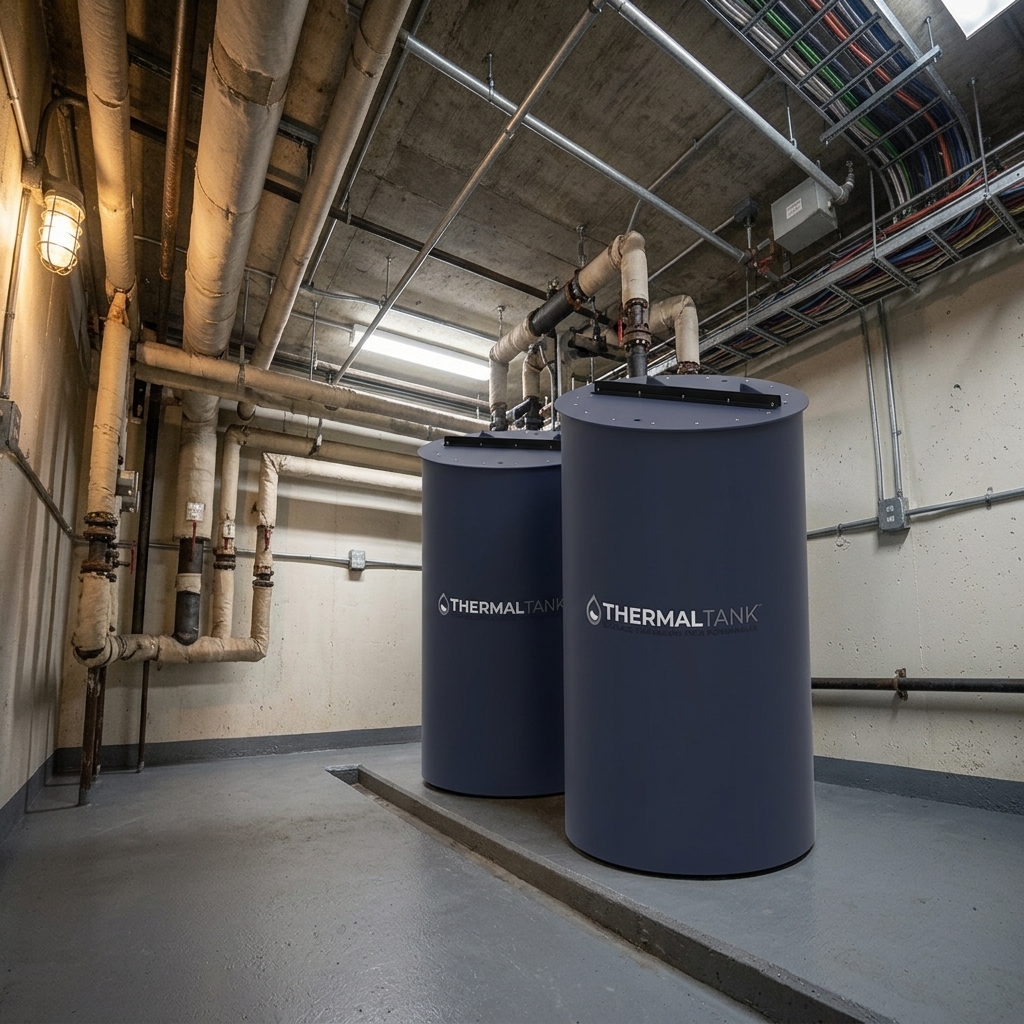
Every thermal storage vendor, including this one, will tell you that storage reduces demand charges. It is true, conditionally, and the condition does most of the work. The useful question is not whether it works but how many kilowatts a specific tank bank removes from a specific billed interval in a specific building — and that number is smaller than a spec sheet full of kilowatt-hours makes it look.
Key Takeaways
In short: Thermal storage reduces a demand charge only when heating or cooling load is present during the peak interval. The reduction is not the tank’s rated capacity. Stored energy is thermal; the utility bills electrical kilowatts. To get from one to the other you take rated capacity, multiply by the fraction that is usefully deliverable, divide by the length of the peak window, and divide again by the plant’s coefficient of performance. That last division is the one most comparisons omit, and it cuts the headline figure by roughly two thirds. Four building types are disqualified outright.
In this article
First, four reasons this will not work for your building
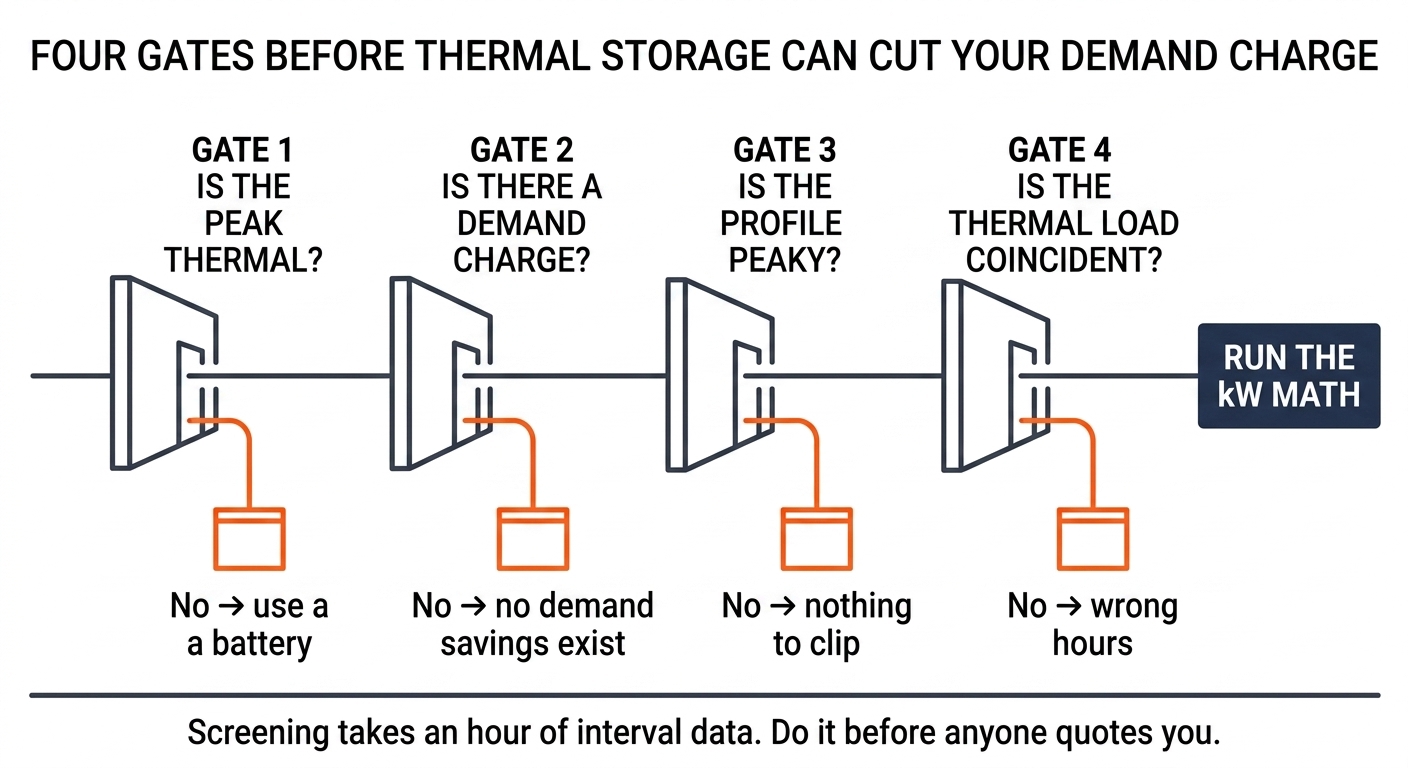
Putting the disqualifiers ahead of the savings math is deliberate. Most of the time spent evaluating thermal storage for demand charge reduction is wasted on buildings that were never candidates, and the screening takes about an hour of interval data review.
Buildings that clear all four tend to share a profile: a sharp, repeatable thermal peak driven by occupancy. Hotels at morning shower peak, multifamily buildings at shift change, commercial laundries, kitchens, and healthcare facilities with scheduled sanitation loads. EIA’s commercial buildings data shows water and space heating dominate gas use in commercial buildings, which is why electrifying those loads is what creates the demand-charge exposure in the first place — and why storage is the natural mitigation.
Building qualification disqualifiers
DisqualifierHow to detect itWhat to do instead
The peak is not thermalPull interval data, isolate the highest intervals of the last twelve months, and correlate against equipment schedules. If the peak lines up with process equipment, EV charging, refrigeration, elevators, or plug load, thermal storage cannot discharge against it.Battery storage, or controls-based demand limiting. A tank cannot help you.
No demand charge on the tariffRead the rate schedule. Some small commercial tariffs are energy-only.Storage may still justify itself on plant downsizing, resilience, or time-of-use arbitrage — but do not model demand savings that the tariff cannot produce.
Flat load profile, no distinct peakPlot a week of interval data. If the curve is broad and level rather than spiky, there is little peak to clip and the storage has nothing to shave against.Efficiency measures and rate-schedule review. A flat profile is usually already a good load factor.
Thermal load is real but not coincidentA building can have a large hot water load and a large demand charge and still see no benefit, because the hot water draw and the billed peak interval fall at different times.Check coincidence explicitly before sizing anything. This failure mode is covered in.
The conversion: from stored kilowatt-hours to billed kilowatts
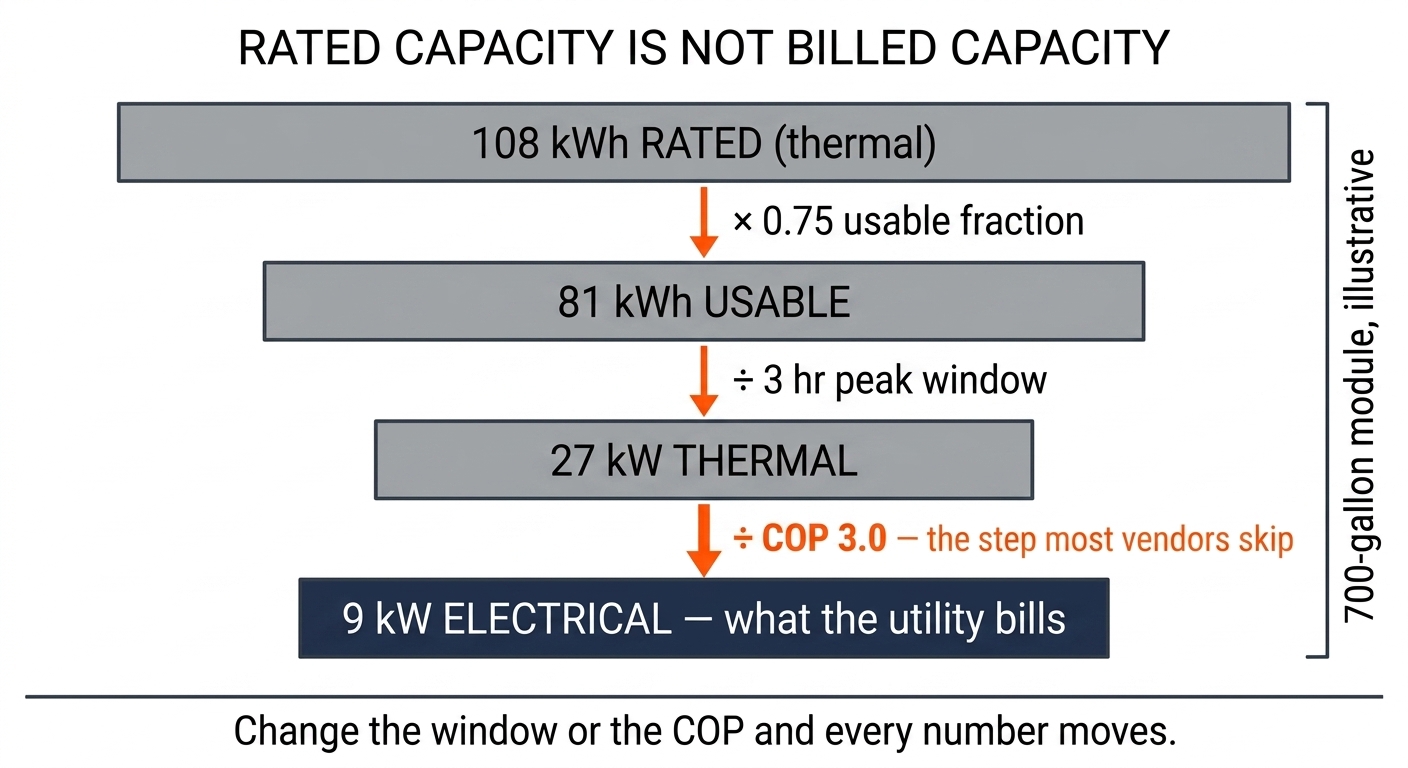
This is the calculation that decides the project, and it is rarely published because it produces a modest number. Four steps.
kW electrical removed = (C rated × f usable) ÷ h peak ÷ COP
C rated — rated storage capacity in thermal kWh, at a stated temperature delta. Ours are rated at 35°C.
f usable — the fraction actually deliverable above minimum useful temperature. This article uses 0.75.
h peak — length of the window the storage must carry, in hours. Not the day. The window containing the billed peak interval.
COP — coefficient of performance of the plant the storage displaces. This is the step that converts thermal kilowatts into electrical ones.
Why the COP division matters so much. A demand charge is levied on electrical draw. Storage does not displace electricity directly — it displaces the heat the plant would otherwise have made at that moment, and the plant makes heat at a multiple of its electrical input. A heat pump running at COP 3.0 draws one electrical kilowatt to deliver three thermal kilowatts. Removing 60 kW of thermal load from the peak interval therefore removes 20 kW from the bill, not 60. A vendor quoting the thermal number is quoting a figure three times larger than the one that appears on your invoice.
Why the usable fraction is an assumption and not a measurement. Water at the bottom of a stratified tank that has fallen below the temperature your distribution needs is stored energy that cannot do the job. How much capacity remains useful at a given draw rate depends on stratification behaviour, thermocline thickness, and draw profile. We have not published third-party draw-down testing for these tanks, so the 0.75 here is a conservative engineering assumption, not a measured result. Vendors selling baffled ASME vessels with published thermocline data can give you a measured number; ask them for it, and ask us for our engineering on your specific draw profile. Where a decision turns on this figure, it should come from a test report rather than from anybody’s article, including this one.
Worked through the tank line
Illustrative, at f usable = 0.75, a three-hour peak window, and COP 3.0. Change any of the three and every number moves.
Read that table honestly. A single 700-gallon module removes about nine electrical kilowatts from a three-hour peak — roughly $162 a month on an $18/kW tariff, against a $5,798 list price for the vessel alone. On demand charge savings in isolation, that is a long payback. Thermal storage projects that pencil do not pencil on demand charges alone. They pencil on the stack: demand charge reduction, plus time-of-use arbitrage, plus the capital avoided by specifying a smaller heat pump, plus utility incentives, plus in electrification projects the electrical service upgrade that storage keeps you from needing.
That last item is frequently the largest number in the whole analysis and it never appears on a utility bill. A central plant sized to meet peak draw directly may push a building past its existing service capacity; storage that keeps the project inside existing switchgear can avoid a six-figure utility upgrade. See domestic hot water electrification retrofit for how that constraint drives design, and heat pump water heater storage tank sizing for the volume math.
Sizing the plant itself is a separate calculation with an established method — Ecotope’s Ecosizer models the design-day draw profile and produces a curve of valid capacity-versus-volume combinations rather than a single answer. DOE and PNNL’s Building America guidance covers the same ground for central heat pump water heating.
How the return actually assembles
Because demand savings alone rarely carry a project, the honest way to present the economics is as a stack with each layer sourced separately.
What we would tell you not to do: build a business case on demand charge reduction alone and then discover the ratchet delays the savings by a year. If the project only works on that one layer, it probably does not work.
Thermal storage project return stack
LayerWhere it comes fromHow to verify it
Demand charge reductionkW removed × $/kW, from the conversion above.Tariff $/kW plus interval data. Model the ratchet cycle — under a ratchet, savings may lag up to twelve months.
Time-of-use arbitrageCharging in cheap hours, discharging in expensive ones.Requires a real on-peak/off-peak spread on your schedule. A narrow spread makes this layer negligible.
Avoided plant capacitySpecifying a smaller heat pump or chiller because storage covers the peak.Compare equipment quotes at both sizes. Often the single largest line.
Avoided electrical service upgradeStaying inside existing switchgear on an electrification project.A load calculation, not an assumption. Where it applies it can dominate everything else.
Incentives and tax treatment§48E, utility custom and demand-reduction programs.Confirm with a tax professional and the program administrator; programs exhaust funding mid-year.
Maintenance and equipment lifeLonger, steadier run times instead of short cycling.Real but hard to quantify. Do not headline it.
When a battery is the right answer instead

Batteries discharge against any load, regardless of cause. That generality is the whole advantage, and it is decisive whenever the peak is not thermal. They also provide sub-second response and backup power, neither of which a hot water tank offers at any price.
Thermal storage wins on cost per stored kilowatt-hour for thermal loads specifically, and on dispatch simplicity — a tank serves the draw when the draw happens, with no dispatch algorithm to mistime and no missed interval to regret. It also degrades far more slowly than a cycled cell. Comparisons between the two should be made on installed cost with the same boundaries on both sides; vessel-only pricing against complete-system pricing is not a fair comparison, and any vendor offering you one is doing so deliberately.
The correct framing is division of labour rather than competition: electrical peaks to batteries, thermal peaks to thermal storage, and in mixed buildings both, each sized to its own load. DOE’s grid-interactive efficient buildings work and the national roadmap developed by Lawrence Berkeley National Laboratory both treat demand flexibility as a portfolio of building assets rather than a single product category, which is the right mental model here. The DOE Better Buildings thermal storage brief covers where TES specifically fits.
Incentives and tax treatment in 2026
None of this is tax advice. Confirm with a tax professional and your program administrator.
The federal clean electricity investment credit covers energy storage technology placed in service after December 31, 2024, and the statutory definition under 26 U.S.C. §48E incorporates the §48 definition, which expressly includes thermal energy storage property. Post-2025 sourcing rules apply: IRS Notice 2026-15 provides interim guidance on the material assistance cost ratio and prohibited foreign entity restrictions for storage beginning construction after December 31, 2025, which makes domestic manufacturing provenance a documentation requirement. The IRS §48E clean electricity investment credit guidance is the starting point for review.
The §179D energy efficient commercial buildings deduction is frequently still listed as available and is not. DOE’s 179D page confirms the One Big Beautiful Bill Act added a termination provision: it does not apply to property whose construction begins after June 30, 2026. That date has passed.
Utility custom commercial and demand-reduction programs are now the most variable and often the most valuable layer, because demand reduction is precisely what many of them pay for. Start with the energy incentive finder, then confirm current status directly — programs open, close, and exhaust funding mid-year. Texas projects should also watch the ERCOT transmission cost allocation proceeding covered on our Texas thermal energy storage page.
Frequently Asked Questions
Does thermal energy storage reduce demand charges?
It does when heating or cooling load is present during the interval that sets the demand charge, because storage lets the plant produce that thermal energy at another hour. It does not reduce a demand charge set by process equipment, EV charging, refrigeration, lighting, or plug load, since a thermal tank cannot discharge against a non-thermal load. Identify what sets the peak from interval data before evaluating storage at all.
How many kilowatts does a thermal storage tank remove from my peak?
Take the rated thermal capacity in kilowatt-hours, multiply by the fraction usefully deliverable above your minimum delivery temperature, divide by the number of hours the storage must carry, then divide by the plant's coefficient of performance. That last step converts thermal kilowatts into the electrical kilowatts a utility actually bills, and it typically reduces the figure by about two thirds. A 700-gallon module rated at 108 thermal kWh removes roughly 9 electrical kW across a three-hour window at COP 3.0.
Why divide by COP?
Because demand charges are billed on electrical draw and storage displaces thermal output. A heat pump operating at a coefficient of performance of 3.0 draws one kilowatt of electricity to deliver three kilowatts of heat, so displacing three thermal kilowatts removes one electrical kilowatt from the bill. Quoting the thermal figure as demand reduction overstates the saving by the full COP multiple.
Can thermal storage pay for itself on demand charges alone?
Usually not. Demand charge reduction is one layer of the return alongside time-of-use arbitrage, the capital avoided by specifying a smaller plant, any electrical service upgrade the storage prevents, incentives, and reduced equipment cycling. In electrification projects the avoided service upgrade is often the largest single item and never appears on a utility bill. A project that only works on the demand charge layer generally does not work.
What is usable capacity and why is it less than the rating?
Rated capacity assumes a stated temperature delta across the full volume. In practice, stored water that has fallen below the minimum temperature your distribution system requires cannot do useful work, so a fraction of the rating is unavailable at any given moment. How large that fraction is depends on stratification behaviour, thermocline thickness, and draw rate. Ask any vendor for measured draw-down data rather than accepting a rated figure as deliverable capacity.
Is thermal storage or a battery better for demand charge reduction?
They address different peaks. Batteries discharge against any load and provide sub-second response and backup power, which makes them the only option for non-thermal peaks. Thermal storage costs substantially less per stored kilowatt-hour for heating and cooling loads and needs no dispatch algorithm. Buildings with mixed peaks frequently justify both, each sized to its own load.
How does a demand ratchet affect the value of thermal storage?
A ratchet sets a floor under billed demand based on a prior peak, so reliably holding a kilowatt ceiling protects up to twelve bills rather than one, which raises the value of a dependable shave. It also delays the payback, because savings do not appear until the floor set by the earlier peak rolls out of the lookback window. Model both effects; a calculation that includes neither is wrong in both directions.
Conclusion
Thermal storage reduces demand charges, in the buildings where the peak is thermal, by an amount you can calculate before anyone quotes you anything. The calculation is not flattering to the technology in isolation, and that is the point: a project justified on demand charges alone rarely survives contact with a ratchet, while a project justified on the full stack — demand, arbitrage, avoided plant, avoided service upgrade, incentives — frequently does.
Bring your rate schedule, twelve months of bills, and interval data. Anyone willing to size a system without those three things is guessing.