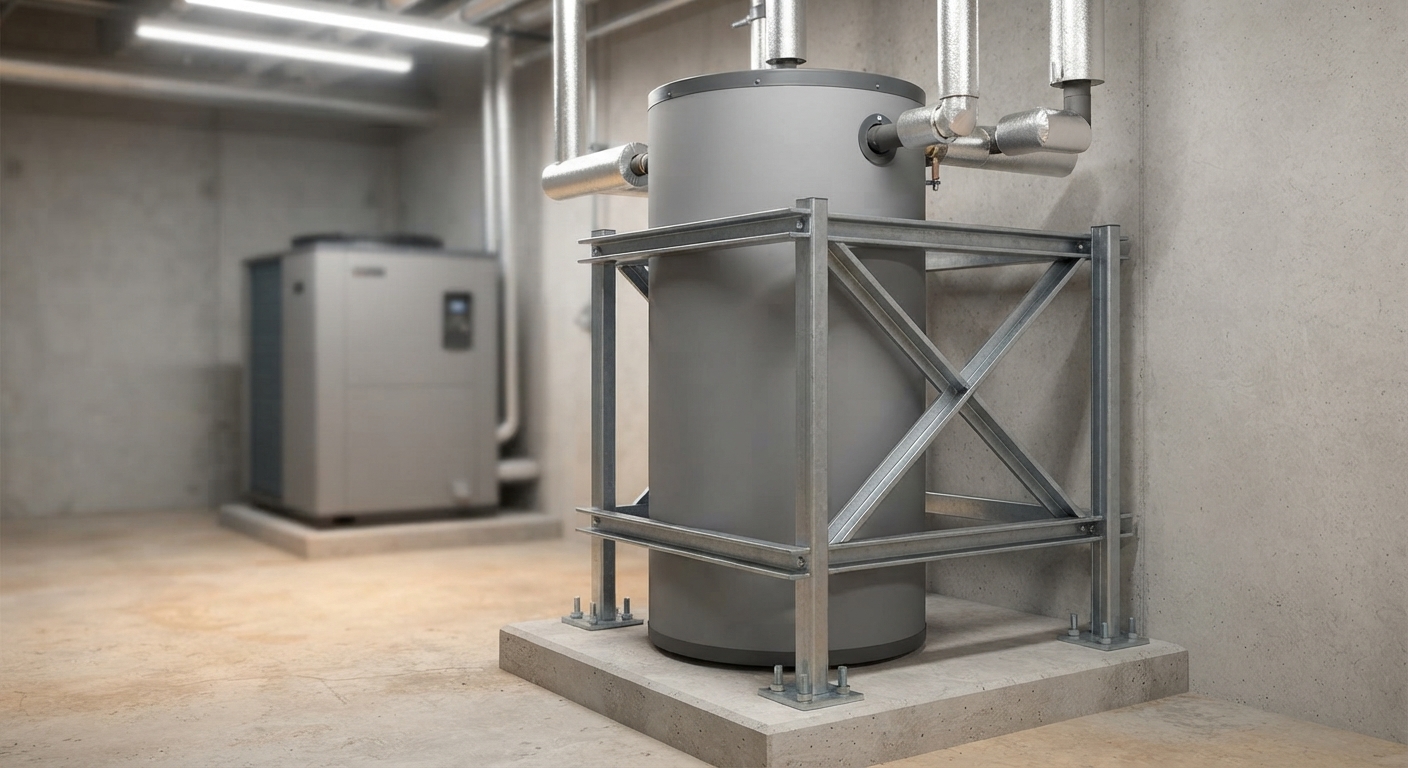
In most of the country, an oversized buffer tank is a modest waste of money and floor space. In California it is also seismic mass — and seismic design force scales directly with weight. Every gallon you specify beyond what the equipment actually requires has to be calculated for, anchored, inspected, and in some occupancies certified. That changes the incentive to get the number right.
In short: The buffer tank calculation itself is the same in California as anywhere: establish the manufacturer’s minimum system volume, count the volume the system already holds, and subtract. What California adds sits around that number. Seismic anchorage forces are proportional to component weight and increase with installation height, so a filled tank is a structural item requiring engineered restraint, special inspection in most of the state, and — in healthcare occupancies — special seismic certification. Meanwhile the two arguments that usually justify generous buffer volume are both weaker here: California’s mild climate produces far less defrost demand than cold-climate installations, and the modulating equipment the market favours cycles less to begin with. The honest California answer is frequently a smaller tank than a national rule of thumb produces, and sometimes none at all.
Key Takeaways
This article does not repeat the buffer tank sizing method. Required system volume, the subtraction against existing piping and equipment volume, the run-time check at minimum load, and the distinction between a buffer tank and a thermal storage tank are covered in the buffer tank guide.
The cooling-side version of the calculation — gallons per ton, chiller minimum system volume, and the low delta-T trap — is covered in Chilled Water Buffer Tank Sizing.
This page covers what California adds: the structural and regulatory context around the tank, and the two climate and equipment factors that shift the answer downward.
Seismic: the constraint that makes tank size structural
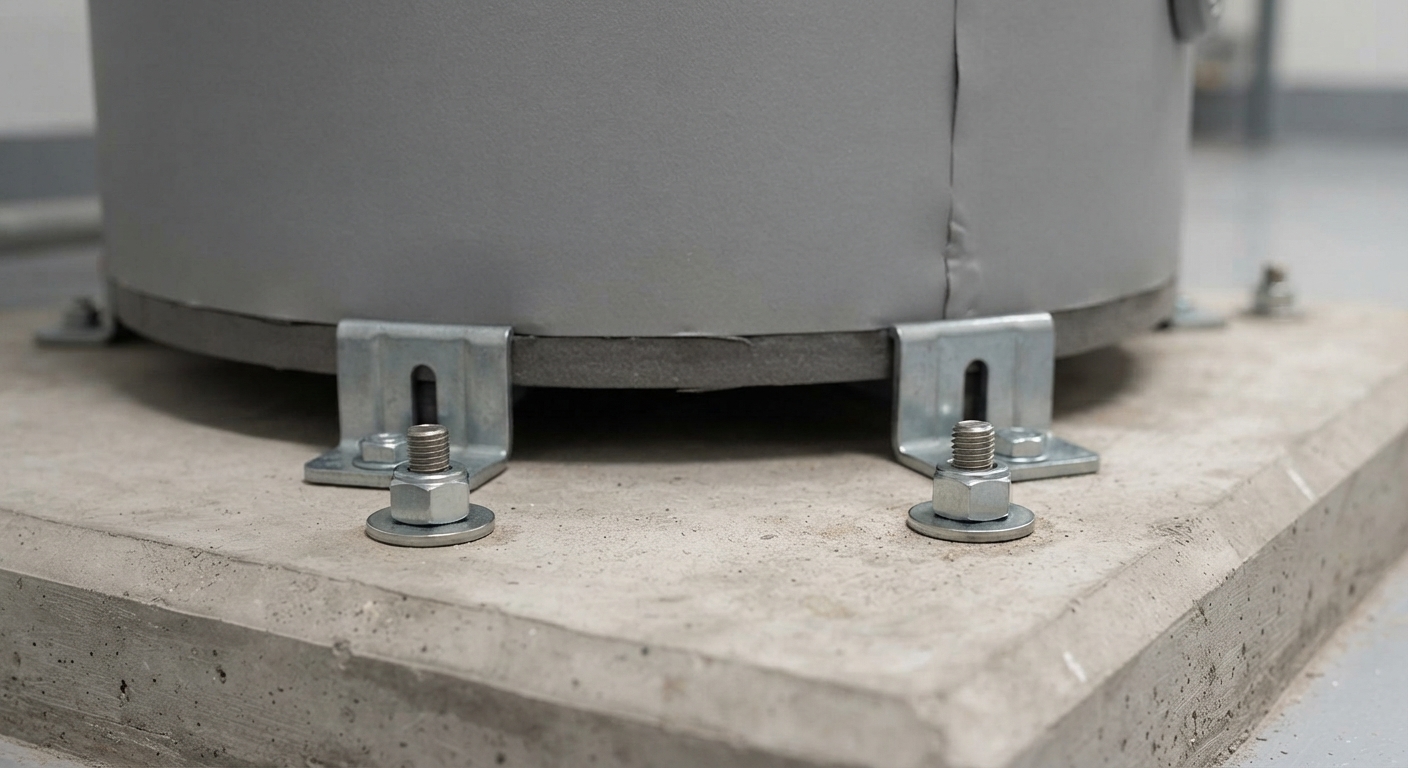
A buffer tank is a nonstructural component under the building code, and in California that carries obligations most specifiers underestimate until plan review.
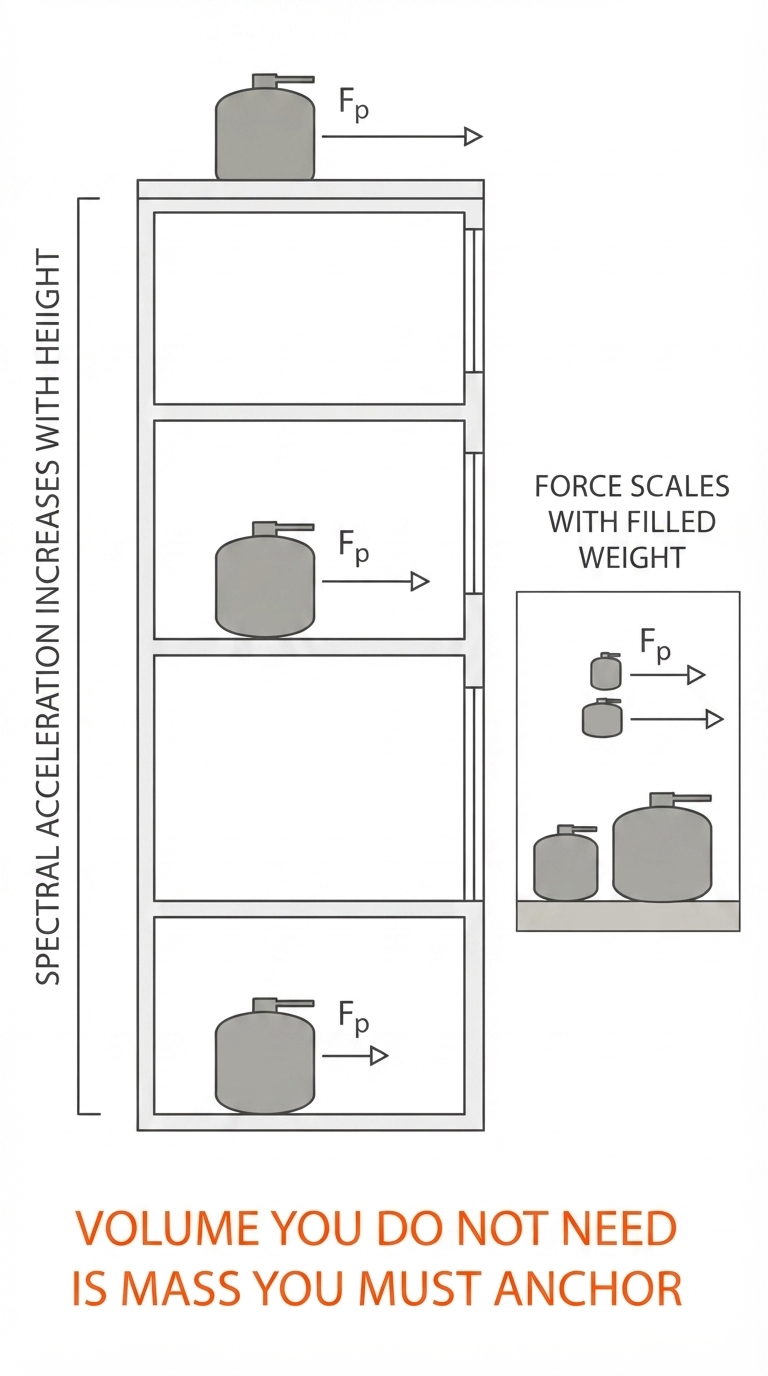
The governing calculation is the design seismic force for nonstructural components under ASCE 7. What matters for sizing is what goes into it: the force is a function of the component’s weight and of the spectral acceleration at the height where it is installed, along with component amplification and response modification factors. Two consequences follow directly.
Restraint is also inspected. Installed seismic bracing is subject to special inspection requirements under the California Building Code in the higher seismic design categories that cover most of the state — a certified special inspector verifies anchorage embedment, bolt torque, and restraint geometry against the approved documents. A tank that arrives without engineered anchorage details does not get signed off because it looks solid.
Pre-engineered restraint systems carrying pre-calculated ratings can streamline plan review, which is worth asking any tank supplier about. What matters commercially is that the seismic scope is real, it is proportional to the mass you specify, and it is not a line item most national sizing guidance mentions at all.
How Tank Decisions Affect Seismic Design
Larger Tank Volume
Seismic Consequence:
As tank volume increases, the filled weight generally rises with it. Because seismic design forces are directly influenced by equipment weight, larger tanks typically require more substantial anchorage, bracing, and structural support.
The tank itself is therefore only one part of the sizing decision. The structure beneath it and the connections restraining it must also be capable of handling the increased seismic forces.
Higher Installation Elevation
Seismic Consequence:
Seismic acceleration can increase higher in a building.
As a result, a tank installed in a penthouse or on an upper floor may experience greater seismic forces than an identical tank located at or near the basement level.
Installation elevation should therefore be considered early when evaluating tank size, anchorage, and structural requirements.
Multiple Smaller Tanks Instead of One Large Vessel
Seismic Consequence:
Using several smaller storage modules can distribute the total system weight across a larger area and may simplify the anchorage requirements for each individual vessel.
However, modular construction does not eliminate seismic requirements. Every tank still requires appropriate restraint and anchorage, and the combined loading on the supporting structure must still be evaluated.
Tank Installation in an Existing Building
Seismic Consequence:
Existing slabs, roofs, and structural framing may not have been designed for the concentrated weight of a large, water-filled thermal storage vessel.
A structural review should therefore occur before the tank is ordered, not after it arrives on site.
This is particularly important for rooftop and upper-floor installations, where both gravity loads and seismic forces can become significant.
Why Tank Selection and Seismic Design Are Connected
Thermal storage sizing cannot be separated from structural design. Increasing tank volume affects not only storage capacity but also operating weight, seismic forces, anchorage requirements, and loads on the supporting structure.
Tank size, installation location, elevation, and modular configuration should therefore be evaluated alongside the structural and seismic requirements early in the design process.
Healthcare occupancies are a different regime
If the building is an acute care hospital, skilled nursing facility, or correctional treatment center under the jurisdiction of the California Department of Health Care Access and Information (HCAI, formerly OSHPD), the requirements step up substantially.
Nonstructural components in those facilities carrying an importance factor of 1.5 require special seismic certification — a Certificate of Compliance from the manufacturer indicating that after a design earthquake the equipment will maintain both structural integrity and functionality. HCAI operates a voluntary preapproval program for manufacturers, described in Policy Intent Notice 55, which was revised in October 2025 and references the 2025 California Building Code and ASCE/SEI 7-22. Approved preapprovals are posted publicly on the HCAI OSP program page.
Ask the manufacturer: do you hold an active OSP or OPM number, what code cycle does it reference, has the equipment been shake-table tested, and can you supply PE-stamped anchorage calculations for this installation?
Then verify it. Preapprovals are posted on a public HCAI register. This is a checkable status, not a marketing claim, and a plan reviewer will check it.
Without preapproval, equipment goes through deferred approval, which adds schedule risk to a project type that has very little schedule tolerance. Build that into the procurement timeline rather than discovering it at review.
Thermal Energy HQ makes no claim about certification status in this article. Ask us the same questions you would ask any supplier, and verify the answers on the register.
Where Title 24 actually fits — and where it does not
Title 24 does not specify buffer tank volume. No section tells you how many gallons to install to prevent a compressor short cycling. Any vendor implying a code-mandated buffer size is confusing energy code compliance with mechanical design.
What the 2025 Building Energy Efficiency Standards do is shape the equipment landscape, and that changes the buffer question indirectly. Projects permitted on or after January 1, 2026 comply with the 2025 cycle, and for nonresidential buildings the governing guidance is the 2025 Nonresidential Compliance Manual (CEC-400-2025-008). The cycle expands heat pump requirements across building types, which means more California commercial buildings are running heat pumps — and heat pumps are what buffer tanks exist to protect.
The indirect connection worth understanding is this: the equipment being installed to satisfy the energy code is predominantly modulating equipment, and modulating equipment cycles less. That points the buffer requirement downward, which is the subject of the next section.
As with any code question, section numbers and thresholds belong to the compliance manual and the project’s energy consultant rather than to an article.
Two reasons California usually needs less buffer
California’s mild climate and the market’s preference for modulating equipment weaken the two main arguments usually used to justify generous buffer volume.
1. The defrost argument mostly does not apply
A significant part of the case for generous buffer volume on air-source systems is defrost. When a heat pump reverses to melt frost off its outdoor coil, it draws heat out of the water loop, and a low-volume system can see loop temperature collapse far enough to trigger a fault.
That is a cold and humid climate problem. Frost forms most readily in roughly the 20–45°F band with meaningful humidity. Coastal and Southern California spend very little of the year there. Inland valleys see some winter morning frost conditions; the Sierra, the far north, and the high desert genuinely do get cold and should not be designed as though they are San Diego.
For most of the state’s commercial building stock, though, the defrost volume requirement that drives buffer sizing in Minneapolis is a small factor. Ask the manufacturer for their minimum system volume for cycling protection and, separately, for defrost — in a mild climate the second number often stops governing.
2. Modulating equipment cycles less
Buffer tanks exist because a fixed-output compressor at part load has only two states: running at full capacity, or off. An inverter-driven compressor reduces output to match the load and keeps running.
UK government-commissioned field research concluded that buffer tanks are less relevant with inverter-driven heat pumps that can modulate down to around 30% of rated output, because cycling is reduced. That research was published in 2013 and turndown has generally improved since, which strengthens the conclusion rather than dating it.
The California-specific point is that the equipment market here skews heavily toward modulating systems, partly because the energy code favours heat pumps and partly because efficiency programs and utility incentives have pushed high-performance equipment for years. A specifier working from a national rule of thumb written for single-stage equipment is likely sizing for a machine that is not what will be installed.
Less defrost demand plus deeper modulation means the two largest drivers of buffer volume are both weaker in most of California than the national guidance assumes. Combined with the seismic mass penalty, the incentives all point the same direction.
The cases where a buffer still does real work here are unchanged: fixed-output or single-stage equipment, circuits with genuinely low water volume, heavily zoned systems where a single small zone call presents a load far below the compressor’s minimum, and inland or mountain climate zones where winter conditions are real.
Everywhere else, count the volume the system already holds before assuming you need to add any. In buildings with long distribution runs and substantial coil volume, the existing system frequently satisfies the manufacturer’s minimum on its own.
When the answer is storage, not a buffer
California has the most consequential time-of-use rate structures in the country, with commercial peak windows commonly running 4 p.m. to 9 p.m. If the reason someone is asking about a tank is a utility bill rather than a cycling compressor, they are asking the wrong question.
A buffer tank holds minutes of thermal mass to protect equipment. Thermal storage holds hours to move load. They are sized by entirely different logic, and in California the second conversation is usually worth more money than the first. The distinction is covered in the buffer tank guide, and the tariff mechanics — including the two tests that determine whether a shaved load actually reduces a billed demand charge — are covered in Peak Shaving vs Load Shifting.
There is a useful practical overlap. Where a building needs both — equipment protection and load shifting — a correctly specified storage vessel can serve both roles, sized for the harder requirement. That is generally a better outcome than installing a small buffer tank now and discovering a storage requirement later, because in California it means one set of seismic calculations, one anchorage detail, and one special inspection instead of two.
A California specification checklist
Use the following questions before ordering a tank:
Weight and footprint data
Because seismic design force follows filled weight, the weight column matters more here than the price column. Verify these figures against the live thermal tank comparison and specifications before any structural calculation, since these figures are load-bearing inputs in the literal sense.
80-Gallon Thermal Storage Tank
Filled Weight: 1,266 lb
Approximate Floor Loading: 100 lb/sq ft
Storage Capacity: 12.0 kWh
List Price: $1,190
The 80-gallon model has the lowest structural load and smallest storage capacity of the group. Its relatively modest weight can make it easier to accommodate in existing buildings, although the supporting structure and anchorage still require verification.
350-Gallon Thermal Storage Tank
Filled Weight: 3,089 lb
Floor Loading: 157.4 lb/sq ft
Storage Capacity: 54.6 kWh
List Price: $3,427
The 350-gallon model provides more than four times the storage capacity of the 80-gallon tank, but its filled weight exceeds 3,000 pounds.
At this size, structural capacity, tank placement, and seismic restraint become increasingly important design considerations.
500-Gallon Thermal Storage Tank
Filled Weight: 4,351 lb
Floor Loading: 221.7 lb/sq ft
Storage Capacity: 77.0 kWh
List Price: $4,464
The 500-gallon model provides 77 kWh of thermal storage while imposing more than 220 lb/sq ft of floor loading.
For existing buildings, this level of concentrated loading should generally be evaluated by the structural design team before equipment is ordered or a final location is selected.
700-Gallon Thermal Storage Tank
Filled Weight: 6,046 lb
Floor Loading: 308 lb/sq ft
Storage Capacity: 108.0 kWh
List Price: $5,798
The 700-gallon model offers the greatest storage capacity but also creates the largest structural demand.
At more than 6,000 pounds filled and approximately 308 lb/sq ft of floor loading, placement can become a major part of the engineering decision. Upper-floor and rooftop installations may require substantial structural reinforcement or may not be practical at all.
Storage Capacity Comes With a Structural Cost
As thermal storage capacity increases, both filled weight and floor loading rise substantially.
Moving from the 80-gallon to the 700-gallon model increases storage capacity from 12 kWh to 108 kWh, but filled weight rises from approximately 1,266 pounds to 6,046 pounds.
This means tank selection should not be based on thermal capacity and price alone. Engineers should evaluate floor loading, structural capacity, seismic restraint, installation elevation, equipment access, and available mechanical-room space before selecting the final vessel size.
Storage capacity is based on the stated usable temperature range and thermal storage assumptions for these vessels.
How to read the table
*Rated at a 35°C temperature delta — a storage rating. Buffer applications operate over different temperature bands.
Weights and pricing are current as of August 2026; verify against the live thermal tank comparison and specifications before any structural calculation. Vessel prices are not installed system prices — and in California the installed cost includes engineered restraint, structural review, and special inspection.
A 700-gallon vessel is not simply a bigger purchase than a 350 — it is roughly double the filled weight, with proportionally larger design forces and a heavier anchorage detail. Where the calculation genuinely calls for the larger volume, that is a cost worth paying. Where it does not, it is cost imported for no reason.
Frequently Asked Questions
Does California change how you size a buffer tank?
Not the calculation, but three things around it. Seismic design force for nonstructural components scales with component weight and with the spectral acceleration at installation height, so tank volume becomes a structural cost. California's mild climate means the defrost demand that drives buffer volume in cold climates is a much smaller factor. And the modulating equipment favoured by the energy code cycles less than the single-stage equipment national rules of thumb were written for. All three point toward a smaller tank.
Does Title 24 require a buffer tank or specify its size?
No. The Building Energy Efficiency Standards do not mandate buffer tank volume, and any guidance implying a code-required buffer size is confusing energy code compliance with mechanical design. Title 24 affects the question indirectly by shaping what equipment goes into California buildings, and the modulating heat pumps the code favours generally need less buffer than fixed-output equipment.
What seismic requirements apply to a buffer tank in California?
A buffer tank is a nonstructural component, and design seismic force is calculated under ASCE 7 based on component weight, the spectral acceleration at its installation height, and component amplification and response modification factors. Engineered anchorage is required, the supporting structure must be reviewed, and installed bracing is subject to special inspection under the California Building Code in the higher seismic design categories that cover most of the state.
Do buffer tanks need OSHPD or HCAI certification?
Only in specific occupancies. Nonstructural components installed in California acute care hospitals, skilled nursing facilities, and correctional treatment centers under HCAI jurisdiction, where the importance factor is 1.5, require special seismic certification in the form of a manufacturer's Certificate of Compliance. HCAI operates a voluntary preapproval program for manufacturers and posts approved preapprovals on a public register, so a supplier's status is checkable rather than something to take on trust.
Does a bigger buffer tank cost more than just the tank?
In California, yes, and the difference is not trivial. Because seismic design force scales with filled weight, a larger tank means larger anchorage forces, a heavier restraint detail, more demanding structural review of the supporting slab or roof, and the same special inspection scope applied to a bigger installation. A 700 gallon vessel is roughly double the filled weight of a 350, with proportionally larger design forces.
Do inverter-driven heat pumps need a buffer tank in California?
Frequently not, or much less than assumed. UK government-commissioned field research concluded that buffer tanks are less relevant with inverter-driven heat pumps that modulate down to around 30 percent of rated output, because cycling is reduced, and turndown has improved since that research was published in 2013. Combined with California's mild climate reducing defrost demand, the two main arguments for generous buffer volume are both weaker here. Confirm against the manufacturer's minimum system volume and count existing circuit volume before adding a tank.
Should I install a buffer tank or thermal storage?
It depends on what problem you are solving. A buffer tank holds minutes of thermal mass to stop a compressor short cycling. Thermal storage holds hours to move load off expensive tariff periods, which matters in California given commercial time-of-use peaks commonly running 4 to 9 p.m. Where a building needs both, a correctly specified storage vessel sized for the harder requirement can serve both roles, which in California also means one set of seismic calculations and one special inspection rather than two.
Is the defrost buffer requirement relevant in California?
In most of the state, much less than in cold climates. Frost forms most readily in roughly the 20 to 45 degree Fahrenheit band with meaningful humidity, and coastal and Southern California spend little of the year there. Inland valleys see some winter morning frost conditions, and the Sierra, far north, and high desert genuinely do get cold. Ask the manufacturer for minimum system volume for cycling protection and for defrost as two separate numbers, and see which governs in your climate zone.
Conclusion
The buffer tank calculation does not change in California. What changes is everything the tank has to survive once it is installed, and what the equipment actually needs.
Seismic design force follows filled weight, so volume specified beyond the requirement becomes anchorage engineering, structural review, and inspection scope that no national sizing guide mentions. Meanwhile the two arguments that usually justify a generous buffer — defrost demand and compressor cycling — are both weaker in a mild climate running modulating equipment.
Count the volume the system already holds. Get both minimum volume numbers from the manufacturer. Check the turndown ratio. And before ordering anything, ask whether the real problem is a cycling compressor or a utility bill — because in California those are two different vessels, and only one of them pays for itself.
This article is general information, not structural, seismic, or code compliance advice. Seismic design for nonstructural components is project-specific and must be performed by a qualified engineer against the applicable code cycle. Certification requirements vary by occupancy and jurisdiction. Confirm all requirements with your structural engineer and the authority having jurisdiction.