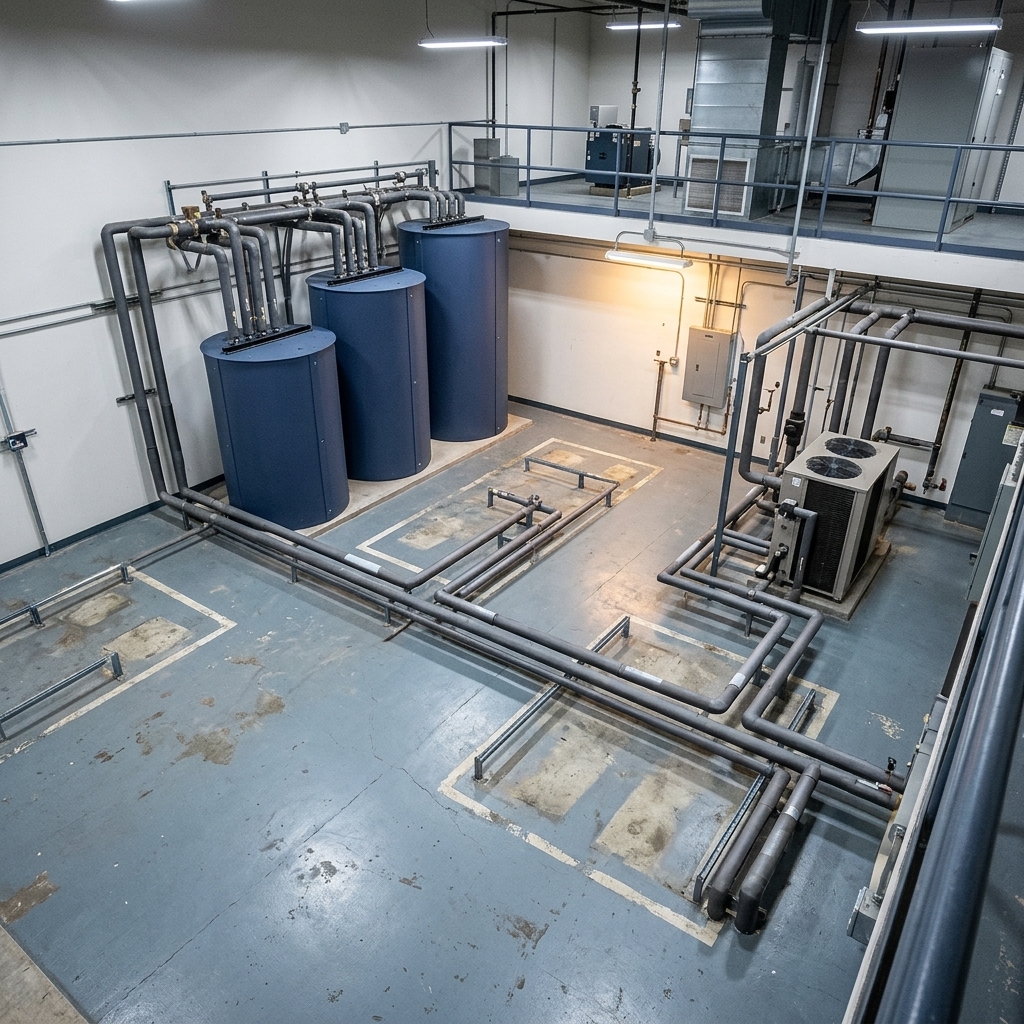
Peak shaving and load shifting are often discussed as if they were interchangeable. They are not. Peak shaving lowers the highest part of a building's load curve, while load shifting moves consumption from one time period to another.
That distinction affects the utility bill, the storage capacity required, the controls strategy, and the way project savings should be modeled. A building can shift substantial energy successfully and still fail to reduce its monthly demand charge.
Key Takeaways
The practical question is not simply whether a building should use storage. It is which part of the bill the storage is meant to affect, when the relevant load occurs, and whether the tariff rewards that behavior.
Thermal end uses are a large share of the flexible load in most buildings. EIA's commercial buildings data shows natural gas in commercial buildings is used principally for space and water heating, and in multifamily properties specifically, domestic hot water is typically both the largest thermal load and the peakiest. That matters here because it means a large share of the shaving and shifting opportunity in these buildings is thermal — and therefore addressable with thermal storage rather than only with batteries.
In this article
Peak shaving vs. load shifting: the basic difference
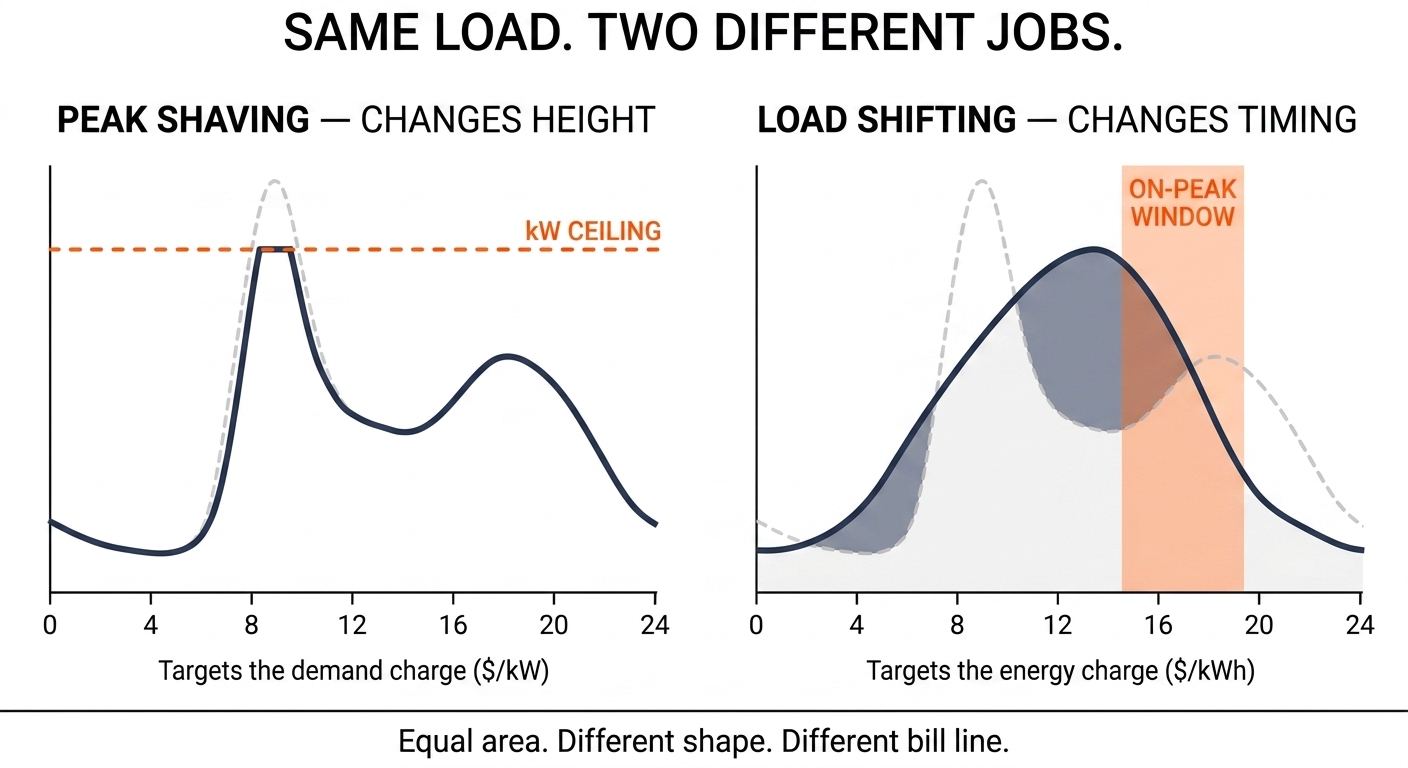
Peak shaving reduces the height of a building's electrical or thermal load during the interval that sets the demand peak. The objective is to keep demand below a target ceiling, usually by discharging storage when the building would otherwise reach its highest kW level.
Load shifting moves energy use from one period to another. The total energy may remain similar, but the timing changes. A building can charge or produce hot water during an off-peak period and use that stored energy during a higher-priced or more constrained period.
Peak shaving is therefore primarily a kW problem. Load shifting is primarily a kWh timing problem. A single thermal storage asset can perform either job, but its controls and sizing must match the intended objective.
Peak shaving compared with load shifting
CategoryPeak shavingLoad shifting
Primary targetThe highest demand intervalThe timing of energy consumption
Bill componentDemand chargeTime-of-use energy charge
MeasurementkWkWh
Core control objectiveHold the load below a demand ceilingMove production or consumption into a different time period
Main sizing questionHow much discharge power and usable energy are needed during the peak interval?How much energy must be moved, and for how many hours?
Why the distinction appears on the utility bill
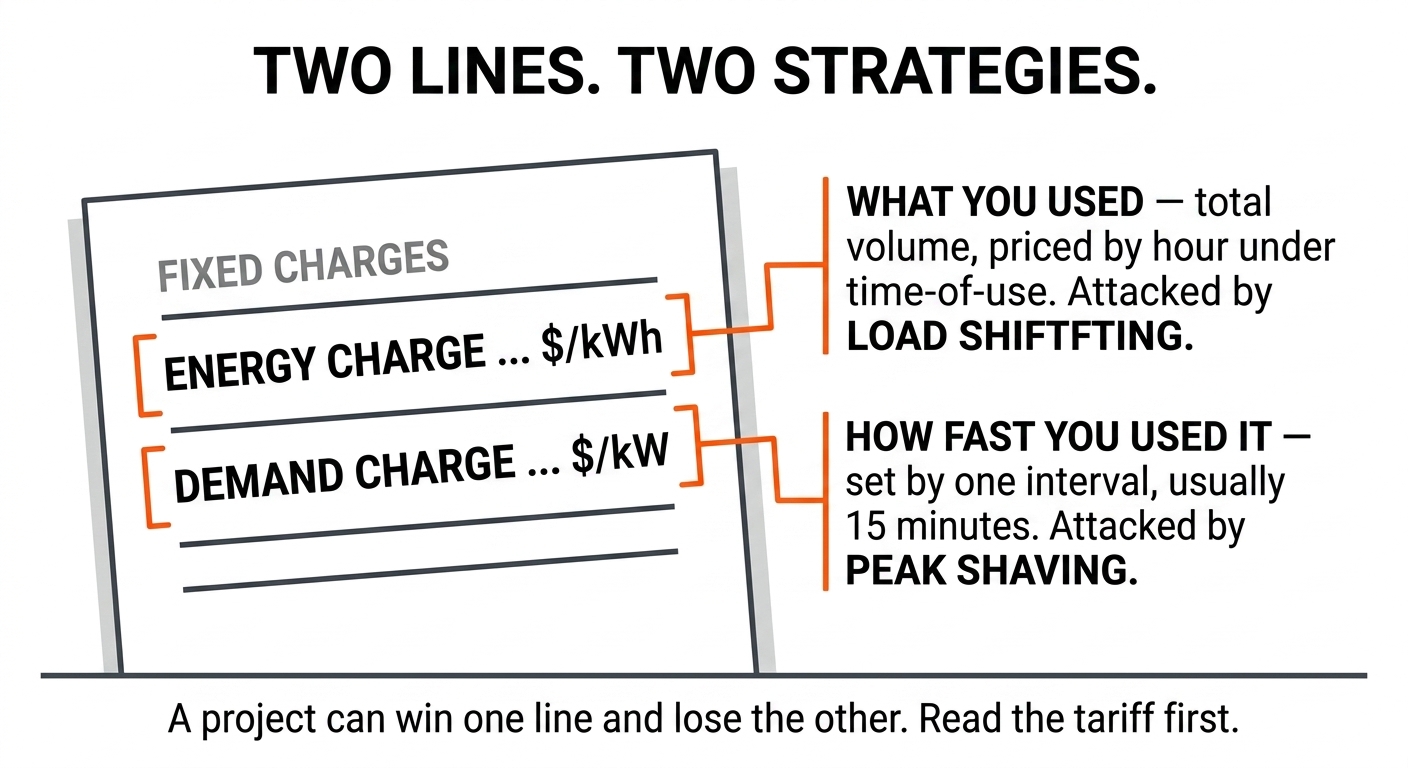
A commercial electric bill usually includes two different components. The energy charge applies to the electricity consumed, measured in kWh. The demand charge applies to the highest measured demand during a billing period, measured in kW, and can be based on a short interval rather than the building's monthly average.
A 2017 survey of more than 10,000 commercial tariffs across 48 states, conducted by the National Renewable Energy Laboratory — now the National Laboratory of the Rockies — with Clean Energy Group, found that demand charges commonly represented roughly 30–70% of a commercial electric bill, and identified several million customers on tariffs at or above $15/kW. The full survey is available from the laboratory, and Clean Energy Group publishes an accompanying fact sheet. The demand-charge fact sheet provides additional context.
Those figures come from a 2017 national survey and describe the range observed across tariffs at that time, not a current guarantee for any specific building. Demand charges have generally risen since. Read your own rate schedule rather than assuming a national range applies to you.
A project can reduce on-peak kWh and still leave the highest demand interval untouched. Conversely, a project can lower the demand peak without moving enough energy to capture a meaningful time-of-use spread. The bill must be modeled as separate demand and energy components.
How a demand ratchet changes the answer
A ratchet provision sets a floor under billed demand based on a prior peak — commonly 60–80% of the highest interval in the previous eleven months. Where one applies, it does not affect peak shaving and load shifting equally, and most comparisons of the two strategies ignore this entirely.
Ratchets make shaving more valuable and make it less forgiving. More valuable, because holding a demand ceiling protects up to twelve bills rather than one — the return on a successful shave is a year of avoided floor, not a month. Less forgiving, because a single missed interval sets that floor and no amount of subsequent performance removes it until the lookback window rolls. A shaving strategy under a ratchet has to be reliable, not merely effective on average.
Ratchets barely touch shifting. Load shifting attacks the energy charge, which is billed on actual consumption in each period. There is no ratchet on kWh. A building can shift successfully in its first month and see the benefit immediately.
Two consequences for project economics. First, payback timing diverges: shifting savings appear on the next bill, shaving savings may not appear until the old ratchet floor expires. A model that applies one timeline to both is wrong. Second, where a ratchet applies, the case for a controls strategy that reliably enforces a kW ceiling — demand-limiting partial storage, in the vocabulary above — strengthens considerably relative to a strategy optimized purely for energy arbitrage. More detail on ratchet mechanics and how to detect one on your own bills is in our guide to reducing peak demand charges in a commercial building.
Full storage vs. partial storage
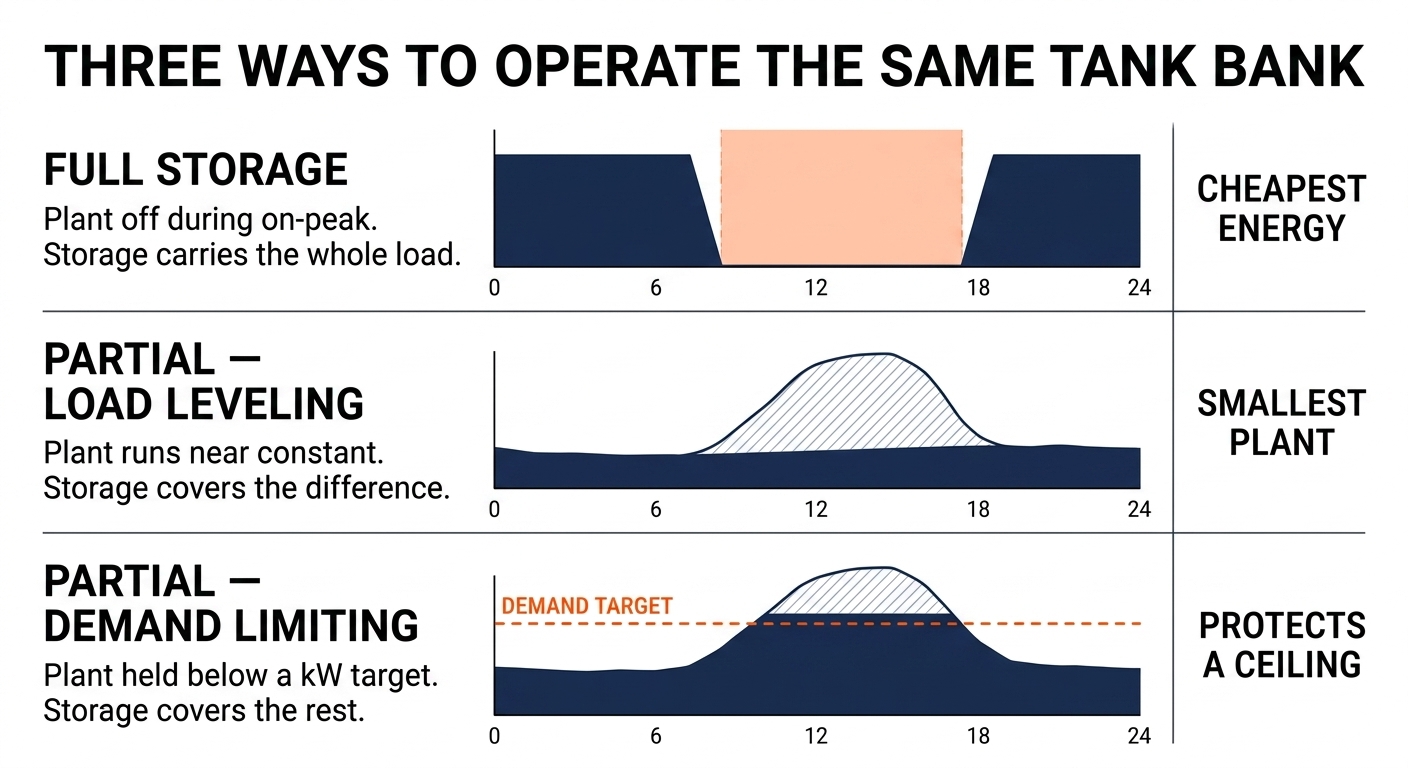
Full storage is sized to meet the targeted load for the entire period being covered. For example, a full-storage domestic hot water design may produce and store enough hot water during an off-peak window to cover the subsequent high-cost period.
Partial storage is sized to reduce or limit the load rather than eliminate it during the target period. The plant continues operating, but the storage system supplies part of the demand so the combined load stays below a selected ceiling.
The choice between full and partial storage depends on the tariff, the duration of the target period, available plant capacity, storage volume, recovery time, and the reliability required by the operating strategy. A buffer tank vs. storage tank comparison can help clarify the distinction between hydraulic buffering and energy storage.
How to size for peak shaving and load shifting
Peak-shaving sizing starts with the demand ceiling. Determine the highest interval that must be reduced, the target kW level, the duration of the event, and the discharge power required to hold the building below that level.
Load-shifting sizing starts with the energy to be moved. Determine how many kWh must be produced or stored during the lower-cost period, how long the shifted period lasts, and how much usable storage remains available after accounting for operating constraints.
For a thermal system, the basic stored-energy relationship is driven by storage volume, the usable temperature difference, and the heat capacity of the storage medium. The sizing example on this page is illustrative only. It does not account for COP, standing loss, recovery time, temperature delta, or simultaneity, all of which can materially affect the required equipment and storage capacity.
For domestic hot water applications, see the related guidance on heat pump water heater storage tank sizing. For a packaged configuration, see the All-In-One thermal energy system.
Illustrative storage sizing example
ItemIllustrative value
Daily thermal energy to be covered600 kWh
Storage objectiveShift or shave the selected thermal load during the target period
InterpretationThe required tank size depends on usable temperature difference, losses, recovery time, COP, and simultaneity
The failure mode nobody models: a successful shift that misses the peak
Illustrative only — modeled figures, not a customer result.
A building moves 70% of its daily hot water production into a 10 p.m.–6 a.m. off-peak window. Measured against the energy charge, the project is a clear success: on-peak kWh drops sharply and the time-of-use line on the bill falls as modeled.
The demand charge does not move. The reason is that the building's peak interval was never in the on-peak TOU window in the first place — it falls at 6:45 a.m., when the recirculation loop, the first shift of occupant draw, and the plant's own morning recovery coincide. The shifted production was moved into the hours that contain the peak-setting interval, not away from them. In the worst version of this, shifting makes the demand charge slightly worse.
What this teaches: TOU windows are set by the utility to reflect system conditions. Your demand peak is set by your building. They frequently do not coincide, and nothing on a monthly bill reveals the mismatch. Only interval data does. This is why the sequence is always tariff first, interval data second, equipment third — and why a blended average rate is useless for storage modeling.
Which strategy saves more? Read the tariff first
There is no universal answer. A tariff with a significant demand charge may reward dependable peak shaving, especially where a demand ratchet applies. A tariff with wide time-of-use differentials may reward load shifting. Many commercial tariffs contain both components, making a combined strategy more appropriate.
Flat energy rate and no demand charge: neither strategy has direct rate-arbitrage value … do not model savings that do not exist.
The correct analysis uses the building's interval load data, the tariff's demand and energy rules, the timing of the thermal loads, and the storage system's actual operating limits. Batteries provide sub-second response and backup power; thermal storage does not. Electrical peaks belong to batteries, thermal peaks belong to thermal storage.
For thermal loads such as heating, cooling, and domestic hot water, domestic hot water electrification retrofit planning can show where one thermal storage asset may serve both shaving and shifting through controls rather than hardware changes.
Thermal tank pricing
Vessel list pricing for our tanks runs roughly $54–$97 per stored kWh. Published benchmarks for complete utility-scale lithium-ion systems sit several times higher per kWh of capacity. The comparison is directional only — vessel-only pricing and complete-system pricing draw their cost boundaries in different places, and a fair comparison requires installed cost on both sides. Ask any vendor, including us, for both.
Capacity is rated at a 35°C temperature delta. List pricing is current as of August 2026 and is subject to change; confirm against the thermal tank overview page or with our team before using these figures in a budget.
Illustrative thermal tank vessel list pricing
MeasureRange
Stored-energy pricing$54–$97 per stored kWh
Rated condition35°C temperature delta
Incentives and project economics
Incentive programs change on their own schedules and several federal provisions moved in 2025 and 2026. Confirm current eligibility with a tax professional and the relevant program administrator before building any of it into a pro forma.
Potential federal treatment should be reviewed against the current §48E clean electricity investment credit guidance, 26 U.S.C. §48E, and the thermal energy storage property definition in 26 U.S.C. §48. Applicable sourcing guidance may also include IRS Notice 2026-15.
For state and local opportunities, use the energy incentive finder and confirm program rules directly. In California, the California BOE information on the §73 active solar property tax exclusion is a relevant starting point, subject to current applicability.
Texas: a rule change that shifts the priority
Buildings in ERCOT territory have a third variable. A significant share of delivery cost is allocated through the Four Coincident Peak method — transmission cost assigned by your demand during the single highest 15-minute system-wide interval in each of June, July, August, and September. Because four summer intervals set a year's transmission cost, Texas customers have historically treated peak avoidance as an event to be predicted and curtailed through.
That is under active reconsideration. Following the 2025 legislative session, the Public Utility Commission of Texas opened a transmission cost allocation proceeding (Project No. 58000) and in July 2026 approved publication of a proposed rule replacing 4CP with a twelve-coincident-peak method — one peak interval every month — measured over 30-minute rather than 15-minute intervals. Comments closed in August 2026; a decision is expected in December 2026.
Why it matters for this comparison specifically: a 12CP rule with longer intervals converts peak avoidance from a seasonal event into a permanent operating characteristic, in every month including winter, over a window twice as long. Strategies that depend on a person watching a forecast do not scale to that. Strategies that structurally lower the building's peak do. For Texas buildings, a proposed rule change is quietly shifting the balance toward reliable shaving and away from episodic curtailment. Regional detail is on our Texas thermal energy storage page.
This is a live proceeding and nothing above is final rule text. Confirm current status before making a decision on it.
Conclusion
Peak shaving and load shifting solve different billing and operating problems. Shaving targets the highest kW interval and the demand charge; shifting moves kWh between periods and targets the time-of-use energy charge.
The strongest design starts with the tariff, verifies the building's interval load profile, and then selects the storage capacity, discharge power, and controls needed for the actual objective. Do not assume that a successful time-of-use shift will lower demand, or that a lower peak will create energy-arbitrage savings under a flat tariff.