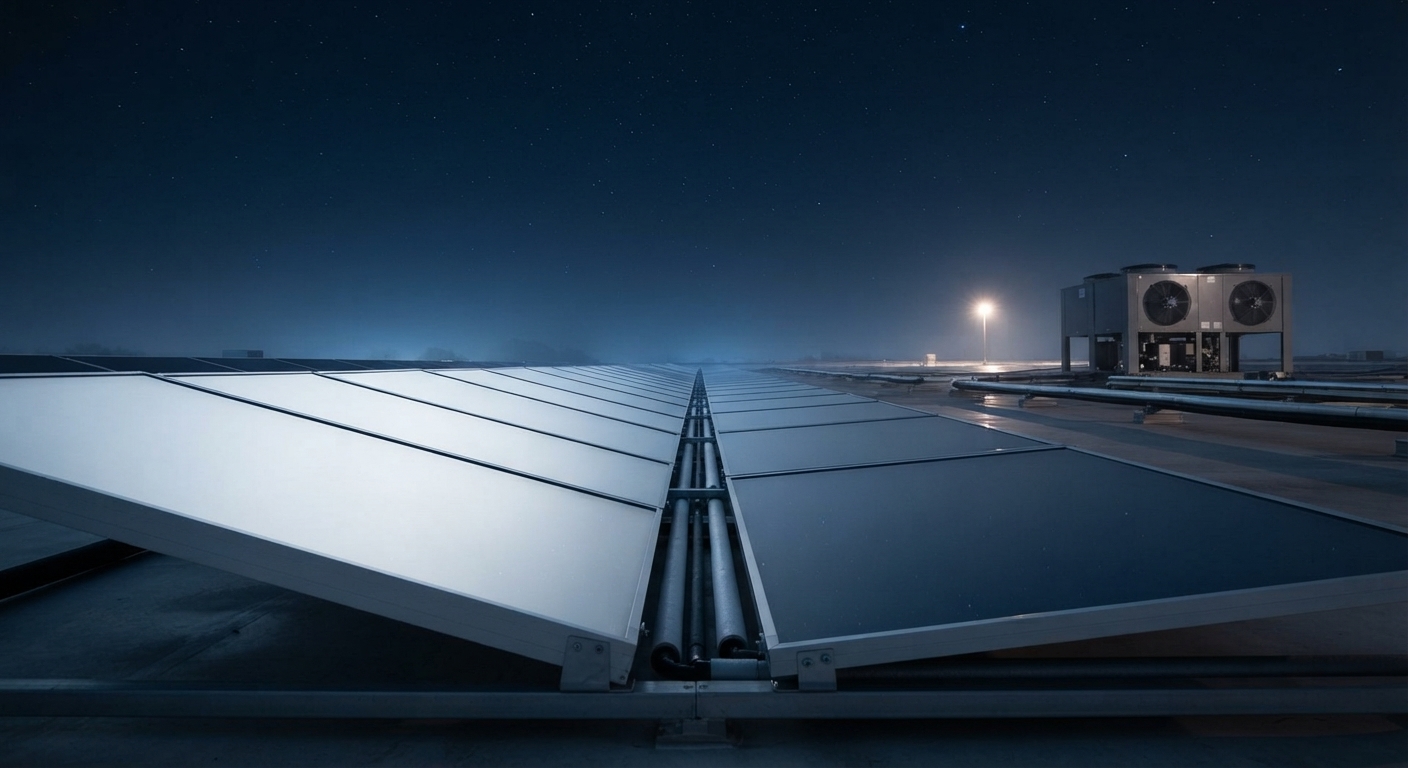
A chiller does not work hard because the building is hot. It works hard because the condenser is hot. Every degree you can take off the condenser side is compressor energy you never spend — and a surface pointed at the night sky can reach a temperature no dry cooler can touch, because it is exchanging heat with something far colder than the air: space.
Key Takeaways
Radiative sky cooling exploits a window in the atmosphere between roughly 8 and 13 microns through which thermal radiation escapes to space. A panel engineered to reflect sunlight while emitting strongly in that band can drop below ambient air temperature, even in daylight.
Circulate condenser water through such panels and the chiller sees a colder condenser, which directly reduces compressor lift and therefore compressor energy. Stanford researchers measured sub-ambient fluid cooling of 3–5°C on a rooftop and, in simulation, estimated a 21% cut in summer cooling electricity for a Las Vegas office building — against an air-cooled chiller baseline.
The constraints are real: radiative flux per square metre is modest, performance depends heavily on dry clear skies, and the cooling arrives on the sky’s schedule rather than the building’s. That last constraint is what thermal storage exists to solve.
In this article
Why the condenser is where chiller energy is decided
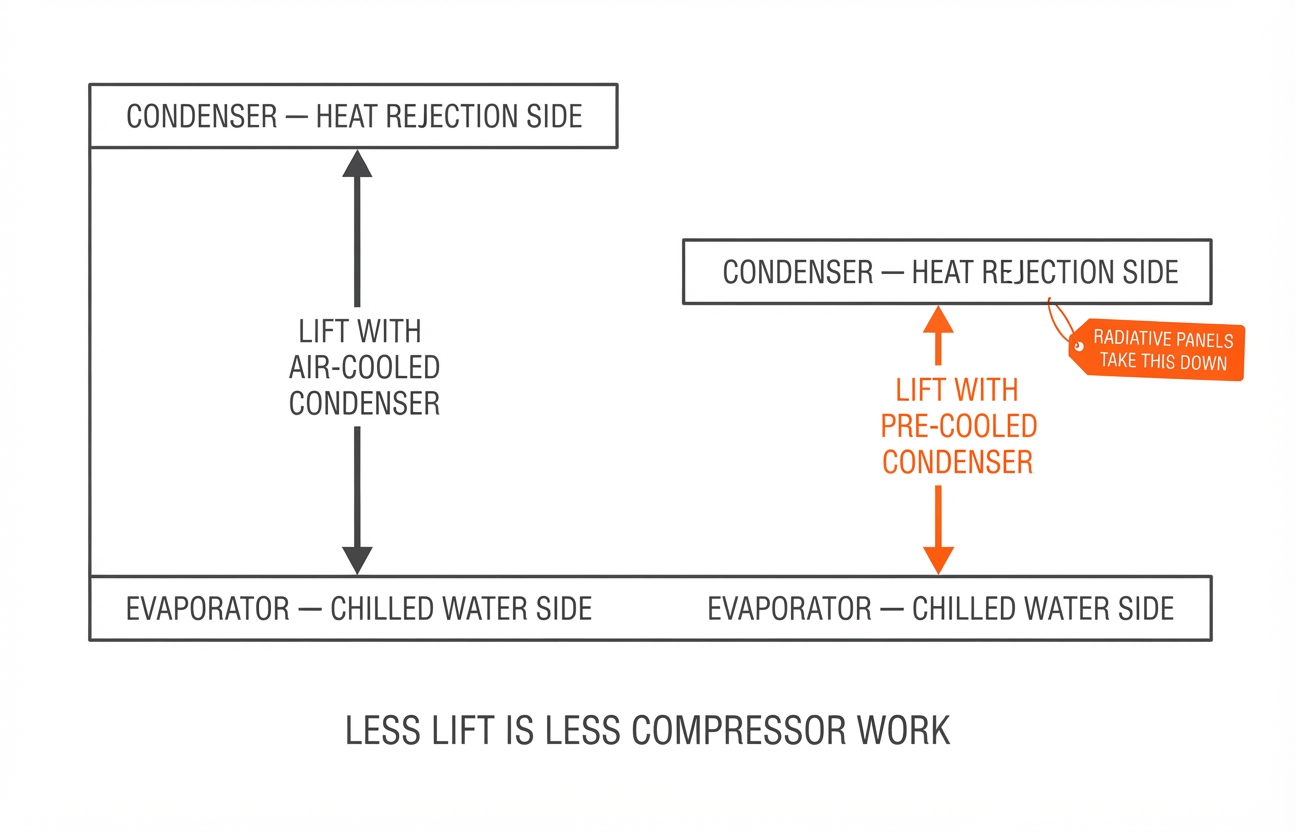
A vapour-compression chiller moves heat from the chilled water loop to the condenser. The compressor’s job is to raise refrigerant pressure far enough that heat will flow out at the condenser temperature. The bigger that temperature gap — the lift — the more work the compressor does.
This is why condenser water temperature is one of the most powerful levers in a chiller plant. It is also why cooling towers exist: evaporative cooling can approach the wet bulb temperature, which on a dry day is well below the air temperature. A dry cooler, by contrast, can never get below the ambient dry bulb, because it is exchanging heat with the air.
Radiative cooling changes the reference. A panel radiating through the atmospheric window is not exchanging heat with the air — it is exchanging with the sky, and effectively with space. As Stanford’s Shanhui Fan put it in describing the work, the limit is no longer the air temperature but something much colder. That is what allows a fluid to go sub-ambient without evaporating any water.
What the Stanford research actually measured
The foundational work here is well documented and worth reporting precisely, because it is routinely quoted without its conditions.
In research published in Nature Energy in September 2017, a Stanford team led by Shanhui Fan with co-lead authors Aaswath Raman and Eli Goldstein built panels covered in a multilayer optical film that reflects roughly 97% of sunlight while emitting thermal energy through the atmosphere. Panels sat atop pipes of running water on the roof of the Packard Electrical Engineering Building. The Stanford Engineering account of the research reported the following results.
Measured Results vs. Modelled Performance
Measured Results
Researchers tested radiative cooling panels measuring slightly more than two feet square, with up to four panels operating at the same time.
During testing in September 2015, the system consistently cooled flowing water to approximately 3–5°C below the surrounding ambient air temperature over a three-day test period.
This demonstrated that the panels could reject heat to the sky and produce water temperatures below ambient conditions without relying on conventional mechanical cooling alone.
Modelled Commercial Building Performance
The measured panel performance was then applied to a simulation of a two-storey commercial office building in Las Vegas.
In the model, a conventional air-cooled chiller was replaced with a vapor-compression cooling system whose condenser was cooled using the radiative panels.
The modeled result showed approximately 14.3 MWh of summer electricity savings, representing a 21% reduction in building cooling electricity use.
Daily electricity savings varied considerably depending on operating conditions, ranging from approximately 18% to 50%.
What the Results Show
The measured testing demonstrated that radiative panels could reliably cool water below ambient air temperature under real operating conditions.
The building simulation suggests that using that cooling effect to improve condenser performance could materially reduce chiller electricity consumption, particularly in hot, dry climates such as Las Vegas.
The distinction is important: the 3–5°C temperature reduction was physically measured, while the 21% annualized cooling-energy reduction was calculated through building simulation rather than measured directly in an occupied commercial building.
The conditions attached to the 21% figure
Las Vegas was selected as a hot, dry location where the panels would work best. The baseline was an air-cooled chiller, which is the least efficient common configuration — against a well-run water-cooled plant the delta would be smaller. The 21% is a summer aggregate, not a year-round figure. And the work is from 2017.
None of that undercuts the result. It locates it. A technology that produces an 18–50% daily swing in a favourable climate against a weak baseline is genuinely interesting and genuinely conditional, and any vendor quoting the headline without the conditions is asking you not to check.
The system architecture
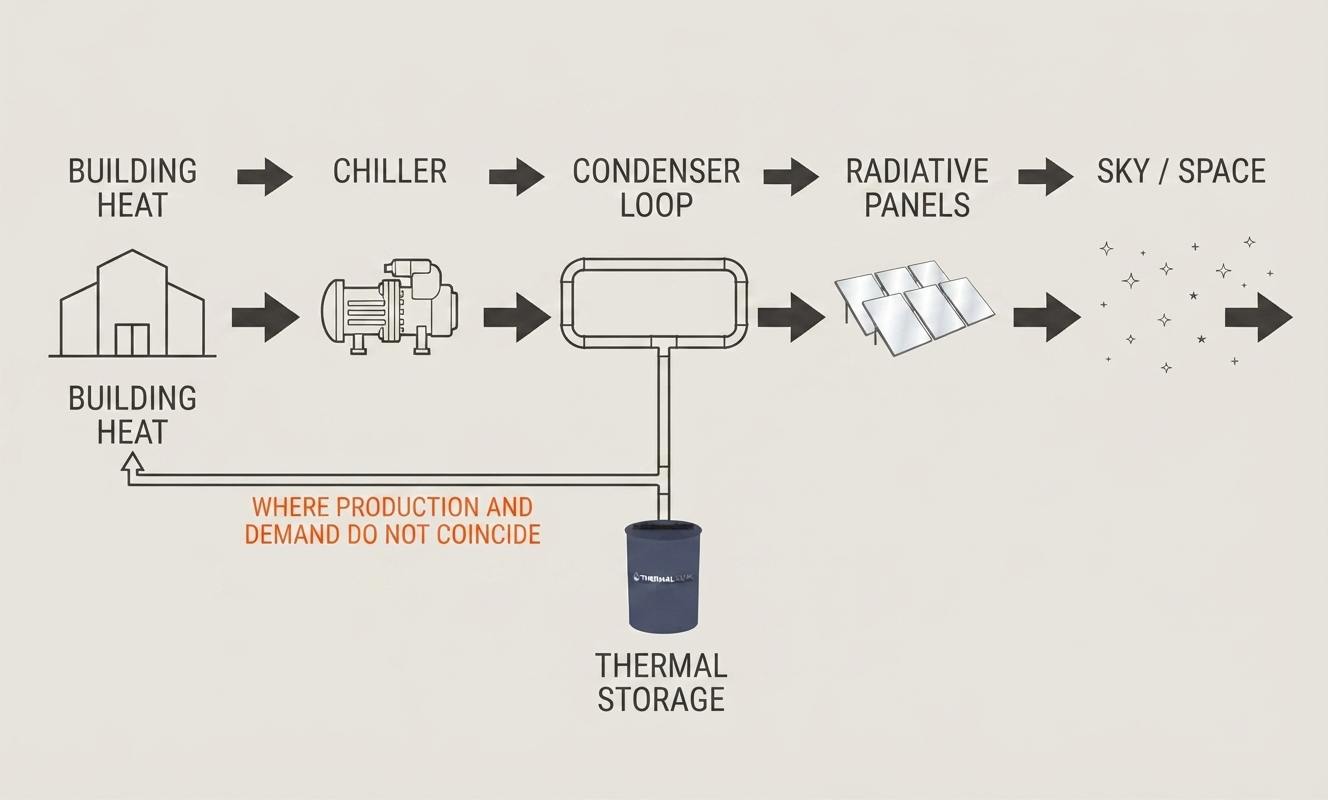
Reduced to its path, the architecture is short:
Building heat → chiller → condenser loop → radiative panels → sky
Heat leaves the occupied space into the chilled water loop. The chiller lifts it to condenser temperature. The condenser loop carries it to the roof. The panels radiate it through the atmospheric window. It leaves the planet.
Where production and demand do not coincide, storage sits between the panels and the load — banking cooling generated overnight or during favourable sky conditions until the building actually needs it.
TEHQ’s implementation: SkyRadiance
TEHQ’s implementation, SkyRadiance, is a water-based system that circulates water through radiative panels using 3M radiative cooling film. The film reflects incoming solar radiation while passively emitting infrared heat, which is what allows useful daytime performance rather than night-only operation.
Flow and drainage are managed by a Drainback Water Cascade assembly, and the system is designed to integrate directly with thermal storage tanks and PV infrastructure rather than as a standalone appliance.
The constraints, stated plainly
This is the section that most radiative cooling content omits, and it is the section an HVAC engineer will read first.
1. Flux per square metre is modest
Radiative cooling moves a limited amount of heat per unit area — enough to take a fluid a few degrees below ambient, not enough to reject a large chiller plant’s full condenser load from a practical roof. For most commercial plants this is a pre-cooling technology, not a heat rejection replacement, and any proposal that claims otherwise should be checked against the available roof area and the plant’s actual rejection duty in Btu/h before anything else.
2. Climate and sky conditions govern performance
The atmospheric window is narrowed by humidity and blocked by cloud. Hot, dry, high-clarity climates — the U.S. Southwest, interior California, much of the Mountain West — are where this works best, which is exactly why Stanford modelled Las Vegas. In humid or persistently cloudy regions the effect is real but smaller, and the business case has to be built on measured local conditions rather than on a published figure from somewhere else.
3. Panels need sky view and orientation
Unlike photovoltaics, which produce something useful whenever light reaches them, a radiative panel needs an unobstructed view of the sky to work at all. Shading, adjacent structures, and roof congestion all reduce output directly. Panels are typically mounted with a slight tilt for drainage and view.
4. Production and demand are on different schedules
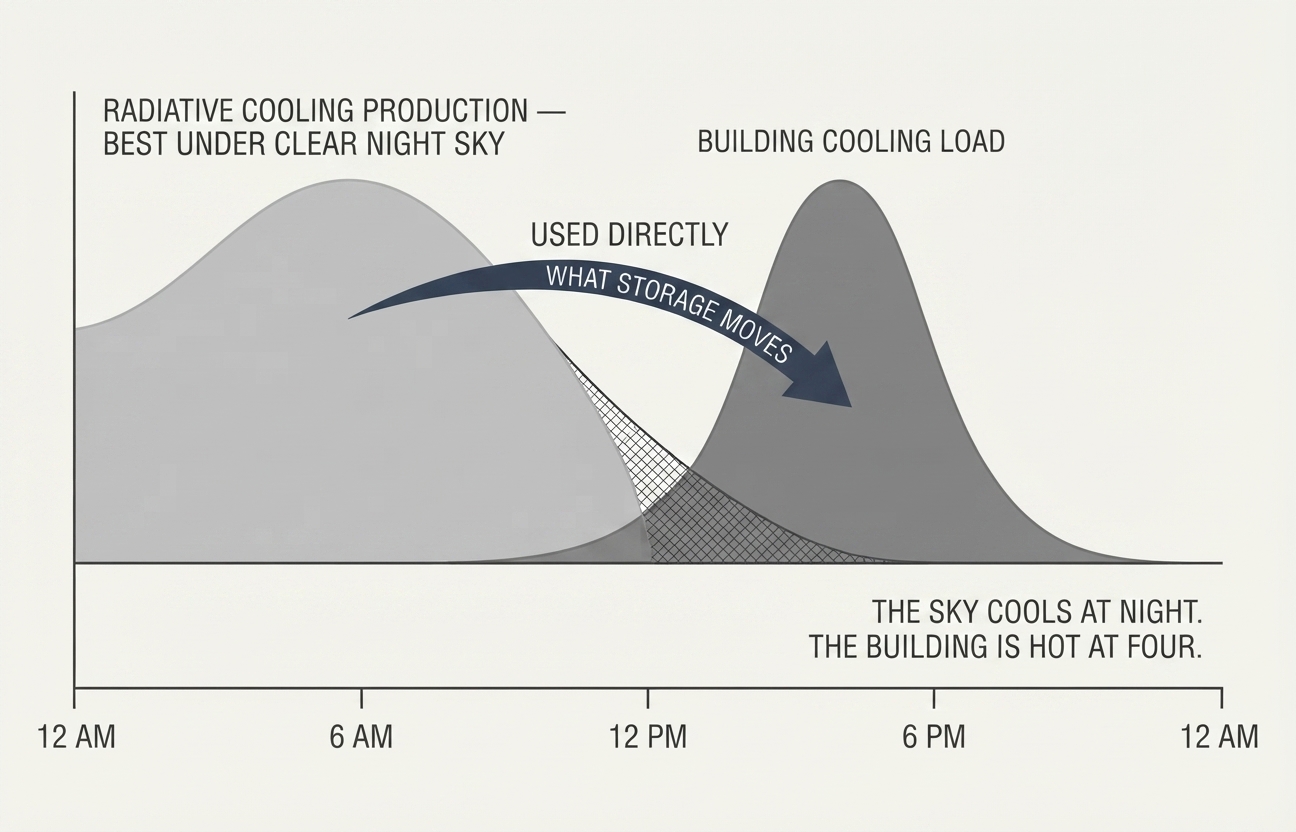
Radiative performance is best at night and under clear skies. Building cooling load peaks in the afternoon. Without storage, the hours of best production are the hours of least demand — which caps how much of the generated cooling is ever used.
5. It is an addition to a plant, not a simplification of one
Panels, a circulation loop, controls, freeze protection where relevant, and roof structural capacity are all real scope. The plant does not get simpler. It gets more efficient, if the first four constraints are satisfied.
Why storage is the component that makes this practical
Constraint four is the one that decides project economics, and it is the same structural problem that appears everywhere in thermal design: the energy is available at the wrong hour.
A radiative array performs best overnight under a clear sky. A commercial building’s cooling load peaks in the mid-to-late afternoon. Without a buffer between them, the array can only contribute what the building happens to want at the moment the sky is cooperating — and the rest of the night’s production is simply not harvested.
Add cool thermal storage and three things change at once.
Sizing and tariff considerations
The third row is the one that changes proposals. Sizing an array to contribute meaningfully at the afternoon peak requires far more panel area than sizing it to charge storage steadily overnight. Storage converts a peak-matching problem into an energy-accumulation problem, and energy accumulation is what a modest panel array is actually good at.
Volume methodology transfers directly from the hot-water case — peak block, recovery credit, and the derates between nameplate and usable capacity. Tariff mechanics, including the two tests that determine whether a shaved load actually reduces a demand charge, are covered in Peak Shaving vs Load Shifting.
Storage sized to prevent chiller short cycling is a different and much smaller calculation than storage sized to shift load. Confirm the applicable sizing method for the project before specifying a tank.
Where this fits best
Project Fit by Situation
Hot, Dry Climate With Air-Cooled Chillers and Ample Flat Roof
Fit: Strongest
Why:
This is the best match for the conditions behind the published radiative cooling results. Hot, dry weather supports stronger radiative heat rejection, while air-cooled chillers provide a relatively inefficient baseline with more room for improvement.
Ample unobstructed roof area also makes it easier to install enough panel area to produce a meaningful cooling effect.
Water-Constrained Sites Using Cooling Towers
Fit: Strong
Why:
Radiative cooling panels reject heat without relying on evaporative water consumption.
That can reduce or eliminate water use associated with cooling towers, along with related requirements for water treatment, blowdown, chemical management, and makeup water.
Facilities With Demand Charges and Sharp Afternoon Cooling Peaks
Fit: Strong With Storage
Why:
These projects can benefit from both improved cooling efficiency and load shifting.
Radiative cooling can reduce the energy required for heat rejection, while thermal storage can move cooling production away from expensive peak-demand periods. In some cases, the value of avoiding peak electrical demand may exceed the direct efficiency savings.
Process or Refrigeration Loads With Continuous Operation
Fit: Good
Why:
Smaller continuous cooling loads can be a practical match because the radiative panels may be able to serve a meaningful portion of the total load.
Continuous operation also allows nighttime cooling production to be used directly rather than depending entirely on storage.
Humid or Persistently Cloudy Climates
Fit: Weaker
Why:
High atmospheric moisture and persistent cloud cover can reduce the effectiveness of radiative heat rejection through the atmospheric window.
Performance should therefore be modeled using local weather and atmospheric conditions before assuming results comparable to those reported in hot, dry climates.
Congested or Structurally Limited Roofs
Fit: Poor
Why:
Radiative cooling depends heavily on available surface area and a clear view of the sky.
Roof area, shading, obstructions, equipment congestion, access, and structural capacity are fundamental design requirements rather than secondary considerations.
Small, Intermittent Loads Without Thermal Storage
Fit: Poor
Why:
Radiative cooling production may not occur at the same time the facility requires cooling.
Without sufficient load coincidence or thermal storage, a significant portion of the available cooling may go unused, weakening the project economics.
Where Radiative Cooling Fits Best
Radiative cooling is generally most attractive for facilities with hot and dry weather, large unobstructed roof areas, significant cooling loads, expensive peak electricity, or high water costs.
Its value declines when local atmospheric conditions limit heat rejection, roof space is constrained, or the cooling load does not align with periods of useful radiative cooling production.
What to ask before specifying
Radiative cooling is a field where laboratory flux figures, single-panel test results, and modelled building savings all circulate as though they were the same kind of number. Ask which one you are being shown. Full specifications are in the technical documentation library and built examples are in the case studies.
Capacity ratings and incentives
*Rated at a 35°C temperature delta — a heating-side rating. Cool storage applications operate over a different and usually narrower temperature band, so usable capacity in a chilled application will differ from these figures and should be calculated for the actual operating temperatures.
Thermal energy storage is expressly within the statutory definition of energy storage technology under 26 U.S.C. §48E, though eligibility depends on ownership, dates, and sourcing rules changed by 2025 legislation. Confirm eligibility with a tax professional, not a vendor.
Frequently Asked Questions
How does radiative cooling reduce chiller energy?
By lowering condenser temperature. A chiller's compressor work is set by the pressure lift between the evaporator and the condenser, so cooling the fluid entering the condenser directly reduces the work the compressor must do. Radiative panels can take a fluid below ambient air temperature because they exchange heat with the sky rather than with the air, which is something a dry cooler cannot do at any size.
How much energy can radiative cooling save on a chiller?
Stanford researchers modelled a two-storey commercial office building in Las Vegas and calculated a 21 percent reduction in summer cooling electricity, with daily savings ranging from 18 to 50 percent. Four conditions attach to that figure: it is a simulation rather than a measured building, Las Vegas was chosen as a hot dry location where the panels perform best, the baseline was an air-cooled chiller rather than a water-cooled plant, and the research dates from 2017. Savings against a well-run water-cooled plant in a humid climate would be materially smaller.
Can radiative panels replace a cooling tower?
Generally no, at commercial chiller scale. Radiative cooling moves a limited amount of heat per square metre, so rejecting a large plant's full condenser load would require impractical panel area. The realistic application is pre-cooling, where panels lower the temperature of fluid entering the existing heat rejection equipment, which stays in place. Panels can carry a larger share of total rejection on smaller loads such as refrigeration racks or process cooling.
Does radiative cooling work during the day?
Yes, with the right surface. A panel that simply emitted infrared would be overwhelmed by absorbed sunlight during daylight hours. Panels engineered for daytime operation use a film that reflects the great majority of incoming solar radiation while emitting strongly through the atmospheric window, which allows sub-ambient performance even under sun. Performance is still better at night and under clear skies.
What climates suit radiative cooling for HVAC?
Hot, dry locations with frequent clear skies perform best, because humidity narrows the atmospheric window through which heat escapes and cloud cover blocks it. The U.S. Southwest, interior California, and much of the Mountain West are favourable. In humid or persistently cloudy regions the effect is real but smaller, and the business case should be built on modelling against local conditions rather than on published figures from a different climate.
Why does radiative cooling need thermal storage?
Because the cooling is produced on the sky's schedule and consumed on the building's. Radiative performance is strongest overnight under clear skies while commercial cooling load peaks in the afternoon. Without storage between them, only the portion of production that coincides with demand is ever used. With storage, the array charges overnight and the building draws by day, which also allows a smaller array to deliver the same annual benefit.
Is radiative cooling the same as evaporative cooling?
No. Evaporative cooling, as used in a cooling tower, rejects heat by evaporating water and can approach the wet bulb temperature, but consumes water and requires treatment, blowdown, and water management. Radiative cooling rejects heat as infrared radiation to the sky in a closed loop with no evaporative water use, and its limit is set by sky conditions rather than by humidity in the same way.
What should I ask a radiative cooling vendor?
Which kind of number they are quoting. Laboratory flux measurements, single-panel test results, and modelled whole-building savings circulate in this field as though they were equivalent, and they are not. Ask for measured performance, the conditions and climate under which it was measured, the panel area required for your actual condenser rejection duty, and what baseline any savings percentage is calculated against.
Conclusion
Radiative cooling is not a way to avoid having a chiller. It is a way to give the chiller a colder condenser than the air can provide, which is a genuine thermodynamic advantage and one that no dry cooler can match at any size.
The published research supports the mechanism convincingly and supports the headline savings figure conditionally — hot dry climate, air-cooled baseline, summer, simulation. Those conditions are not a disqualification; they are the specification for where this works. And the constraint that decides most projects is not the physics of the panel but the timing of its output, which is a storage question.
Establish the rejection duty, the available sky-facing area, the local clear-sky hours, and the tariff. If those four line up, the architecture is sound and the storage is what turns it into delivered cooling.
Garth Schultz is President of Thermal Energy HQ, where he leads development of modular thermal energy storage systems manufactured in the United States. He is the inventor named on patents covering hybrid photovoltaic-thermal (PVT) solar panels and insulated modular storage tank construction, and has worked in solar-thermal product development since founding the company’s technology line in 2007. Connect on LinkedIn.