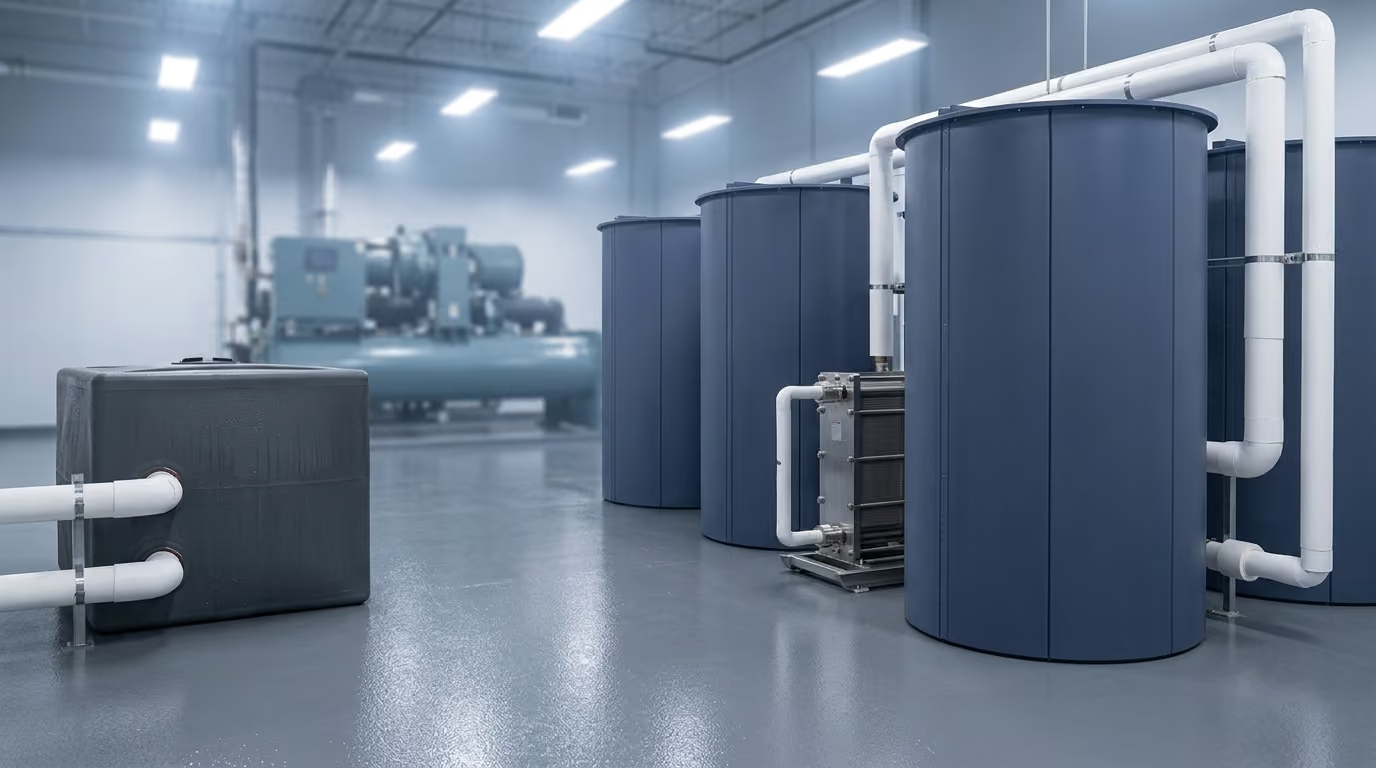
The federal investment tax credit for energy storage was written for batteries, and the thermal storage language was added with three conditions that determine eligibility. A tank of hot water can be “energy storage technology” under Section 48E of the Internal Revenue Code, with a credit of up to 30 percent of eligible basis, or it can be an ordinary water heater with no credit.
The difference is not the tank. It is what the tank is connected to and what the stored heat is used for. Section 48E(c)(2) defines energy storage technology by reference to Section 48(c)(6), which includes “thermal energy storage property.” Treasury’s regulations at 26 CFR 1.48E-2 add the HVAC-use, time-shifting and one-hour requirements. Treasury’s preamble to TD 10015 states that the statute does not provide for stored energy for domestic hot water supply for consumptive use.
Key Takeaways
Section 48E is the technology-neutral clean electricity investment credit that replaced Section 48 for property placed in service after 2024. Section 48E(c)(2) says energy storage technology “has the meaning given such term in section 48(c)(6) (except that subparagraph (D) of such section shall not apply).” Subparagraph (D) is the Section 48 termination for construction beginning after December 31, 2024. The carve-out keeps storage within Section 48E.
Treasury’s final regulations for 48E, TD 10024, effective January 15, 2025, state that the definition mirrors 48E(c)(2).
Section 48(c)(6)(A) describes two kinds of property: clause (i) covers property that receives, stores and delivers energy for conversion to electricity with a nameplate capacity of not less than 5 kilowatt hours. That is the battery definition. Clause (ii) covers “thermal energy storage property.”
Subparagraph (C) defines thermal energy storage property as property comprising a system that is directly connected to a heating, ventilation or air conditioning system, removes heat from or adds heat to a storage medium for subsequent use, and provides energy for heating or cooling the interior of a residential or commercial building. The definition excludes a swimming pool, combined heat and power system property, and a building or its structural components.
Every eligibility question about a hot water tank runs through these clauses. The 5 kWh floor in clause (i) does not apply to thermal property. 26 CFR 1.48-9(e)(10)(iii) and 26 CFR 1.48E-2(g)(6)(ii) state that thermal energy storage has no kWh threshold and use a time-based safe harbor instead.
In this article
The three-part test, one part at a time
Directly connected to an HVAC system
The regulation repeats the statutory requirement that the system be “directly connected to a heating, ventilation, or air conditioning (HVAC) system.” Treasury’s preamble to TD 10015 adds that the HVAC system itself is not eligible property merely because storage is connected to it. The preamble also states that storage connected to a district heating system serving multiple buildings is not excluded.
Commenters asked Treasury to add “refrigeration” and “industrial.” Treasury declined in order to retain the statutory wording.
For a hydronic building, a storage tank charged by a heat pump and discharged into the heating loop, air-handler coils or chilled-water loop is connected to HVAC. A tank discharged into domestic hot-water distribution is not, because potable hot-water distribution is plumbing rather than heating, ventilation or air conditioning.
Removes or adds heat to a storage medium for subsequent use
The regulation at 1.48E-2(g)(6)(ii)(B) states that “for subsequent use” means the property must be designed to substantially alter the time profile of when stored heat can be used for heating or cooling. The regulation provides a safe harbor: property that can store enough energy to heat or cool the interior of the building for at least one hour is deemed to meet that purpose.
The one-hour test is a capacity-to-load comparison. The TEHQ specification sheet rates the 700-gallon Thermal Tank module at 108 kWh thermal at a 35 C (63 F) delta. One kWh is 3,412 Btu, so the module holds about 368,500 Btu at that delta.
A building with a design heating load of 100,000 Btu/h would draw that charge down in roughly 3.7 hours. A 400,000 Btu/h load would use it in about 55 minutes and would need a second module to reach the safe harbor at the same delta.
The delta changes the result. A 20 F usable delta between a 120 F supply and a 100 F return holds less than one-third of the 63 F rating. The Thermal Storage Tank Sizing Calculator converts load and usable delta into module count.
Provides energy for heating or cooling the interior of a building
This is the clause that excludes domestic hot water. The regulation includes equipment that stores thermal energy “for providing hot water for use in heating a residential or commercial building,” which covers hydronic heating.
Treasury’s preamble to TD 10015 is explicit on the other side of the line: “the statute does not provide for stored energy for domestic hot water supply for consumptive use.” Property supplying domestic hot water exclusively for consumptive use is not eligible. A commenter asked that “hot water heat pumps” be added to the definition; the preamble records the request without adopting it.
A building that uses one heat pump plant and one storage bank for both space heating and domestic hot water is a mixed case. Treasury’s regulations address mixed-function heat pumps through a cost allocation rule, described below, but publish no method for splitting a single tank between heating and consumptive hot water. That split is for the owner’s tax advisor. Keeping the two functions in separate modules can prevent the eligible basis from being disputed.
What is excluded even if the three parts are met
The regulation excludes property that “transforms other forms of energy into heat in the first instance.” Treasury’s preamble gives a conventional gas boiler with an integrated storage tank as an example. The boiler is excluded, although “the integrated storage tank, however, may be thermal energy storage property.”
An electric furnace that heats bricks is excluded while the bricks and the equipment that move heat in and out of them are eligible. A heat pump, which moves heat rather than creating it, is on the eligible side: “a heat pump system that transfers heat into and out of a storage medium is thermal energy storage property.”
For a modular tank with an immersion backup element, the element creates heat in the first instance and its cost belongs on the excluded side. The tank, heat exchanger coils, pumps and piping that move heat, and the heat pump that charges it are on the eligible side, subject to the allocation rule.
The incremental cost rule for heat pumps that also serve HVAC
Where a heat pump both charges storage and serves the building’s real-time heating or cooling, the regulation limits qualified investment to the total cost of the storage property and HVAC system less the cost of an HVAC system without thermal storage that meets the same heating or cooling needs apart from time shifting. The regulation calls this the incremental cost rule and cross-references 26 CFR 1.48-14(h).
Credit rates, bonuses and the 1 MW exception
Section 48E(a)(2)(B) sets the applicable percentage for energy storage technology at 6 percent, or 30 percent if the storage has a capacity of less than 1 MW, if construction began before the prevailing wage and apprenticeship guidance deadline, or if the project meets the prevailing wage requirements of 48E(d)(3) and apprenticeship requirements of 48E(d)(4). The 2025 Form 3468 instructions state the same three routes and add that apprenticeship labor hours for energy storage fall between 10 and 15 percent of total labor hours depending on when construction began.
The credit is claimed in Part V, Section B of Form 3468, “Qualified Energy Storage Technology.”
The 2033 phase-out and what did not change in July 2025
Pub. L. 119-21, signed July 4, 2025, rewrote the phase-out. Section 45Y(d)(3), which 48E(e)(2) uses, now reads: “the term ‘applicable year’ means calendar year 2032.” The earlier later-of test tied to power-sector emissions was struck.
Under 48E(e)(2), the phase-out percentage is 100 percent for construction beginning in the first calendar year after the applicable year, 75 percent in the second, 50 percent in the third and zero after that.
The prohibited foreign entity rules for storage beginning construction after 2025
Two restrictions from Pub. L. 119-21 apply to storage. Section 48E(c)(3) excludes energy storage technology whose construction begins after December 31, 2025 if it includes material assistance from a prohibited foreign entity. Section 48E(d)(6)(A) provides that no credit is determined for any taxable year if the taxpayer is a specified foreign entity or a foreign-influenced entity. The 2025 Form 3468 instructions note that these restrictions were added to Part V.
Treasury and the IRS issued Notice 2026-15 on February 12, 2026 (IR-2026-23). The notice explains how to calculate the material assistance cost ratio under interim safe harbors with example calculations.
Taxpayers may rely on the notice for Section 48E energy storage technology whose construction begins after December 31, 2025 until 60 days after Treasury publishes the forthcoming safe harbor tables. The notice does not mention thermal energy storage specifically.
For a modular tank assembled from panels, liner, insulation and heat exchanger coils, the cost ratio is a supply-chain documentation exercise that starts with the manufacturer’s bill of materials. TEHQ’s documentation library is the starting point for that request.
A decision sequence for an owner or engineer
Eligibility is a determination the owner’s tax advisor makes on the facts of the project. The design and documentation sequence should address the following items.
What this means for a domestic hot water project
A central heat pump water heater with thermal storage serving showers and sinks is the most common TEHQ application. Under the current statute and regulations, it is the case Treasury described as not provided for. The economic case for that project rests on demand charge reduction, time-of-use load shifting, utility custom incentives and the smaller heat pump plant that storage allows.
Owners who want the 48E credit on a hot water tank need a hydronic heating connection, a documented time-shifting purpose and a tax advisor’s opinion on the facts. Demand charge applications are addressed in the demand charge reduction article.
Frequently Asked Questions
Does a hot water storage tank qualify for the 48E investment tax credit?
Only if it is thermal energy storage property under 26 U.S.C. 48(c)(6)(C): directly connected to an HVAC system, storing heat for subsequent use, and providing energy for heating or cooling the building interior. A tank that stores hot water for hydronic space heating can meet the test. Treasury’s preamble to TD 10015 states that the statute does not provide for stored energy for domestic hot water supply for consumptive use. Eligibility is a determination the owner’s tax advisor makes on the project’s facts.
Is there a minimum size for thermal energy storage under 48E?
There is no kWh floor for thermal storage. The 5 kWh nameplate minimum in 48(c)(6)(A)(i) applies to electrical and hydrogen storage. For thermal storage, 26 CFR 1.48E-2(g)(6)(ii)(B) provides a safe harbor: property that can store enough energy to heat or cool the building interior for at least one hour is deemed to meet the time-shifting purpose.
What credit rate applies to thermal storage?
The rate is 6 percent, or 30 percent for storage with a capacity under 1 MW or for projects meeting prevailing wage and apprenticeship requirements, under 48E(a)(2)(B). The energy community and domestic content bonuses each add 2 percentage points on the 6 percent rate or 10 percentage points on the 30 percent rate.
Does the heat pump that charges the tank count toward the credit?
A heat pump that transfers heat into and out of a storage medium is thermal energy storage property under Treasury’s reading. If it also serves the building’s real-time heating or cooling, eligible basis is the total cost less the cost of an HVAC system without storage that meets the same needs, under the incremental cost rule in 1.48E-2(g)(6)(ii) and 1.48-14(h).
When does the 48E storage credit end?
Pub. L. 119-21 fixed the applicable year at 2032. The credit is 100 percent for storage whose construction begins in 2033, 75 percent in 2034, 50 percent in 2035 and zero for construction beginning in 2036 or later, under 48E(e)(2). Storage is not subject to the December 31, 2027 placed-in-service cutoff for wind and solar.
What are the prohibited foreign entity rules for storage?
Under 48E(c)(3), energy storage technology whose construction begins after December 31, 2025 is excluded if it includes material assistance from a prohibited foreign entity. Under 48E(d)(6)(A), no credit is allowed to a specified foreign entity or foreign-influenced entity. Notice 2026-15 provides interim safe harbors for the material assistance cost ratio.
The bottom line
The 48E credit for thermal energy storage turns on three statutory words: heating, ventilation and air conditioning. A storage tank that shifts when a building’s hydronic heating or cooling load is met, is charged by a heat pump and is sized to carry the building for at least one hour is inside the definition and can earn 30 percent of eligible basis, with bonuses, for construction beginning through 2033.
A tank that stores hot water for showers and sinks is outside Treasury’s stated reading, however well it shifts load. Decide which system the tank serves before the design is fixed, keep the two functions in separate modules, document the one-hour test at the usable delta, and have the owner’s tax advisor determine eligibility on the project’s own facts.