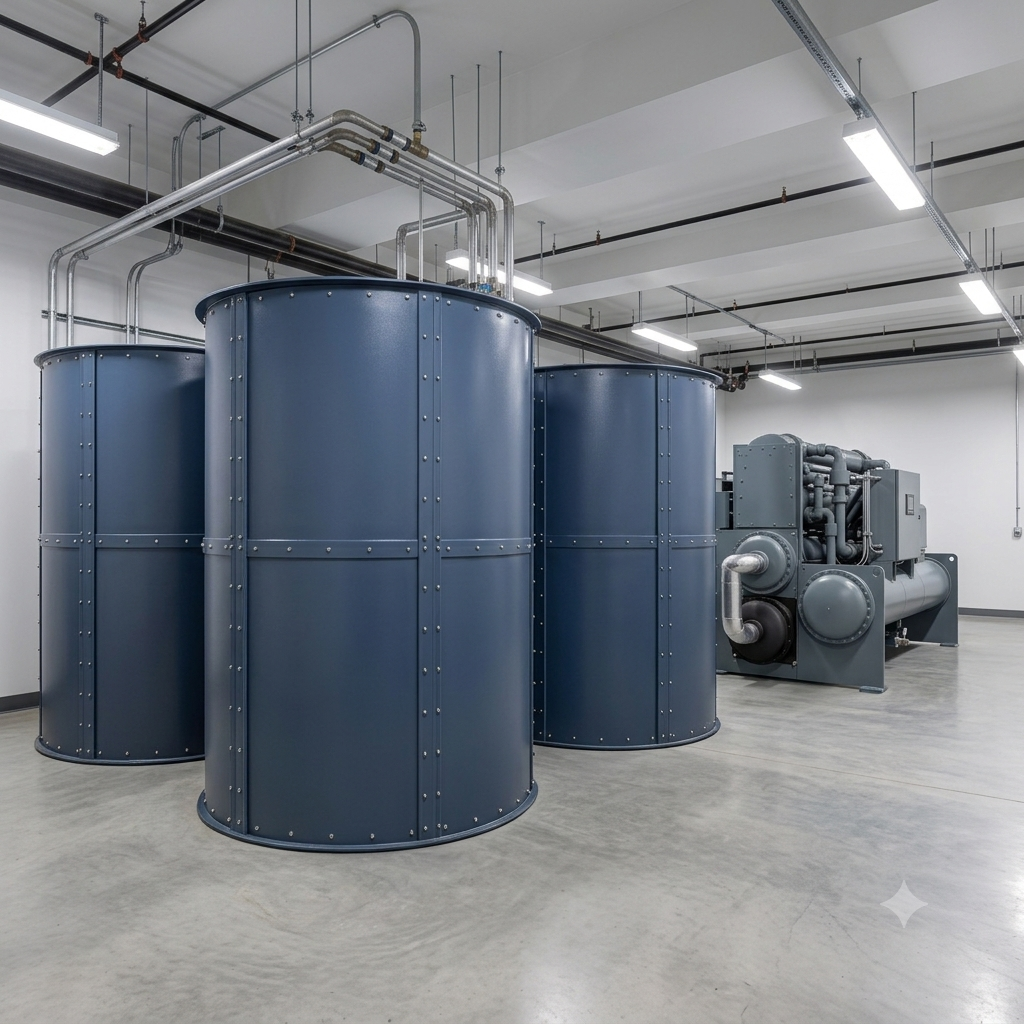
This comparison gets framed as a choice, and on most projects it is not one. A heat recovery chiller and a thermal storage tank do different jobs on different axes: the chiller moves heat across the plant, from the chilled water loop to the hot water loop, at the moment both are being called. Storage moves heat across time, from the hour it was available to the hour it is needed. Neither substitutes for the other, and the reason both keep appearing in the same electrified central plants is that the two functions multiply.
In short: the variable that determines how much value a heat recovery chiller delivers is load coincidence, the fraction of operating hours in which meaningful heating and cooling demand exist at the same time. High coincidence, and an HRC runs in recovery mode most of the year and earns its capital quickly. Low coincidence, and the same machine spends much of its time rejecting condenser heat to a tower while something else makes hot water. Thermal storage raises coincidence artificially, by buffering one or both sides so that recovery-mode operation no longer requires the two loads to peak in the same hour. Peer-reviewed work on large-building electrification makes exactly this point: storage allows a heat recovery chiller to recover heat even when heating and cooling loads are not simultaneous.
In this article
Briefly, for shared vocabulary rather than instruction. A heat recovery chiller produces chilled water at the evaporator and, instead of rejecting all condenser heat to ambient, delivers useful hot water from the condenser side. New York's Clean Heat program documentation describes the mode plainly: heat is moved between the hot water and chilled water loops within the building envelope, serving buildings that require simultaneous cooling and heating, with the unit providing both at the same time.
Two configurations dominate. A heat recovery chiller serves the chilled water load as its primary duty and recovers condenser heat when there is a call for it, reverting to conventional rejection when there is not. A dedicated heat recovery chiller is selected so that essentially all of its condenser heat is recovered and it operates in that mode as its design condition, with the chilled water it produces treated as a beneficial byproduct that unloads the main plant.
Published ASHRAE Journal material on dedicated heat recovery notes that the availability of scroll and screw machines capable of producing elevated condenser water temperatures is what opened this application for heating and domestic hot water service. ASHRAE published a dedicated Chiller Heat Recovery Application Guide out of research project 892 for engineers evaluating these systems.
The thermodynamic appeal is straightforward and genuine. In recovery mode you are paying compressor energy once and receiving two useful outputs, so the combined effect is far better than producing chilled water and hot water separately. This is why ASHRAE 90.1 treats heat recovery performance as its own metric with compliance evaluated at the simultaneous cooling and heating condition, rather than folding it into ordinary cooling efficiency. It is a well-engineered answer to a real problem and nothing in this article disputes its value.
The constraint is in the definition. Both outputs have to be wanted at the same time.
Thermal storage does not generate or upgrade anything. It absorbs heat when it is available and releases it when it is needed, and its only real losses are standing losses through the insulation rather than a conversion penalty. The underlying technology is covered in more depth in what a thermal battery is, and the bill mechanics in peak shaving vs load shifting.
For a central plant engineer the relevant framing is narrower: storage is a degree of freedom in time. Every hydronic plant decision that currently has to be made in real time, because production and consumption must balance instantaneously, becomes a decision that can be made across a window. That is useful for tariff arbitrage and peak demand, which is the usual justification. It is considerably more useful, and less frequently exploited, as a way to make other equipment operate in its efficient mode more of the time.
That second use is where storage and heat recovery meet.
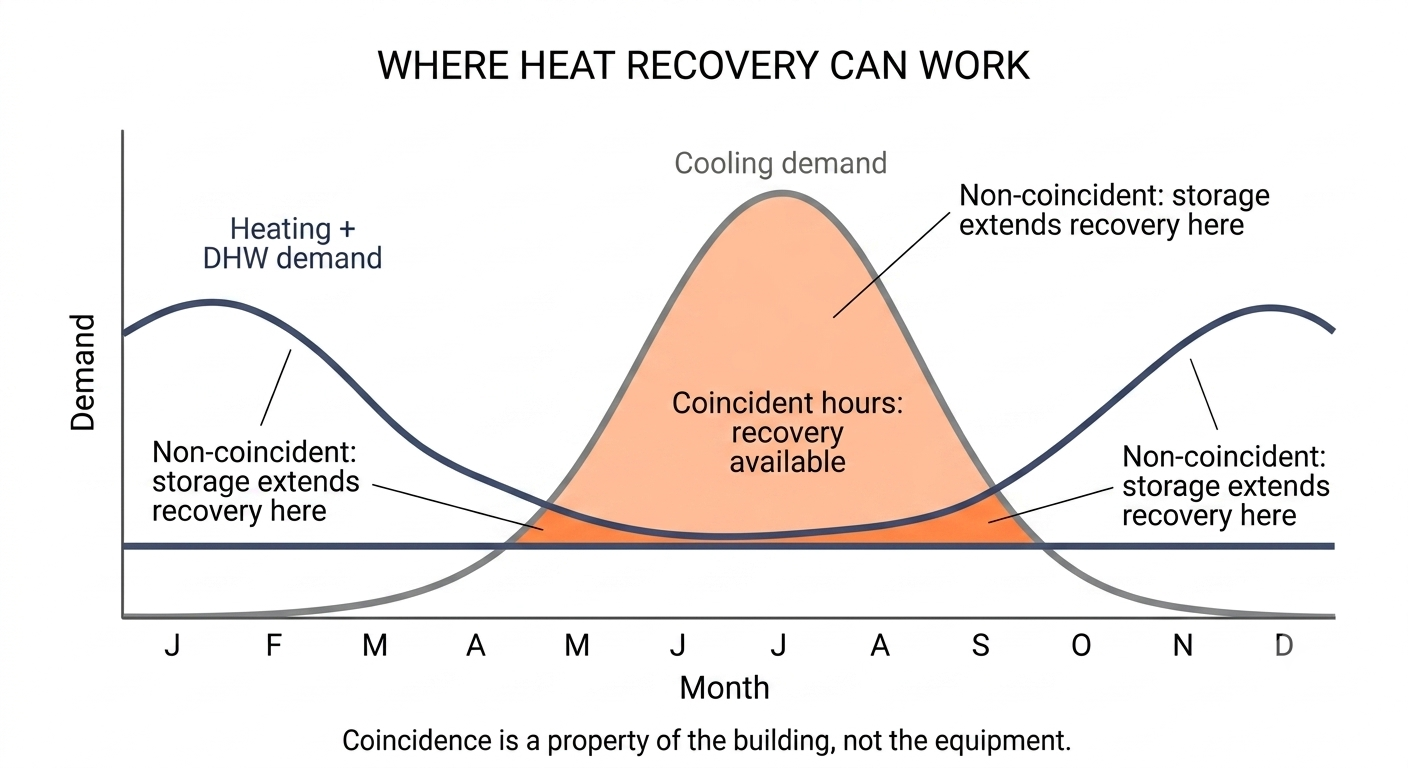
Every argument about heat recovery chillers reduces to one question that is rarely asked directly: in how many operating hours does this building actually have meaningful heating and cooling demand at the same time?
Call it load coincidence. It is a property of the building, its climate, its envelope, its ventilation strategy, and its occupancy, and it varies enormously across building types that otherwise look similar.
The practical implication is that HRC economics are far more building-specific than equipment-specific. Two identical machines in two buildings with different coincidence profiles return very different results, which is why generic payback figures for heat recovery are close to meaningless and why the sizing conversation should start from load profiles rather than from tonnage.
Coincidence is measurable, not a matter of judgment. Trend simultaneous heating and cooling demand from existing plant instrumentation or the BAS across a full year and count the hours of overlap, weighted by magnitude. Where a plant is not instrumented for it, this is worth adding before the design is fixed. Nearly every argument in this article resolves against that dataset.
Typical load coincidence by building type
Building typeTypical coincidence driverCoincidence tendency
Hospital, laboratory, high outside-air facilityContinuous reheat of conditioned outside air alongside continuous cooling of internal zones and equipmentHigh, often year-round
Hotel, dormitory, senior livingSteady domestic hot water demand alongside cooling of common areas and guest roomsHigh for DHW, with a strong morning and evening draw shape
Mixed-use with data or equipment roomsConstant internal cooling load beside space heating and DHW demandModerate to high
Multifamily residentialDomestic hot water demand is steady, but cooling is seasonal and peaks when heating demand is lowestModerate, with pronounced seasonal mismatch
Office, mild climatePerimeter heating and core cooling in shoulder seasons; little overlap in summer or deep winterModerate, concentrated in shoulder seasons
Single-use, envelope-dominated, no significant internal gainsLoads are seasonally opposed by constructionLow
There is a simple observable that tells you coincidence is failing, and most plants that have it do not know they do.
If your cooling tower or air-cooled condenser is rejecting heat during hours when a boiler, electric element, or separate heat pump is producing hot water, the plant is buying energy to make heat while simultaneously paying to throw heat away. Those hours are pure loss, and they are precisely the hours a heat recovery chiller is meant to capture. But an HRC alone can only capture them when both calls are active in the same interval. When the cooling load exists at 2 p.m. and the hot water demand arrives at 6 a.m. the following morning, recovery mode has nothing to recover into.
This is worth quantifying rather than estimating, because the number is often surprising. Count the annual hours in which condenser heat is being rejected while a heating source is operating, and multiply by the thermal quantity involved. That figure is the size of the prize that neither an HRC alone nor storage alone fully captures, and that the combination does.
It also reframes what the storage is for. In this configuration the tank is not primarily a tariff arbitrage device. It is a buffer that lets recovered heat wait until the building wants it, which converts otherwise wasted condenser heat into delivered heating energy.
This is the central argument, and it has direct support in the electrification literature. Work presented at the ACEEE Summer Study on large-building electrification describes an architecture pairing heat recovery chillers with thermal energy storage and states the mechanism plainly: the storage allows the heat recovery chiller to recover heat even when heating and cooling loads are not simultaneous. The same work reports that the configuration substantially reduces the peak load imposed on air-source heat pumps in the plant, with the consequence that the overall system is less expensive and occupies a smaller footprint than a conventional heat pump plant.
Mechanically there are three places to put the buffer, and they solve different problems:
Buffer location and the problem it addresses
Buffer locationWhat it decouplesWhen it is the right move
Hot side (heating hot water or DHW storage)Recovered condenser heat from the hour the building calls for heating or hot waterMost common. Especially strong where DHW demand is sharply peaked and cooling load is steady, which describes hotels, dormitories, and multifamily buildings
Cold side (chilled water storage)Chilled water production from the hour the cooling load occursWhere the cooling call is the limiting side, or where shifting chiller operation off peak tariff hours is independently valuable
Both sidesFull decoupling; the machine can run in recovery mode whenever it is efficient to do so rather than when both loads happen to coincideLarger plants with strong tariff signals and enough coincidence failure to justify the added complexity
Adding storage does not make the chiller more efficient in any given hour. The instantaneous COP in recovery mode is what it is. What storage changes is how many hours per year the machine gets to operate in that mode instead of a worse one. Annual performance improves because the operating hours redistribute, not because the machine changed.
That distinction matters when presenting to a client, because it is the honest version and it survives scrutiny. A vendor claiming that a tank raises chiller efficiency is saying something an engineer will immediately identify as wrong. A vendor explaining that a tank raises the annual fraction of recovery-mode operation is saying something defensible and checkable.
Conventional dedicated heat recovery sizing guidance is straightforward: compare the maximum winter chilled water load against the maximum summer hot water load, and select the machine to serve the larger of the two. That rule exists because without a buffer the machine has to meet whichever instantaneous demand governs.
Introduce storage and the governing constraint changes from an instantaneous peak to an energy quantity over a window. The machine no longer has to meet the peak of the larger load; it has to deliver the energy that load requires across the hours available to it, with the tank absorbing the difference between production rate and consumption rate.
In most profiles that permits a smaller machine.
Three consequences follow, and the third is usually the largest:
Storage adds tanks, piping, pumps, controls, and commissioning complexity, and it consumes mechanical room space that retrofit plants rarely have spare. Whether the trade is worth it is a project-specific calculation rather than a general truth. Space constraints in existing buildings are their own design problem, covered in designing thermal storage for existing buildings, and capacity sizing is covered in the thermal storage tank sizing calculator.
Read down the last two rows in particular. The failure mode of each is substantially addressed by the presence of the other, which is the structural reason these two technologies keep appearing together in electrified plant designs rather than in competition for the same budget line.

Heat recovery chiller and thermal energy storage comparison
ComparisonHeat recovery chillerThermal energy storage
FunctionMoves heat between loops, and upgrades it to useful temperatureMoves heat between hours
AxisSpace, within the plant, in the presentTime
RequiresSimultaneous heating and cooling demandA source that produced heat at some point
Energy inputCompressor workNone of its own; standing loss only
Adds capacity?Yes, it produces heating capacityNo, it holds what something else produced
Serves peak demand charge?Indirectly, by reducing heating source operationDirectly, by decoupling draw from production
Serves tariff arbitrage?No, it operates when the loads callYes, this is a primary function
Effect on the otherProvides recovered heat worth storingRaises the annual fraction of recovery-mode operation
Main constraintLoad coincidenceSpace, structural capacity, and standing loss over the hold period
Fails whenLoads are seasonally opposedThere is no cheap or recoverable source to charge from
Two honest cases, both real.

A building with large, continuous, well-matched heating and cooling loads has high coincidence by construction, and a heat recovery chiller in such a plant already operates in recovery mode most of the year. Hospitals and laboratories with substantial outside air and continuous reheat are the classic examples. In these buildings the marginal storage volume buys comparatively few additional recovery hours, because there were few non-coincident hours to convert.
Storage may still be justified on tariff arbitrage, peak demand, or resilience grounds, but the heat recovery argument for it is weak and should not be the one you make. A modest buffer for hydraulic stability and turndown is a different and much smaller proposition.
A building with a large domestic hot water load and little simultaneous cooling has low coincidence, and a heat recovery chiller has correspondingly little to recover for much of the year. Multifamily residential is frequently in this position: hot water demand is steady and sharply peaked, cooling is seasonal and peaks in the months when heating demand is lowest. EIA data puts the load in context, finding that space heating and water heating together accounted for 62 percent of household energy consumption, with water heating often exceeding space heating in large apartment buildings. Here the productive architecture is usually a heat pump plant with substantial storage rather than heat recovery, and DOE's Grid-interactive Efficient Buildings work on water heating flexibility is the more relevant literature.
The useful generalization: heat recovery earns its place in proportion to coincidence, storage earns its place in proportion to the mismatch between when energy is cheap or available and when it is needed. Most real buildings have some of both, which is why most well-designed electrified plants end up with some of each.
On incentives, one note relevant to plant budgeting: thermal energy storage is expressly within the statutory definition of energy storage technology under 26 U.S.C. §48E, the commercial technology-neutral credit administered per IRS guidance, subject to project size, prevailing wage and apprenticeship, and sourcing rules. Heat recovery equipment is generally evaluated under different program and utility pathways, and several state programs treat heat recovery chillers as their own measure category with dedicated calculation methodology, as New York's does. Confirm both with the relevant program administrator and a tax professional; TEHQ's utilities and programs page covers alignment.
On most projects the question is how much of each rather than which one, because they act on different axes. A heat recovery chiller moves heat from the chilled water loop to the hot water loop at the moment both are called, and it produces useful heating capacity. Thermal storage moves heat between hours and produces nothing. The variable that determines the balance is load coincidence: the fraction of operating hours in which meaningful heating and cooling demand overlap in your building.
Load coincidence is the fraction of operating hours in which a building has meaningful heating and cooling demand at the same time. It matters because a heat recovery chiller can only operate in recovery mode when both calls are active, so its annual value is roughly proportional to coincidence. It is a property of the building, its climate, ventilation strategy, and occupancy rather than of the equipment, which is why generic payback figures for heat recovery are close to meaningless. It is measurable by trending both demands across a year and counting weighted overlap hours.
Not in any given hour. Instantaneous COP in recovery mode is a property of the machine and its operating conditions, and a tank does not change it. What storage changes is how many hours per year the machine gets to operate in recovery mode instead of rejecting condenser heat, because buffering decouples heat production from the hour the building calls for it. Annual performance improves because operating hours redistribute. Stating it the other way is a claim an engineer will identify as wrong.
No. Storage holds heat that something else produced; it cannot move heat from the cooling side to the heating side and it cannot upgrade low-grade condenser heat to useful temperature. Those are things a chiller does and a tank cannot. Conversely a heat recovery chiller cannot serve a load in an hour when the cooling call is absent, and it cannot shift consumption off expensive tariff periods. Each addresses the other's principal failure mode.
Hot side is the more common answer, and it is usually right where domestic hot water demand is sharply peaked while cooling load is comparatively steady, which describes hotels, dormitories, and multifamily buildings. Cold side storage makes sense where the cooling call is the limiting side or where shifting chiller operation off peak tariff hours is independently valuable. Larger plants with strong tariff signals and significant coincidence failure sometimes buffer both, which allows the machine to run in recovery mode whenever it is efficient rather than when the loads happen to align.
Usually yes. Conventional dedicated heat recovery sizing compares the maximum winter chilled water load against the maximum summer hot water load and selects for the larger, because without a buffer the machine must meet whichever instantaneous demand governs. With storage the constraint becomes an energy quantity delivered across a window rather than an instantaneous peak, which in most load profiles permits a smaller machine, better part-load behavior, and lower connected electrical load.
Look for hours in which the cooling tower or air-cooled condenser is rejecting heat while a boiler, electric element, or separate heat pump is producing hot water. In those hours the plant is paying to make heat and paying to throw heat away simultaneously. Count those hours annually and weight them by thermal quantity; that figure is the size of the opportunity that a heat recovery chiller captures only when the calls coincide, and that heat recovery plus storage captures more fully.
Yes. Buildings with large, continuous, well-matched heating and cooling loads have high coincidence by construction, and hospitals and laboratories with substantial outside air and continuous reheat are the classic cases. In those plants a heat recovery chiller already operates in recovery mode most of the year, so marginal storage volume buys few additional recovery hours. Storage may still be justified on tariff arbitrage, peak demand, or resilience grounds, but the heat recovery argument for it is weak and should not be the one presented.
The versus framing survives because both technologies compete for the same line in a plant budget, not because they do the same work. A heat recovery chiller solves simultaneity: it takes heat the building is already rejecting and delivers it where the building wants it, in the same hour. Thermal storage solves non-simultaneity: it holds that heat until the hour the building actually calls for it. In a building whose loads coincide perfectly, the second capability is nearly worthless. No such building exists.
The design question worth asking is therefore not which technology to select but how much coincidence your building actually has, and that is a measurement rather than an opinion. Trend both demands, count the weighted overlap hours, count the hours you are rejecting heat while making heat, and let those two numbers set the balance between recovery capacity and storage volume. Plants designed that way tend to end up with a smaller machine and more buffer than the conventional rules produce, and they run in their efficient mode a great deal more of the year.
The fastest way to size the balance is a short engineering conversation with a year of plant trends in hand.
Tell our team about your building, operating goals, and energy needs.