Restaurants and quick service kitchens are being electrified under a water heater sizing rule that credits a heat pump with a coefficient of performance of one. Here is the arithmetic, and where stored volume changes the answer.
Commercial kitchen hot water storage is usually treated as a mechanical sizing question. In an all-electric restaurant it is a permitting question first. The health department’s water heater worksheet, not the connected load calculation, decides how large the electrical service has to be because the sizing formula counts input kilowatts at an assumed thermal efficiency of 98 percent.
A heat pump running at a COP of 3 gets no credit for that performance. The permit can therefore demand three to four times more installed input than the physics requires. The practical approach is to install the code-required kilowatts as immersed elements in a large stored volume, then charge that volume off-peak with a heat pump so the elements almost never fire.
Thermal storage does not exempt a kitchen from the sizing rule and does not reduce the required nameplate.
Key Takeaways
Food service is the most energy-intensive commercial building type in the country. The 2018 Commercial Buildings Energy Consumption Survey reports food service buildings at 263 thousand Btu per square foot, compared with 70 thousand Btu per square foot for the average commercial building, on an average footprint of 4,800 square feet. Cooking accounts for 40 percent of end use, refrigeration 15 percent, space heating 12 percent, and every remaining end use 7 percent or less. Water heating is not the largest line on a restaurant’s energy bill, so the case for commercial hot water thermal storage has to be made on something other than therms.
Water heating is the largest permit-gated electrical load in an all-electric kitchen, which is a different problem. California foodservice water heating accounts for roughly 340 million therms per year, about 16 percent of statewide commercial gas use. Quick service and full service restaurants carry 76 percent of the foodservice share, according to the CalNEXT market potential study on heat pump assisted hot water in foodservice. Heat pump water heating penetration in existing foodservice facilities remains below 1 percent.
The electrical service is the obstacle. CalNEXT reports that quick service restaurants are typically served at 400 to 600 amps, 208 volts, three-phase, with no spare capacity and no spare breaker space. Its experts estimated that a panel upgrade would be needed in roughly 80 to 100 percent of existing facilities. A sizing rule that inflates required input by a factor of three lands on the tightest service in commercial construction.
In this article
Storage separates the kilowatts you install from the kilowatts you run
Commercial kitchen hot water storage satisfies two separate requirements. The health department tests installed input rating, so the code-required kilowatts must exist. The utility bills operating demand, so those kilowatts should almost never run. A stored volume charged off-peak by a heat pump lets one system answer both requirements.
The relevant rule is a nameplate test. The San Francisco Department of Public Health and San Francisco Environment Department published a January 2025 technical bulletin on heat pump plan review for food facilities. It states that proposed input kilowatts meeting the CCDEH Formula 2 minimum can be approved and that, where water heaters are piped in parallel, the input figure is the sum of all devices in combination.

Formula 2 counts input kilowatts rather than heat output. That pushes designers toward oversizing equipment that would otherwise be right-sized.
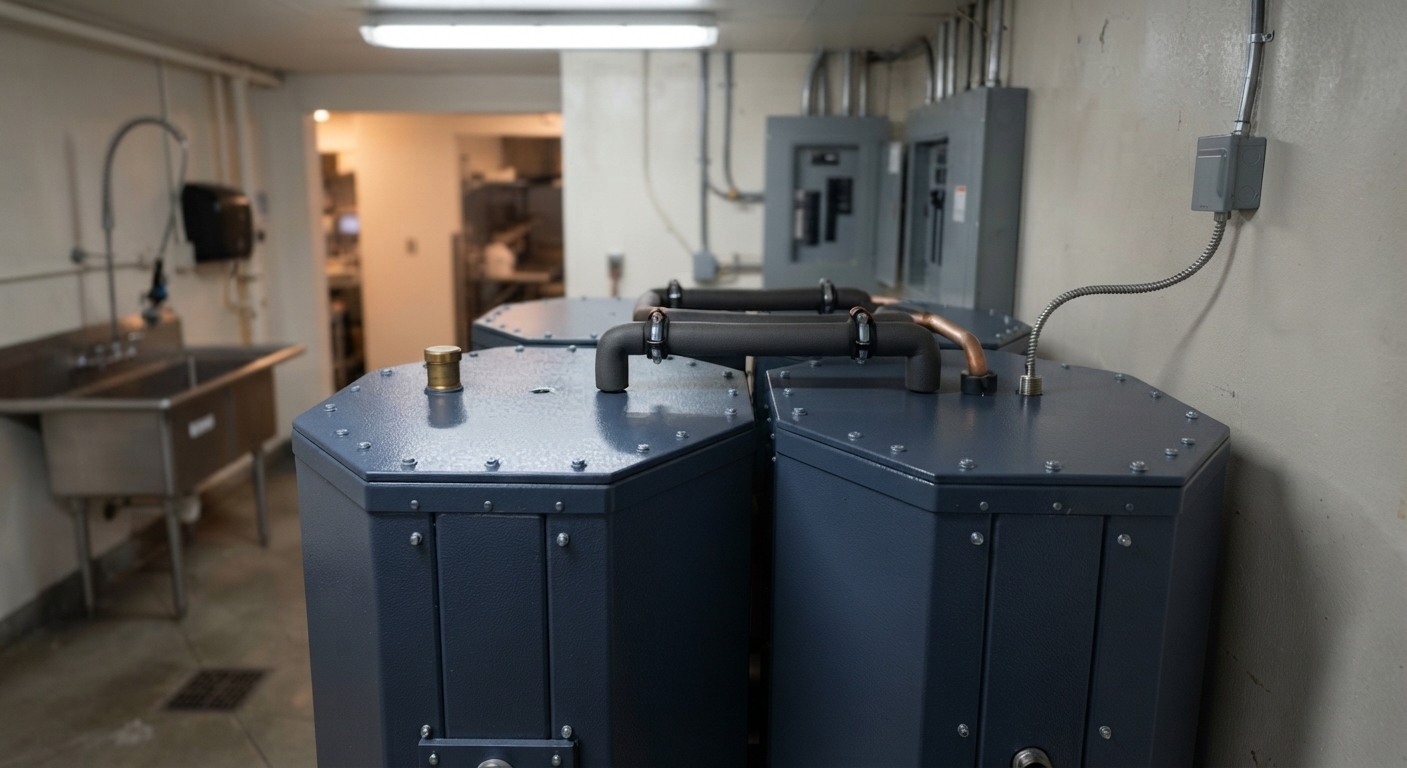
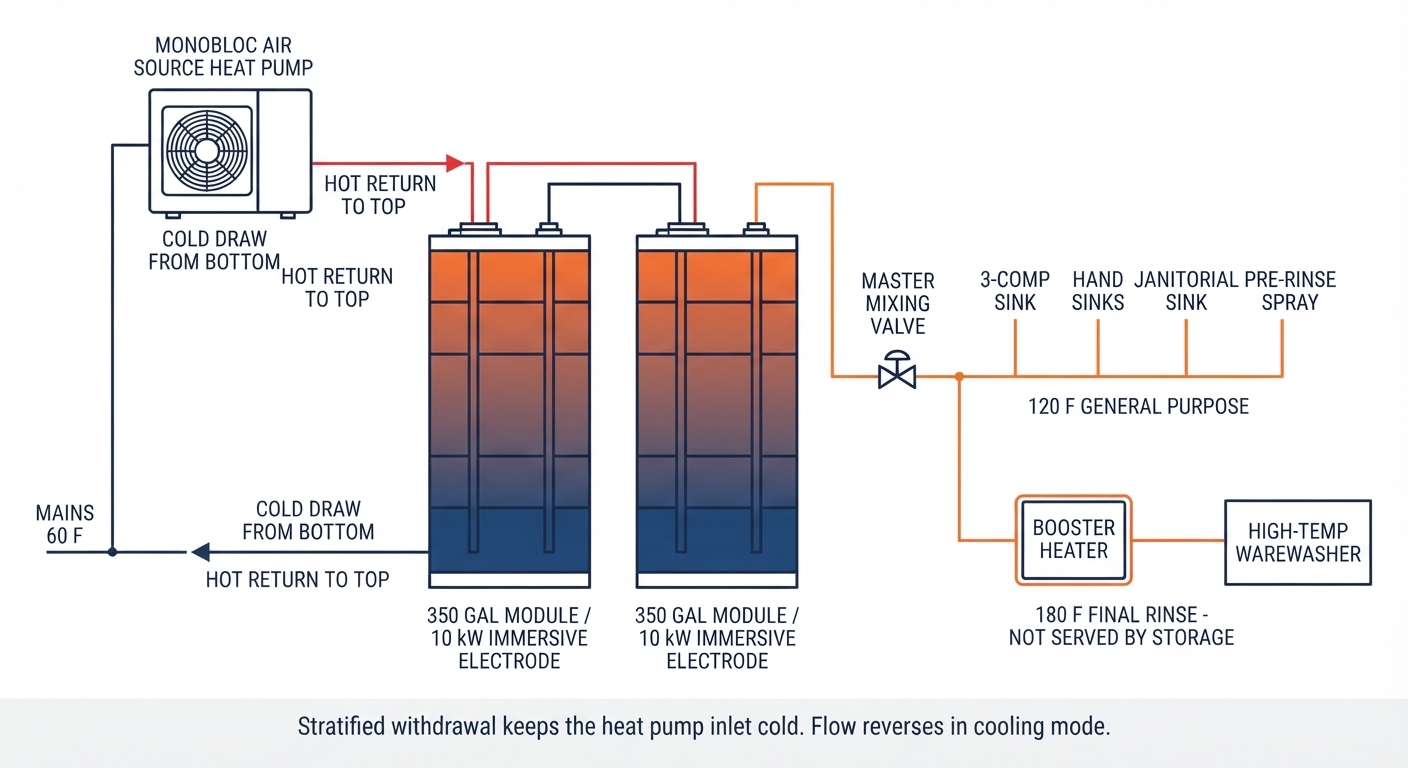
A modular thermal storage array reads to that test as a parallel bank. Each Thermal Energy HQ module carries an immersive electrode element rated at 10 kW, so two modules present 20 kW of documented input on the plan-check submittal. The heat pump sits upstream of that rating rather than inside it.
The array operates through stratification. The coldest water is drawn from the bottom of the module as the input to the monobloc air source heat pump, and hot output is introduced at the top through the 32 mm DN corrugated stainless steel tubing heat exchanger. That gradient keeps the heat pump seeing a cold inlet, which is where its coefficient of performance operates.
A master mixing valve blends stored water down to tap temperature. One gallon of stored water therefore yields more than one gallon of code-temperature water. A short distribution run avoids recirculation losses that reduce heat pump performance.
The electrode elements are wired, documented and permitted, then scheduled off through the Modbus register interface across the on-peak window. They are standby capacity, which is the condition the worksheet is testing for.
Storage does not shrink the nameplate, and four other things it cannot do
Formula 2 gives no credit for stored volume. None. The required input kilowatts are purchased, wired and inspected whether the array holds 80 gallons or 1,400 gallons. Storage changes when those kilowatts run, not whether they are installed.
The 180°F final sanitizing rinse is not served by the store. A high-temperature warewasher gets a dedicated booster heater sized from the machine’s listing. That booster is a separate electrical load with its own duty cycle.
The economics depend on the baseline being replaced. CalNEXT modeling using DEER load profiles at $0.29 per kWh and $1.75 per therm puts annual water heating for a quick service restaurant at $2,355 to $3,019 for an electric heat pump water heater with storage, compared with $1,710 to $2,068 for a gas storage heater. Against gas at those prices, electricity loses. Against electric resistance with storage, modeled at $6,426 to $7,754, it wins by roughly $4,000 per year.
The demand benefit is a controls outcome rather than a property of the hardware. If the electrodes fire during the dinner rush because the array was undercharged, the demand charge reappears. It is set by a single 15-minute interval. Where the tariff carries a ratchet, one bad interval prices 12 months.
Floor area is a real constraint, especially for quick service restaurants. Modules arrive panelized and assemble inside the room through a standard doorway, which solves rigging rather than square footage. Local environmental health authorities have the final say. CalNEXT documents a Long Beach coffee shop pushed toward tankless electric resistance and a Bay Area university café that abandoned a heat pump design after several attempts.
Formula 2 sets the module count, and the peak draw sets the module size
The CCDEH Guidelines for Sizing Water Heaters, adopted county by county, compute hourly demand from the fixture schedule and convert it to a required input rating. Formula 2 covers electric water heaters.
Required input rating
kW input = (GPH × Rise × 8.33 lb/gal) ÷ (Thermal Efficiency × 3,412 Btu/kWh)
Worked quick service restaurant case, single-service utensils
Three-compartment sink, 18 in × 24 in: 3 × 19 GPH = 57 GPH
Pre-rinse hand spray: 45 GPH
Three hand sinks: 3 × 5 GPH = 15 GPH
Janitorial sink: 15 GPH
Food preparation sink: 5 GPH
Garbage can wash facility: 15 GPH
Computed hourly demand: 152 GPH
Single-service utensil allowance, 80%: 122 GPH
kW input = (122 GPH × 60°F × 8.33 lb/gal) ÷ (0.98 × 3,412 Btu/kWh)
kW input = 60,976 ÷ 3,344
kW input = 18.2 kW
GPH is the maximum hourly hot water use of every fixture and piece of equipment on the system. Rise is delivery temperature minus incoming mains temperature. The 60°F value comes from CCDEH published examples; a county may specify another value. Thermal efficiency for electric water heaters is fixed at 98 percent unless a testing laboratory lists otherwise.
Module count
Modules = required kW ÷ 10 kW immersive electrode per module
Modules = 18.2 ÷ 10 = 1.82, rounded up to 2 modules = 20 kW installed input
Module size, based on the volume intended to shift
Q = m × c × delta-T
Q = 700 gal × 8.34 lb/gal × 1 Btu/lb·°F × 70°F
Q = 408,660 Btu = 120 kWh thermal
The 700-gallon array consists of two 350-gallon modules. The calculation uses a 130°F store against 60°F mains, producing a 70°F delta-T.
Blending a 130°F store with 60°F mains to 120°F delivery gives seven gallons of code-temperature water for every six stored. The 700 gallons therefore delivers about 817 gallons at 120°F. A quick service restaurant using roughly 500 gallons per day holds its whole day in the array with margin.
Electrical energy to charge the array
E_electrical = Q_thermal ÷ COP
E_electrical = 120 kWh thermal ÷ 2.5 = 48 kWh electrical
Average charging draw = 48 kWh ÷ 8 h off-peak window = 6.0 kW

The permitted nameplate is 20 kW. The operating draw is 6 kW. The 14 kW difference does not have to reach the demand meter when controls keep the electrodes off-peak. Price it against the demand rate on the facility’s tariff and multiply by 12.
Capacity moves with delta-T. The 350-gallon module is published at 54.6 kWh thermal at a 35°C, or 63°F, delta. This calculation uses a 70°F delta, which is why it yields about 60 kWh thermal per module. At 45°F winter mains, the delta widens to 85°F and each module carries about 73 kWh thermal. At a 120°F store, the usable delta falls to 60°F and capacity is about 51 kWh thermal; the array can no longer deliver 120°F at the tap without the electrode firing.
Every capacity figure here is a thermal kWh. Divide by COP before comparing it with an electric bill. Rounding runs against the client: fixture demands are rounded up, and COP is rounded down from the 3.0 used in Thermal Energy HQ space-heating quotations to 2.5.
The savings land in demand charges and in plan check, not in therms
The value case has several channels, but none changes the Formula 2 nameplate requirement.
The zero-NOx dates for water heaters are already on the calendar
The San Francisco bulletin sets out the schedule. Under Bay Area Air Quality Management District zero-NOx Rule 9-6, gas-fired tank water heaters rated up to 75,000 Btu per hour will not comply with the emissions limit in 2027 and can no longer be sold or installed. By 2031, the same applies up to 2 million Btu per hour.
The South Coast Air Quality Management District is phasing in comparable rules across much of the Los Angeles basin. San Francisco Building Code 106A.1.17 already requires new construction to be all-electric, with gas allowed for commercial cooking but not for water heating.
Statewide, the California Air Resources Board is developing zero-greenhouse-gas-emission standards for space and water heaters. Staff indicated that they anticipated bringing a proposed regulation to the Board during 2026. Check the current CARB workshop and meeting record before citing a date in a proposal because these dates move.
These are equipment sale and installation rules rather than use bans. Existing water heaters can be operated and repaired. The schedule sets the replacement decision for anyone signing a 10-year lease in an affected district today, and it is why utility programme teams are building foodservice electrification offers.
No claim is made here about federal tax credit eligibility for thermal energy storage property. The regulatory definition may not extend to equipment serving only domestic hot water; that question belongs with tax counsel.
Bring the worksheet to the first design meeting, not the last
The fixture schedule, local interpretation, tariff and site constraints should be resolved before equipment selection.
Frequently Asked Questions
How much hot water does a restaurant use per day?
A quick service restaurant uses about 500 gallons of hot water per day and a full service restaurant about 2,000 gallons, based on figures compiled in the CalNEXT foodservice study. Coffee shops are near 150 gallons and delis near 100 gallons. Those daily volumes size storage. The health department worksheet asks a different question: the maximum possible demand in a single hour.
Will a health department approve a heat pump water heater in a restaurant?
It can if the installed input kilowatts satisfy the sizing formula. San Francisco’s 2025 bulletin confirms approval where proposed input meets CCDEH Formula 2 and allows parallel units to be summed. The guidelines do not credit heat pump output, so a heat-pump-only system usually has to be oversized three to four times. Local jurisdictions have the final say.
Does adding a thermal storage tank reduce the required water heater size?
No. CCDEH Formula 2 computes a required input rating from hourly demand and takes no account of storage volume. Storage changes when the required kilowatts operate, not whether they are installed. Research is underway that may change how future guidelines treat heat pump performance.
Heat pump water heater or electric resistance: which costs less to run in a restaurant?
The heat pump costs less than electric resistance by a wide margin, and the reverse is true against gas. CalNEXT modeling at $0.29 per kWh puts annual water heating for a quick service restaurant at $6,426 to $7,754 for electric resistance with storage, $2,355 to $3,019 for a heat pump with storage, and $1,710 to $2,068 for a gas storage heater. Against gas, the case rests on emissions rules and demand charges.
Does thermal storage handle the 180°F dish machine rinse?
No. A high-temperature warewasher uses a dedicated booster heater that lifts general-purpose hot water to at least 180°F at the final rinse manifold. The booster is sized from the machine’s listing. Stored volume serves the 120°F system and, at an elevated setpoint, the 140°F supply required at the machine inlet. The booster remains a separate electrical load.
How much space does commercial kitchen hot water storage need?
Two 350-gallon modules cover a typical quick service load and provide a 20 kW input rating. Space is one of the segment’s most cited barriers, so the binding constraint is floor area rather than volume. Modules ship as panels and assemble inside the room through a standard doorway, which addresses access. It does not create square footage that is not there.
The worksheet is the constraint, and storage is where you put it
A restaurant going all-electric is sized by a formula that assumes its water heater is a resistance element. For a modest quick service kitchen, that formula returns 18.2 kW of input, and no amount of heat pump efficiency reduces the required installed input.
Installing those kilowatts as immersed electrodes inside 700 gallons of stored water satisfies the plan checker on nameplate. A heat pump drawing 6 kW keeps the volume charged overnight, which keeps the 14 kW difference off the demand meter when the controls perform as designed.
The storage does not make the requirement smaller. It decides what the requirement costs to operate. In a building type with 400 to 600 amps and no spare breakers, that is the decision worth engineering.