These two are placed in opposition surprisingly often, usually in a conversation that starts with someone asking whether more storage would let them scale back the recirculation loop. The answer is no, and the reason is worth understanding, because it changes how the whole plant gets sized.
In short: recirculation is a distribution strategy. It exists to put hot water near the fixture so occupants do not wait, and it maintains temperature in the loop, which is also a primary Legionella control. Thermal storage is a capacity and timing strategy: it covers peak draw and decouples heat production from consumption. They are not substitutes, and more importantly, recirculation is not neutral in the storage calculation. It is a continuous parasitic load that runs every hour of the year, and measured studies put distribution losses at a substantial fraction of total water heating energy, in some multifamily building sets approaching or exceeding the useful delivered load. Storage sized without accounting for it will underperform, and in a heat pump plant it will underperform badly.
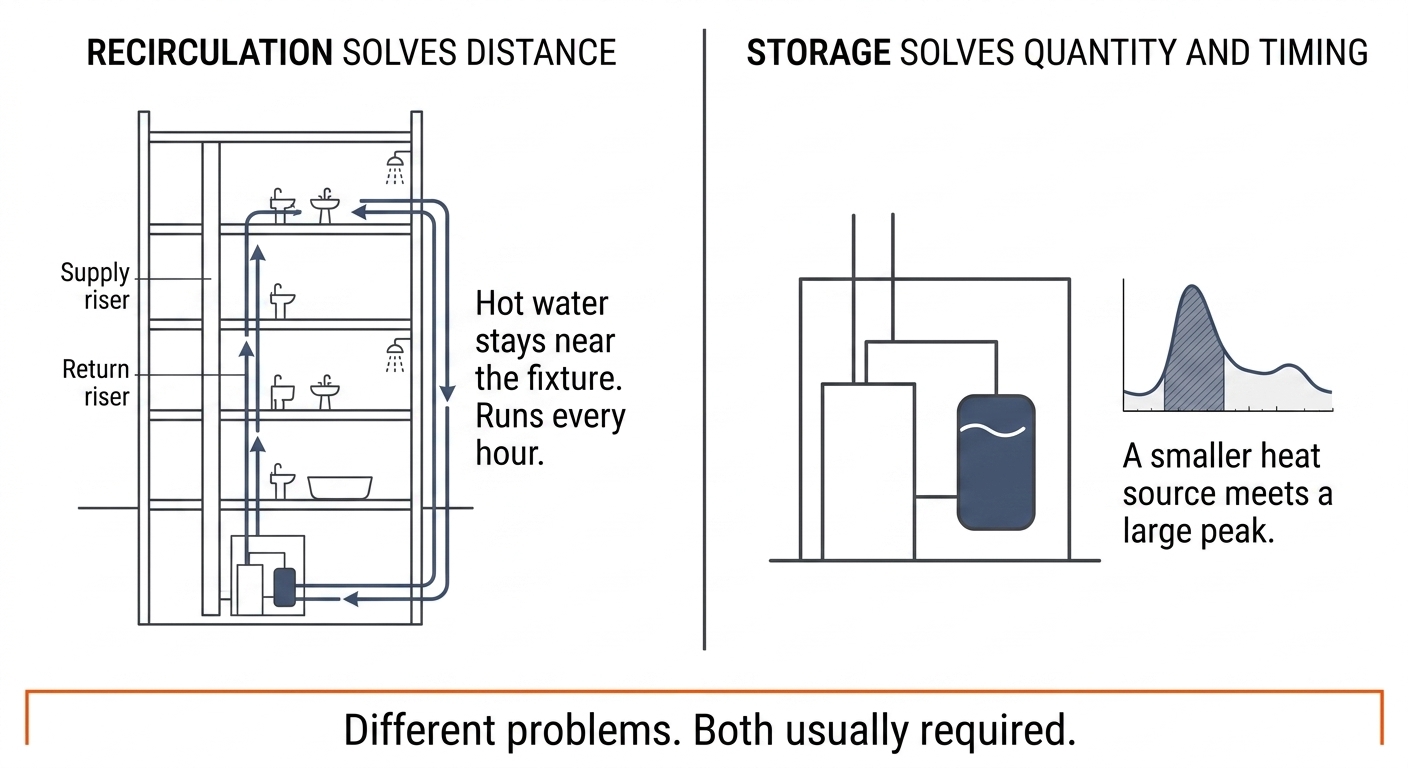
Recirculation is about distance and time-to-tap. In a building of any size, the volume of water sitting in the piping between the water heater and a remote fixture is large enough that a resident would run the tap for an uncomfortable interval before hot water arrives, wasting water and generating complaints. A recirculation loop keeps hot water moving through the distribution system so that it is always close to the point of use. That is the primary design intent, and it is why recirculation appears in essentially every multifamily, hospitality, and institutional building.
It has a second function that is often treated as a side effect and should not be. By keeping water moving and hot, the loop maintains temperature throughout the distribution system, which suppresses conditions favorable to Legionella growth. Published guidance on Legionella prevention in plumbing design treats temperature maintenance as a central control strategy, and notes that a recirculation system is a good first step but that it must be properly balanced so flow is actually maintained in every riser and branch. An unbalanced loop can be simultaneously wasteful and unsafe, delivering excessive flow through the path of least resistance while remote risers stagnate.
Thermal storage is about quantity and timing. It holds heat so that a smaller heat source can meet a large morning draw, and so that heat can be produced during hours when energy is cheaper or a solar or recovery source is available. It does nothing whatsoever about how long a resident waits at the tap, because the water sitting in the branch line is cold regardless of how much hot water is in the mechanical room.
So the honest framing is that these appear in the same system doing unrelated jobs, and the interesting engineering question is not which to choose but what recirculation does to the storage design.

Every foot of loop piping loses heat continuously to the surrounding space, and the pump adds its own energy. Unlike a draw load, this runs whether or not anyone uses hot water, which means it dominates consumption in buildings with modest draws and it never goes away.
The measured literature is consistent that this is a first-order effect rather than a rounding error, though the figures vary considerably with building type, layout, insulation, and study scope, and should be read with their context rather than averaged into a single number:
Read these as a range, not a headline. The studies differ in scope, vintage, building set, and what they count as a loss, and the highest figures come from specific building populations rather than from all buildings. The defensible general statement is that recirculation and distribution losses are large enough to change plant sizing decisions, and that they must be measured or modeled for the building in question rather than assumed from a published percentage.
The design consequence is direct: this load belongs in your storage sizing calculation. A tank sized against the draw profile alone will spend part of its charge covering loop losses instead of serving the morning peak. If you charge storage overnight expecting it to be available at 6 a.m., the loop has been drawing from it all night. Sizing methodology is covered in the thermal storage tank sizing calculator, and the temperature-maintenance load is one of the inputs that most commonly gets omitted.
Published findings on domestic hot water distribution losses
Source and scopeReported finding
ACEEE 2012, best practices for efficient hot water distribution in multifamily buildings. Multifamily central DHW energy flows, citing a 2011 California Utilities Statewide Codes and Standards study.Roughly one third of energy lost in the recirculation loop, with about one percent in remaining distribution piping.
NREL, evaluating DHW distribution system options. Validated modeling across distribution configurations, climates, and occupancies.Distribution losses of 13 to 29 percent of total water heating energy, with compact insulated low-load systems lowest.
CBE Berkeley, hot water and electric reheat comparison. Referenced prior research across 28 multifamily buildings.Reported energy losses in domestic hot water systems on the order of two thirds of input in that building set.
ACEEE 2024, balancing methods for multifamily distribution. Comparative evaluation of balancing methods in a 36-dwelling building model.Balancing valve selection alone changed distribution thermal losses meaningfully relative to a manually balanced baseline.
Because recirculation losses are large, the intuitive response is to run the pump less, lower the loop temperature, or throttle the flow. Each of these is a recognized hazard when taken past a limit, and the limits are not intuitive.
The practice of shutting down a hot water recirculation system during periods of low or no occupancy has long been condemned by OSHA and ASHRAE, precisely because stagnation and cooling in the distribution system create conditions for bacterial growth. Published growth-range figures vary by source, with CDC describing an optimal propagation range and OSHA and ASPE citing a somewhat different band, and the practical point for a designer is that ordinary delivery temperatures sit uncomfortably close to those ranges once water stops moving and begins losing heat.
Flow reduction has its own floor. Recent comparative work on balancing methods found that when the recirculation target is reduced to very low levels, no balancing method could keep the system thermally balanced, and the authors advise against reducing recirculation flow to such values because of bacterial growth potential during operation. Low flow does not distribute itself evenly; it concentrates in the path of least resistance and abandons the remote risers, which are exactly the locations you would least like to abandon.
The governing framework is ANSI/ASHRAE Standard 188, Legionellosis: Risk Management for Building Water Systems, complemented by ASHRAE Guideline 12, which was updated in 2023 with new guidance on temperature control and supplemental disinfection. Standard 188 is oriented toward establishing a water management program and assigning responsibility; Guideline 12 is the more design-oriented companion. General guidance from CDC and OSHA should inform the program. Setpoints are a project-specific determination made within a water management program and in coordination with the authority having jurisdiction, and this article deliberately does not recommend any.
The design implication is constructive rather than defeatist. Since you cannot reduce the loop's temperature maintenance duty below what safety requires, the productive move is to change how that duty is served so it stops damaging the rest of the plant. That is what the remainder of this article is about.
Recirculation losses were always wasteful, but a gas-fired plant absorbed them without much complaint. An electrified plant does not, and this is one of the most common failure modes in central heat pump water heating retrofits.
This is the single most consequential piping decision in a combined recirculation and storage system, and it is made carelessly more often than any other.
A storage tank's usable capacity depends on stratification. Hot water sits above cooler water with a relatively narrow transition zone between them, and the delivered temperature stays high until that zone reaches the outlet. Anything that mixes the tank collapses the stratification and reduces the volume that can be delivered at useful temperature, which is why nameplate volume and usable volume are different numbers.
Recirculation return is a continuous stream of tempered water entering the tank. Introduce it at the bottom, where cold make-up water belongs, and you are warming the coolest part of the tank, which reduces the temperature lift available to the heat source and gives the equipment a warmer entering water temperature than it should see. Introduce it high, near the outlet, and you dilute the hottest water in the tank with tempered return, directly reducing delivery temperature. Introduce it through a fitting that discharges as a jet rather than diffusing, and it mixes the tank regardless of elevation.
The correct answer is a design decision that depends on the configuration chosen in the next section, on the tank's internal arrangement, and on the relative flow rates involved, and it should be made by the mechanical designer with the tank's connection detail in hand rather than resolved in the field. Connection detail and arrangement guidance for specific modules is in the technical documentation library.
Diagnostic worth running on an existing system: if a plant delivers less hot water than its tank volume suggests it should, and the equipment appears to be operating correctly, check where the recirculation return enters and how. Stratification collapse from a poorly placed or poorly diffused return is a common and entirely fixable cause that gets misdiagnosed as undersized storage. It is worth checking before anyone specifies a larger tank.
Published analysis of temperature maintenance in heat pump water heating systems organizes the options into recognizable configurations, and the Bonneville Power Administration's work on distribution heat loss examines their effects specifically on heat pump plants. The four below cover essentially all central multifamily practice.

Central domestic hot water recirculation and storage configurations
ConfigurationHow it worksEffect on the plantWhere it fits
No recirculationCompact distribution, short branch runs, no return loop.Eliminates the loss entirely; no temperature maintenance duty.Small or highly compact buildings only. Rarely available as a choice in an existing multifamily building.
Return to primaryRecirculation return is piped back into the primary storage or the heat source inlet.Simplest, and the most likely to cause short cycling and stratification damage if the connection is not carefully detailed.Common by default, frequently by inheritance rather than by design.
Parallel temperature maintenanceA separate, dedicated heat source serves the loop in parallel with the primary DHW plant.Decouples the trickle load from the primary equipment, avoiding short cycling; adds a second heat source, often electric resistance.Where protecting the primary plant matters more than the efficiency of the maintenance energy.
Series temperature maintenance (swing tank)A dedicated storage volume sits in series on the return path, absorbing loop losses, typically with a small supplemental element.Buffers the continuous load so the primary plant sees draw events rather than a trickle; protects stratification in the primary storage.The common answer for central heat pump water heating in multifamily buildings.
The swing tank deserves emphasis because it is the configuration that most directly resolves the tension this article describes. Rather than asking the primary plant to serve both a large intermittent draw load and a small continuous maintenance load, it separates them: the primary storage and heat source handle draws, while a dedicated volume in series on the return absorbs temperature maintenance losses and is topped up by a small supplemental heat source when needed.
The benefits compound. The primary heat pump sees fewer, larger, better-matched load events instead of a continuous trickle, so it cycles less and operates nearer its efficient range. The primary storage keeps its stratification, so usable capacity approaches nameplate. And the supplemental energy, which is generally the least efficient energy in the plant, is confined to a small, well-defined duty rather than being called on unpredictably. Sizing this volume is its own exercise and is covered in our swing tank sizing guide.
The cost is an additional vessel and additional space, which in a retrofit is not a trivial ask. Where mechanical room space is the binding constraint, the modular approach helps for the same reason it helps elsewhere: a swing tank volume can be assembled in place and sized to the maintenance load rather than selected from a limited range of finished vessels. Space and access constraints are covered in designing thermal storage for existing buildings, and modular tank specifications list the available module sizes.
With the safety constraint established, these are the measures that reduce loop losses without reducing the temperature maintenance function below what it needs to do. Each is paired with its constraint deliberately.
Establish the temperature maintenance load for the actual loop: length, diameter, insulation condition, ambient conditions, and target loop temperature. Measure it where possible on an existing building rather than estimating.
Establish the draw profile separately, particularly the peak hour. These are two different loads with different shapes and they must be carried separately through the calculation.
Decide the configuration before sizing storage, because a swing tank arrangement changes what the primary storage has to cover.
Size the primary storage against the draw peak, not against the draw peak plus loop losses, if a swing tank or parallel maintenance arrangement is carrying the maintenance duty. If return-to-primary is unavoidable, the maintenance load must be added and the usable fraction reduced to account for the stratification penalty.
Size the swing tank volume against the maintenance load and the acceptable temperature droop between supplemental heat calls.
Detail the return connection explicitly on the drawings, including elevation and diffusion. Do not leave it to the field.
Confirm supplemental heat capacity for the conditions under which the primary source cannot maintain loop temperature.
Verify the whole arrangement against the building's water management program before it is built, not after.
The financial picture, including whether the additional vessel earns its place, follows the framework in the thermal energy storage ROI calculator. Where a central plant also serves cooling and has simultaneous loads, the interaction with heat recovery is covered in heat recovery chillers vs thermal energy storage.
No. They solve different problems. Recirculation exists to keep hot water near the fixture so occupants do not wait, and to maintain temperature throughout the distribution system, which is also a primary Legionella control. Thermal storage covers peak draw and decouples heat production from consumption. No quantity of storage in the mechanical room changes how long a resident waits at a remote tap, because the water in the branch line is cold regardless.
Enough to change plant sizing decisions, though published figures vary widely with building type, layout, insulation, and study scope. A widely cited California study reported roughly one third of central domestic hot water energy lost in the recirculation loop, and NREL modeling of distribution configurations found distribution losses accounting for 13 to 29 percent of total water heating energy. These are not interchangeable figures and should not be averaged; the loss should be measured or modeled for the specific building.
No. The practice of shutting down hot water recirculation during periods of low or no occupancy has long been condemned by OSHA and ASHRAE, because stagnation and cooling in the distribution system create conditions favorable to Legionella growth. Loop temperature maintenance is a safety function, not only a comfort one. Demand-based pump control that maintains loop temperature within the parameters of the building's water management program is a recognized energy-saving approach; switching the system off is not.
Yes, and it is one of the most commonly omitted inputs in storage sizing. Recirculation is a continuous parasitic load that runs every hour including those in which nobody draws water, so storage charged overnight will have been partially discharged by loop losses before the morning peak arrives. Whether the load lands on the primary storage depends on the configuration: a swing tank or parallel temperature maintenance arrangement carries it separately, while a return-to-primary arrangement puts it directly on the primary plant.
It is a design decision, not a default, and it has large consequences. Return water arrives tempered rather than cold, so introducing it at the bottom warms the coolest part of the tank and reduces the temperature lift available to the heat source, while introducing it high dilutes the hottest water and directly reduces delivery temperature. A connection that discharges as a jet rather than diffusing will mix the tank at any elevation. The correct arrangement depends on the configuration chosen, the tank's internal detail, and the relative flow rates, and should be resolved by the designer rather than in the field.
A swing tank is a dedicated storage volume placed in series on the recirculation return path, typically with a small supplemental heat source, that absorbs temperature maintenance losses so the primary plant does not have to serve them. It is the common answer for central heat pump water heating in multifamily buildings because it separates a small continuous load from a large intermittent one. The primary heat pump then sees draw events rather than a trickle, so it cycles less, and the primary storage keeps its stratification and therefore its usable capacity.
Because temperature maintenance is a small, continuous, low-grade load, and heat pumps respond poorly to it. A heat pump sized for the peak draw and asked to also serve a trickle load short cycles, which degrades efficiency and equipment life, whereas a boiler with large turndown tolerated it better. Recirculation return also arrives tempered rather than cold, which reduces the temperature lift available and shifts the operating point for equipment whose capacity and efficiency depend strongly on entering water temperature.
Demand-based pump control is identified in the distribution literature as the most effective control strategy, monitoring real building demand together with return line temperature rather than running the pump continuously, provided loop temperature is still maintained within the water management program's parameters. Proper balancing and pipe insulation are the other two high-value measures, and recirculation systems show the largest benefit from insulation because of the larger pipe diameters and lengths involved. Reducing loop temperature or throttling flow below the thermally balanced threshold saves energy but creates safety risk and is not an energy conservation measure.
Recirculation and thermal storage are not competing line items. Recirculation is a distribution strategy with a safety function attached, and it produces a continuous load that the rest of the plant has to carry. Thermal storage is a capacity and timing strategy. The question worth asking is not which to install but how the maintenance load gets served so it does not degrade everything else.
For a central heat pump plant the answer is usually architectural rather than operational: separate the continuous maintenance duty from the intermittent draw duty, most often with a swing tank in series on the return, detail the return connection so it does not destroy stratification, and pursue the loss reductions that are compatible with temperature maintenance, which are control, balancing, and insulation. What is not available is turning the loop down until it stops costing money. That path ends somewhere no engineer wants to be.
The fastest way to resolve a configuration is a short engineering conversation with the loop details and a draw profile in hand.
Tell our team about your building, operating goals, and energy needs.