A commercial laundry hot water system fails in twenty minutes, not over a day. Commercial washers draw approximately two-thirds of their hourly hot water inside a single twenty-minute window, and most sizing guides answer that surge by enlarging the heat source.
That approach pays twice: once for equipment sized for a peak it meets only a few hours a week, and again through fuel and demand charges billed at the worst moment of the day. Size stored volume against the surge and tariff, then size the heat source against the daily total.
The calculation differs by application. A 1,200 lb vended laundromat can use a heat-pump-charged tank for a 120°F header. An institutional laundry requiring 160°F to 180°F sanitizing water still needs a booster heater for the final temperature rise.
Key Takeaways
Laundry dominates hot water consumption in any building that operates one. The CDC's environmental infection control guideline states that laundries are typically the largest users of hot water in hospitals, consuming 50% to 75% of total hot water and representing an average of 10% to 15% of hospital energy use.
A vended laundromat concentrates that load because the entire business is the load. The general case for commercial hot water thermal storage applies, with the volumes multiplied and the schedule compressed.
The operating problem is the shape of demand, not only its total. Washer fills are short, high-flow events. Sizing a heat source to the Saturday peak hour produces equipment that idles for most of its service life while setting monthly billing demand.
Reducing the load comes before storing it. The Better Buildings commercial laundry toolkit reports evaluations of ozonation at the Charleston Place Hotel and the Rogerson House assisted living facility that found up to 60% savings in hot water requirements. Storage sized against a load that chemistry is about to remove is capital spent on the wrong problem.
Commercial electricity prices and tariff structures make the arithmetic material to a project pro forma. The EIA's Electric Power Monthly publishes state-by-state commercial averages. The federal standard governing gas commercial water heaters has also changed, turning the next equipment failure into a design decision.
In this article
The surge lasts twenty minutes and the recovery window lasts twenty-two hours
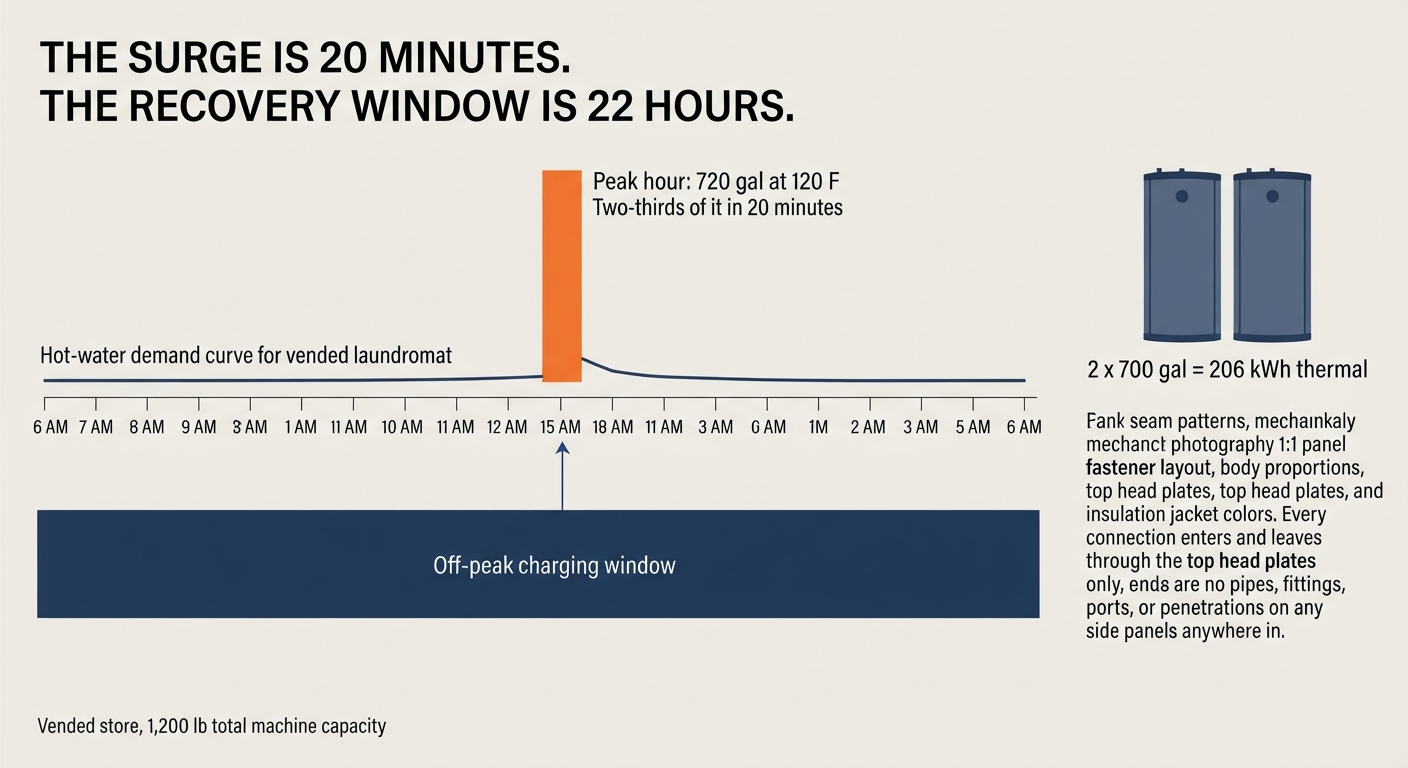
AERCO's laundry hot water technical bulletin sets the average hourly hot water rate at 2 gallons per pound of machine capacity and states that commercial laundry machines use approximately two-thirds of their hourly hot water consumption in twenty minutes.
The same bulletin provides a second sizing path for a restricted energy source: size the heater to the average hourly rate and use a stratified storage tank to absorb the surge. An air source heat pump is a restricted energy source by definition. A monobloc unit sized to a laundry's daily total is a fraction of the burner capacity the same laundry would need to chase its peak instantaneously.
This differs from heat pump buffer tank sizing for commercial systems, which is measured in minutes of compressor run time. Thermal storage for a laundry is sized in hours of load and recharged against the tariff.
The physical mechanism is stratified withdrawal. The coldest water sits at the bottom of the tank and is drawn through the heat exchanger as the input to the heat pump. Hot output enters at the top of the coil. A laundry draws from the top of the stack at header temperature while the bottom refills with cold main. The boundary between the layers rises through the surge and falls during recovery.
TEHQ modular thermal storage tanks use a 32 mm DN corrugated stainless steel tubing heat exchanger in a dual coil loop of 40 m to 80 m, with all connections entering through the top head plate.
Thermal storage cannot reach sanitizing temperature, and that decides the architecture
The temperature ceiling determines whether a heat pump and storage serve a laundry directly or serve it as preheat. The ENERGY STAR central heat pump water heater discussion guide uses 140°F leaving water temperature as the benchmark for the equipment class.
The CDC recommends at least 160°F held for a minimum of 25 minutes for health care hot-water washing, and the AERCO bulletin specifies 180°F at institutional laundry machines. Those numbers do not overlap.
The CDC guideline identifies steam jet or a separate booster heater as the resolution. A stratified tank charged by a heat pump takes cold main from 50°F to roughly 130°F, and a booster carries the final rise to setpoint. In a 180°F institutional laundry, that split assigns 62% of the thermal energy to the heat pump and 38% to the booster.
A vended laundromat sits on the other side of the line. A 120°F header is within reach of a heat-pump-charged tank. Low-temperature chemistry moves the line again: CDC notes that wash temperatures of 71°F to 77°F can reduce microbial contamination when washer cycling, detergent, and additive dosing are carefully monitored and controlled. Those cycles rely on chlorine- or oxygen-activated bleach. State licensing standards may still dictate hot cycles.
Two 700-gallon modules move about 68 kWh of electrical load off peak
The reference case uses machine water at 2.0 gallons per pound of rated capacity per full cycle, turnover at 1.2 loads per hour during the weekend peak, hot share at 25%, cold main at 50°F, and a 120°F header. The resulting temperature rise is 70°F.

Peak-hour hot water volume:
V_hot = capacity × gal/lb × turns/hr × hot share
V_hot = 1,200 lb × 2.0 gal/lb × 1.2/hr × 0.25
V_hot = 720 gallons per hour at 120°F
Thermal energy in the peak hour:
Q = m × c × ΔT
Q = 720 gal × 8.34 lb/gal × 1 Btu/lb·°F × 70°F
Q = 420,336 Btu
Q = 123 kWh thermal
Under the AERCO restricted-source rule, storage covers one-third of the hourly requirement. A vertical tank delivers roughly 70% of its volume before outlet temperature degrades.
Surge-ride storage:
V_store = (V_hot / 3) / 0.70
V_store = (720 / 3) / 0.70
V_store = 343 gallons
That is the capacity answer. The tariff answer is larger because riding one surge and shifting a billing period are different objectives.
A 700-gallon module is published at 108.0 kWh at a 35°C delta, but the laundry preheat calculation uses a narrower usable delta.
Usable module capacity at laundry delta:
Q = 700 gal × 8.34 lb/gal × 1 Btu/lb·°F × 60°F
Q = 350,280 Btu
Q = 103 kWh thermal per module
The published rating is 108.0 kWh at a 63°F delta. The 103 kWh thermal figure is the laundry-usable value at the stated 60°F delta, rounded down.
Electrical load shifted with two modules at COP 3.0:
E_shifted = Q_thermal / COP
E_shifted = (2 × 10³ kWh thermal) / 3.0
E_shifted = 206 kWh thermal / 3.0
E_shifted = 68 kWh electrical
The 68 kWh figure is electrical. The 206 kWh figure is thermal. Those units are not interchangeable in a proposal.
Using the TEHQ First Baptist Church project file, off-peak energy landed below $0.14/kWh against on-peak rates three to six times higher. A conservative 3× spread gives $0.42/kWh on peak.
Value per full cycle:
S = E_shifted × (on-peak rate − off-peak rate)
S = 68 kWh × ($0.42 − $0.14)
S = $19.04 per cycle
At 200 full cycles per year, the value is approximately $3,800/year.
Two 700-gallon modules list at $11,596, which is roughly a three-year simple payback against tank cost alone. The figure excludes the heat pump, heat exchanger, controls, piping, and installation. It is a component figure, not a project payback.
Two hundred cycles rather than 260 was used because a vended store does not reach full discharge every operating day. Effective cost per stored kWh at the narrower delta is $56 rather than the published $54, and $56 is the figure to model.
Run site volumes through the thermal storage tank sizing calculator, then test the tariff spread against thermal energy storage ROI before fixing a module count.
The value lands in demand charges, equipment count, and off-peak energy
Five channels carry the return. Verify each against the site's tariff and machine schedule before it appears in a pro forma.
The October 2026 standard changes what a replacement gas heater looks like
DOE published amended energy conservation standards for commercial water heating equipment in the Federal Register on October 6, 2023, at 88 FR 69686, with compliance required on and after October 6, 2026.
The practical effect for gas-fired commercial equipment is condensing technology, which brings different venting material, condensate drainage, and neutralization requirements than the units being replaced.
The timeline has since moved twice. On May 5, 2026, DOE's Office of the General Counsel published an enforcement policy delaying enforcement of the thermal efficiency standards for gas-fired storage, storage-type instantaneous, and instantaneous water heaters and hot water supply boilers manufactured on or after October 6, 2026, but before October 6, 2027. The standard remains in effect during that window.
Separately, on February 19, 2026, DOE received a petition from the American Gas Association, the American Public Gas Association, and the National Propane Gas Association asking that the compliance date be amended to January 1, 2030 at a minimum. That petition was pending at writing.
A laundry operator replacing a failed water heater inside this window chooses between a non-condensing unit built before the cutoff, a condensing unit with new venting and condensate work, and an electrified path. Condensing conversion scope is the honest comparison point for a heat pump plus storage retrofit because both require mechanical room work.
On the equipment horizon, Oak Ridge National Laboratory has been running a DOE-funded project to develop a 30 kW or larger commercial heat pump delivering at least 180°F sink temperature with acceptable COP, on a project term running to June 30, 2025. Confirm the current status of the Oak Ridge National Laboratory project before citing it as available technology. If such machines reach the market at scale, the 62/38 split narrows and the booster shrinks toward a trim function.

Five checks decide whether storage belongs in your laundry
Frequently Asked Questions
How much hot water does a commercial laundry use per pound of laundry?
Commercial laundry equipment generally uses about 2 gallons of water per pound of machine capacity per full cycle, which the AERCO technical bulletin applies as an average hourly hot water rate for institutional laundries washing at 180°F. A vended laundromat uses far less hot water than that implies because most vended cycles run warm or cold. Measure the hot share on site.
Can a heat pump water heater supply a commercial laundry?
It can supply the preheat, and it can supply a full vended laundromat header at 120°F. It cannot by itself reach the 160°F the CDC recommends for health care hot-water washing or the 180°F specified for institutional machines. In those applications, a heat pump charges storage from 50°F to roughly 130°F, covering 62% of the rise, and a booster carries the other 38%.
What size thermal storage tank does a laundromat need?
Two answers apply, depending on the objective. To ride the surge, take one-third of the peak-hour hot water requirement and divide by a 0.70 usable fraction: 343 gallons for a 1,200 lb store drawing 720 gallons in its peak hour. To shift load off peak, size against on-peak energy instead, which produced two 700-gallon modules in the worked example.
Does thermal energy storage reduce laundromat dryer costs?
No. Dryers are a separate load, they are frequently the dominant gas consumer in a vended store, and thermal storage does nothing for them. Storage addresses water heating only. A dryer strategy is a separate project involving heat pump dryers, exhaust heat recovery, or make-up air tempering, and it should be evaluated on its own numbers.
What is the payback on thermal storage for a commercial laundry?
The worked example returns approximately $3,800 per year against $11,596 of tank list price, producing a three-year simple payback on tanks alone. Project payback is longer because the heat pump, heat exchanger, controls, piping, and installation are excluded. Payback is driven by the on-peak to off-peak spread and by how many days per week the store reaches full discharge.
Is a buffer tank the same as thermal storage for a laundry?
No. A buffer tank stabilizes heat pump cycling and is sized in minutes of run time, while thermal storage is sized in hours of load and recharged against a tariff. A laundry can need both functions, and one modular vessel can serve both, but the two calculations produce different volumes. See the comparison of buffer tank vs storage tank.
What the evidence supports
The laundry surge is a twenty-minute event inside a twenty-four-hour day. Sizing literature answered it with burner capacity because burner capacity was the cheapest answer available when that literature was written.
AERCO's restricted-source path shows the alternative. The CDC guideline names the booster heater that makes an electrified version workable at sanitizing temperatures, and the October 2026 standard has made the replacement decision an active one.
For a 1,200 lb vended store, two 700-gallon modules move 68 kWh electrical load out of the peak window per cycle while providing 206 kWh thermal of stated storage capacity at the laundry delta. For an institutional laundry, a heat-pump-charged tank carries 62% of the rise and a booster carries the remaining 38%.
Thermal storage serves the thermal share of the load and nothing else. It cannot export power to the grid, back up lighting, card systems, or motors, operate as a multi-day reserve, or reduce the gas load of dryers.