Buy a 500-gallon tank and the building does not get 500 gallons of hot water. It gets somewhere between roughly 300 and 700, depending on four decisions made during design — and the gap between those numbers is where undersized systems come from. Sizing storage is not a lookup. It is a short calculation with three derates in it, and most published sizing advice skips at least two of them.
Sizing thermal storage for peak hot water demand is a four-step calculation. Define the peak block — the window of highest sustained draw, not the daily total. Compute the energy that block requires. Subtract what the heat source produces during the block, because it does not stop running when the draw starts. Convert the remaining deficit to gallons, applying three derates: the usable temperature band between storage and delivery, the fraction of the tank a real thermocline makes available, and the standing loss over the hold period. The result is a nominal tank volume. Skip the recovery credit and you oversize; skip the derates and you undersize.
Key Takeaways
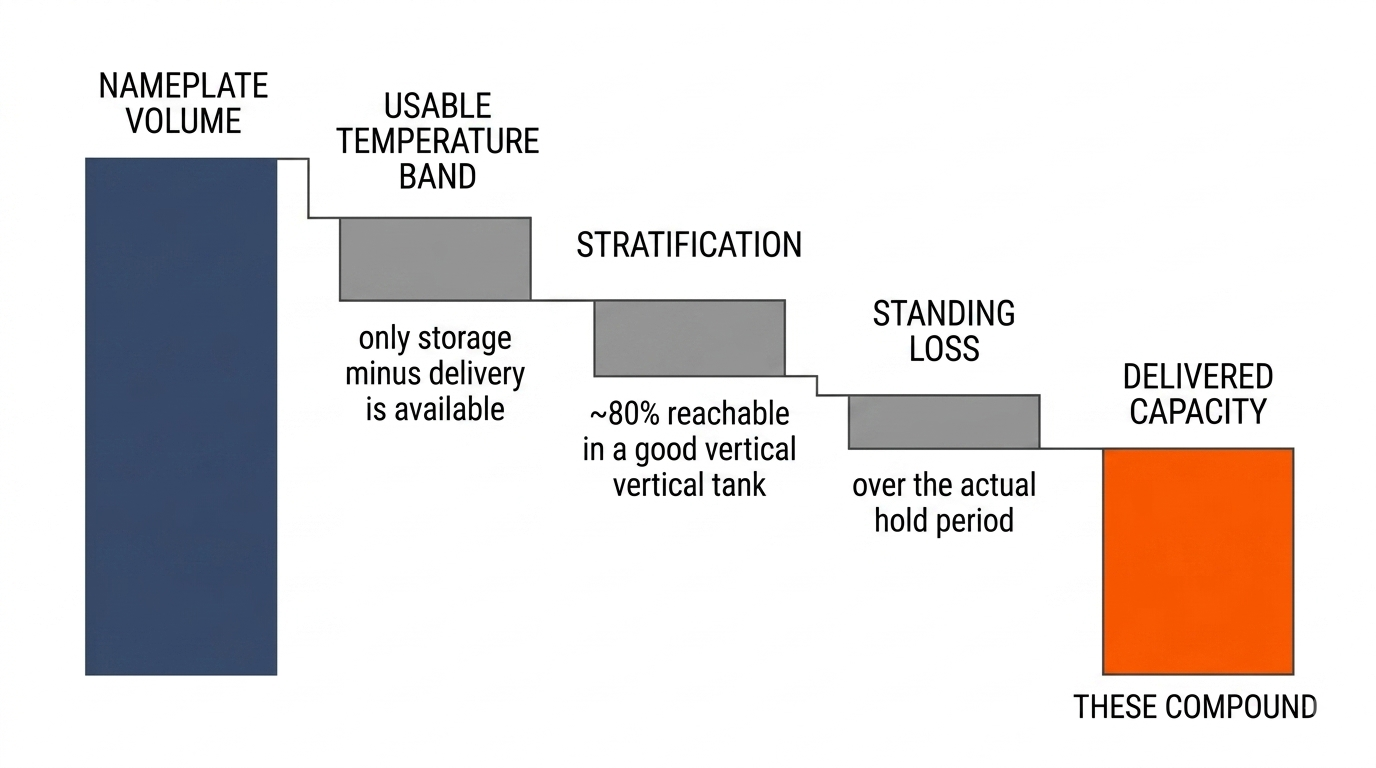
The number on a tank label is a vessel volume, not a guarantee of delivered hot water. The sizing calculation has to account for the temperature band that carries useful energy, the part of the tank that remains accessible under real stratification, and the heat lost while the tank waits for the draw.
This article owns the volume arithmetic: how a peak demand becomes a number of gallons. Plant-side selection — including how much heat-source capacity to buy — is a separate decision. For a first-pass estimate, use the thermal storage tank sizing calculator.
In this article
Why nameplate gallons are not usable gallons
Three separate reductions sit between the number on the tank and the hot water the building receives. They compound, and they are the reason two engineers can size the same building and land 40% apart.
The third one is the most commonly underestimated, and the arithmetic is worth seeing once. Standing loss expressed as °F per 24 hours looks trivial against a tank storing 100+ kWh. But if the usable band is 30°F, a tank losing 2.4°F per day has given up 8% of its useful capacity in twenty-four hours — and a code-minimum tank losing roughly 4°F has given up 13%. That is why standing loss belongs in a sizing calculation rather than in a footnote, and why federal insulation minima are a floor rather than a target: 10 CFR 431.110 sets R-12.5 as the minimum for unfired hot water storage tanks and exempts tanks over 140 gallons from standby loss testing entirely if they meet it.
The three derates between nameplate volume and usable capacity
DerateWhat it doesTypical direction
Usable temperature bandOnly the energy between storage setpoint and delivery temperature is available. Store at 150°F and deliver at 120°F and you use a 30°F band, not the full range.Fixed by setpoint choice; wider band = more usable energy per gallon
Stratification / usable fractionThe thermocline is a transition zone, not a plane. Water within it is neither hot enough to deliver nor cold enough to ignore.A well-stratified vertical tank reaches a much higher fraction than a mixed tank
Standing loss over the holdEnergy leaves the tank between charge and draw. It consumes the usable band, not a percentage of volume.Grows with hold duration and with surface-to-volume ratio
Step 1: Define the peak block
The peak block is the window of highest sustained draw the storage must carry. Everything downstream depends on getting it right, and it is defined by two numbers: duration and share of the daily load.
How to establish it, in descending order of reliability:
1. Measured data. On an existing building, meter hot water flow at the plant at fifteen-minute resolution across at least one winter week. This is the only method that produces the building’s actual load shape rather than a category average.
2. A published load profile for the building type. The Ecosizer accepts multifamily presets and ASHRAE commercial building load shapes, and derives peak demand from the 98th-percentile hot water day in an annual profile per its sizing tool manual.
3. Fixture-count and per-capita methods. The “Service Water Heating” chapter of the ASHRAE Handbook — HVAC Applications remains the reference for demand tables by building type. Use it to establish the load; use a heat-pump-aware method to size the plant that serves it.
Typical peak character by building type
Building typeTypical peak characterSizing implication
MultifamilySharp morning peak, secondary evening peakStorage-heavy; the morning block governs
HotelVery compressed morning peak, high simultaneityThe hardest case; storage does most of the work
HospitalDiverse loads on different schedules, flatter aggregateLower peak-to-average ratio; continuity may matter more than peak
Fitness / athleticShower peaks tracking class schedulesKnowable in advance; submeter before design
LaundrySustained high-volume draw, little diversityVolume-driven rather than peak-driven
OfficeLow, dispersedStorage rarely justified for DHW alone
Do not skip the recirculation loop
Whatever method establishes the fixture load, a central system with a recirculation loop carries a continuous additional load that the plant must also serve. EPA’s ENERGY STAR heat pump water heater design guidance puts central distribution losses at 30–50% of delivered energy.
On retrofits, DOE recommends metering it with a flow meter and temperature sensors rather than estimating, because that range is wide enough to swing the plant size by a third. Distribution-side options for reducing it before you size anything are in Domestic Hot Water Recirculation vs Thermal Storage.
Step 2: Compute the block energy
Once the block is defined, its energy requirement is straightforward physics:
Block energy (Btu) = gallons × 8.33 lb/gal × (delivery temperature − inlet temperature)
Use the design-day inlet temperature — the coldest entering city water of the year — not an annual average. Cold inlet is simultaneously when each gallon costs the most energy and, for air-source plants, when the heat source produces least. Sizing on an average inlet temperature produces a plant that fails in February.
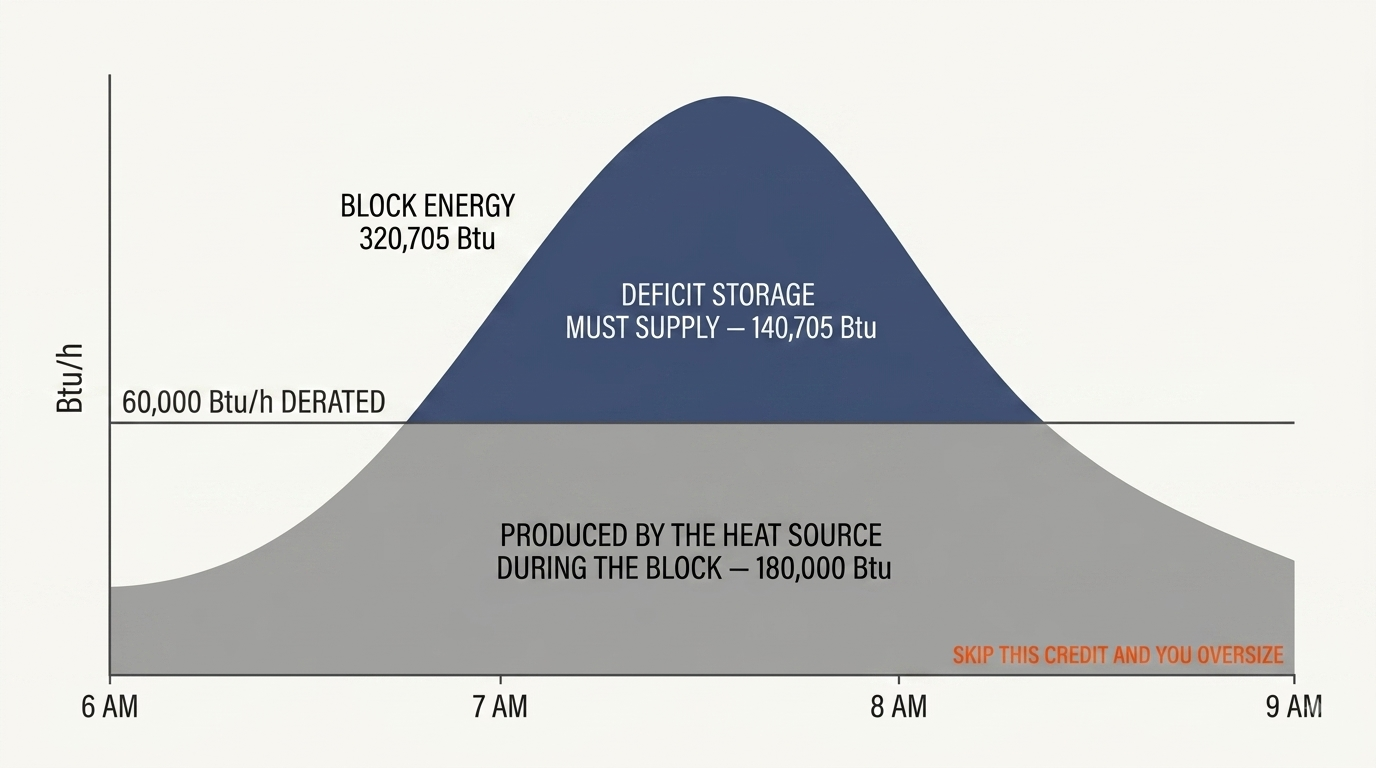
Worked example: a block requiring 550 gallons at 120°F delivery against 50°F design inlet needs 550 × 8.33 × 70 = 320,705 Btu, or about 94 kWh.
This is a teaching calculation, not a design output. A licensed engineer of record owns the final number.
Step 3: Credit what the heat source produces during the block
This is the step that separates a modern sizing calculation from the classic one, and skipping it is the most common cause of oversizing.
The heat source does not switch off when the draw begins. Across a three-hour morning block, a plant producing 80,000 Btu/h contributes 240,000 Btu — which storage does not have to supply. The Ecotope method behind the Ecosizer accounts for hot water production during the peak demand period precisely for this reason, and it is why that method permits systems to be sized smaller than the classic approach that assumes storage covers the entire peak unaided.
Storage deficit (Btu) = block energy − (heat source output × block duration)
Use derated output at design-day conditions, not nameplate — an air-source plant produces less on the same cold morning that drives the peak. Also confirm the plant can actually run at full output through the block; a plant that must also serve temperature maintenance is not delivering all of that to the primary load.
Continuing the example: 320,705 Btu of block energy, a plant producing 60,000 Btu/h derated, across a 3-hour block, contributes 180,000 Btu. The deficit storage must supply is 320,705 − 180,000 = 140,705 Btu.
This is a teaching calculation, not a design output. A licensed engineer of record owns the final number.
Plant-side selection is a separate decision
How much heat-source capacity to buy in the first place, and where to sit on the capacity-versus-storage curve, is a separate plant-side decision. This article takes the heat source as given and sizes the tank around it.
Step 4: Convert the deficit to a tank volume
Now apply the three derates in order.
4a. Usable energy per stored gallon
Energy per usable gallon (Btu per gallon) = 8.33 × (storage temperature − inlet temperature)
At 150°F storage and 50°F inlet: 8.33 × 100 = 833 Btu per gallon.
Note this uses storage minus inlet, not storage minus delivery, because each stored gallon is blended with cold water at the mixing valve to produce a larger volume at delivery temperature. At 150°F storage, 120°F delivery, and 50°F inlet, one stored gallon yields roughly 1.43 gallons of service hot water.
Usable volume = 140,705 ÷ 833 ≈ 169 gallons.
Storage temperature is a sizing lever, and it is also a public health parameter. The CDC’s guidance on controlling Legionella in potable water systems directs storing hot water above 140°F and keeping circulating hot water above 120°F, with anti-scald handled by a thermostatic mixing valve. Raising the setpoint increases energy per gallon and shrinks the tank; it also lowers heat pump efficiency. Both effects are real and the tradeoff belongs to the design team.
4b. Stratification and usable fraction
A tank does not deliver its full volume at storage temperature. The thermocline — the transition layer between hot and cold — occupies real volume, and water inside it is neither usable nor negligible. How much of the tank you reach depends on geometry and on how gently water enters it.
A well-designed stratified tank commonly assumes a usable fraction around 80%; a mixed or poorly diffused tank materially less. Ask the manufacturer what fraction their published capacity assumes — if the answer is 100%, the number is a volume, not a capacity.
Applying 80%: 169 ÷ 0.80 ≈ 211 gallons nominal.
4c. Standing loss over the hold period
Finally, correct for energy lost between charging and drawing. The hold period is what matters, not the 24-hour figure on the spec sheet.
For a six-hour hold on a large module losing 2.4°F per 24 hours, the correction is roughly 0.6°F against a 30°F usable band — about 2%, which rounds into the safety factor. For the sixteen-hour load-shift case it is roughly 1.6°F, or over 5%, and should be applied explicitly. Published standing loss by model is in the thermal tank comparison and specifications, and why the metric deserves more attention than it usually gets is covered in What Is the Best Thermal Energy Tank? The 7 Specs That Actually Decide It.
Result: approximately 215–225 gallons for this example, met by a single 350-gallon module with margin, or by a 350 plus an 80 if the design calls for a separate temperature maintenance vessel.
The complete method on one page
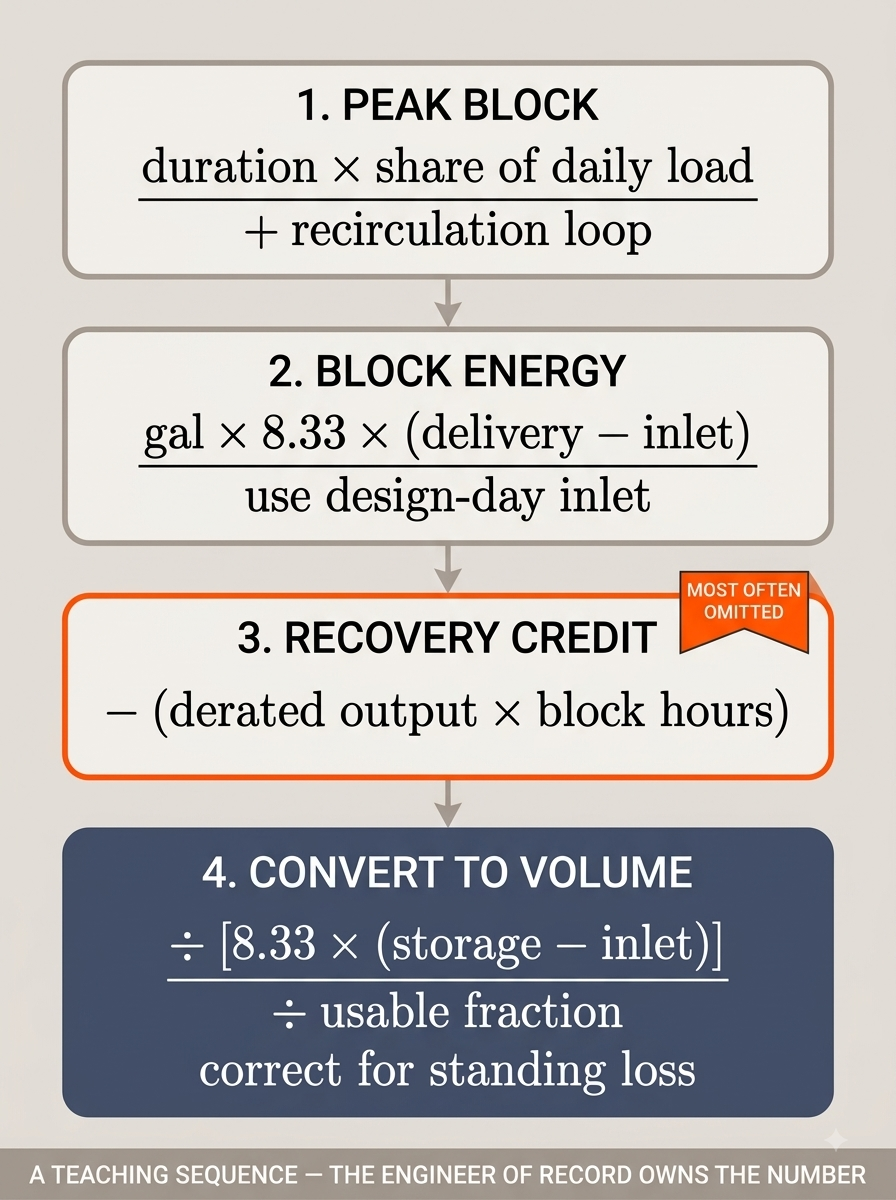
This is a teaching sequence, not a design output. Real projects run the Ecosizer or a manufacturer tool with site-specific inputs, and a licensed engineer of record signs the result. The value of working it by hand is knowing which assumption to challenge when a proposal arrives with a single number and no derivation.
Thermal storage tank sizing calculation
StepCalculationWatch for
1. Peak blockDuration × share of daily loadUse metered data where it exists; add the recirculation loop
2. Block energygal × 8.33 × (delivery − inlet)Design-day inlet temperature, not annual average
3. Recovery credit− (derated output × block hours)Derated output, and confirm the plant is not also serving temperature maintenance
4a. Usable gallonsdeficit ÷ [8.33 × (storage − inlet)]Storage setpoint is a sizing lever and a pathogen-control parameter
4b. Nominal gallons÷ usable fraction (~0.8 stratified)Ask what fraction the manufacturer’s capacity assumes
4c. Standing lossCorrect against the actual hold periodLong holds and load-shift designs need this applied explicitly
Safety factor: how much, and where to put it
Every sizing calculation carries uncertainty. The question is where to absorb it, and the honest answer is that adding a blanket percentage to the end is the worst option because it hides which input was uncertain.
Modularity changes the calculus. Where capacity is added by module rather than by replacing a vessel, the cost of being slightly short later is far lower, which argues for sizing to the calculation and phasing rather than padding heavily up front. Cost per stored kWh also falls with module size — from $97/kWh on the 80-gallon to $54/kWh on the 700 — so the marginal gallon gets cheaper as the design grows.
Five errors specific to volume sizing
These errors turn a reasonable volume calculation into either an oversized project or a tank that cannot carry the design-day draw.
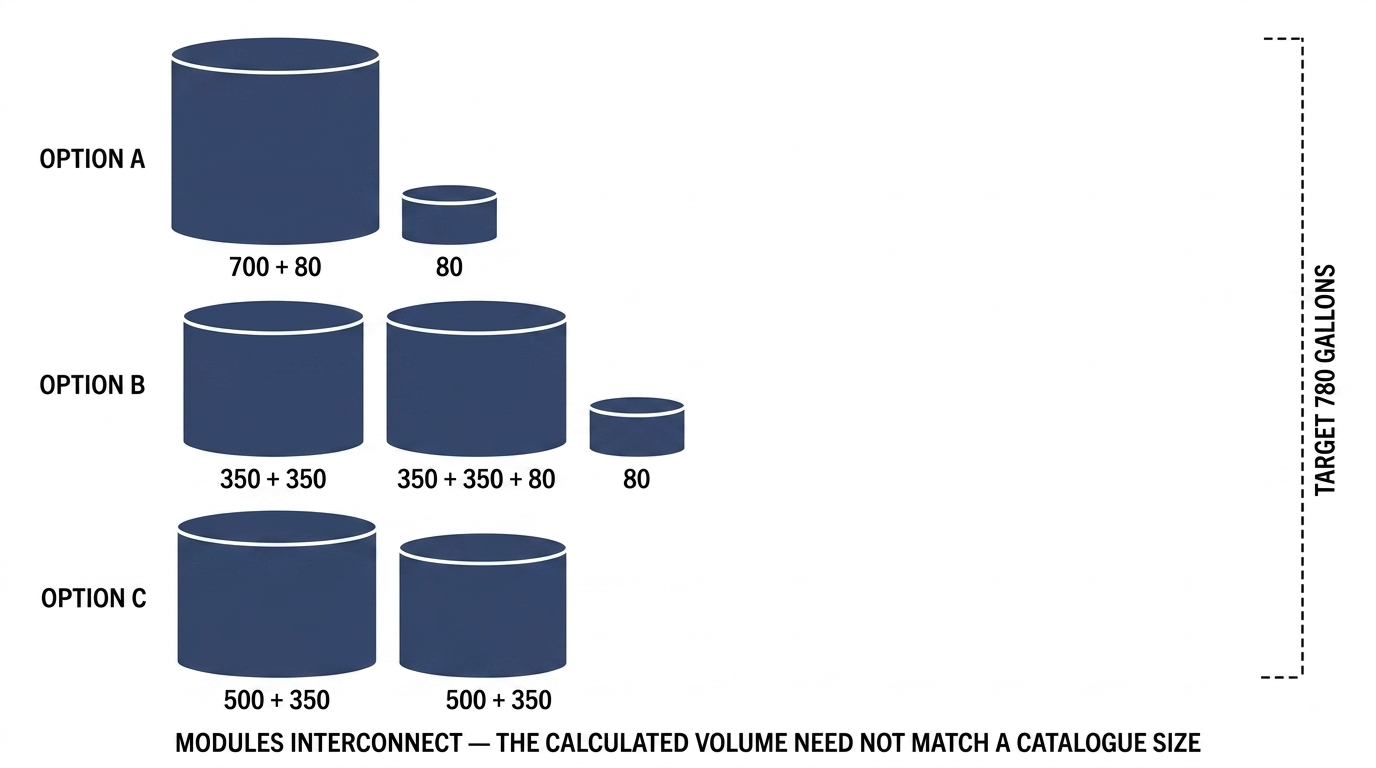
Turning the number into modules
A calculated volume becomes a specification when it is met by real vessels that fit the room, the floor, and the delivery path.
Pricing and specifications are current as of August 2026; verify against the live thermal tank comparison and specifications before use in a submittal. Vessel prices are not installed system prices.
Three practical notes get from a number to an order:
For a first-pass estimate before working the arithmetic by hand, use the thermal storage tank sizing calculator. For packaged assemblies that arrive coordinated rather than field-built, see the All-In-One thermal energy system. Payback structure is in the thermal energy storage ROI calculator.
Thermal tank comparison
Model capacityList price$/kWh storedStorage capacityFilled weightFloor loadingStanding loss
80 gallon$1,190$9712.0 kWh1,266 lb~100 lb/sq ft7–8°F / 24 hr
350 gallon$3,427$6354.6 kWh3,089 lb157.4 lb/sq ft3.8°F / 24 hr
500 gallon$4,464$5877.0 kWh4,351 lb221.7 lb/sq ft3.0°F / 24 hr
700 gallon$5,798$54108.0 kWh6,046 lb308 lb/sq ft2.4°F / 24 hr
Frequently Asked Questions
How do you calculate thermal storage tank size for peak hot water demand?
In four steps. Define the peak block by its duration and its share of the daily load. Compute the block energy as gallons times 8.33 times the temperature rise from design-day inlet to delivery. Subtract what the heat source produces during the block, using derated output at design conditions. Then convert the remaining deficit to gallons by dividing by 8.33 times the difference between storage and inlet temperature, dividing again by the usable fraction the tank actually achieves, and correcting for standing loss over the actual hold period.
Why is usable tank capacity less than nameplate volume?
Because three reductions sit between them. Only the energy between storage setpoint and delivery temperature is available. The thermocline occupies real volume that is neither hot enough to deliver nor cold enough to ignore, so a stratified tank typically reaches around 80 percent of its volume and a mixed tank less. And standing loss removes energy between charging and drawing, consuming the usable temperature band rather than a percentage of volume.
How much energy does one gallon of hot water storage hold?
It depends on the temperature difference. Usable energy per stored gallon is 8.33 pounds per gallon times the difference between storage temperature and incoming water temperature. At 150 degrees Fahrenheit storage and 50 degrees inlet, that is about 833 Btu per gallon. Because stored water is blended with cold water at the mixing valve, one stored gallon at 150 degrees produces roughly 1.43 gallons of service hot water delivered at 120 degrees.
Should storage cover the entire peak demand period?
No, and assuming it must is the most common cause of oversizing. The heat source continues producing during the peak, so storage only has to cover the deficit between block energy and what the plant delivers across the block. The Ecotope method underlying the Ecosizer accounts for hot water produced during the peak demand period, which is why it permits systems to be sized smaller than the classic approach.
What is a peak block in hot water sizing?
The window of highest sustained draw that storage must carry, defined by a duration and a share of the daily load. It matters far more than daily volume: two buildings consuming identical gallons per day need very different tanks if one concentrates its draw into three hours and the other spreads it across sixteen. The most reliable way to establish it is to meter hot water flow at the plant at fifteen-minute resolution across at least one winter week.
What inlet water temperature should be used for sizing?
The design-day figure, meaning the coldest entering city water of the year, not an annual average. Cold inlet water is simultaneously when each delivered gallon requires the most energy and, for air-source plants, when the heat source produces the least. Sizing on an average inlet temperature produces a plant that performs acceptably most of the year and falls short in late winter.
Does the recirculation loop need to be included in storage sizing?
Yes. A central system with a recirculation loop carries a continuous additional load the plant must serve on top of fixture demand. EPA guidance puts central distribution losses at 30 to 50 percent of delivered energy. On existing buildings DOE recommends measuring loop losses with a flow meter and temperature sensors rather than estimating, because that range is wide enough to change plant size by roughly a third.
How much safety factor should be added to a storage calculation?
Rather than padding the final number, put the uncertainty where it originates. Load growth assumptions belong in the peak block step where they can be revisited. Equipment derate uncertainty belongs in the recovery step where it can be checked against performance data. Tank performance uncertainty is best resolved by asking the manufacturer for the usable fraction and the standing loss test conditions. Where storage is modular, adding capacity later is comparatively inexpensive, which argues for sizing to the calculation and phasing rather than padding heavily.
Conclusion
The gap between a tank’s nameplate volume and the hot water a building receives is not a rounding error. It is the usable temperature band, the fraction a real thermocline makes available, and whatever standing loss removes across the hold — and those three compound.
Work the four steps in order: define the block, compute its energy at design-day inlet, credit the recovery that happens during it, then convert the deficit through the derates. Skip the recovery credit and the project is oversized and may not survive its own capital number. Skip the derates and the building runs out of hot water on a February morning.
Then hand the inputs to an engineer of record, who owns the number that goes on the drawing.