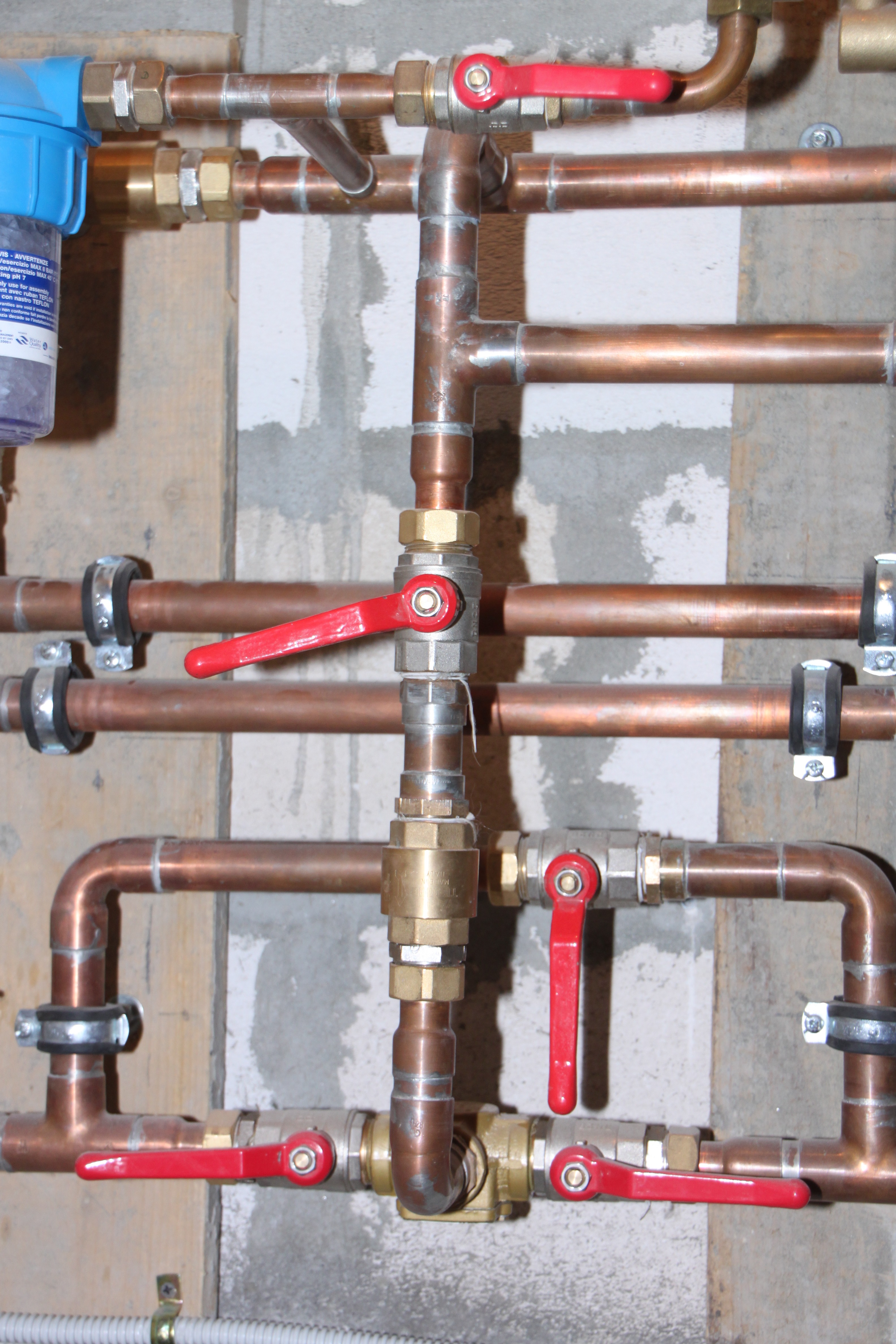
When a hot water system needs multiple storage tanks, the piping arrangement determines how much of the purchased volume the building can use. For reverse cycle chillers serving multifamily buildings, the Ecotope design guidelines recommend series storage: the bank behaves like one tall stratified tank, keeping the coldest water at the heat pump inlet and the hottest water at the building outlet. Parallel piping can reduce pressure drop and provide redundancy, but it delivers its rated capacity only when flow is balanced.
Doorways, floor loading, lead time and the economics of standard sizes push many commercial systems toward several smaller tanks rather than one large tank. Two tanks in parallel behave like one wide tank only if flow through them is equal; unequal flow lets one tank deplete while another still holds hot water.
Tank piping and recirculation return are separate decisions. The published configurations below establish the design context for a central heat pump water heater serving multifamily buildings, including the recirculation arrangements named by the Washington energy code.
Key Takeaways
In this article
What stratification does and why piping controls it
Hot water is less dense than cold water. In a tank with a cold inlet at the bottom and a hot outlet at the top, the water separates into layers with a transition zone—the thermocline—between them. A stratified tank delivers water at nearly its stored temperature until the thermocline reaches the outlet, then delivery temperature collapses. A mixed tank delivers a steadily falling temperature from the first gallon.
The Energy Trust of Oregon new buildings design guide for central heat pump water heaters describes stratification as critical for single-pass units: the bottom of storage should stay cool while heated water enters the top, and the heat pump cycles on when a sensor part way up the tank cools.
The Energy Trust guide puts that aquastat fraction at 30 percent in its Ecosizer default. The NEEA Advanced Water Heating Specification v8.0, also hosted through the DOE Building America Solution Center listing, uses 40 percent as its default, meaning the heat pump starts when 40 percent of primary storage has been used.
Piping controls stratification in two ways. Inside a tank, inlet and outlet positions and inlet velocity determine how much mixing the entering water causes. Across a bank, series or parallel piping determines whether the thermocline is one surface moving through the whole bank or several surfaces moving through separate tanks at different rates.
Series piping: one tall tank
In a series arrangement, cold make-up enters the bottom of the first tank. Water flows from the top of the first tank to the bottom of the second, and so on, with the building drawing from the top of the last tank. The heat pump draws from the bottom of the first tank and returns hot water to the top of the last.
The Ecotope design guidelines for reverse cycle chillers, prepared for Seattle City Light and published by the Bonneville Power Administration in December 2015, recommend this arrangement for reverse cycle chillers serving multifamily buildings. The guide states that the design should be based around multiple storage tanks plumbed in series, providing high stratification with the hottest water at the end of the storage system feeding the apartments. It also notes that smaller, cheaper tanks are easier to install.
The same guide sets out the staging sequence. Each tank carries a temperature sensor. The first heat pump starts when the second tank drops below setpoint and runs until the first tank reaches setpoint; the second heat pump follows the same pattern with the third and second tanks, and so on. The bank is read as a column, and the sensors report how far the thermocline has moved.
The series arrangement has the following consequences.
Parallel piping: one wide tank, if balanced
In a parallel arrangement, a common cold header feeds the bottom of every tank and a common hot header collects from the top of every tank. Each tank sees a fraction of the total flow. If the fractions are equal, the bank behaves as one tank with the combined volume, and each tank stratifies on its own.
If flow is unequal, the tank with the shortest, least restrictive path takes more than its share. It depletes first, its thermocline reaches its outlet first, and cold water reaches the hot header while other tanks still hold hot water the building cannot get to.
Equal flow is a piping problem. Reverse-return layout makes the first tank supplied the last tank returned so that every flow path has the same length and fittings. Balancing valves on each tank are set during commissioning and checked afterward.
Both measures add cost and require on-site verification. The Ecotope guide recommends on-site quality assurance to confirm that piping was installed as drawn and notes that the more efficient piping options are often the more complex ones.
Worked example: usable capacity in a four-module bank
The example uses four 700-gallon modules: 2,800 gallons installed, heat pump supply at 140 F, delivery through a mixing valve at 120 F, and cold make-up at 50 F.
The draw-down fractions are assumptions chosen to illustrate the mechanism, not test results. A stratified series bank typically retains most of its volume at delivery temperature until the thermocline reaches the outlet; an unbalanced parallel bank does not. Replace the assumed fractions with measured values from a decay or draw-down test on the installed system.
Recirculation return: the third decision
A multifamily or commercial building with a recirculation loop must place the warm return water somewhere, and that choice interacts with the tank arrangement. The NEEA Advanced Water Heating Specification v8.0 publishes the recognized configurations listed below. Recirculation strategy is covered separately in domestic hot water recirculation vs thermal storage.
The Energy Trust guide describes a swing tank as an unstratified tank in series with primary storage. Hot water flows from primary storage through the swing tank to the fixtures, so primary water mixes into it and keeps it warm. A resistance element runs only if the swing tank drops too far.
A parallel loop tank has its own multi-pass heat pump reheating loop losses. The Energy Trust guide describes this as allowing a lower primary storage temperature at the cost of more storage volume and a second heat pump.
Return to primary routes recirculation return to the bottom of the primary tank near the heat pump feed. The Energy Trust guide describes this as appropriate where the equipment can heat warm return water efficiently and loop losses are low.
For reverse cycle chiller systems serving multifamily buildings, the Ecotope guide warns that high flows of relatively warm water at 105 to 115 F returning to storage can reduce heat pump efficiency and cause high-pressure faults on single-pass equipment. Storage and circulation must be managed to avoid high-temperature water entering the heat pumps directly. The guide's remedy is a dedicated circulation-loop heat pump that keeps the loop separate from primary storage.
The Energy Trust and Ecotope guides share a new-construction sizing assumption of 100 W of loop loss per apartment with a 1.75 safety factor. The Ecotope pilots measured 55 to 75 W per apartment, which was 30 to 45 percent of heat pump output at those sites.
Section C404.2.1.3 of the Washington State Energy Code requires a heat pump service water heating system to follow one of three configurations: decoupled temperature maintenance for single-pass units, return-to-storage for multi-pass units, or a unitary configuration in conditioned space sized to meet all demand with the compressor alone, with a thermostatic mixing valve sized from recirculation minimum flow to maximum fixture demand.
The code applies to permitted work in Washington. The configurations it names are the same ones the NEEA and Energy Trust documents describe for use in any jurisdiction; that does not make the Washington requirement applicable elsewhere.
Single-pass and multi-pass want different banks
The two heat pump types push the tank arrangement in different directions. The Energy Trust guide puts the single-pass lift at 70 to 100 F in one pass and the multi-pass lift at about 10 F per pass. The NEEA glossary describes multi-pass units as staying efficient when incoming water is near 120 F.
Selection between the two, and the storage temperature that follows, is covered in single-pass vs multi-pass heat pump water heaters and 140 F storage with a heat pump. Decide the tank arrangement after that selection, not before.
Modular banks and the heat exchanger
A bank assembled from modular atmospheric tanks changes the pressure-drop side of the argument without changing the stratification side. TEHQ's Thermal Tank modules are atmospheric unpressurized tanks, 60 inches in diameter in 350-, 500- and 700-gallon heights, that connect to the pressurized potable system through a heat exchanger. The stored water is not the delivered water.
The building side of the exchanger sees one pressurized pass. The storage side is a pumped charging and discharge loop whose piping can run the modules in series as a single column, with the exchanger drawing from the hottest module and returning to the coldest. There is no pressurized-tank pressure drop to sum.
The remaining design decisions are the same as for any bank: where the loop draws, where it returns, whether modules are piped as one string or balanced parallel strings, and where the recirculation return goes.
The TEHQ specification sheet and exchanger documentation are available in the documentation library. The retrofit case for assembling storage inside an existing mechanical room is covered in thermal storage for existing buildings.
Checks before the drawing is issued
Frequently Asked Questions
Should hot water storage tanks be piped in series or parallel?
For reverse cycle chillers serving multifamily buildings with stratified primary storage, the Ecotope design guidelines published by BPA recommend multiple tanks plumbed in series, with heat pumps in parallel staged lead-lag. Parallel tank piping is used where connection sizes limit flow, where a tank must be isolated for redundancy, where the volume is buffer duty, or where pressure drop is constrained. It needs reverse-return layout and balancing to deliver its rated capacity.
Why does series piping preserve stratification?
The bank becomes one column. Cold water enters the bottom of the first tank and hot water leaves the top of the last, so the thermocline moves through the tanks one at a time and the outlet tank stays at storage temperature until nearly the whole bank is depleted.
What goes wrong with parallel tanks?
Unequal flow. The tank with the least restrictive path depletes first and feeds cold water into the hot header while the others still hold hot water. In the worked example, an unbalanced parallel bank of four 700-gallon modules delivered about 2,340 gallons of 120 F water against about 3,060 gallons from the same tanks in series, at assumed draw-down fractions of 0.65 and 0.85. These are illustrative assumptions, not test results.
Where should the recirculation return connect?
The NEEA and Energy Trust documents describe three configurations: primary storage, routed to the bottom of the tank near the heat pump feed; a swing tank in series with a resistance element; or a parallel loop tank reheated by a multi-pass heat pump. The Energy Trust guide describes return to primary as appropriate where equipment can heat warm return water efficiently and loop losses are low. The Ecotope guide warns against sending 105 to 115 F return water directly to a single-pass heat pump.
How are heat pumps staged across a series bank?
With a temperature sensor in each tank. In the Ecotope sequence for reverse cycle chillers serving multifamily buildings, the first heat pump starts when the second tank drops below setpoint and runs until the first tank reaches setpoint; the second heat pump follows the same pattern with the third and second tanks.
Does series piping raise pressure drop?
On pressurized potable tanks, yes; the drops add. On atmospheric modules coupled through a heat exchanger, the storage loop is pumped separately and the potable side sees one pass through the exchanger, so the series arrangement on the storage side does not add potable-side pressure drop.
What does the Washington energy code require?
Section C404.2.1.3 requires one of three configurations for heat pump service water heating in permitted work in Washington: decoupled temperature maintenance for single-pass units, return-to-storage for multi-pass units, or a unitary configuration in conditioned space sized to meet all demand with the compressor alone, with a thermostatic mixing valve sized from recirculation minimum flow to maximum fixture demand.
The bottom line
Series piping makes a bank of storage tanks behave like one tall tank. It keeps cold water at the heat pump inlet, hot water at the outlet, and the thermocline moving through one column that sensors can read and heat pumps can stage from. This is the arrangement recommended by the Ecotope guide for reverse cycle chillers serving multifamily buildings.
Parallel piping has specific uses, and the reason for selecting it should be written on the drawing. Without reverse-return and balancing, usable capacity can fall below installed capacity; in the worked example, the assumed unbalanced bank delivers about one module less than the assumed series bank.
Decide the heat pump type, apply the storage arrangement appropriate to that system, choose the recirculation configuration from the published set, and commission the result against measured flow and temperature rather than the drawing alone.