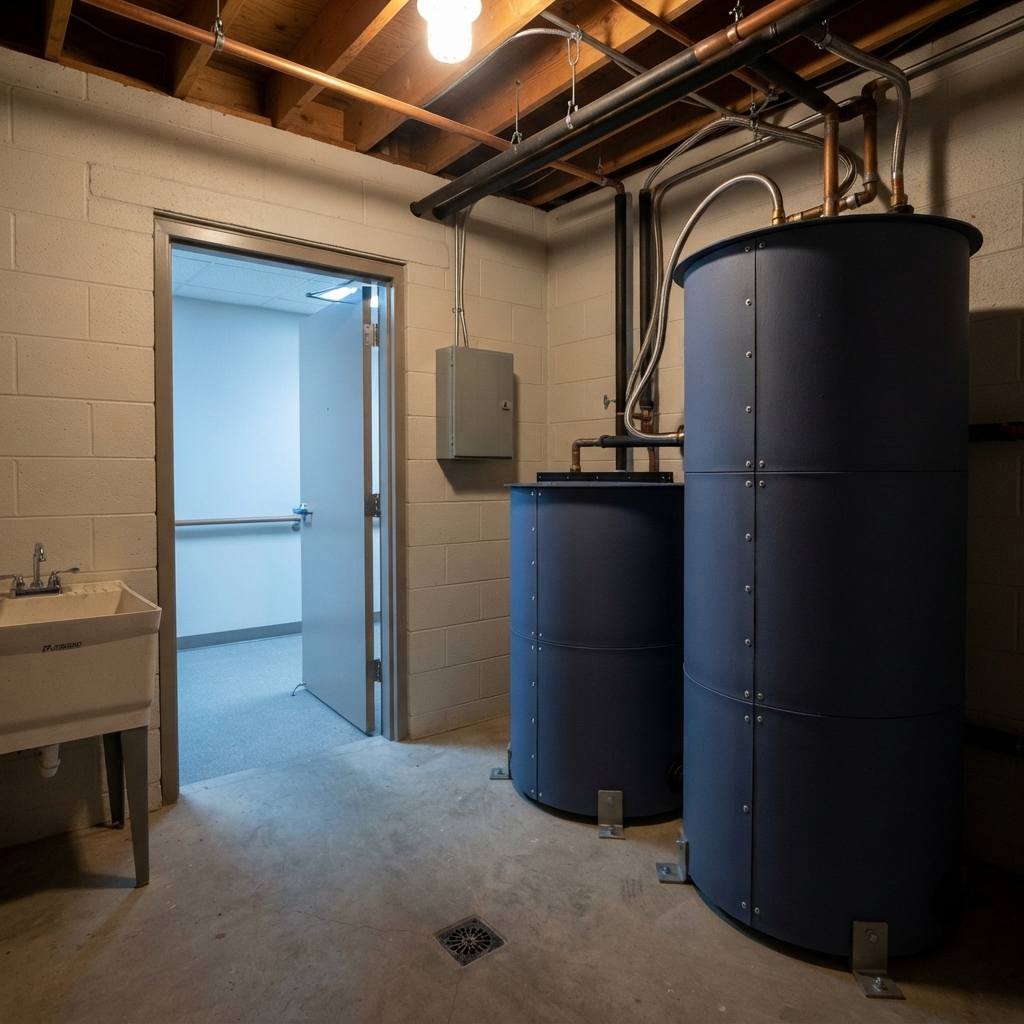
A senior living hot water plant has to hold water hot enough to suppress Legionella and deliver it cool enough that a resident with thin skin and slow reaction time cannot be burned.
Thermostatic devices reconcile those requirements at the fixture. At the plant, a heat pump making 140°F water works against a much larger lift than its rating condition, while the morning bathing peak lands inside a three-hour window that a right-sized heat pump array cannot cover alone.
Stored thermal capacity separates production from demand. This article shows the sizing math, quantifies heat pump output at a 140°F setpoint, and states what thermal storage cannot do for a water management program.
Key Takeaways
A senior living hot water plant must satisfy two temperatures that pull the system in opposite directions. The storage temperature supports Legionella control, while the fixture temperature limits scald risk. The design must also cover a concentrated morning bathing peak without sizing the heat pump array for its least efficient operating point.
This article does not argue that storage substitutes for a water management program, and it makes no claim about federal tax credit eligibility.
In this article
Every senior living hot water plant carries two temperatures that fight each other
Legionella control and scald control pull the same system in opposite directions. CDC potable water systems guidance calls for storing hot water above 140°F (60°C) and keeping circulated water at or above 120°F (49°C), because Legionella grows best between 77°F and 113°F. The CDC control table provides the supporting temperature guidance.
Exposure time makes this a senior living problem rather than a general plumbing problem. Scald data used by ASSE plumbing standards puts serious burn injury at roughly five minutes of contact at 120°F, thirty seconds at 130°F, and a few seconds at 140°F. Older residents burn faster because skin is thinner, and they move out of the water more slowly.
The regulatory driver differs across a campus. CMS memorandum QSO-17-30, revised July 2018, directs surveyors to verify that hospitals, critical access hospitals, and long-term care facilities have completed a water risk assessment and implemented a water management program considering ASHRAE Standard 188 and the CDC toolkit, with temperature management named as a control measure. The authority for skilled nursing is 42 CFR 483.80. CMS reported that 19 percent of United States Legionnaires' disease outbreaks between 2000 and 2014 were associated with long-term care facilities.
Most assisted living and memory care is state-licensed rather than Medicare certified, so the pressure there is state licensing, owner liability, and the standards the design team cites. ANSI/ASHRAE Standard 514-2023 requires ASHRAE 188 compliance and extends the same framework to physical hazards, including scalding.
A stratified store holds 140°F while the building sees 110°F
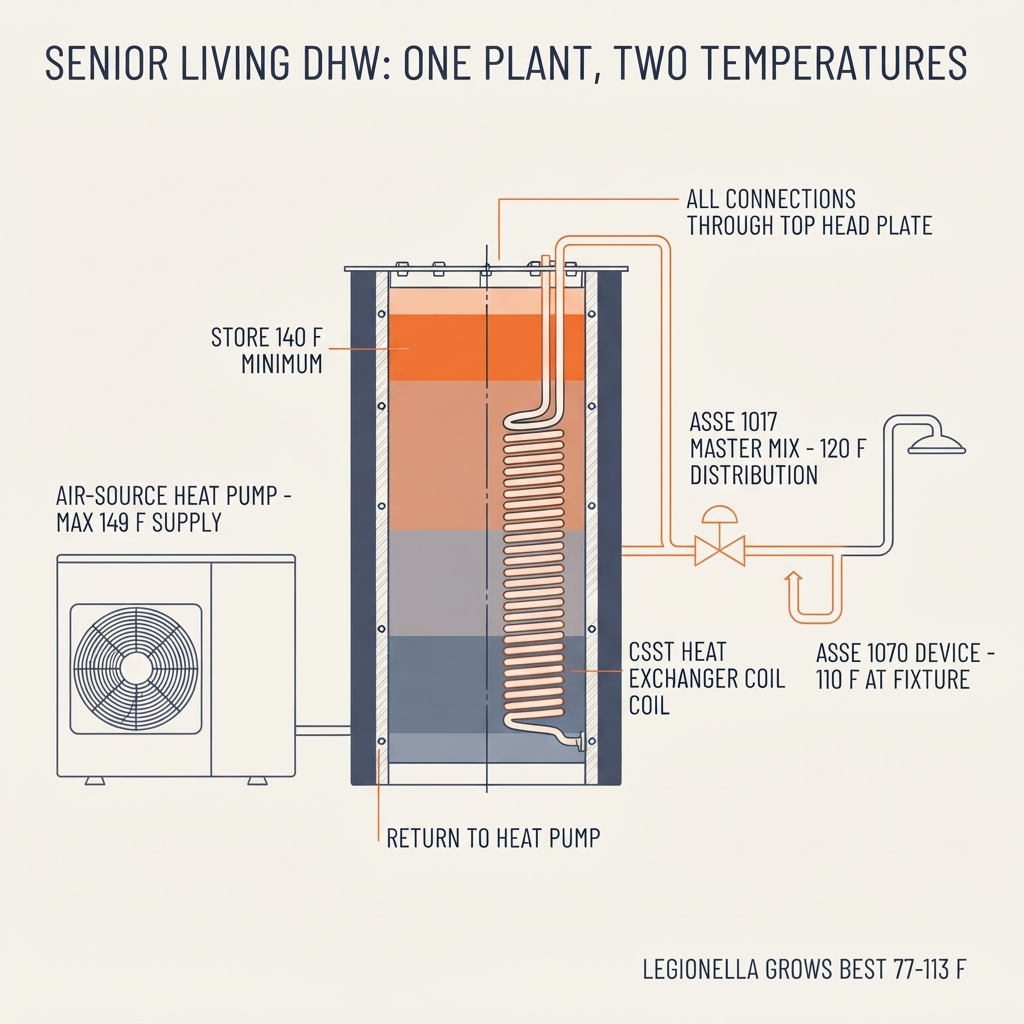
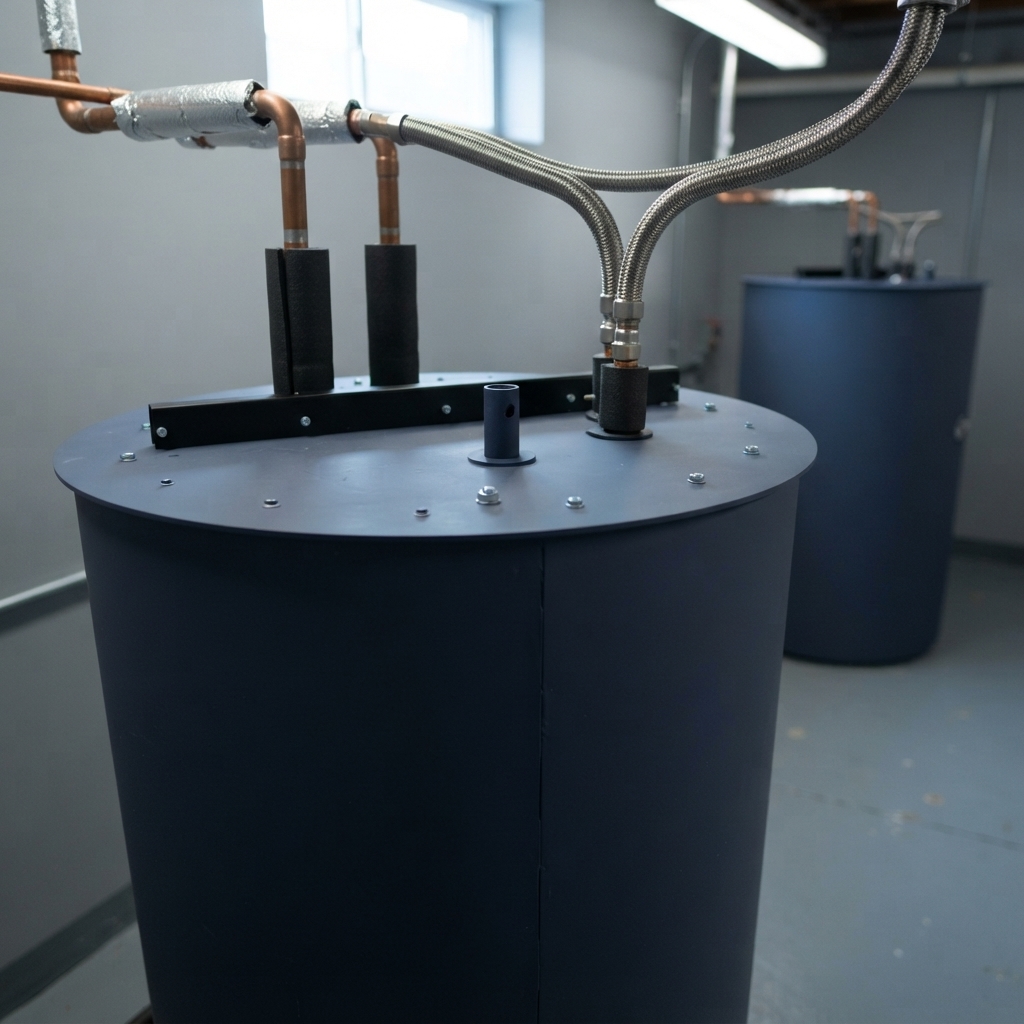
A thermal store separates the temperature the plant produces from the temperature the building consumes. In the Thermal Energy HQ architecture, the stored volume is a closed hydronic charge inside a modular panelized vessel. Heat moves in and out through 32 mm DN corrugated stainless steel tubing (CSST) heat exchangers in a dual-coil loop of 40 to 80 m. All connections enter and leave through the top head plate. No piping penetrates a side panel.
Taking smooth-bore volume as an upper bound, a 40 to 80 m coil of 32 mm tubing holds roughly 8.5 to 17 gallons. A dual-coil module therefore carries on the order of 17 to 34 gallons of potable holdup against 700 gallons of stored non-potable charge. An indirect store holds the heat and moves potable water through a small, high-turnover path instead of storing it. Confirm coil count, duty assignment, and internal volume with Thermal Energy HQ engineering before using this as a design input.
Stratification preserves delivery temperature during a draw. The coldest water at the bottom is drawn as heat pump input, and hot output is introduced at the top. The upper zone holds delivery temperature while the lower zone depletes, so a stratified vessel gives up less usable capacity than a mixed tank of the same volume.
An immersive electrode element rated 10 kW per tank performs the final lift to setpoint and any thermal disinfection cycle. SCADA control over a Modbus register interface schedules charging against time-of-use windows.
Downstream, an ASSE 1017 master mixing valve sets distribution temperature and ASSE 1070 devices cap delivery at resident fixtures. Those classes are not interchangeable. An ASSE 1017 valve can be adjusted above 120°F and is not a scald protection device on its own.
A storage tank does not satisfy a water management program
A tank does not make a building compliant. CMS and ASHRAE 188 require a documented program with a risk assessment, control measures, monitoring locations, control limits, and corrective action. Stored capacity helps hold one control limit at one point. The CDC water management program toolkit provides the build guide for the rest.
Much of the exposure risk sits downstream. CDC recommends flushing low-flow runs and dead legs at least weekly and cleaning mixing valves, aerators, showerheads, hoses, and filters on a schedule. A community holding rooms vacant between residents carries more low-use fixtures at a given occupancy than a hotel does, and no storage strategy reaches them.
Thermal storage has four standing limits in every building. It cannot export power. It cannot back up non-thermal loads such as lighting, elevators, nurse call, or medical equipment. It is a daily-cycle asset rather than a multi-day one. It addresses only the thermal share of the load.
A fifth limit applies specifically here. Published full-speed COP for the Chiltrix CX65X is measured at 95°F leaving water and 47°F ambient, and maximum supply temperature is 149°F. A 140°F setpoint sits close to that ceiling and far from the rating condition.
Usable storage capacity is not the nameplate kWh

Nameplate capacity is rated across a 35°C (63°F) delta. Domestic hot water never gets that delta because delivery temperature has a floor. Once the store falls far enough that the coil cannot deliver the loop minimum, the heat left in the tank is not available to the building. Sizing on nameplate kWh undersizes a senior living plant.
Every figure below depends on the following design basis.
Step 1 - Energy in the peak-window draw
Q = V x d x c x dT
Q = 1,800 gal x 8.34 lb/gal x 1 Btu/lb-F x (110°F - 55°F) = 825,660 Btu = 242.0 kWh thermal
Step 2 - Heat pump output inside the window, and the deficit
Q_ashp = 3 units x 45,000 Btu/hr x 3 hr = 405,000 Btu = 118.7 kWh thermal
Deficit = 825,660 - 405,000 = 420,660 Btu = 123.3 kWh thermal
Step 3 - Usable capacity per 700-gallon module in DHW duty
Q_mod = 700 gal x 8.34 lb/gal x 1 Btu/lb-F x 20°F = 116,760 Btu = 34.2 kWh thermal usable
Nameplate at the rated 63°F delta = 108.0 kWh thermal
Usable in this duty = 32% of nameplate
Step 4 - Module count
n = 420,660 / 116,760 = 3.60 modules -> specify 4, rounded up
Array usable = 467,040 Btu = 136.9 kWh thermal, an 11% margin
Step 5 - Thermal energy is not electrical energy
E_elec = Q_thermal / COP = 123.3 / 2.2 = 56.0 kWh electrical shifted out of the morning window.
Using the datasheet COP of 4.84 would give 25.5 kWh electrical and understate the electrical load by a factor of 2.2.
The storage sensitivities change the design
Two sensitivities change the answer. A 700-gallon module loses 2.4°F per 24 hours, which is 4.1 kWh thermal per module per day, or 16.4 kWh thermal across four modules. That is about 12 percent of the array's usable capacity because a narrow usable band makes standing loss proportionally larger.
The 80-gallon module loses 7 to 8°F per 24 hours and is wrong for a 24-hour duty.
Thermal disinfection also changes the energy balance. A cycle above the heat pump's 149°F ceiling falls to the immersive element at a COP of 1.0. Raising a four-module array 20°F takes 136.9 kWh thermal, delivered for 136.9 kWh electrical against 62.2 kWh electrical by heat pump. The incremental cost is 74.7 kWh electrical per cycle and roughly 3,884 kWh electrical per year on a weekly schedule.
Load characterization matters more than any of these figures. Characterize heat loss and gain from fuel bills using the ASHRAE Base 68°F method, and take the draw profile from the community's own metering. Work the volumes through the thermal storage tank sizing calculator and check buffer volume separately using the heat pump buffer tank sizing method.
The value lands in demand charges, avoided capacity, and continuity
Each value channel below carries either a source or a project figure.
The grid-side and central-system case
The grid-side case for this load class is in the Department of Energy's grid-interactive efficient buildings technical report series, and the central-system equipment path is in the Pacific Northwest National Laboratory central heat pump water heater resource guide.
Payback for a specific building is worked in the thermal energy storage ROI calculator.
The rules moved, and three of them need a publish-day check
Four dated items govern this specification as of September 2026. CMS memorandum QSO-17-30, revised 6 July 2018, remains the operative Legionella guidance for hospitals, critical access hospitals, and long-term care facilities. The original June 2017 version is marked expired on the CMS site, so cite the revised memo.
ANSI/ASHRAE Standard 514-2023 became an ANSI standard in July 2023 and adds physical hazards, including scalding. Adoption varies, and adoption status must be verified with the authority having jurisdiction.
Section 179D is terminated for construction beginning after 30 June 2026. On Section 48E, this article makes no eligibility claim. The regulatory definition of thermal energy storage property may not extend to tanks serving only domestic hot water, which is the configuration described here. That question belongs with tax counsel.
State anti-scald maximums and licensing rules set the delivery ceiling and vary by jurisdiction. Benchmarking sits in the EIA lodging category, where nursing home and assisted living buildings account for 30 percent of lodging energy use and water heating accounts for about 20 percent of lodging end-use energy, per EIA 2018 CBECS lodging data.
Eight checks before you specify a senior living hot water plant
The design team should resolve the operating condition, usable capacity, controls, physical installation, and water management interfaces before commissioning.
Retrofit and packaged-system paths
Retrofit sequencing for constrained plant rooms is covered in designing thermal storage for existing buildings. The packaged replacement path is on the all-in-one system page.
Frequently Asked Questions
What temperature should hot water be stored at in an assisted living facility?
CDC potable water guidance calls for storing hot water above 140°F and keeping circulated hot water at or above 120°F. Delivery temperature at the fixture is a separate question, handled downstream by thermostatic devices. Confirm the setpoint against state licensing rules and the facility water management program before commissioning.
Why not set the water heater to 120°F and avoid scald risk entirely?
A 120°F storage setpoint sits inside the range where Legionella grows best, which CDC puts at 77°F to 113°F. Scald control belongs at the fixture, where an ASSE 1070 device caps delivery. Lowering the plant trades a burn risk for an infection risk in a population already at elevated risk.
How much hot water storage does a senior living community need?
Size storage on the deficit between peak-window demand and heat pump output at the actual leaving-water temperature, not on nameplate kWh. The worked example here covers a three-hour draw of 1,800 gallons and arrives at four 700-gallon modules.
Does a thermal storage tank satisfy the CMS Legionella requirement?
No. CMS QSO-17-30 requires a documented water management program with a risk assessment, control measures, monitoring, control limits, and corrective actions. Temperature management is one control measure inside that program. Storage does not address dead legs, low-use fixtures, mixing valves, or showerheads.
Is a heat pump efficient enough at 140°F for a senior living hot water plant?
It is less efficient than its headline rating. Published full-speed COP for the specified Chiltrix CX65X is measured at 95°F leaving water and 47°F ambient, and maximum supply temperature is 149°F. At a 140°F setpoint, the machine works against a much larger lift. Pull the performance map at the design condition.
Can thermal storage keep hot water running during a power outage?
Only while stored heat lasts, and only if pumps and controls have power. A 700-gallon module loses about 2.4°F per 24 hours, so the heat survives an outage but circulation does not. Thermal storage cannot export power and cannot back up non-thermal loads.
The number that decides this
The decision comes down to usable storage capacity at the delivery temperature the building actually needs, not the capacity printed on a datasheet.
A 700-gallon module rated at 108.0 kWh thermal across a 63°F delta delivers 34.2 kWh thermal across the 20°F swing a recirculated domestic hot water loop will tolerate. That is 32 percent of nameplate capacity.
Size on that usable number, buy heat pump capacity at its efficient operating point rather than at the peak, and let stored volume carry the morning bathing window.
The temperature conflict between Legionella control and scald protection then becomes a plant design question with a known answer. The water management program still has to be written, monitored, and documented by the people who run the building.