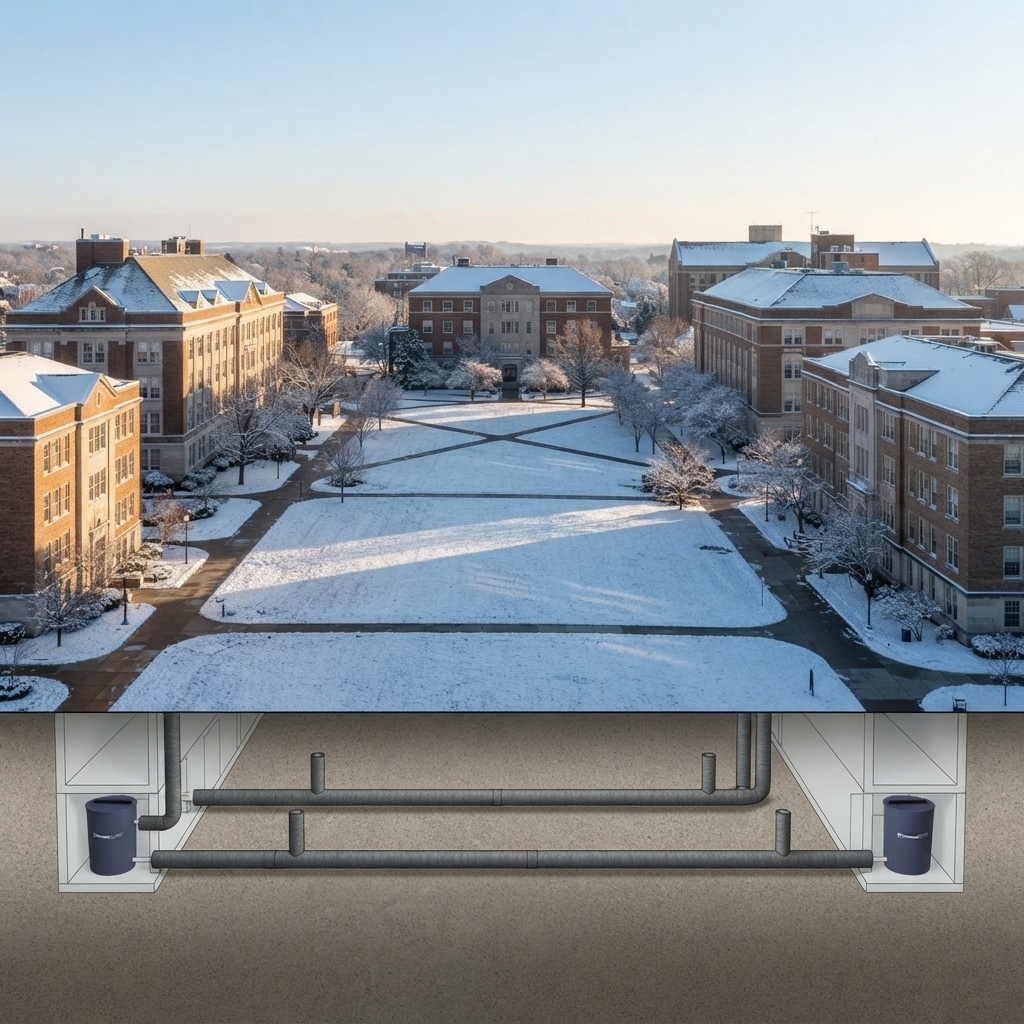
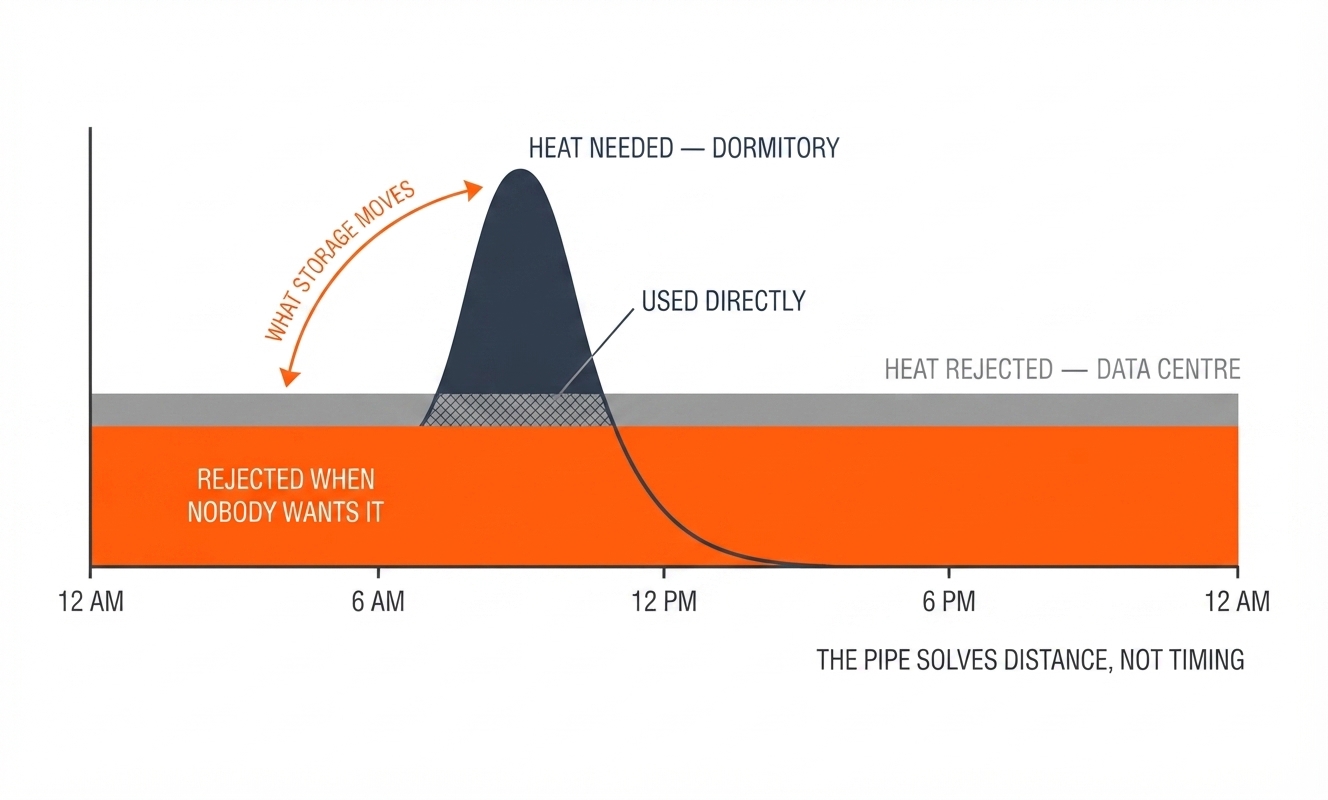
A campus data centre rejects heat all year. Two hundred yards away, a dormitory pays to make it. A thermal energy network connects them, and the second building heats itself with the first building’s waste. That is the promise, and it is a good one. The catch is that the data centre rejects heat continuously while the dormitory wants it at six in the morning — and a pipe between two buildings does not fix a difference in timing.
In short: A thermal energy network is shared piping that lets multiple buildings exchange heating and cooling rather than each running its own plant. The Department of Energy describes networked geothermal as district-scale heating and cooling using shared infrastructure among many buildings, drawing on the ground, bodies of water, wastewater, or excess heat from other buildings in the network. The economics depend on diversity — one building rejecting heat while another needs it — which means they depend on coincidence in time.
Building-level thermal storage is what makes that coincidence optional: a tank holds heat that arrived at the wrong hour until the building wants it, buffers the building’s heat pumps, and separates network behaviour from building behaviour so neither has to chase the other.
Key Takeaways
What a thermal energy network actually is
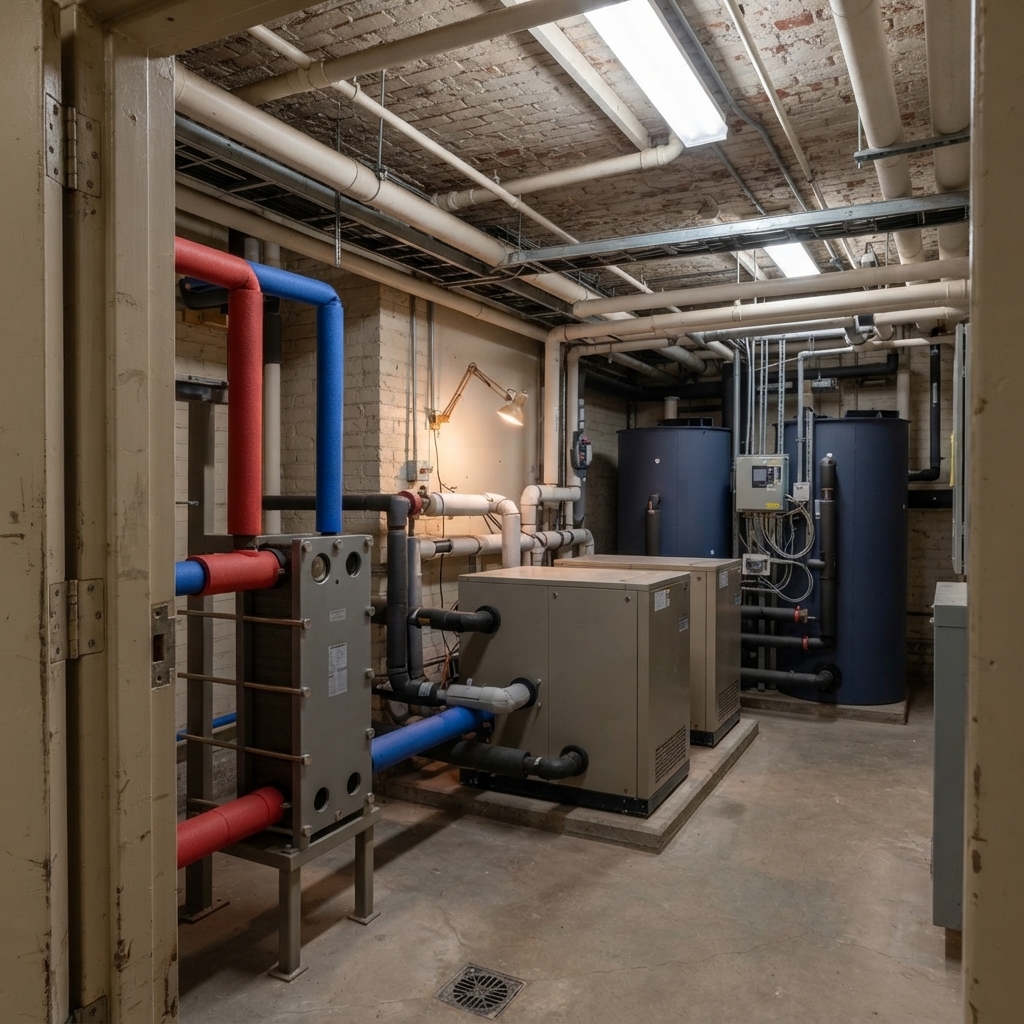
A thermal energy network — often called a TEN, and when the ground is the primary source, networked geothermal — is shared piping that circulates water between buildings so they can exchange thermal energy instead of each generating it alone.
The U.S. Department of Energy’s Office of Geothermal describes networked geothermal as a community- or district-scale heating and cooling solution using shared infrastructure among many buildings, serving entire neighbourhoods, city blocks, campuses, and communities. Rather than supporting one building at a time, these systems provide heating and cooling to multiple buildings together.
Three things distinguish a modern TEN from the steam district heating a campus may already have:
The constraint that governs network economics: coincidence
Here is the part that determines whether a network delivers what its feasibility study promised.
A network creates value through diversity — the fact that at any moment some buildings are rejecting heat and others need it. A laboratory with high ventilation loads, a data centre, an ice rink, and a commercial kitchen all reject heat. Dormitories, classrooms, and offices need it. Connect them and the rejected heat becomes the supply.
But diversity is not a property of a campus. It is a property of a campus at a particular hour. And the mismatch runs in three directions at once:
Networks address seasonal mismatch with the ground itself — boreholes are a thermal battery on a months-long time constant, and DOE explicitly notes TENs can use shallow boreholes for heat storage. That works, but round-tripping heat through the earth costs pumping energy and heat pump lift, and the ground’s time constant is far too slow to help with the daily mismatch.
The argument of this article: The ground handles the seasonal mismatch. Building-level tanks handle the daily one.
A tank in a building’s mechanical room holds heat on a timescale of hours — exactly the gap between when the network can supply energy cheaply and when the building actually wants it. Without it, every daily mismatch becomes a round trip through the ground loop or a call on a supplementary source. With it, the building takes energy from the network when the network is favourable and uses it when the occupants say so.
This is the same load-shifting logic that applies to a single building against a utility tariff, applied instead to a shared loop against its own availability.
Five roles for storage inside a networked building
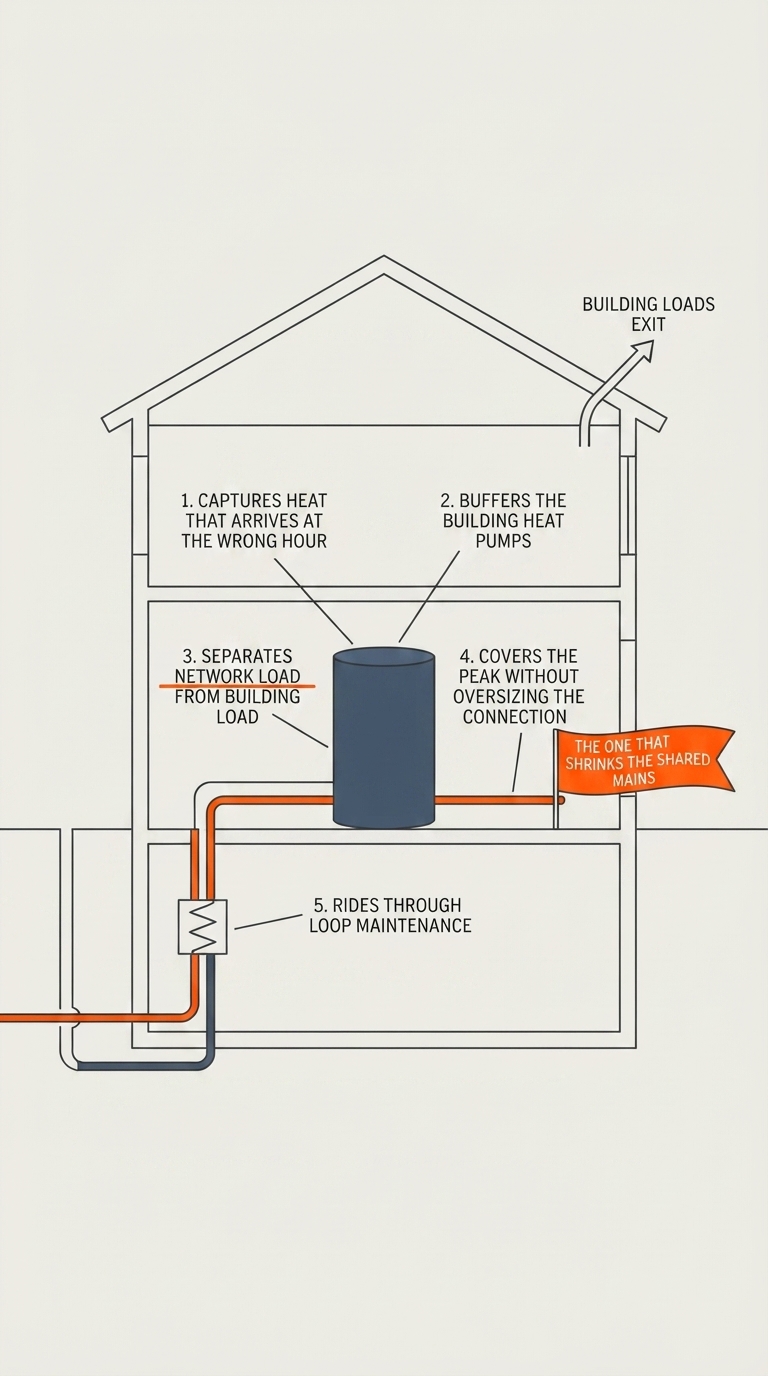
Role three is the one campus engineers tend to appreciate first and the one that matters most at scale. If every building on a network presents a sharp, uncoordinated peak, the mains and the central equipment must be sized for the sum of those peaks. If each building buffers itself, the network sees an aggregate that is flatter than the sum of its parts, and the shared infrastructure — the most expensive and least changeable part of the whole system — gets smaller.
That is a capital argument, not an operating one, and it lands during design rather than after commissioning. It is also the argument most often missed, because building-level storage is usually specified building by building, after the network has already been sized.
Five roles for building-level thermal storage in a network
RoleWhat the tank doesWhy it matters on a network
1. Capture heat that arrives at the wrong hourAbsorbs energy available from the loop during favourable periods and holds itTurns a daily mismatch into a scheduling choice instead of a loss
2. Buffer the building’s heat pumpsAdds volume so building-side heat pumps run long, steady cyclesShort cycling degrades seasonal efficiency regardless of how good the network is
3. Separate network load from building loadDecouples what the building draws from the loop from what occupants draw from the buildingThe network sees a smoother, more predictable profile from every connected building
4. Cover the building peak without oversizing the connectionMeets a morning draw from stored energy rather than from instantaneous network capacitySmaller heat exchangers, smaller building-side plant, and less peak load on shared mains
5. Ride through network eventsHolds usable energy while a section of loop is isolated for maintenance or repairA shared network means a shared failure mode; stored energy is local resilience
Why campuses specifically, and why now
Campuses are the natural first market for thermal energy networks for reasons that have nothing to do with technology.
New York is the centre of gravity
And the capital has arrived. In August 2026 SUNY reported that over the past three years New York State has invested $230 million building out thermal energy networks at SUNY campuses, with 23 campuses already using geothermal systems, most on a building-by-building basis. SUNY’s own framing is that thermal energy networks are more efficient than that building-by-building approach precisely because their piping ties together multiple buildings that can exchange heating and cooling.
The Oswego project is a useful picture of what this looks like in practice: a $30 million climate resiliency grant extending an existing geothermal installation into a network across four additional buildings, built on a first-of-its-kind project labor agreement with the Pipefitters. The initial Hewitt Hall system — 90 boreholes at 500 feet, 8.5 miles of drilling, 18.8 miles of piping — delivered a 48% reduction in that building’s site annual energy consumption.
The national picture
Nationally, DOE’s District-Scale Geothermal Energy Pilots initiative selected eleven community coalitions across ten states for planning, then three for installation: a utility-owned system in Framingham, Massachusetts, a retrofit of 1950s buildings in Ann Arbor, Michigan, and a project serving multiple buildings on Tribal lands in Oklahoma. Ball State University’s campus system — roughly 3,600 boreholes serving 47 buildings — remains the reference point for scale, with DOE citing $2 million in annual savings.
Design considerations for storage on a network
Storage in a networked building is not the same specification as storage in a standalone one. Five differences matter.
1. Two temperature regimes, not one
A networked building sits between an ambient-temperature loop and its own service temperatures. Storage may serve either side, and which side it sits on changes everything about the specification — low-temperature storage on the network side buffers the exchange, while high-temperature storage on the building side serves domestic hot water and heating. Decide which problem the tank is solving before selecting one. Storage temperature also governs usable capacity: the wider the band between storage and delivery, the more service water each stored gallon produces.
2. Controls must see both the building and the loop
A tank that charges on a simple schedule cannot respond to network conditions. To capture heat when the loop is favourable, the control sequence needs loop temperature as an input alongside tank state of charge — which means multi-height tank sensing and a controller with visibility on both sides. This is a specification item at order, not a commissioning adjustment.
3. The heat exchanger is the boundary and should be treated as one
Most networked buildings connect through a heat exchanger that isolates building water from loop water. Sizing it for peak instantaneous transfer is expensive; sizing it for average transfer and letting storage cover the peak is usually cheaper. That trade is only available if the storage is planned at the same time as the connection.
4. Building-side heat pump selection still governs plant performance
A networked building uses water-source heat pumps against a loop rather than air-source equipment against outdoor air, which is generally favourable — loop temperature is far more stable than winter air, so capacity holds on the design day. The tradeoffs, including the ancillary pumping energy that belongs in any honest efficiency comparison, are covered in the air-source versus water-source heat pump analysis.
5. The mechanical room has not got any bigger
Campus buildings joining a network are usually existing buildings, and their mechanical rooms were sized for the plant they had. Filled weight, floor loading, doorway clearance, and delivery path decide feasibility exactly as they do in any other retrofit — covered in Designing Thermal Storage for Existing Buildings Without Major Mechanical Room Expansion.
Where a welded vessel cannot reach the room, panelized modular tanks that assemble in place are the standard workaround. Volume methodology is in the thermal storage tank sizing calculator, and the specification details that determine whether a tank can actually be cycled daily are in What Is the Best Thermal Energy Tank? The 7 Specs That Actually Decide It.
How to read the table
*Rated at a 35°C temperature delta. Pricing current as of August 2026; verify against the live thermal tank comparison and specifications. Vessel prices, not installed system prices. Because modules interconnect, a calculated volume can be met by combination and expanded as a campus connects buildings in phases. For packaged assemblies that reduce on-site work, see the All-In-One thermal energy system. Full cost structure is in How Much Does Thermal Energy Storage Cost?.
Where a campus is also exposed to demand charges, storage earns a second return that is independent of the network — shifting building electrical load off expensive intervals. Those mechanics are in Peak Shaving vs Load Shifting.
A planning checklist for campus teams
Use these questions to test whether building-level storage is being treated as part of the network strategy rather than as an afterthought.
The timing of the storage decision
Question four is the one that changes outcomes. Storage specified after the network has been sized can only optimise a building. Storage specified before it can make the shared infrastructure smaller — and the shared infrastructure is the part nobody can economically revisit later. Examples of built projects are in the case studies, with specification sheets in the technical documentation library.
Frequently Asked Questions
What is a thermal energy network?
A thermal energy network, or TEN, is shared piping that circulates water between multiple buildings so they can exchange heating and cooling rather than each running a separate plant. The U.S. Department of Energy describes networked geothermal as a community or district-scale heating and cooling solution using shared infrastructure among many buildings, serving neighborhoods, city blocks, campuses, and communities. Networks typically circulate water at low or ambient temperature, and each building uses its own heat pumps to reach the temperatures it needs.
How do buildings share heat in a thermal energy network?
Through a shared loop that carries energy in both directions. A building rejecting heat, such as a data centre or a laboratory with high ventilation loads, puts energy into the loop; a building that needs heat takes energy out. Networks can also draw on the ground, bodies of water, wastewater systems, cooling tower rejection, and other waste sources, blending several at once.
Why does thermal storage matter in a thermal energy network?
Because sharing heat requires the rejection and the demand to happen at the same time, and they usually do not. A data centre rejects heat continuously while a dormitory wants it in the morning. Building-level storage holds energy taken from the loop when conditions are favourable until the building actually needs it, which converts a daily timing mismatch from a loss into a scheduling decision. It also buffers building heat pumps, smooths the profile each building presents to the network, and provides local energy during loop maintenance.
Can building-level storage reduce the cost of the network itself?
Yes, if it is specified early enough. If every connected building presents a sharp uncoordinated peak, the shared mains and central equipment must be sized for the sum of those peaks. If each building buffers itself with storage, the network sees a flatter aggregate and the shared infrastructure can be smaller. That is a capital saving on the least changeable part of the system, and it is only available if storage is planned before the network is sized rather than after.
How much is being invested in thermal energy networks?
Substantially, and New York is currently the lead market. SUNY reported in August 2026 that over the past three years New York State invested $230 million building out thermal energy networks at SUNY campuses, where 23 campuses already use geothermal systems. Nationally, the Department of Energy's District-Scale Geothermal Energy Pilots initiative selected eleven community coalitions across ten states for planning and three for installation.
Are thermal energy networks the same as district heating?
Not quite. Traditional district heating distributes steam or high-temperature hot water from a central plant outward to buildings. A thermal energy network typically circulates water at low or ambient temperature and moves energy in both directions, with each building using its own heat pumps to reach service temperature. The lower distribution temperature substantially reduces pipe losses and makes modest-temperature waste heat usable rather than discarding it.
Why are campuses the natural first market for thermal energy networks?
Single ownership of the buildings and the land between them removes the easement and split-incentive problems that slow neighborhood projects. Campuses also contain genuinely diverse loads, with laboratories, data infrastructure, athletics, and dining rejecting heat while residences and classrooms need it. Institutions hold buildings for decades, which suits long-lived infrastructure, and their emissions are concentrated in buildings, so building thermal systems are the decarbonization plan.
Does a networked building still need its own heat pumps?
In an ambient-temperature network, yes. The loop delivers low-grade thermal energy, and each building uses its own water-source heat pumps to lift that to the temperatures it requires. This is generally favourable compared with air-source equipment, because loop temperature is far more stable than winter outdoor air, so capacity holds on the design day rather than falling when demand peaks.
Conclusion
A thermal energy network is a machine for moving heat between buildings that need it at different times — and the phrase doing the work in that sentence is at different times. The pipe solves distance. It does not solve timing.
The ground handles the seasonal half of that problem, which is why boreholes appear in almost every network. Building-level tanks handle the daily half, and they do four other things while they are there: buffer the building’s heat pumps, smooth what the building asks of the shared loop, cover peaks without oversizing the connection, and hold usable energy when a section of the network is down.
If a campus is planning a network, the most valuable moment to think about building storage is before the mains are sized — because that is the only point at which storage can make the expensive, permanent part of the system smaller.
Garth Schultz is President of Thermal Energy HQ, where he leads development of modular thermal energy storage systems manufactured in the United States. He is the inventor named on patents covering hybrid photovoltaic-thermal (PVT) solar panels and insulated modular storage tank construction, and has worked in solar-thermal product development since founding the company’s technology line in 2007. Connect on LinkedIn.