
Most thermal storage projects that miss incentive money were eligible for it. They lost it on sequence—equipment ordered before a pre-approval was filed, a custom program application submitted without the twelve months of interval data it required, or a construction start date that landed on the wrong side of a rule nobody had read. Eligibility is usually the easy part. Timing is where the money goes.
In short: Incentives for commercial thermal energy storage come in four layers: a federal investment tax credit, state-level programs, utility custom or prescriptive programs, and state property or sales tax treatment. They stack, but each has its own timing rules and evidence requirements. Thermal energy storage sits within the statutory definition of energy storage technology for federal credit purposes, and storage was treated more favourably than wind and solar in the 2025 tax legislation—but that legislation also added ownership and supply-chain restrictions that now apply. Utility custom programs generally pay on measured savings, which makes metering a prerequisite rather than a formality. The single most expensive mistake is buying equipment before checking whether a program requires pre-approval.
Key Takeaways
The four layers of the stack
These are administered by different bodies with no coordination between them, which is why a project can be comfortably eligible for three layers and still collect only one. The rest of this article works through each layer, then sets out the sequence.
Because programs vary by utility territory, sector, and building type, the practical starting point is a lookup rather than a list. Cross-check applicable programs against the DSIRE database, operated by the N.C. Clean Energy Technology Center at N.C. State University and the longest-running public record of U.S. energy incentives.
In this article
The four layers of the stack
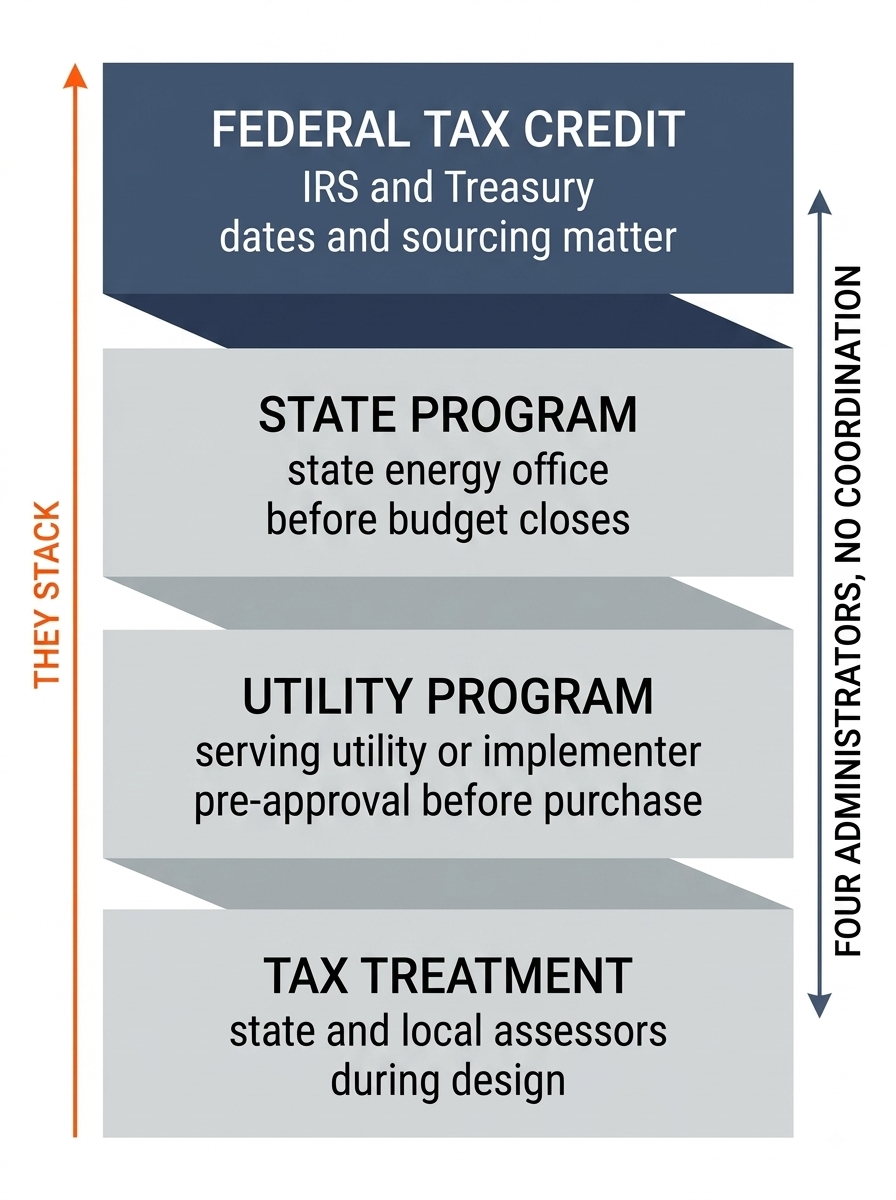
The four layers are federal tax credits, state programs, utility programs, and tax treatment. Each is administered by a different organization and each may require a different application sequence.
Four incentive layers for commercial thermal energy storage
LayerWhat it isWho administersTypical timing requirement
Federal tax creditInvestment tax credit on qualifying energy storage technologyIRS / TreasuryConstruction start date and placed-in-service date both matter
State programsDirect install, grants, or performance incentives, often income- or sector-targetedState energy office or designated administratorApplication before work begins; budgets close when subscribed
Utility programsCustom, measured-savings incentives or prescriptive, fixed-per-unit incentivesThe serving utility or a program implementerPre-approval before purchase; measurement and verification before and after
Tax treatmentProperty tax exclusions, sales tax exemptions, and accelerated depreciationState and local assessors; IRS for depreciationOften tied to completion dates or system configuration
Layer 1: The federal investment tax credit—and what changed
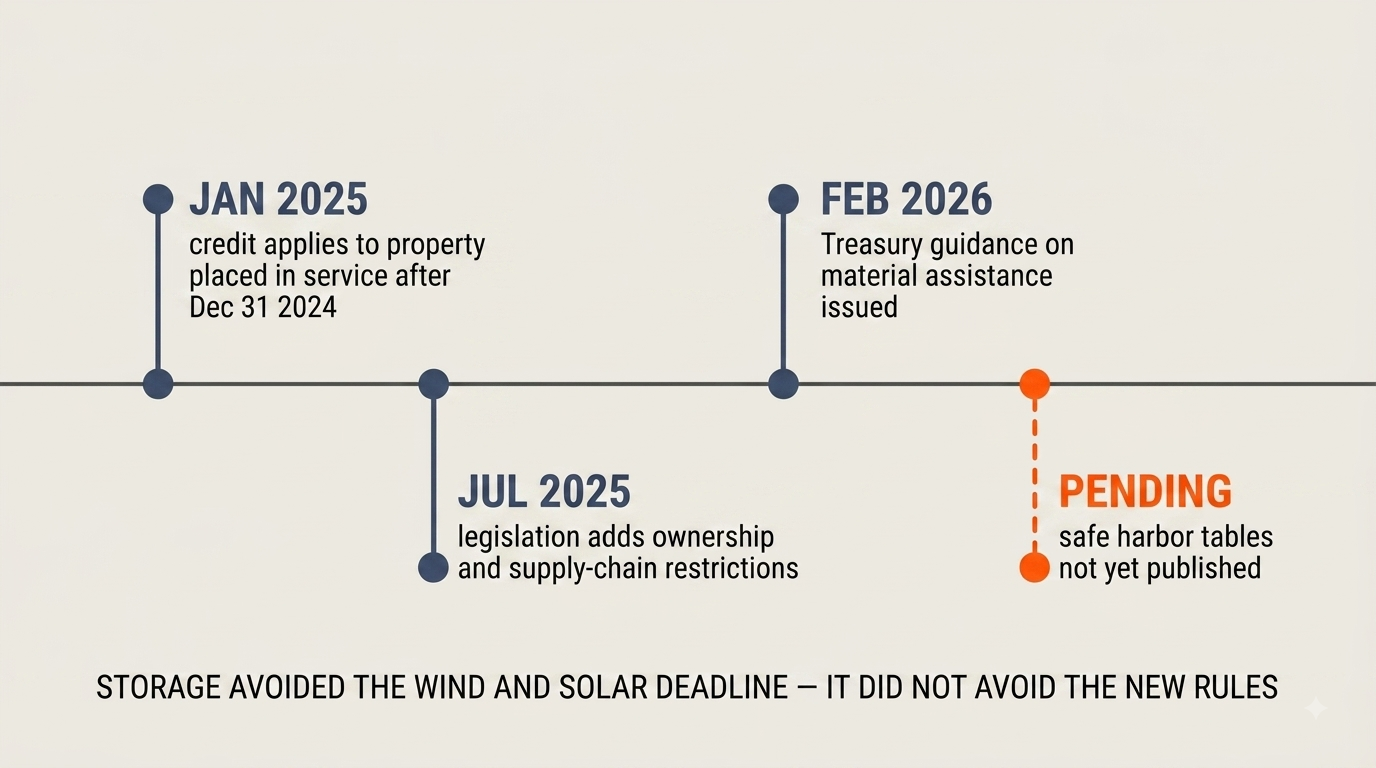
This is the layer that moved most in the last eighteen months, and any guidance written before mid-2025—including some still circulating—is incomplete.
The starting point is unchanged. The statutory definition of energy storage technology under 26 U.S.C. §48E expressly includes thermal energy storage, and the IRS Clean Electricity Investment Credit governs qualifying property placed in service after December 31, 2024.
What the 2025 legislation changed. The One Big Beautiful Bill Act, enacted July 4, 2025, restructured these credits substantially. Three points matter to a thermal storage project:
What this means practically
Federal credit eligibility for a thermal storage project is now a function of who owns it, where the equipment and its components came from, when construction began, and whether prevailing wage and apprenticeship requirements were met—in addition to whether the property qualifies at all.
The sourcing question is now a diligence item, and where equipment is manufactured is a relevant fact for a tax advisor to evaluate. Thermal Energy HQ manufactures in the United States; whether that is sufficient for any particular threshold on any particular project is a determination for your tax professional, not for a vendor. Guidance is still being written, and safe harbor tables have been announced but not published.
Nothing on this page is tax advice, and Thermal Energy HQ makes no representation that any product qualifies for any credit.
If your organisation does not pay federal tax
A large share of the buildings best suited to thermal storage—affordable housing, hospitals, universities, municipal facilities, and houses of worship—are owned by entities with no federal tax liability to offset. Historically that excluded them from investment credits entirely. It no longer does.
Layer 2 and 3: State and utility programs—how they actually work
This is where the largest non-tax dollars usually sit, and where the procedural traps live.
Prescriptive versus custom
Thermal storage is almost always a custom-program conversation. Custom programs pay on savings that have to be demonstrated against a baseline, and a baseline cannot be established retroactively.
The metering prerequisite
A custom incentive application generally needs a documented pre-installation baseline and a measurement and verification plan agreed in advance. For a load-shifting thermal storage project that usually means twelve months of interval data showing the load shape the project intends to change.
This is the same data the project needs for its own engineering—establishing the peak block, confirming whether the thermal load coincides with the billed demand peak, and sizing the storage. Pulling it once serves both purposes. Not pulling it forfeits the incentive layer entirely, regardless of how well the system performs.
The demand-charge mechanics that determine whether savings are real are worked through in Peak Shaving vs Load Shifting.
Where to look
Your serving utility’s commercial program pages, account representative, or program implementer are important starting points because custom programs are often not well documented publicly.
The DSIRE database tracks federal, state, local, and utility incentives and has included energy storage incentives and state storage targets since 2020.
State energy office program pages are useful for direct-install and sector-targeted programs. California’s multifamily programs are covered in the CEC Equitable Building Decarbonization Program guide.
Utility program managers and implementers evaluating thermal storage against measured demand reduction can start at the Thermal Energy HQ utilities and programs page.
Layer 4: Property tax, sales tax, and depreciation
This is the quietest layer, and frequently the one nobody checks.
Who should answer these questions?
All three are jurisdiction-specific and all three are tax determinations. They belong to the accountant, not the engineer—but the engineer needs to know the answers, because two of them can depend on how the system is configured.
The sequence that keeps every layer available
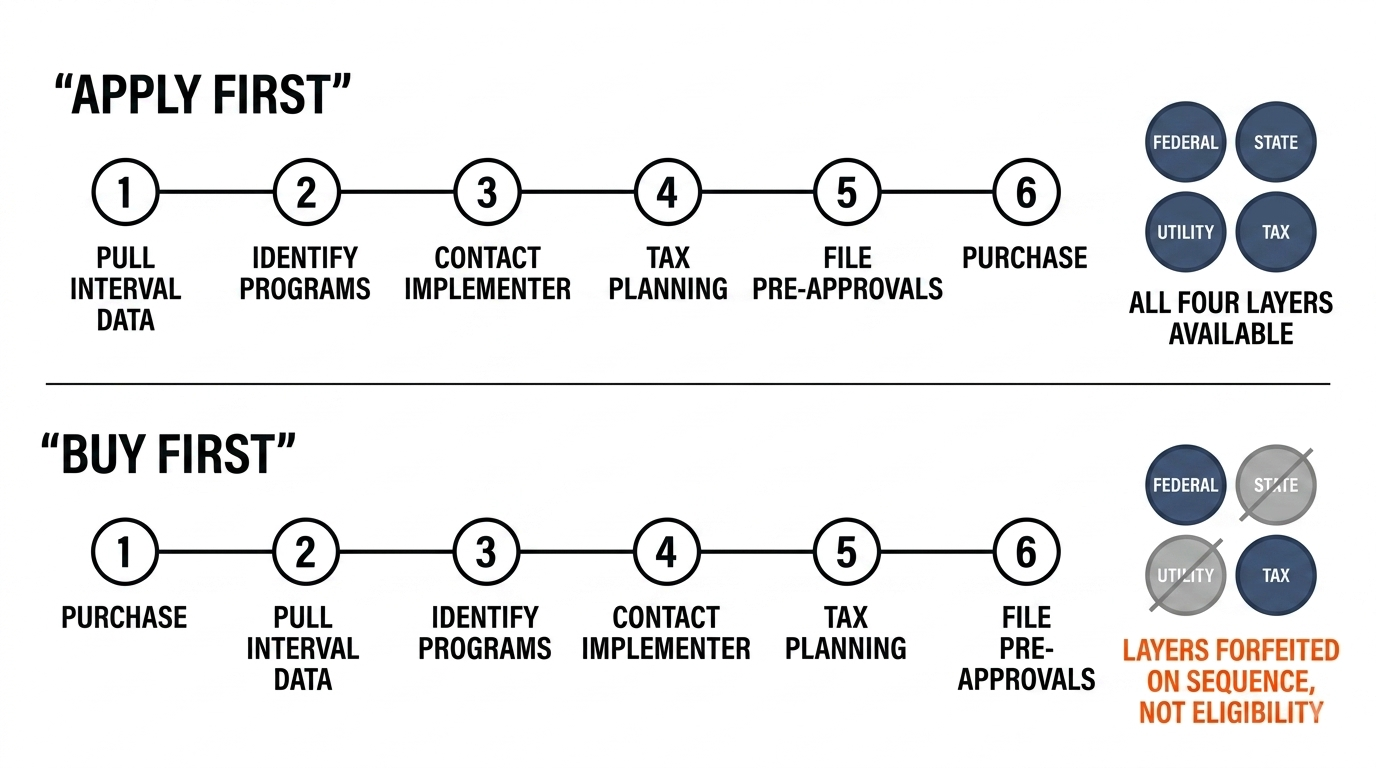
The following order puts anything with a deadline before anything that spends money.
The three most expensive sequencing errors
Buying before pre-approval: Many custom programs will not fund equipment already purchased. This forfeits an entire layer for a scheduling reason.
No baseline data: Without a documented pre-installation baseline there is nothing to measure savings against, and a custom program has nothing to pay on.
Applying late in a program year: Budgets close when subscribed. Several California programs referenced elsewhere on this site closed mid-cycle when they filled.
A worked stack—structure, not amounts
Program values change by jurisdiction and by program year, so a worked example with invented numbers would be the most quotable and least reliable thing on this page. What follows is the structure of a stack and the question each layer turns on.
Questions that determine each incentive layer
LayerThe question it turns onWho answers itWhen
Federal creditDoes the property qualify, does the owner qualify, and do the dates and sourcing work?Tax professionalBefore procurement
Elective pay / transferDoes the owner have tax liability, and if not, which monetisation path applies?Tax professionalBefore structuring
Utility custom programDoes the utility have budget, what M&V will it accept, and is pre-approval required?Utility program implementerBefore design is fixed
State programIs the building type and sector eligible, and is the current round open?State energy office or administratorBefore application deadline
Property / sales taxDoes the configuration qualify, and does it change what we should build?Accountant, with the engineerDuring design
DepreciationWhat recovery period applies and what is it worth to this owner?AccountantDuring financial modelling
The practical implication
Four of the six questions are answered by someone other than the engineer, and five of the six have to be answered before equipment is ordered. That is the entire argument of this article.
What the incentive has to be measured against
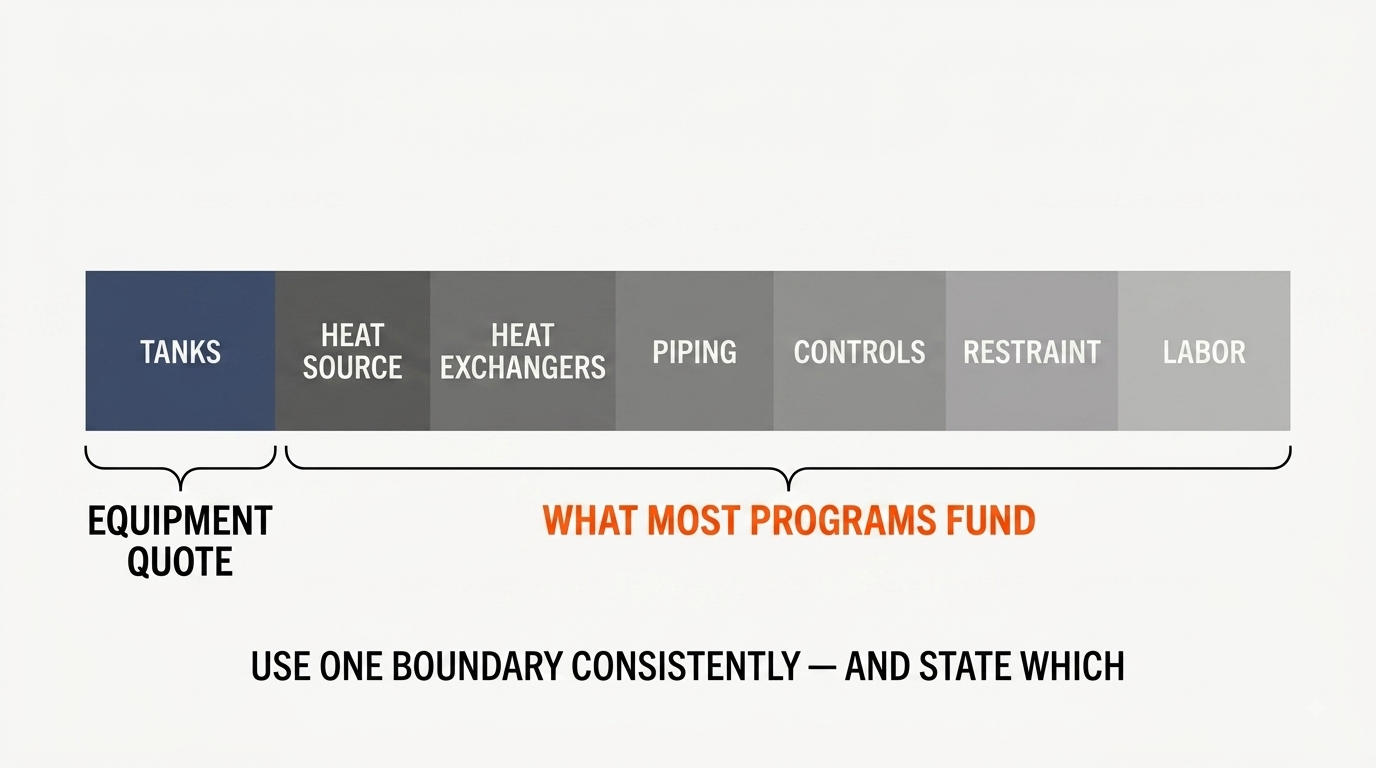
Incentive applications ask for project cost, and vendor pricing is usually quoted for equipment while programs usually fund installed systems. Getting that boundary right matters for both the application and the pro forma.
Thermal tank vessel pricing and capacity
ModelList price$/kWh storedStorage capacity*Standing loss
80 gallon$1,190$9712.0 kWh7–8°F / 24 hr
350 gallon$3,427$6354.6 kWh3.8°F / 24 hr
500 gallon$4,464$5877.0 kWh3.0°F / 24 hr
700 gallon$5,798$54108.0 kWh2.4°F / 24 hr
Two practical notes for applications
The values above are rated at a 35°C temperature delta. Pricing is current as of August 2026; verify against the live thermal tank comparison and specifications. These are vessel list prices, not installed system costs. A complete system adds the heat source, heat exchangers, piping, controls, restraint, and labour. Full cost structure is in How Much Does Thermal Energy Storage Cost? and the 2026 price guide; payback structure is in the thermal energy storage ROI calculator.
A cost basis that mixes equipment quotes with installed estimates will not survive review—use one boundary consistently and state which. Incentive value should be modelled as a range, not a line, until pre-approvals are in hand; a pro forma that books an unapproved incentive at full value is a forecast rather than a budget.
Questions to put to every party
Ask the utility program implementer:
Questions for your tax professional
Questions for the equipment vendor—including us
Why the sourcing question matters
A vendor who cannot answer the sourcing question in writing is a diligence problem under the current federal rules, regardless of what the equipment does.
Frequently Asked Questions
Does thermal energy storage qualify for the federal investment tax credit?
Thermal energy storage is expressly included in the statutory definition of energy storage technology under 26 U.S.C. Section 48E, and the clean electricity investment credit applies to qualifying property placed in service after December 31, 2024. Whether a specific project qualifies depends on the property, the owner's status, construction start and placed-in-service dates, prevailing wage and apprenticeship compliance, and supply-chain sourcing rules added in 2025. That determination belongs to a tax professional, not to a vendor.
Did the 2025 tax legislation change incentives for energy storage?
Yes, and storage was treated more favourably than wind and solar. Industry analysis of the One Big Beautiful Bill Act notes that the accelerated placed-in-service deadline imposed on wind and solar does not apply to energy storage projects. However, the Act also added prohibited-foreign-entity ownership restrictions and material assistance supply-chain rules that apply to storage, and Treasury issued implementing guidance in February 2026 with safe harbor tables still forthcoming.
Can a non-profit or public agency benefit from energy storage tax credits?
Yes. Elective pay, sometimes called direct pay, allows applicable tax-exempt and governmental entities to receive the value of certain credits as a payment rather than as an offset against tax liability. Transferability also remains available to taxable entities that wish to sell credits. Both carry registration, filing, and timing requirements, and both should be discussed before the project is structured rather than after.
What is the difference between a prescriptive and a custom utility incentive?
A prescriptive incentive pays a fixed amount per unit of a defined measure and requires relatively little documentation. A custom incentive pays on modelled or measured savings unique to the project and requires engineering calculations, a documented baseline, and a measurement and verification plan. Thermal storage is almost always a custom conversation, because it is rarely a listed prescriptive measure and its savings are project-specific.
Why do utility incentive programs require interval data?
Because custom programs pay on savings demonstrated against a pre-installation baseline, and a baseline cannot be established retroactively. For a load-shifting thermal storage project this generally means twelve months of interval data showing the load shape the project intends to change. The same data is needed for the engineering, so pulling it once serves both purposes.
When should I apply for thermal storage incentives?
Before purchasing equipment. Many custom utility programs require pre-approval and will not fund equipment already bought, program budgets close when subscribed rather than at a fixed date, and federal credit eligibility now depends partly on construction start dates. Applications, reservations, and tax planning all belong ahead of procurement in the project sequence.
Where can I find incentives available for my building?
Start with a lookup rather than a list, because programs vary by utility territory, sector, and building type. The DSIRE database, maintained by the N.C. Clean Energy Technology Center, is the longest-running public record of U.S. federal, state, local, and utility incentives and has covered energy storage since 2020. Your serving utility's commercial account representative is the authoritative source for custom program availability, which is often not documented publicly.
Does where equipment is manufactured affect incentive eligibility?
It can. The 2025 legislation added a material assistance test based on the share of project costs attributable to prohibited foreign entities, alongside revised domestic content provisions. Treasury and the IRS issued guidance in February 2026 indicating that regulations defining the material assistance cost ratio are forthcoming. Manufacturing location is therefore a relevant fact for a tax advisor to evaluate, but whether any threshold is met on any particular project is a tax determination rather than a vendor claim.
Conclusion
There are four layers of incentive available to a commercial thermal storage project, they stack, and they are administered by four sets of people who do not talk to each other. Most of the money that gets left behind is lost to sequence rather than eligibility—equipment bought before a pre-approval, an application filed without a baseline, or a construction date that landed badly.
Pull the interval data first, because it serves the engineering and the incentive application at once. Talk to the utility implementer before design is fixed. Get tax counsel involved before procurement, because federal eligibility now turns on ownership and sourcing as well as on the equipment. Then buy.
Treat every figure you read about a specific program—here or anywhere—as a starting point for a phone call rather than as a number to put in a budget.