NYC Local Law 97: How Heat Pump Water Heating and Thermal Storage Can Help Buildings Prepare for 2030

Local Law 97 emissions limits tighten in 2030, and a New York City building that meets its cap today can exceed the next one without using any more energy. Where water heating accounts for a large share of gas use, a heat pump water heater paired with thermal storage can cut reported emissions while keeping electricity costs in check.
Key Takeaways
- Local Law 97 sets annual greenhouse gas emissions limits for many large buildings in New York City. The limits tighten in 2030, so a building that meets its cap today could exceed the new limit even if its energy use stays the same.
- If water heating accounts for a significant share of your building’s gas use, switching to an electric heat pump can help cut emissions.
- Thermal storage can support a switch to lower-emissions water heating, cut energy and demand charges, and allow for a smaller heat pump.
- Building owners and their teams should compare their latest reported emissions with their building’s 2030 limit and work with an engineer to prioritize upgrades if they need to make cuts.
- Thermal Energy HQ can help you evaluate whether heat pump water heating and thermal storage make sense for your NYC building’s Local Law 97 compliance plan.
Buildings generate more than two-thirds of New York City’s greenhouse gas emissions. To address this, the city passed Local Law 97 in 2019 as part of the Climate Mobilization Act. With even stricter limits set for 2030, it’s critical for building owners, property managers, co-op and condo boards, and their engineers to understand how heat pump water heating and thermal storage can play a role in cutting emissions and managing electricity costs.
What is Local Law 97?
New York City’s Local Law 97 (LL97) caps annual greenhouse gas emissions for many large buildings, including apartments, offices and hotels. It generally applies to individual buildings over 25,000 gross square feet. The law also covers groups of buildings that exceed a total of 50,000 gross square feet if they share a tax lot (a parcel in the city’s property tax records) or are condos governed by the same board. Buildings subject to Article 320 that exceed their annual emissions caps are subject to a Local Law 97 penalty of $268 per metric ton of carbon dioxide equivalent (CO₂e) over the limit.
What changes under Local Law 97 in 2030?
When passed in 2019, Local Law 97 set emissions caps for 2024 through 2029. Buildings subject to those caps must stay within their limit each year, necessitating careful planning with even lower emissions limits for 2030 through 2034.
The table compares the annual limits for both periods across three property types.
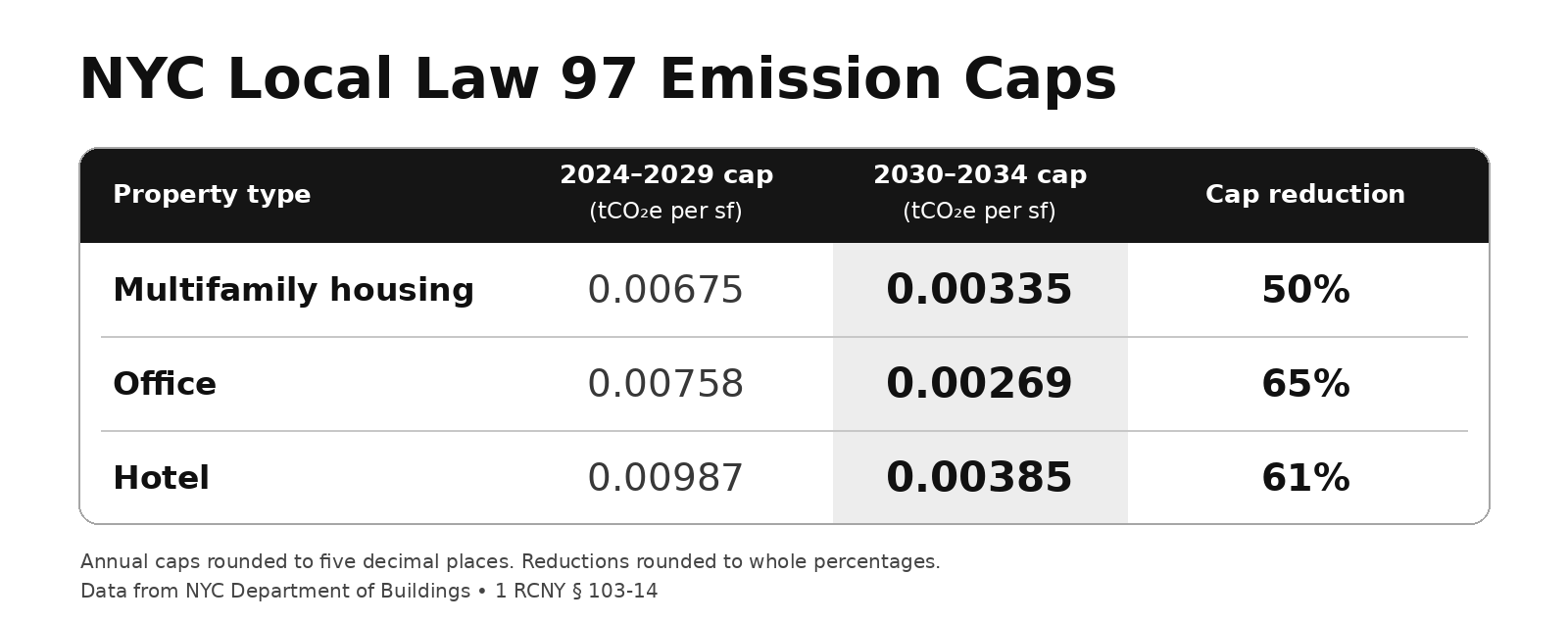
As evidenced in the table, emissions ceilings become much stricter in 2030. A building that meets its emissions cap today could still be over the line then. In fact, more than half of covered buildings would exceed their Local Law 97 2030 limits based on their current energy use. NYC building owners and their teams will need to examine whether their properties are on track to meet lower requirements and—if they need to cut emissions—where to begin.
Hot water and building emissions
One important place to look is the building’s hot water system. If it runs on gas, it can contribute to emissions year-round. When the system circulates hot water so it’s ready at the tap, it also uses energy to replace heat lost through the pipes.
Summer gas bills can provide a starting point for estimating how much fuel goes toward hot water. Working with an engineer to complete that estimate can help owners decide whether water heating is a good place to focus their emission reduction efforts.
How heat pump water heating can cut emissions
If water heating accounts for a significant share of your building’s gas use, switching to an electric option can help lower emissions. An air-source heat pump water heater uses electricity to transfer heat from the surrounding air to the water. A proper design can produce the same amount of hot water as a conventional gas-fired system while using less energy. Local Law 97 counts emissions from both on-site gas use and purchased electricity. The emissions savings depend on how much gas the heat pump replaces as well as the emissions associated with the electricity it uses.
Heat pump water heating and your electric bill
As your gas bill falls, your electric bill may rise when you switch to a heat pump water heater. To keep electricity costs in check, consider how your utility charges for power and whether changing when the heat pump runs could save you money.
Start by looking at two parts of your electric bill:
- Time-of-use rates: If your building is on a time-of-use rate, the price per kilowatt-hour varies by time of day. Running the heat pump during lower-priced hours can reduce what you pay for the electricity it uses.
- Demand charges. If your rate includes a demand charge, part of your bill is based on how much power your building draws during its highest-use interval in the billing period. Running the heat pump while other equipment is drawing a lot of power could push that number higher and increase the charge.
Your building may draw the most power outside your utility’s highest-priced hours. Heating water ahead of time gives you more flexibility to manage both costs.
Reducing costs with thermal storage
Insulated tanks—typically part of a central heat pump water heating system—store heat until the building needs hot water. By running the heat pump during lower-cost hours and using stored heat when electricity is more expensive or demand is higher, owners can shift their building’s electricity use (load shifting) and reduce peak power draw (peak shaving). For example, heating water overnight at off-peak rates and using it during the day can help lower electricity costs. If this also reduces the building’s maximum power draw, it can lead to additional savings on demand charges.
Thermal storage can make switching from gas to heat pump water heating easier and support LL97 compliance if the switch lowers reported emissions. Key benefits include:
- Lowering electricity costs by running the heat pump when rates are cheapest
- Reducing demand charges by minimizing peak power use
- Potentially requiring a smaller, less expensive heat pump, since storage can cover short spikes in hot water demand
To see how quickly these savings can offset your upfront investment, check out our guide to thermal energy storage payback.
What it looks like in real buildings
These are on our own site. Have Garth confirm them before publishing.
- Cleveland Lofts (multifamily): storage covers 42% of thermal demand, 17.15 tons of GHG avoided, 660 kWh of capacity, operating since 2019.
- Tank capacity: 54.6 kWh per 350-gallon tank, 108 kWh per 700-gallon tank.
- Bolongo Bay: 70% reduction in electricity use.
Optional illustration: at $268 per ton, 17.15 tons a year would be about $4,600 in LL97 fines if it were over a building's cap. Present it as an illustration only. Cleveland Lofts is in Ohio, not NYC, and isn't subject to LL97.
Optional illustration: at $268 per ton, 17.15 tons a year would be about $4,600 in LL97 fines if it were over a building's cap. Present it as an illustration only. Cleveland Lofts is in Ohio, not NYC, and isn't subject to LL97. https://www.thermalenergyhq.com/case-studies/cleveland-lofts-multifamily-pvt-and-thermal-storage-case-study
How should buildings prepare for Local Law 97 2030 emissions limits?
Local Law 97 annual emissions reports are due each May for the previous calendar year, and filing late can trigger separate LL97 fines. For the 2024–2029 LL97 compliance period, the NYC Department of Buildings may reduce emissions Local Law 97 penalties for owners who demonstrate qualifying good-faith efforts to comply, so proactive planning is key.
With much tighter limits arriving in 2030, now is the time to review your building’s systems and strategy. Here’s how to get ahead:
- Compare your latest reported emissions to your building’s Local Law 97 2030 limit.
- If you’re at risk of exceeding the cap, bring your benchmarking data to an engineer to identify the most effective upgrades.
- If hot water is a major source of emissions, ask about heat pump water heating and whether pairing it with thermal storage could lower operating costs and demand charges.
- Remember, thermal storage is just one part of a broader LL97 compliance strategy.
Before you finalize your plans or budget:
- Check for available rebates and incentive programs with our Energy Incentive Finder.
Ready to take the next step? Talk with our team about a heat pump water heating system with storage for your building.
FAQs
How can I check whether Local Law 97 applies to my building?
Whether you’re checking a multifamily building, a co-op, an office or another property type, start with the NYC Department of Buildings’ Covered Buildings List. Look up your property by borough, block and lot (BBL). If your property is missing or the listing looks incorrect, see the city’s Covered Buildings List FAQs for guidance.
How do I estimate my building’s Local Law 97 penalty?
Subtract your building’s annual emissions limit from its reported emissions for the same year. If the building is over its limit, multiply the difference by $268 per metric ton of carbon dioxide equivalent (CO₂e). For example, going 10 metric tons over the cap would result in a potential penalty of $2,680 before any reductions.
If my building meets its Local Law 97 limit today, how can I tell if it will meet the 2030 limit?
Compare the annual emissions in your latest report with your building’s 2030 limit. If your building reported 200 metric tons of CO₂e and its 2030 limit is 150, it would need to cut annual emissions by 50 metric tons from that baseline.
When does it make sense to pair a heat pump water heater with thermal storage?
Thermal storage is worth evaluating if your building uses a lot of hot water during periods when electricity is expensive or when other equipment is already drawing a lot of power. Ask your engineer to compare your hot water usage, your building’s peak electricity demand and your utility rate to see whether heating water ahead of time could lower operating costs.