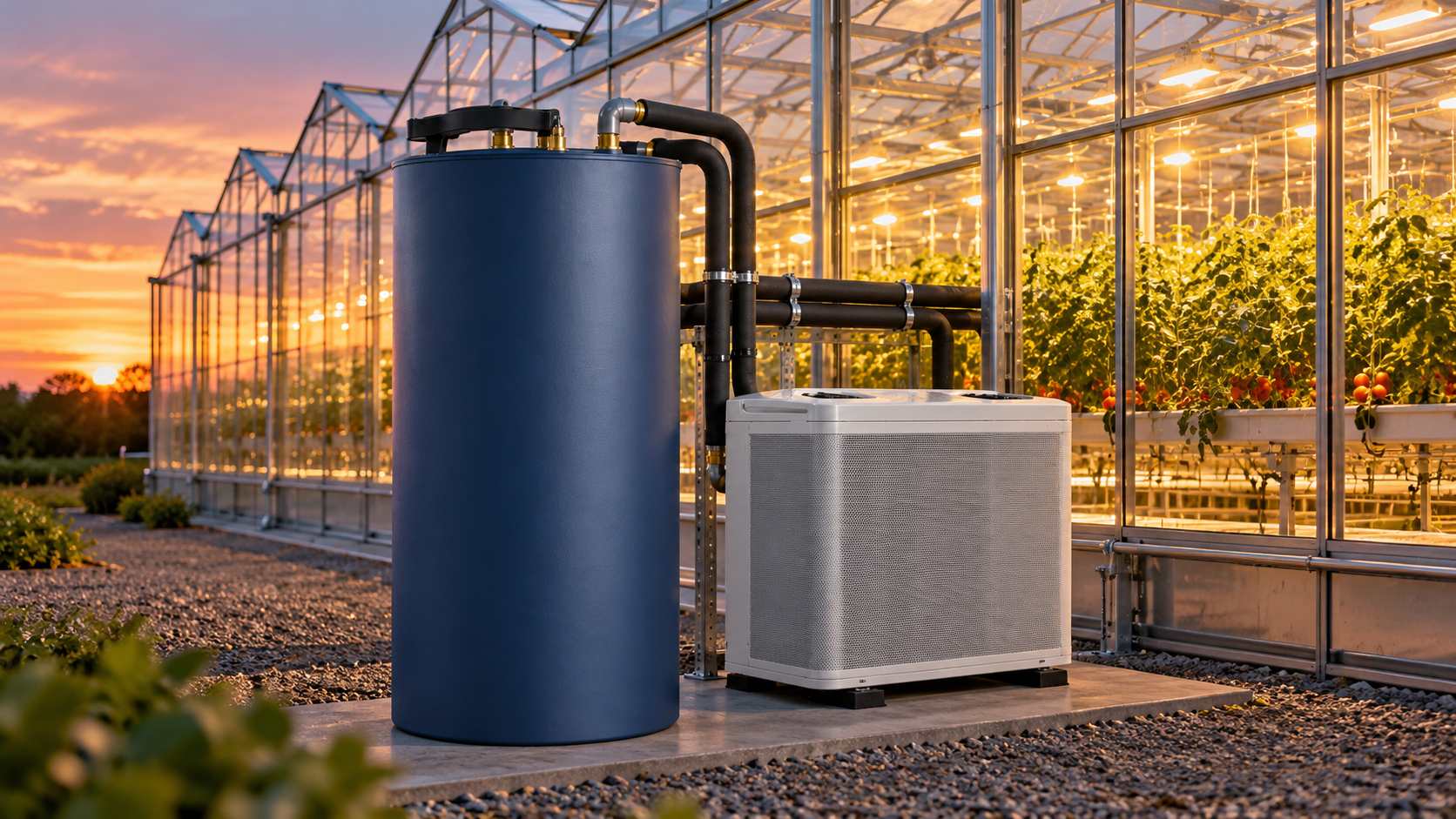
Water storage shifts greenhouse heat production into different hours; it does not replace the heater. For a grower adding or replacing propane, natural gas or boiler heat, the emitter temperature determines how much storage a heat pump can use. Extension guidance sizes buffer tanks in gallons per Btu/hr of boiler capacity, but nighttime load shifting also requires a usable temperature delta, a charging window and a heat source that can carry the design night.
A commercial greenhouse gains surplus heat by day and loses heat through a thin skin at night. UMass Extension puts usable daytime excess at roughly 200 to 400 Btu per square foot of floor area: a 30 by 100 foot house can have 600,000 to 1,200,000 Btu of surplus heat on a clear winter day, then lose heat through a double-poly skin all night. Published water-storage guidance still assumes 150 to 200 F water.
Air source heat pumps deliver, in the DOE Energy Saver summary, up to three times the heat energy of the electricity they consume, but at supply temperatures well below a fin-pipe loop. Commercial tariffs increasingly charge by the hour and by peak kW. Storage can now be assembled in a headhouse in 700-gallon modules instead of requiring a 3,000-gallon buried vessel.
This article applies the extension method to a 30 by 96 foot double-poly house, converts buffer volume and nighttime thermal energy into module counts, and prices shifted electricity against stated assumptions. Storage cannot create heat: the heater or heat pump still has to produce every Btu the greenhouse loses.
Extension guidance is sound and boiler-era
UMass Extension's heat storage fact sheet specifies one gallon per 200 to 300 Btu/hr of boiler heat capacity, a storage period of one to two days, a maximum tank temperature around 200 F, and a floor of roughly 150 F for distribution through steel pipe or fin radiation. Lower water temperatures can be used with root zone heating. The fact sheet lists tanks from 1,000 gallons to over 500,000 gallons.
UConn Extension's version frames the tank as a buffer for outdoor wood boilers rated up to one million Btu/hr. It recommends a 3,000 to 4,000 gallon insulated tank so the boiler burns at a steady rate while the load swings. Both sources were written around combustion. Both choose water because, as UMass notes, it holds roughly three times the heat of concrete, crushed rock or sand by volume.
The Minnesota CARD field study of air-to-water heat pumps, run by the Center for Energy and Environment, monitored four residential installations and projected 27 to 50 percent space heating savings against electric resistance or propane baselines. Its emitter finding transfers directly: radiators designed for 160 F and higher water may not deliver enough capacity in cold weather from a heat pump, while radiant slabs and other low-temperature emitters do. A fin-pipe loop sits in the first category and a root zone loop in the second. The study is residential and is cited here only for its emitter-temperature conclusion, not as a greenhouse savings or COP basis.
Trade press reporting published September 2, 2026 describes a Korea Institute of Energy Research greenhouse that paired seasonal solar storage—a 350 cubic metre tank and a 100 cubic metre buffer—with heat pumps and recorded an annual average COP of 4.1 over three heating cycles monitored from April 2022 to May 2025. The figure shows what a heat pump reaches with a warm source; it is not a sizing basis here.
Heater capacity comes first, storage second
Purdue's controlled environment agriculture program publishes the heat loss method used throughout extension guidance: Q = U x A x dT. Q is heat loss in Btu/hr, U is the covering's overall heat transfer coefficient, A is exposed surface area, and dT is the inside-to-outside temperature difference.
Purdue lists U at 0.70 Btu/hr-ft²-F for double polyethylene, 0.50 Btu/hr-ft²-F for double polyethylene with an infrared blocker, 0.55 Btu/hr-ft²-F for double polycarbonate, and about 1.2 Btu/hr-ft²-F for single polyethylene.
The worked example assumes a 30 ft x 96 ft gable greenhouse, 8 ft sidewalls, a 6 ft rise to the ridge, double polyethylene with U = 0.70 Btu/hr-ft²-F, a 60 F inside setpoint and a -5 F outside design temperature. These are calculation assumptions, not project specifications. Substitute the actual house dimensions, covering, setpoint and local design temperature.
Floor area A_floor = length x width A_floor = 30 ft x 96 ft = 2,880 sq ft
Exposed surface area A_sidewalls = 2 x length x sidewall height A_sidewalls = 2 x 96 ft x 8 ft = 1,536 sq ft A_ends = 2 x [(width x sidewall height) + (0.5 x width x ridge rise)] A_ends = 2 x [(30 ft x 8 ft) + (0.5 x 30 ft x 6 ft)] = 660 sq ft A_roof = 2 x length x sqrt[(width / 2)² + ridge rise²] A_roof = 2 x 96 ft x sqrt(15² + 6²) ft = 3,103 sq ft A = A_sidewalls + A_ends + A_roof A = 1,536 + 660 + 3,103 = 5,299 sq ft, rounded to 5,300 sq ft
Design-night heat loss Q = U x A x dT Q = 0.70 Btu/hr-ft²-F x 5,300 sq ft x [60 F - (-5 F)] Q = 0.70 x 5,300 x 65 = 241,150 Btu/hr Q ≈ 241,000 Btu/hr, or 70.7 kW thermal
Purdue's example at 30 F outside and a 66.6 F average setpoint returns 170,860 Btu/hr for a double-poly Quonset of similar size, confirming the order of magnitude. Engineers add wind and infiltration allowances that this calculation omits, so the specified heater will be larger than 241,000 Btu/hr.
Buffer storage: extension rule of thumb V = Q / (200 to 300 Btu/hr per gal) V = 241,000 Btu/hr / (300 Btu/hr per gal) = 803 gal V = 241,000 Btu/hr / (200 Btu/hr per gal) = 1,205 gal V ≈ 800 to 1,200 gallons, or one to two 700-gallon modules
That is buffer volume, the service heat pump buffer tank sizing covers for commercial systems generally. Shifting hours of nighttime load off a utility's peak window needs more volume. The amount depends on the usable delta.
The emitter sets the usable delta, not the tank
A water tank stores sensible heat, so capacity scales linearly with the temperature difference between charged and depleted states. TEHQ publishes 108 kWh thermal for the 700-gallon Thermal Tank module at a 35 C (63 F) delta. That rating does not apply to the greenhouse loops considered here: neither offers a 63 F swing.
UMass's root zone installation fact sheet puts the water heater thermostat at 100 to 110 F, reports 15 to 30 Btu/hr per square foot of floor or bench, and credits root zone heating with 25 to 75 percent of total heat depending on climate while allowing air 5 to 15 F cooler. It also notes that return water below 135 F causes condensation in non-condensing boilers.
The Farm Energy extension summary, adapted from UConn and UMass material, is more conservative: about 100 F water in poly pipe for 70 to 75 F soil, less than 25 percent of the coldest-night load in most of the United States, and up to 10 percent savings from a 5 to 10 F air setback.
A heat pump charging a tank to 120 or 130 F serves a root zone loop fully and a fin-pipe loop not at all. Root zone heat carries a minority of the coldest-night load in most of the United States; it heats the bench and soil, not the whole house. An air heating system is still required.
The 130 F heat pump supply ceiling below is an assumption representing common air-to-water equipment. Confirm the selected unit's maximum supply temperature and capacity at that temperature. The charge and depleted temperatures are comparison cases, not specifications for a selected system.
Emitter types and the storage delta they leave
- Aluminum fin pipe or bare steel pipe—perimeter air heat. Supply water needed: about 150 F minimum, per UMass. Boiler storage window: 180 F → 150 F, leaving a 30 F usable delta. Heat pump case: assumed 130 F maximum supply is below the 150 F emitter floor, leaving a 0 F usable delta. Heat pump charging is not practical because supply tops out below the loop's minimum temperature.
- Root zone bench or floor tubing. Supply water needed: roughly 100 to 110 F at the heater, per UMass, and about 100 F in poly pipe, per Farm Energy. Heat pump storage window: 120 F → 90 F, leaving a 30 F usable delta. Higher-charge case: 130 F → 90 F, leaving a 40 F usable delta. Heat pump charging is feasible because supply is within the normal air-to-water range, subject to the selected unit's data.
- Hot water unit heater or fan coil—air heat. Supply water needed: typically 140 to 180 F; output falls with entering water temperature. Boiler storage window: 180 F → 140 F, leaving a 40 F usable delta. Heat pump storage window: 130 F → 110 to 120 F, leaving a 10 to 20 F usable delta. Heat pump charging is marginal because output falls sharply at low water temperatures.
Capacity, module count and electricity at stated assumptions
The worked case shifts the evening on-peak window on a cold but not extreme night, the condition that recurs most often in a heating season. The root zone charging cases assume 120 F or 130 F charged water and 90 F depleted water. The boiler fin-pipe case assumes 180 F charged water and a 150 F emitter floor.
Stored thermal energy per 700-gallon module: root zone loop at a 30 F delta Q = m x c x dT Q = 700 gal x 8.34 lb/gal x 1 Btu/lb-F x (120 F - 90 F) Q = 175,140 Btu = 51.3 kWh thermal at a 30 F delta
Same module, heat pump charged to 130 F: root zone loop at a 40 F delta Q = m x c x dT Q = 700 gal x 8.34 lb/gal x 1 Btu/lb-F x (130 F - 90 F) Q = 233,520 Btu = 68.4 kWh thermal at a 40 F delta
Same module, boiler-charged fin-pipe loop at a 30 F delta Q = m x c x dT Q = 700 gal x 8.34 lb/gal x 1 Btu/lb-F x (180 F - 150 F) Q = 175,140 Btu = 51.3 kWh thermal at a 30 F delta, boiler only
Same module, heat-pump-charged fin-pipe loop Q = m x c x dT Q = 700 gal x 8.34 lb/gal x 1 Btu/lb-F x (130 F - 150 F) Result: no usable capacity; supply is below the emitter floor, so the usable storage delta is 0 F.
Published nameplate, for comparison only Q = m x c x dT Q = 700 gal x 8.34 lb/gal x 1 Btu/lb-F x 63 F Q = 367,800 Btu = 108 kWh thermal at a 63 F delta; this delta does not apply here.
The 30 F root zone case retains 47 percent of the nameplate capacity rated at a 63 F delta; the 40 F case retains 63 percent. Sizing from the 108 kWh thermal rating at a 63 F delta would undercount the modules needed by half in the 30 F case.
Evening on-peak load to shift Assumptions: 25 F outside, 60 F inside, and a 4 to 9 pm window lasting 5 hours. Q = U x A x dT Q = 0.70 Btu/hr-ft²-F x 5,300 sq ft x 35 F Q = 129,850 Btu/hr, rounded to 130,000 Btu/hr E_shift = Q x time E_shift = 130,000 Btu/hr x 5 h = 650,000 Btu = 190 kWh thermal
Module count n = E_shift / usable thermal energy per module At a 30 F root zone delta: n = 190 kWh thermal / 51.3 kWh thermal per module = 3.7, so 4 modules. At a 40 F root zone delta: n = 190 kWh thermal / 68.4 kWh thermal per module = 2.8, so 3 modules. At the 63 F nameplate delta: n = 190 kWh thermal / 108 kWh thermal per module = 1.8, so 2 modules; this delta is not achievable in this loop.
Ten degrees of additional charge temperature removes one module from the array. Specifying from the 63 F nameplate delta instead of the 30 F usable delta would remove two modules and leave the greenhouse short on every shifted evening.
Four modules at the published list price of $5,798 each, as of September 2026, total $23,192 for the storage line item alone. That excludes the heat pump, piping, pumps, controls and installation.
Thermal kWh is not electrical kWh. Divide thermal energy by the heat pump's COP at the ambient and supply temperature during charging. Use the manufacturer's performance tables, not a brochure rating.
Electrical energy to charge in a mid-day window Assumptions: 40 F ambient, 120 F supply and COP 3.0. E_elec = E_thermal / COP E_elec = 190 kWh thermal / 3.0 = 63.3 kWh electrical
Same charge on a cold morning Assumptions: 5 F ambient, 120 F supply and COP 1.8. E_elec = E_thermal / COP E_elec = 190 kWh thermal / 1.8 = 105.6 kWh electrical
Heat pump output needed to charge in a 6-hour window Assumed charging window: 9 am to 3 pm. P_charge = E_thermal / time P_charge = 190 kWh thermal / 6 h = 31.7 kW thermal This is about 108,000 Btu/hr above the live load during charging.
Mid-day is chosen because a greenhouse on a clear day has near-zero heating load and the warmest ambient, allowing the heat pump to run at its best COP with its full output going to the tank. Whether mid-day is also the cheapest tariff period depends on the utility. Some tariffs price mid-day lowest; many price overnight lowest. Time-of-use electricity rates for commercial customers explains how to read the tariff.
Avoided on-peak demand Assumed evening COP: 2.5. P_avoided = (Q / 3,412 Btu/kWh) / COP P_avoided = (130,000 Btu/hr / 3,412 Btu/kWh) / 2.5 P_avoided = 38.1 kW thermal / 2.5 = 15.2 kW electrical during the 4 to 9 pm window
Energy cost shifted per evening Assumptions: $0.30/kWh electrical on-peak, $0.12/kWh electrical mid-day, evening COP 2.5 and charging COP 3.0. S_night = (E_thermal / COP_evening) x rate_on-peak - (E_thermal / COP_charging) x rate_mid-day S_night = (190 kWh thermal / 2.5) x $0.30/kWh electrical - (190 kWh thermal / 3.0) x $0.12/kWh electrical S_night = $22.80 - $7.60 = $15.20 per shifted evening
Over an assumed 150 heating nights, that is roughly $2,280 per year before any demand charge. If the tariff bills peak demand at an assumed $15 per kW-month over an assumed six-month heating season, 15.2 kW of avoided evening electrical demand adds about $1,370. Every rate, COP, ambient temperature and night count here is an assumption. Replace them with the grower's tariff and the selected heat pump's published data before presenting a payback figure.
For fuel context, EIA's weekly Heating Oil and Propane Update reported a U.S. residential propane price of $2.674 per gallon for the week of March 30, 2026, the last week of its October-to-March survey. At an assumed 91,500 Btu per gallon and an assumed 80 percent unit heater efficiency, that is about $36.50 per million Btu delivered. A heat pump at an assumed COP of 2.8 and an assumed $0.14 per kWh electrical delivers heat at about $14.70 per million Btu. Bulk commercial propane contracts price differently; use the grower's contract price.
Where the heater gets smaller and where it does not
Storage lets the heat source run more hours at a steadier output. That is the mechanism by which it reduces heater size. UConn's buffer for a one million Btu/hr wood boiler serves that purpose. Applied to a heat pump, the unit can be sized nearer the average load over its charging and operating hours than the peak-hour load. The method in thermal storage for commercial boiler electrification transfers directly to a greenhouse.
The limit is the design night, when the greenhouse loses heat for 14 hours or more and ambient temperature is lowest. An air source heat pump derates on the coldest night exactly when the load peaks: both capacity and COP are at their lowest.
Design-night energy Assumed duration: 14 hours at the calculated 241,000 Btu/hr design load. E = Q x time E = 241,000 Btu/hr x 14 h = 3,374,000 Btu = 989 kWh thermal n = E / usable thermal energy per module n = 989 kWh thermal / 51.3 kWh thermal per module at a 30 F delta n = 19.3, so 20 modules at a 30 F delta
Twenty modules to carry one night is not a defensible specification for a 2,880 square foot house. The practical arrangement is a heat pump and storage sized for the recurring cold evening, with the existing or replacement combustion heater, or the 10 kW immersion element on each module, retained for the design night. Storage shifts the heat pump's hours. It does not remove the need for a design-night heat source that can meet the peak.
Standing loss bounds the storage period. A 700-gallon module loses roughly 2.4 F per 24 hours. Against a 30 F usable delta, that is 8 percent of stored capacity per day. Storage is a daily-cycle asset, not a multi-day one. UMass's one-to-two-day storage period is realistic; multi-day carryover is not.
What storage buys a grower
- Evening demand reduction. About 15 kW of avoided on-peak heat pump electrical draw in the worked case, valued at the grower's own demand charge.
- Energy arbitrage. About $15 per shifted evening at the assumed $0.18 per kWh electrical rate spread and the worked COP assumptions, or roughly $2,280 over an assumed 150-night season.
- Better COP. Charging at an assumed 40 F ambient and COP 3.0 instead of running at an assumed 5 F ambient and COP 1.8 cuts electrical input for the same thermal output by about 40 percent in the worked case: 63.3 versus 105.6 kWh electrical.
- Steadier heat pump duty. Longer cycles at steady output, the service UConn's buffer provides a wood boiler.
- Daytime surplus capture. UMass's 200 to 400 Btu per square foot of daytime excess at up to about 90 F is usable as heat pump source heat or root zone preheat, not as fin-pipe supply. Hybrid PVT solar panels on a headhouse roof deliver a warmer source; PowerPanel PVT is covered separately.
- Headhouse fit. An assembled 700-gallon module is 88.6 inches tall and 60 inches in diameter. It ships in panels, assembles through a standard doorway, and interconnects to scale from buffer to load-shifting volume.
- Cost per usable stored energy. The published cost is $54 per stored kWh thermal for the 700-gallon module at a 63 F delta. At a 30 F greenhouse delta, the effective cost per usable kWh thermal is roughly double. That is a derived figure, not the published rating, and is the figure to carry in the pro forma.
Regulatory and market timing, as of the publish date
USDA Rural Development's Rural Energy for America Program page, as of October 2026, describes grants and guaranteed loans for agricultural producers and rural small businesses covering renewable energy systems and energy efficiency improvements. HVAC upgrades are among the efficiency examples, and efficiency projects require an energy audit or assessment. The grant application window showed as closed at the time of writing.
No eligibility determination is made here. Confirm current application windows and whether a heat pump and storage project fits either category with the State Rural Development Energy Coordinator.
Utility and state incentives for agricultural heat pumps and thermal storage vary by territory and change annually. The incentive finder is a starting point; the utility's program administrator and the grower's tax advisor make the determination. EIA's propane survey runs October through March, so re-check the latest value on the publish date.
Eight checks before you specify anything
- Compute heat loss with Q = U x A x dT from the actual exposed area, covering U-value, night setpoint and local design temperature. Add the infiltration and wind allowance the engineer specifies.
- Decide the emitter before sizing storage. Fin pipe needs about 150 F water and cannot be supplied from a tank charged by a heat pump at 120 to 130 F. Root zone tubing runs at 100 to 110 F and can.
- Pull the heat pump's published capacity and COP at the design ambient and the charging ambient. Use charging-ambient COP for the electrical conversion and design-ambient capacity for the cold-night check.
- Confirm the selected heat pump's maximum supply temperature. Set the storage charge temperature below it with margin.
- Size the module count from the usable delta the loop will actually give, not from a nameplate rating at a 63 F delta.
- Read the tariff for actual off-peak hours and any demand charge or ratchet. Load shifting hot water off-peak describes the same scheduling logic for a different load.
- Retain a design-night heat source. Storage sized for the recurring cold evening does not carry the coldest night.
- Check the headhouse floor for a 6,046 lb filled module, imposing 308 lb per square foot on its footprint. Check the delivery path for panelized assembly.
Frequently Asked Questions
How much water storage does a greenhouse boiler or heat pump need?
UMass and UConn Extension give one gallon per 200 to 300 Btu/hr of heater capacity for buffer duty, so roughly 800 to 1,200 gallons for a 241,000 Btu/hr heater. Shifting nighttime load off a peak window is sized from the thermal energy to be shifted and the capacity available at the usable delta: three to four 700-gallon modules in the worked case, at 40 F and 30 F deltas respectively.
Can a heat pump charge a greenhouse fin-pipe heating loop?
Not in practice under the supply-temperature assumption used here. UMass puts the lowest useful water temperature for steel pipe or fin radiation at about 150 F. The assumed common air-to-water heat pump ceiling of 130 F supply leaves no usable storage delta; confirm the selected unit's maximum supply and capacity. A boiler can charge a fin-pipe loop to 180 F and draw it to 150 F for a 30 F delta.
What water temperature does root zone or bench heating use?
UMass puts the water heater thermostat at 100 to 110 F. The Farm Energy summary reports about 100 F in poly pipe for 70 to 75 F soil, with polyethylene rated to 130 F. That range is within a heat pump's supply capability and gives a tank charged to 120 to 130 F a 30 to 40 F usable delta in the worked case.
How many kWh does a 700-gallon tank store for a greenhouse?
It depends on the delta. TEHQ publishes 108 kWh thermal at a 63 F delta. At a 30 F root zone delta, the same module stores 51.3 kWh thermal; at a 40 F delta, it stores 68.4 kWh thermal. Divide thermal kWh by the heat pump COP during charging to calculate electrical kWh.
Does thermal storage let a grower remove the propane or gas heater?
Storage cannot create heat, and an air source heat pump derates on the coldest night. Carrying a 14-hour design night from storage alone needed 20 modules at a 30 F delta in the worked case. The defensible design retains a design-night heat source.
Does root zone heating alone heat a greenhouse?
No. UMass reports 25 to 75 percent of total heat depending on climate, and the Farm Energy summary puts the coldest-night share below 25 percent in most of the United States. An air heating system is still required.
The delta and the design night decide the project
Extension guidance on greenhouse water storage is correct and incomplete. The gallons-per-Btu rule sizes a buffer, not load shifting, and its 150 to 200 F tank temperatures belong to boilers. A heat pump charging a tank to 120 or 130 F serves a root zone loop at a 30 to 40 F usable delta and serves a fin-pipe loop not at all. In the clear-day case, it runs at its best COP in the mid-day hours when the greenhouse needs no heat. Size the modules from the usable delta, not a 63 F nameplate rating, and keep a heat source that can carry the design night.
Use this article with engineering services, the heat pump manufacturer's performance data and the utility tariff to verify that the proposed solution will satisfy the project's goals.