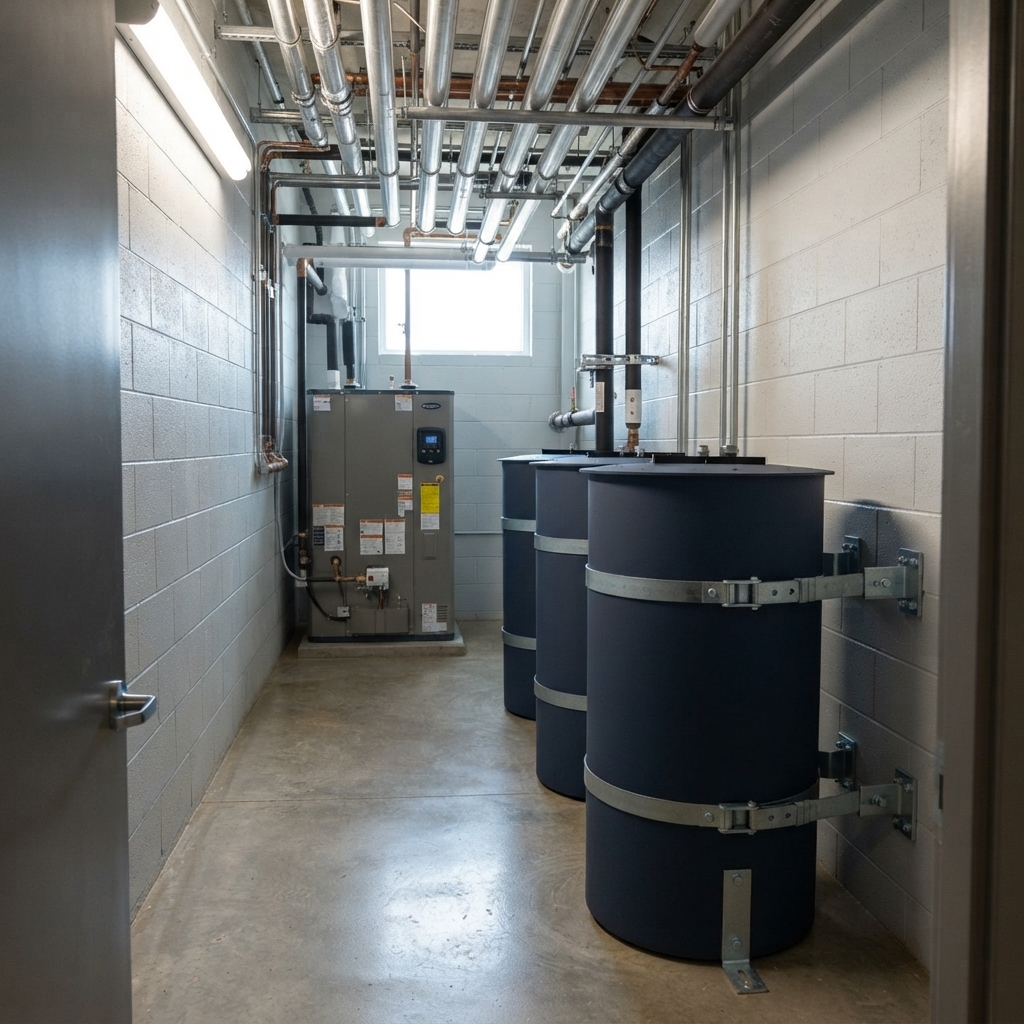
The thermodynamics of sizing a central heat pump water heater are the same in Fresno as in Boston. What changes in California is everything wrapped around the calculation: a code you have to model compliance against, sixteen climate zones with materially different design-day water temperatures, a tariff structure that turns storage volume into an operating decision, and an incentive stack that may pay for part of it.
In short: Sizing a central heat pump water heater plant for a California multifamily building involves two separate exercises that are easy to confuse. The engineering sizing—establishing the peak block, crediting recovery during it, and converting the deficit to usable gallons—is the same method used anywhere and is covered in our national guide. The compliance modelling is California-specific: projects permitted on or after January 1, 2026 must demonstrate compliance with the 2025 Building Energy Efficiency Standards using CEC-certified software, and the 2025 cycle replaced Time Dependent Valuation with Long-Term System Cost as the performance metric. On top of that, design-day inlet water temperature varies meaningfully across the state’s sixteen climate zones, and the 4–9 p.m. time-of-use peak makes storage volume a tariff decision as much as an engineering one.
Key Takeaways
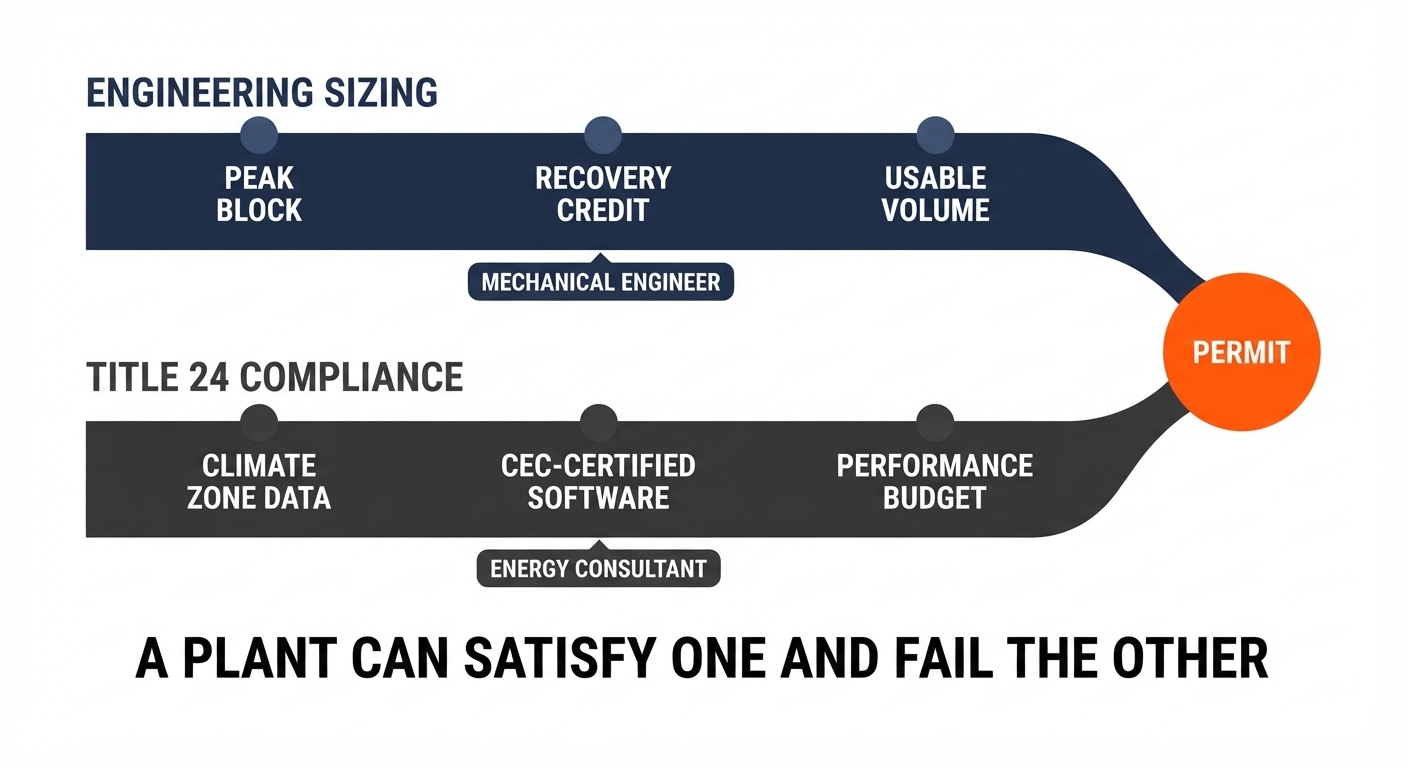
The most common confusion on California projects is treating energy code compliance and plant sizing as the same activity. They are not, they use different tools, and a plant can satisfy one while failing the other.
Both have to happen, and they inform each other. A storage-heavy design chosen for engineering reasons changes the building’s modelled load shape; a compliance path chosen to hit a budget can constrain equipment selection. On projects that go badly, these two conversations happened in separate rooms and met at permit review.
The engineering half—how peak demand becomes a tank volume, and the three derates that separate nameplate gallons from usable ones—is worked through in the national guide, Heat Pump Water Heater Sizing for Multifamily and Commercial Buildings. This article covers what California adds on top.
Engineering Sizing and Compliance Modelling Answer Different Questions
Engineering Sizing
Question it answers:
Will the domestic hot water plant actually meet the building’s demand on the design day?
Governed by:
Engineering physics, equipment performance data, manufacturer specifications, design temperatures, expected hot water demand, and the judgment of the engineer of record.
Primary Output:
Required plant heating capacity and thermal storage volume.
Who Owns It:
The mechanical engineer or engineer of record responsible for the system design.
Failure Mode if Skipped:
The project may technically satisfy a compliance model while still being physically undersized.
In practical terms, that means residents can run out of hot water during the coldest periods of the year because the installed system cannot recover quickly enough to meet actual demand.
Compliance Modelling
Compliance modelling serves a different purpose. Its job is to determine whether the proposed design satisfies the applicable energy code or regulatory requirements using the assumptions and calculation methods defined by that compliance framework.
It should not be treated as a substitute for engineering sizing.
Why the Distinction Matters
A compliance model can show that a project meets an energy standard without proving that the equipment is properly sized for real-world operation.
Engineering sizing answers whether the system will work.
Compliance modelling answers whether the system will comply.
Both are necessary, but they are not interchangeable.
What the 2025 Energy Code changes
California’s Building Energy Efficiency Standards, Title 24 Part 6, are updated on a triennial cycle. The 2025 standards apply to permit applications submitted on or after January 1, 2026; anything permitted before that date proceeds under the 2022 cycle. For multifamily projects, the governing guidance is the 2025 Multifamily Compliance Manual (CEC-400-2025-009), published by the CEC in June 2025.
Three aspects matter to anyone sizing a water heating plant.
1. The performance metric changed from TDV to Long-Term System Cost
This is the headline change of the 2025 cycle and it is not cosmetic. Performance compliance works by comparing a proposed design against a standard design under an energy budget, and the metric used to value energy determines what the budget rewards. Moving from Time Dependent Valuation to Long-Term System Cost changes how energy consumed at different hours is weighted.
For a storage-heavy water heating design, that is directly relevant: a plant that shifts its consumption out of expensive hours has a different modelled profile from one that does not. How much credit that earns under LSC is a question for the energy consultant and the CEC’s Alternative Calculation Method Reference Manual, which sets out how proposed and standard designs are determined and how compliance software must model them. Ask the question early rather than assuming the answer in either direction.
2. Compliance runs through certified software, not spreadsheets
The CEC certifies the software permitted for demonstrating performance compliance, and the ACM Reference Manual establishes the rules for building the model, defining the proposed design, establishing the standard design, and reporting on the compliance certificate. The engineering sizing you do in a manufacturer tool or the Ecosizer is not a compliance calculation and does not substitute for one.
3. Mandatory provisions apply to heat pump water heater installations
The 2025 cycle carries mandatory requirements specific to heat pump water heaters—including provisions around ventilation for installations and around backup heat where a unit draws inlet air from outside and its compressor cutout temperature sits at or above the local winter design extreme. There are also electric-ready provisions requiring pre-wiring and pre-plumbing in multifamily construction.
These are stated here in general terms deliberately. Section numbers and precise thresholds should be taken from the Multifamily Compliance Manual and confirmed with the project’s energy consultant, not from an article—including this one. The requirements differ between low-rise and high-rise multifamily, between new construction and alterations, and between residential and nonresidential occupancies within mixed-use buildings.
Sixteen climate zones, one design day each

California is divided into sixteen building climate zones, and a heat pump water heater plant sized on a statewide average is sized for nowhere.
The reason is arithmetic from the national method: energy per delivered gallon is proportional to the rise from entering water temperature to delivery temperature. The colder the incoming water, the more energy every gallon costs—and the design day is the coldest-entering-water day, not the coldest-air day, though in practice they arrive together.
The practical instruction is simple and routinely ignored: use the project’s climate zone data, not a state average and not a number from a comparable project in a different zone. A coastal Northern California building and a Central Valley building of identical unit count and mix will produce different design-day loads, and the difference is large enough to change equipment selection.
Where a building already exists, the far better input is measurement: meter hot water flow at the plant at fifteen-minute resolution across at least one winter week, and record entering water temperature across the year. That produces the building’s actual load shape rather than a category average—and the same data serves any utility custom incentive application, which generally requires a documented pre-installation baseline.
The 4–9 p.m. peak: why California storage is usually bigger
This is the most consequential California-specific sizing driver, and it has nothing to do with the Energy Code.
California’s major investor-owned utilities structure commercial time-of-use rates around a late-afternoon-to-evening peak—commonly 4 p.m. to 9 p.m. A central heat pump water heater plant sized purely to survive the morning shower draw will happily run during that window, buying its most expensive electricity of the day.
Two cautions before that becomes a business case
First, savings on a demand charge depend on whether the water heating plant actually runs during the interval that sets the billed peak, and are capped by the next-highest interval that month—both tests are worked through in Peak Shaving vs Load Shifting.
Second, a tank charged overnight and held to 9 p.m. has held its charge for a long time, so standing loss stops being a rounding error—it consumes the usable band between storage and delivery temperature, and over a sixteen-hour hold that matters. Specification detail is in What Is the Best Thermal Energy Tank? The 7 Specs That Actually Decide It.
The one place California makes sizing easier
Most of the state’s population lives in climate zones where winter design air temperature is mild by national standards, and that is genuinely favourable for air-source equipment.
The design-day problem that dominates cold-climate central heat pump water heater plants—peak load and minimum capacity arriving on the same morning, with defrost cycles further reducing output—is much less severe in coastal and southern California than in the Northeast or Upper Midwest. A plant that would need heavy derating and a substantial backup strategy in Minneapolis may need considerably less of both in Santa Ana.
That has a direct consequence for the capacity-versus-storage tradeoff: with a smaller design-day derate, more of the plant’s nameplate capacity is available when it is needed, which means storage is being bought primarily for load shifting and peak coverage rather than to compensate for equipment that cannot perform. That is a better reason to buy it, and it usually produces a cleaner business case.
The exceptions matter though. Inland and mountain zones—the Sierra, the high desert, and the far north—are not mild, and a design approach borrowed from a coastal project will underperform there.
Where the incentive stack fits
California has the deepest incentive landscape in the country for multifamily electrification, and it interacts with sizing in one specific way: several programs require a documented pre-installation baseline, which means the metering that informs your sizing is the same metering that supports the application. Pull it once.
The programs themselves are covered in detail in the CEC Equitable Building Decarbonization (EBD) Program guide. The national framework for federal credits and utility custom programs is addressed separately.
One sizing-relevant note: programs and code paths can constrain configuration. A property tax exclusion tied to a qualifying solar energy system, for instance, depends on how the storage is charged—which is an engineering decision that a tax outcome is riding on. Identify every program before the design is fixed, not after it.
A California-specific checklist
Use these questions to keep the engineering and compliance conversations connected:
The feasibility question
Question ten is the one that decides feasibility in occupied California retrofits more often than any thermal calculation. Where a welded vessel cannot reach the room, panelized construction that assembles in place is the standard answer—covered in Designing Thermal Storage for Existing Buildings Without Major Mechanical Room Expansion.
Built examples are in the case studies and specification sheets in the technical documentation library.
How to read the table
*Rated at a 35°C temperature delta. Note the standing loss column against the 4–9 p.m. hold discussed above—on a long ride-through it is a sizing input rather than a specification detail.
Because modules interconnect, volume can be phased as a portfolio electrifies building by building. Packaged assemblies are in the All-In-One thermal energy system; the full cost structure is in How Much Does Thermal Energy Storage Cost?.
Frequently Asked Questions
Does California change how you size a heat pump water heater?
Not the physics, but four things around it. Projects permitted on or after January 1, 2026 must demonstrate compliance with the 2025 Building Energy Efficiency Standards using CEC-certified software, which is a separate exercise from engineering sizing. Design-day entering water temperature varies across the state's sixteen climate zones. The 4 to 9 p.m. time-of-use peak usually calls for more storage than the morning draw alone. And California's incentive programs may fund part of the work but often constrain configuration.
Which Title 24 code cycle applies to my project?
The permit application date decides. Applications submitted on or after January 1, 2026 must meet the 2025 Building Energy Efficiency Standards. Projects permitted before that date proceed under the 2022 cycle. For multifamily buildings, the governing guidance is the CEC's 2025 Multifamily Compliance Manual, publication CEC-400-2025-009.
What changed in the 2025 Energy Code that affects water heating?
The most significant change for performance compliance is the metric: the 2025 cycle replaced Time Dependent Valuation with Long-Term System Cost, which changes how energy consumed at different hours is valued in the energy budget. The cycle also carries mandatory provisions specific to heat pump water heater installations and electric-ready requirements for multifamily construction. Specific section numbers and thresholds should be confirmed against the CEC compliance manual with a qualified energy consultant.
Is energy code compliance the same as sizing the plant?
No, and treating them as one exercise is a common source of trouble. Engineering sizing answers whether the plant will deliver hot water on the design day and is owned by the mechanical engineer. Compliance modelling answers whether the building meets the Energy Code's performance budget, runs through CEC-certified software under the rules in the Alternative Calculation Method Reference Manual, and is typically owned by an energy consultant. A plant can satisfy one and fail the other.
Why does California's climate zone matter for hot water sizing?
Because energy per delivered gallon is proportional to the temperature rise from entering water to delivery temperature, and entering water temperature differs materially across the state's sixteen climate zones. Winter design air temperature also varies, which determines how much an air-source plant derates on the design day. A plant sized on a statewide average is sized for nowhere in particular, and a design borrowed from a coastal project will underperform in an inland or mountain zone.
How much storage does the 4 to 9 p.m. peak require?
Enough energy for the plant to stay off for roughly five hours, which is generally a larger volume than covering the morning draw alone. In California the tariff requirement frequently governs over the engineering minimum, so calculate both and take the larger. Note that a tank charged overnight and held through the evening peak has held its charge a long time, so standing loss becomes a genuine sizing input rather than a specification detail.
Is air-source viable for California multifamily hot water?
In most of the state, yes, and more comfortably than in cold climates. The design-day problem that dominates cold-climate plants—peak load and minimum capacity arriving together, with defrost further reducing output—is much less severe in coastal and southern zones. That means storage is being bought mainly for load shifting and peak coverage rather than to compensate for derated equipment. Inland, high desert, and mountain zones are a different case.
Do California incentive programs affect how the system should be designed?
They can, in two ways. Several programs require a documented pre-installation baseline, so the metering that informs sizing is the same metering the application needs—pull it once, before design is fixed. And some benefits depend on configuration; a property tax exclusion tied to a qualifying solar energy system, for example, depends on how the storage is charged, which is an engineering decision carrying a tax consequence.
Conclusion
Sizing a central heat pump water heater for a California multifamily building is the same calculation it is anywhere—establish the peak block, credit what the plant produces during it, and convert the deficit through the derates. Do that work using the national method and do not let anyone tell you California has a different physics.
What California adds is a compliance exercise running in parallel on different software under different rules, sixteen climate zones that make a statewide design-day number meaningless, a tariff structure that usually calls for more storage than the engineering minimum, and an incentive landscape that can fund the project and constrain it at the same time.
Get the climate zone data, meter the building if it exists, ask the energy consultant about Long-Term System Cost before the design is fixed, and calculate both storage volumes—morning block and evening ride-through. The larger one is usually the answer.
Garth Schultz is President of Thermal Energy HQ, where he leads development of modular thermal energy storage systems manufactured in the United States. He is the inventor named on patents covering hybrid photovoltaic-thermal (PVT) solar panels and insulated modular storage tank construction, and has worked in solar-thermal product development since founding the company’s technology line in 2007.
This article is general information, not code compliance advice. Title 24 requirements vary by occupancy, building height, project type, and climate zone, and are updated on a triennial cycle. Confirm all requirements against the applicable CEC compliance manual with a qualified energy consultant before relying on them.