Local Law 97 is a carbon budget with a price. Every covered building in New York City gets an annual emissions limit in metric tons of CO2 equivalent, computed from its floor area and occupancy, and pays $268 for every ton it reports above the limit.
The 2030 multifamily limit is about 40 percent below the 2024 limit, and the Department of Buildings has said about three quarters of covered properties need to act to meet it. Domestic hot water is one of the most direct loads to electrify because a central water heating plant can be replaced without touching apartments, radiators or windows.
A 100-unit, 100,000-square-foot R-2 building has a 2024-2029 limit of 675 tCO2e and a 2030-2034 limit of 407 tCO2e. At the EIA national average of 10.1 million Btu of water heating energy per apartment per year, gas-fired hot water accounts for about 53.6 tCO2e under the law's natural gas coefficient.
At an assumed COP of 2.5, a heat pump water heater reduces that to about 27.4 tCO2e under the 2024-2029 electricity coefficient and about 13.7 tCO2e under the 0.000145 tCO2e per kWh figure published by DOB for 2030-2034. At $268 per ton, the difference is worth about $7,000 per year now and about $10,700 per year from 2030 for a building over its limit, before the beneficial electrification credit. Equipment operating before January 1, 2027 can receive a deduction of 0.00130 tCO2e for every kWh the heat pump consumes.
Key Takeaways
Local Law 97 of 2019 added Article 320 to Chapter 3 of Title 28 of the Administrative Code. Section 28-320.3.1 sets a building emissions intensity limit for each occupancy group for calendar years 2024 through 2029, multiplied by the gross floor area of each space. A mixed-use building adds the products. Section 28-320.3.2 does the same for 2030 through 2034.
Section 28-320.3.1.1 fixes the greenhouse gas coefficients for 2024-2029. DOB's rule 1 RCNY 103-14 governs the calculation, including the coefficients for 2030-2034. The emissions limits and 2024-2029 coefficients are quoted from the NYC Administrative Code and the Local Law 97 text.
Reports are due May 1 each year for the prior calendar year under 28-320.3.7 and 1 RCNY 103-14(g). DOB's enforcement guidance states that no penalty applies if the report is filed within 60 days after May 1 and that DOB may grant extensions.
For the 2025 reporting year, the April 22, 2026 HPD release gave May 1, 2026 as the due date, a grace period through June 30 and an extension option through August 29.
In this article
What the law requires and when
Two penalty paths exist under 28-320.6 and the rule. A building over its limit owes the excess multiplied by $268 per tCO2e. DOB's own example is 222.85 tCO2e over the limit for a penalty of $59,723.80.
A building that fails to file owes its gross floor area multiplied by $0.50 for each month the report is late. DOB's illustration gives $12,500 per month for a 25,000-square-foot building.
Owners can seek a mitigated penalty for good-faith efforts. DOB ties mitigation to items such as a decarbonization plan under way, electrification readiness, benchmarking and lighting compliance and prior compliance with limits.
The limits, 2024 against 2030
The intensity limits below are in tCO2e per square foot and come from Sections 28-320.3.1 and 28-320.3.2.
A 100,000-square-foot multifamily example
For a 100,000-square-foot multifamily building, the limit falls from 675 tCO2e to 407 tCO2e, a 39.7 percent reduction.
DOB's 2023 presentation estimated that about 5,300 buildings would be out of compliance in 2024 and that around 75 percent of properties would need to achieve compliance for 2030.
The April 2026 HPD release reported that about 28,000 buildings filed for 2024 and that DOB is auditing the filings. It did not report how many were over their limits.
Converting hot water to tons
The coefficients in Section 28-320.3.1.1 for 2024-2029 are:
2024-2029 electricity comparison
One kWh is 3.412 kBtu. At the 2024-2029 coefficients, a kBtu of grid electricity carries 0.0000847 tCO2e, compared with 0.0000531 tCO2e for a kBtu of gas.
Electricity delivered as heat by a resistance element is therefore 59 percent more carbon-intensive per kBtu than gas burned at 100 percent efficiency under the current coefficient, and roughly on par with an 80 percent boiler.
A heat pump changes that arithmetic because it delivers more kBtu of heat than it consumes. The break-even COP against an 80 percent boiler is 0.0000847 divided by (0.0000531 / 0.80), which is 1.28. Any heat pump water heater operating above a COP of 1.28 reduces reported emissions; the question is by how much.
2030-2034 electricity comparison
For 2030-2034, DOB's June 26, 2024 presentation lists a grid electricity coefficient of 0.000145 tCO2e per kWh.
At that published DOB figure, a kBtu of electricity carries 0.0000425 tCO2e, less than a kBtu of gas, and the break-even COP against an 80 percent boiler falls to 0.64. Resistance heating would then beat gas on paper; a heat pump beats it by a factor of its COP.
DOB sets 2030 coefficients by rule under 1 RCNY 103-14. Re-verify the 0.000145 tCO2e per kWh figure against the current rule before quoting any 2030 projection to an owner.
A worked example: 100 apartments, gas-fired hot water
The EIA 2020 Residential Energy Consumption Survey reports that apartments in buildings with five or more units used 10.1 million Btu per household per year for water heating, or 29.9 percent of their 33.7 million Btu of total site energy.
The 10.1 million Btu figure is a national average across fuels and is used here as a labeled placeholder. A New York building should substitute its own gas bills, with the hot water share separated from space heating.
What the example does and does not show
The penalty avoidance figures are not energy cost figures. The energy cost comparison depends on the Con Edison tariff and demand charge the heat pump creates, as well as the hours it runs. Thermal storage changes that operating profile.
The COP moves the result. At a COP of 1.9, the low end of the range measured at five California multifamily sites in the Statewide Electric Emerging Technologies field study, the 2024-2029 reduction falls to 17.6 tCO2e. At a COP of 3.2, the high end, it rises to 32.2 tCO2e.
The beneficial electrification credit doubles before 2027
DOB's August 2024 beneficial electrification presentation states that its rule allows a deduction from reported emissions for electricity consumed by qualifying heat pump equipment that replaces fossil fuel or low-efficiency electric equipment in an existing building.
Measurement and deemed consumption
Consumption is established either by metering or by a deemed method. Metering can use a utility meter, revenue-grade submeter or energy tracking software, with hourly, monthly and annual records kept for six years.
The deemed method uses New York State Technical Resource Manual tables for air-source heat pumps and heat pump water heaters under 100 tons.
Applied to the worked example
Banking and unresolved end date
Unused credit can be banked for a future reporting year. The banking window shrinks from six years for equipment installed in 2024 or earlier to one year for 2029 installations. One year's banked savings applies to one future report, and years cannot be combined.
DOB's presentation gives two statements about the last year the deduction can be used: 2034 to 2036 depending on installation date, and generally through reporting year 2035. Re-check the rule and the Article 320 guide before an owner relies on the exact end date.
Where thermal storage fits in a New York plan
Storage does not appear in the tCO2e calculation. It appears in the four constraints that decide whether the heat pump project gets built.
Electrical service
A central heat pump plant sized to the recovery rate of the boiler it replaces draws peak power at the same moment as the building's morning shower peak. Storage charged overnight carries that peak, so the plant can be sized to the daily average load rather than the peak hour. This lowers connected kW and the chance of a service upgrade.
The hub article on electrifying hot water in existing multifamily buildings sets out the sequencing. Heat pump water heater sizing covers the capacity-versus-storage curve.
Demand charges
Con Edison's commercial tariffs bill on peak demand. A heat pump plant that runs through the morning peak adds its full kW to the building's billed demand. A plant that charges storage in off-peak hours adds little or nothing to the coincident peak.
The peak demand charges article explains the mechanics, and demand charge reduction gives the method for converting stored thermal kWh into avoided electrical kW.
Mechanical room space
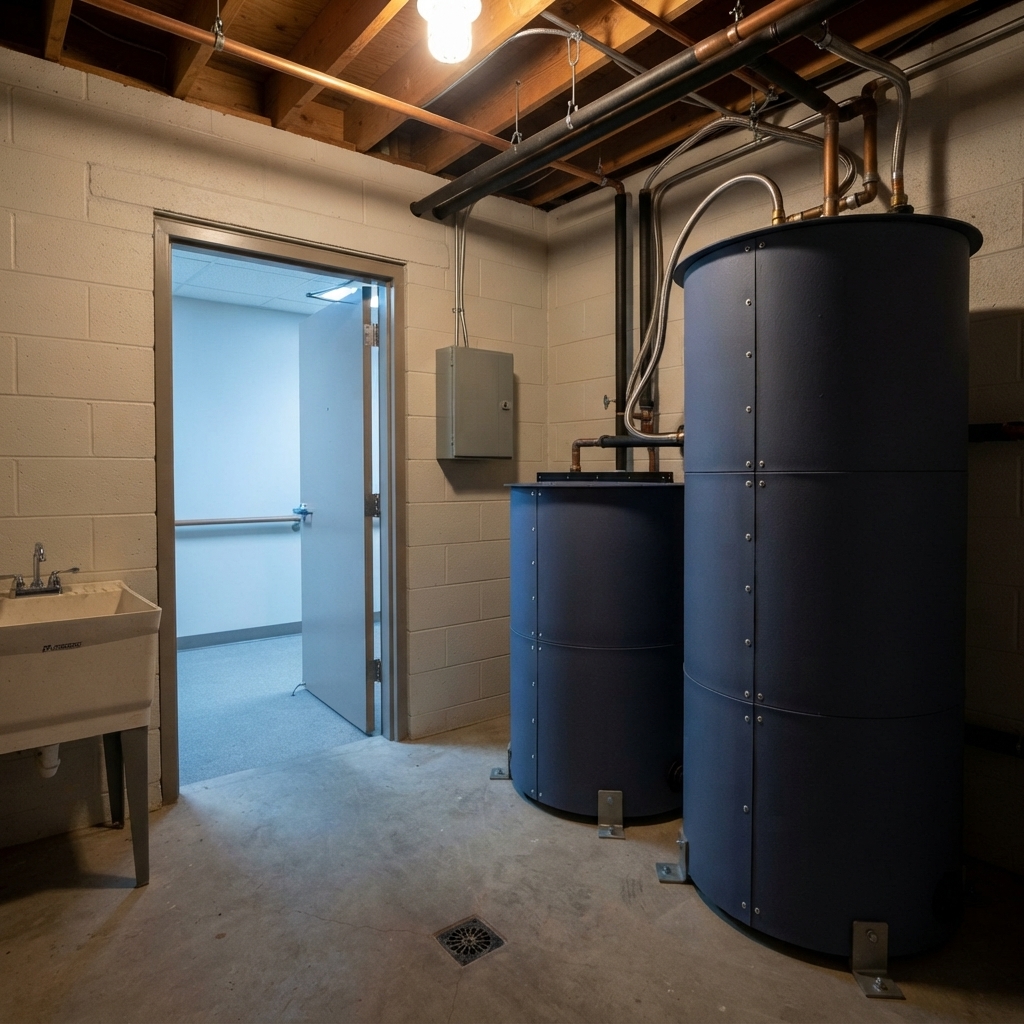
New York central plants sit in basements reached by stairs and corridors. The TEHQ Thermal Tank ships as panels and is assembled on site.
The 700-gallon module is 60 inches in diameter and 88.6 inches tall, weighs 6,046 lb filled and loads the floor at 308 lb per square foot.
The specification sheet lists heat loss of 2.4 F per 24 hours for that module under free convection. That heat loss specification supports an overnight charge available for a morning draw.
The mechanical room retrofit article covers placement without expansion.
Reliability during the transition
A storage bank between a new heat pump and the existing distribution lets the gas plant remain as backup during commissioning. It also lets the heat pump run at steady output rather than cycling against the peak.
Sequencing a hot water electrification against the LL97 calendar
Use the building's own filings, fuel data, winter operating conditions and electrical constraints before selecting equipment. The national EIA figure and the assumed COP in the worked example are placeholders, not a compliance determination.
Frequently Asked Questions
What are the Local Law 97 emissions limits for multifamily buildings?
Under Administrative Code 28-320.3.1 and 28-320.3.2, the R-2 limit is 0.00675 tCO2e per square foot for 2024-2029 and 0.00407 for 2030-2034. For 100,000 square feet, that is 675 and 407 tCO2e per year.
How much is the Local Law 97 penalty?
Under 28-320.6, the penalty for exceeding the limit is the excess emissions multiplied by $268 per tCO2e. Failing to file costs $0.50 per gross square foot per month. DOB's guidance states that no penalty applies if the report is filed within 60 days after May 1.
Does a heat pump water heater count for the beneficial electrification credit?
DOB's August 2024 guidance lists heat pump water heaters as qualifying equipment when they replace fossil fuel or low-efficiency electric equipment in an existing building, with no minimum efficiency beyond being a heat pump. The coefficient is −0.00130 tCO2e per kWh electrical for equipment operating before January 1, 2027 and −0.00065 for 2027-2029. Instantaneous electric water heaters do not qualify.
How much CO2e does domestic hot water represent in a New York apartment building?
At the EIA RECS 2020 national average of 10.1 million Btu per apartment per year, gas-fired hot water for 100 apartments is about 53.6 tCO2e under the law's 0.00005311 tCO2e per kBtu coefficient. That is about 8 percent of a 100,000-square-foot R-2 building's 2024 limit and 13 percent of its 2030 limit. A building's own gas bills should replace that average.
What electricity coefficient applies in 2030?
DOB's June 26, 2024 presentation lists 0.000145 tCO2e per kWh for grid electricity in 2030-2034, compared with 0.000288962 for 2024-2029. DOB sets the 2030 coefficients by rule under 1 RCNY 103-14. Confirm the current figure before relying on it.
When is the next Local Law 97 report due?
Reports are due May 1 each year for the prior calendar year. HPD's April 2026 release gave May 1, 2026 for the 2025 reporting year, with a grace period through June 30 and an extension option through August 29. The 2026 reporting year follows the same May 1 schedule in 2027.
Does thermal storage reduce a building's Local Law 97 emissions?
Not by itself. The calculation counts consumed kWh and kBtu. Storage lowers the heat pump plant's connected kW, shifts electricity use out of the demand peak and lets a smaller plant serve the building. Those effects can make the heat pump project feasible and affordable in an existing New York building, but storage itself does not change the building's tCO2e.
The bottom line
Local Law 97 prices carbon at $268 per ton and cuts the multifamily limit by about 40 percent in 2030. Domestic hot water is a modest share of reported emissions: about 8 percent of the 2024 limit and 13 percent of the 2030 limit in the example above.
It is also a load that can be removed without entering an apartment. The beneficial electrification credit provides a −0.00130 tCO2e per kWh deduction for qualifying equipment operating before January 1, 2027.
The heat pump does the carbon work. Storage does the electrical service, demand charge and mechanical room work that can allow the heat pump to be installed in an existing building.
Run the building's own numbers, confirm the 2030 coefficient and the credit's end date in the current rule, and sequence the project to be operating before January 1, 2027. Whether a building complies, avoids penalties or qualifies for the credit is a determination for the owner's compliance consultant and registered design professional. This article is not legal advice.