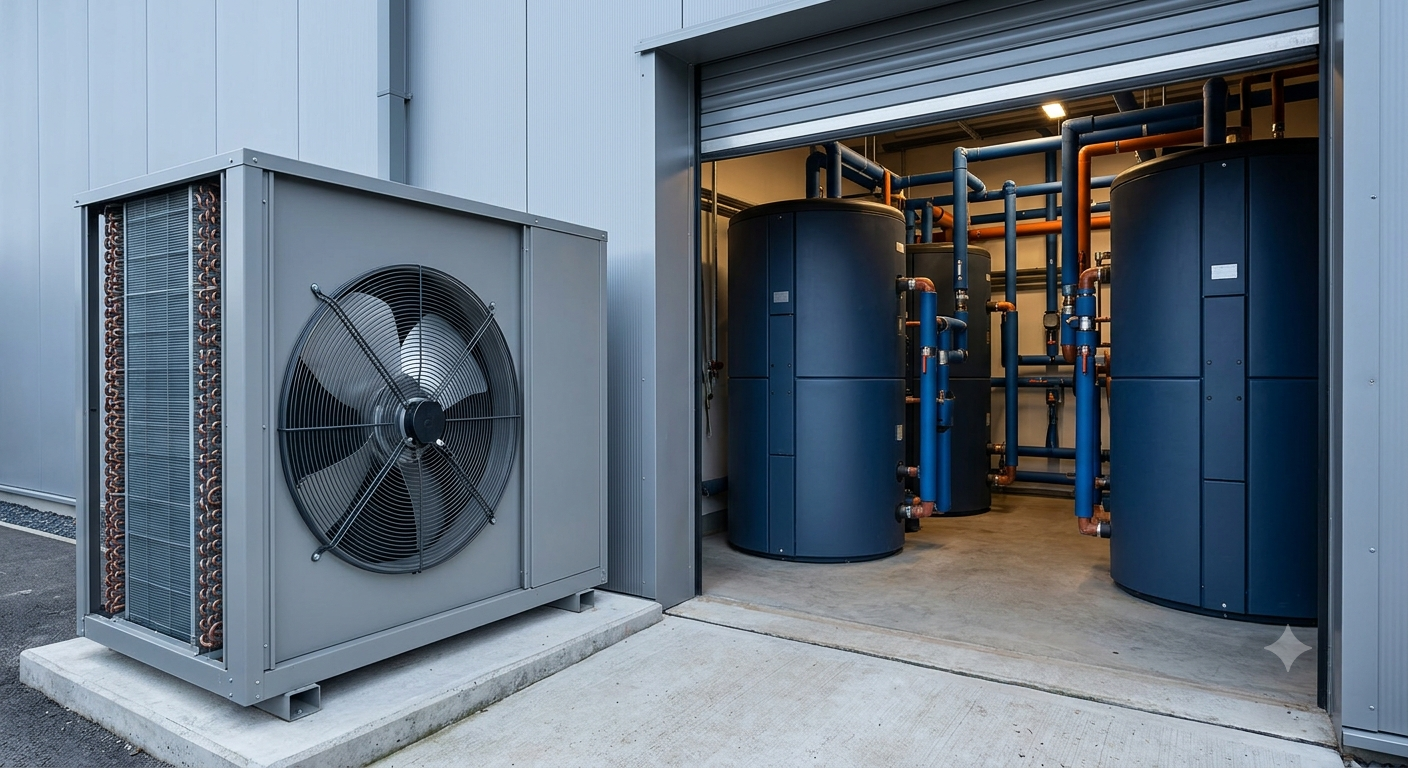
The comparison usually gets made on a single number: this unit has a COP of 3.2, that one has a COP of 4.5, pick the bigger number. Those two numbers were measured under different conditions, describe different boundaries, and neither one is what you will pay for. For domestic hot water specifically, the decision turns on what happens on the coldest day of the year, when the load is at its maximum and one of these architectures is at its weakest.
Air-source heat pumps draw heat from outdoor air; water-source heat pumps draw it from a ground loop, a building condenser water loop, wastewater, or a body of water. Because water temperature is far more stable than air temperature, water-source plants hold capacity and efficiency on the design day — which for domestic hot water is the same day the load peaks, because the entering city water is coldest then.
Air-source plants are cheaper to install, simpler to permit, and increasingly viable in cold climates with CO2 equipment, but they lose capacity exactly when it is needed most and must be sized at derated output. The honest comparison is not nameplate COP; it is annual system COP at design conditions, with pumping energy counted.
Key Takeaways
Both machines run the same vapor-compression cycle and both move heat rather than creating it. The only structural difference is where the evaporator gets its heat.
Air-source plants place the evaporator in outdoor air, usually as a packaged outdoor unit or a split system with the compressor outside and heat exchange indoors. DOE’s Building America guidance on central heat pump water heaters identifies single-pass and multi-pass units as the most common commercial types. Single-pass units maximize efficiency by heating water to target temperature in one pass; multi-pass units raise water 5–10°F per pass into mixed storage.
Water-source plants place the evaporator against a circulating liquid. That liquid can come from a closed ground loop, a building’s condenser water or hydronic loop, a wastewater stream, or a body of water. EPA’s ENERGY STAR criteria for geothermal heat pumps recognize water-to-water models that provide domestic water heating through refrigerant-to-water heat exchangers, either as a dedicated function or through a desuperheater.
Everything else in this article follows from that one difference.
In this article
Why source temperature is the entire argument
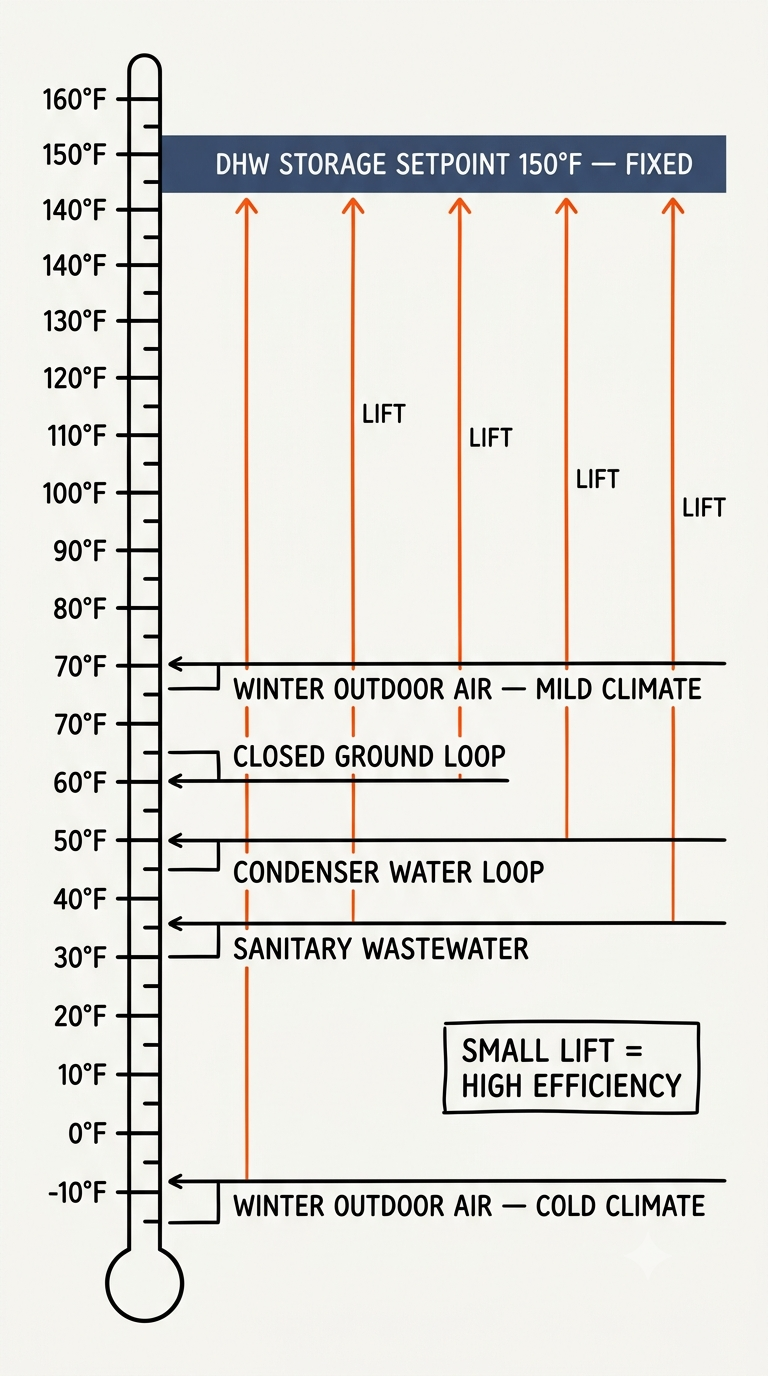
A heat pump’s efficiency is governed by the temperature lift — the gap between the source it pulls from and the sink it pushes into. Small lift means high efficiency; large lift means low efficiency. That is thermodynamics, not marketing.
Domestic hot water is a hard case because the sink is fixed high. Storage typically sits at 140°F or above for pathogen control and usable capacity, and swing-tank configurations often run 150°F or more. You do not get to lower the sink. So the only lever on lift is the source.
Read the stability column rather than the temperature column. A ground loop at 45°F is not dramatically warmer than mild-climate winter air, but it is 45°F reliably, at 3 a.m. in January, during the week the building draws the most hot water it will draw all year.
Typical source conditions for domestic hot water heat pumps
SourceTypical operating temperatureSeasonal stabilityNotes
Outdoor air, cold-climate winter-10°F to 40°FPoor — swings with weather and hourThe same condition where defrost cycles further reduce output
Outdoor air, mild-climate winter35°F to 55°FModerateMuch of the air-source penalty disappears in mild coastal and southern climates
Closed ground loop~40°F to 70°FVery highDOE cites 40–70°F for the shallow subsurface below seasonal variation
Building condenser water loop60°F to 90°FHigh while the building is coolingHeat is otherwise rejected to a cooling tower; recovering it serves two loads at once
Sanitary wastewaterWarm year-round; flow-dependentHigh, but flow-dependentWarmest common source; requires storage, screening, and fouling management
The design-day coincidence that decides most projects
This is the point that separates domestic hot water from space heating, and it is why a DHW source decision should not be made by analogy to an HVAC decision.
Water heating load is driven by the temperature rise from entering city water to delivery temperature. Entering water is coldest in late winter. So the peak DHW load and the minimum air-source capacity arrive on the same calendar day.
Load goes up: colder entering water means more energy per gallon delivered. Capacity goes down: air-source output falls as ambient air cools, and DOE guidance notes that moisture freezing on the evaporator between roughly 20–45°F forces defrost cycles that further reduce both heating capacity and efficiency.
The gap has to be covered by extra compressor capacity, electric resistance backup, or storage — each of which costs something different.
A water-source plant experiences the first effect and largely escapes the second. That is the structural case, and it is worth more than a point of nameplate COP.
The practical instruction from DOE is to stop accepting a single capacity figure. Designers should request heating capacity and COP at the record low air temperature, to confirm the unit will run at all; the design cold temperature, to size the plant; and the design hot temperature, to confirm storage cycling volume is adequate when capacity peaks.
None of this makes air-source wrong. It makes air-source a plant that must be sized differently, and it means any proposal quoting a single capacity number has not done the work.
Why nameplate COP cannot answer this question
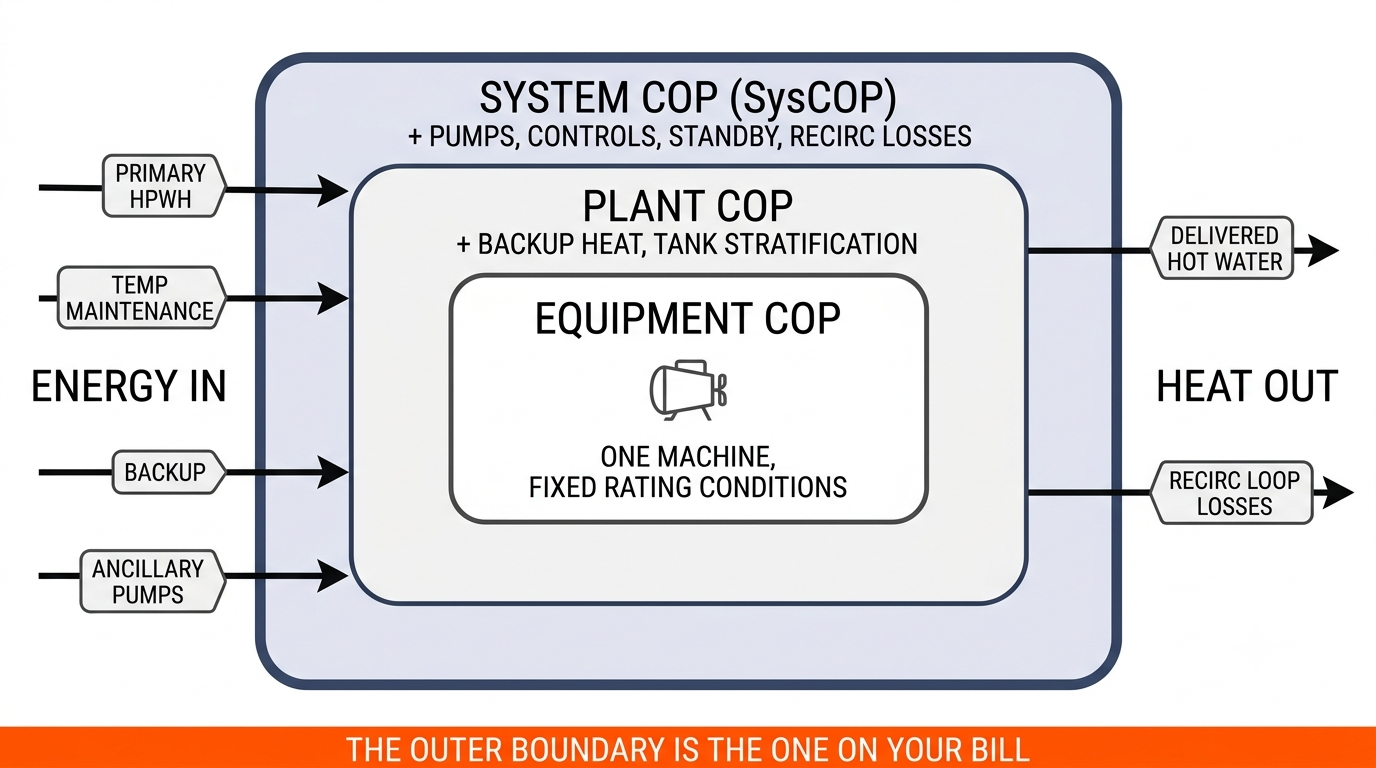
Equipment COP is measured on a performance map: fix the entering air temperature, fix the entering and leaving water temperatures, measure output capacity, divide by power input. It is a useful engineering characterization. It is not a prediction of what a building will consume.
Bonneville Power Administration’s memo defining system coefficient of performance for central heat pump water heaters is unusually direct: isolated equipment performance is inadequate to describe system efficiency because it accounts neither for how the components perform together nor for actual operating conditions.
The standardized alternative is SysCOP: the annual heat delivered by the water heating system divided by all energy input to it. The numerator includes both the energy in delivered hot water and the recirculation loop losses the plant must replace. The denominator includes the primary heat pump, the temperature maintenance heater, any backup heaters, and ancillary energy such as the pumps required to move storage water through the heating equipment.
Two consequences follow for a source comparison. First, a water-source plant’s loop pumps land in the denominator, which is where part of its source advantage goes back. Second, temperature maintenance is not a rounding error. BPA notes it can typically be around 30% of the DHW load in multifamily buildings. How each architecture covers that low-lift, tepid-return load matters as much as how it covers the primary load. The distribution-side mechanics are covered in Domestic Hot Water Recirculation vs Thermal Storage.
BPA’s broader finding across its field studies is that properly designed central heat pump water heating systems can be two to three times more efficient than traditional electric and gas water heating equipment. That range is measured at the system boundary, which is why it is lower than the nameplate COPs quoted in product literature — and why it is the number to plan against.
COP boundaries for domestic hot water systems
BoundaryWhat it includesWhat it hides
Equipment COPOne machine at fixed rating conditionsBackup heat, pumps, controls, standby, real weather, and real load shape
Plant COPPrimary or temperature maintenance plant, including backup within itThe other plant, ancillary pumping, and interaction between them
System COP (SysCOP)All thermal output including loop losses, and all electrical input including pumps and backupNothing material — this is the number owners and code bodies care about
Air-source: what you are actually buying
Air-source wins on lowest installed cost and the shortest path to a permit. There is no drilling, water rights, wells, or wastewater interface. It works on a site with no ground area and no existing hydronic infrastructure, which describes most retrofits.
Equipment availability is far better, and the qualified product landscape is well documented through the NEEA Advanced Water Heating Specification and its commercial heat pump water heater qualified products list. In mild climates the design-day penalty is modest, and CO2 refrigerant equipment extends viability considerably — DOE notes CO2-based units can operate far below 0°F.
Air-source also brings a design-day derate and defrost penalty. Capacity falls when it is needed most. Central units are larger and louder than in-unit equipment and gas plants, so rooftop or property-line placement can trigger local sound limits and screening requirements.
Evaporators condense water that must be drained. Outdoors in freezing climates that means heated drain pans and heat-traced condensate lines.
A unit in an enclosed room will over-cool the space and starve itself. DOE specifically recommends confirming that the location has access to sufficient thermal resource and notes that placing equipment in a below-grade parking garage can temper winter intake air and raise operating efficiency.
Airflow also requires discipline. One unit’s discharge blowing into another’s intake quietly derates the whole plant. DOE illustrates this as a canonical installation error.
Water-source: four practical sources, four different projects
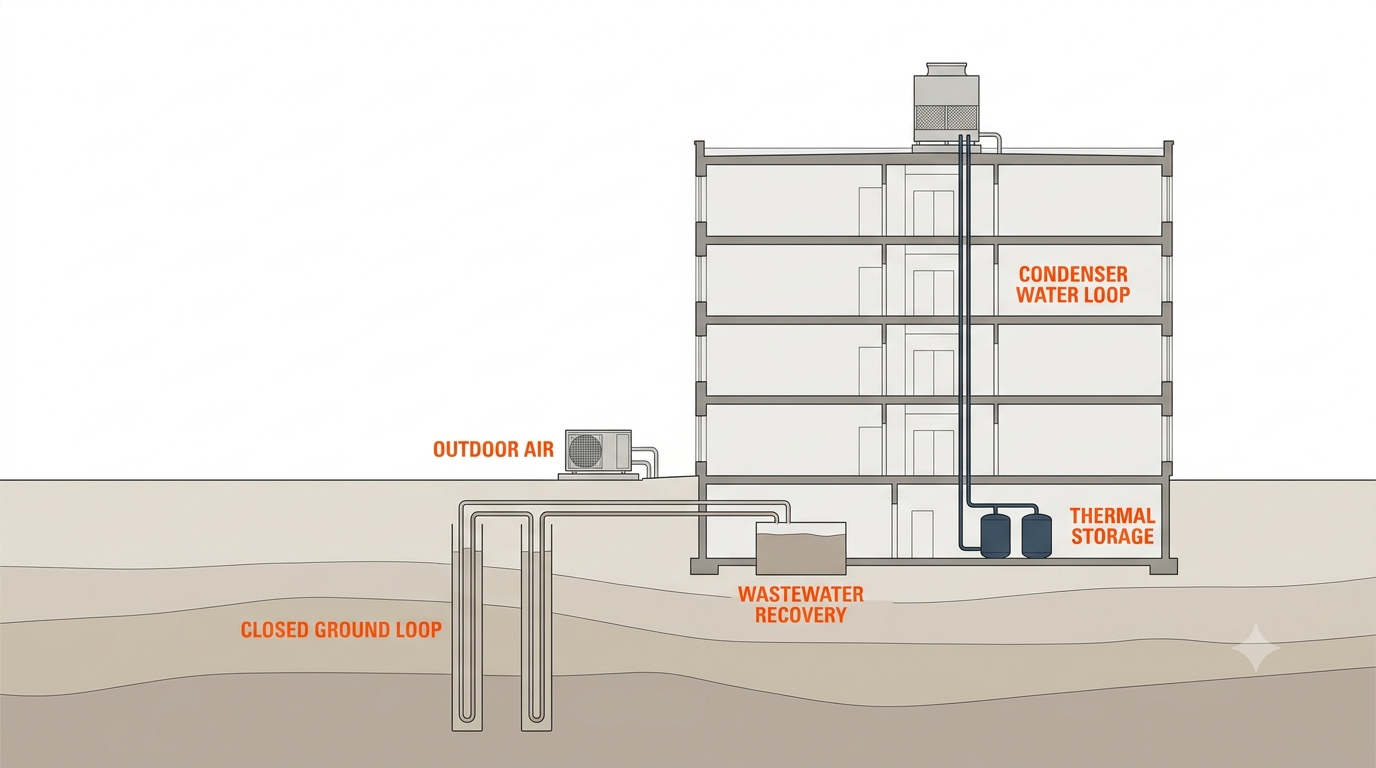
“Water-source” covers architectures with almost nothing in common on cost or schedule.
The condenser-water case deserves emphasis because it is often missed. A building rejecting heat to a cooling tower while simultaneously burning energy to make hot water is paying twice for the same thermodynamics. Whether recovery pencils depends almost entirely on how well the two loads overlap in time — the question worked through in Heat Recovery Chillers vs Thermal Energy Storage: Why Load Coincidence Decides.
Wastewater recovery has moved from novel to documented. Bonneville Power Administration’s measurement and verification report on a wastewater heat pump water heating system at the Sitka Apartments documents a multifamily building using building sewage as the heat pump’s source. It is real, metered, and not a pilot-stage curiosity — but it carries operational obligations that an outdoor air unit does not.
Four practical water-source architectures
SourceBest fitMain advantageMain obstacle
Closed ground loop (geothermal)New construction, campuses, and sites with drilling or field areaMost stable source; DOE estimates 50+ year ground loop life and 25 years for interior componentsHighest first cost and longest schedule; needs land or borehole access
Building condenser water or hydronic loopBuildings with simultaneous heating and cooling — hotels, hospitals, labs, and mixed-useWarmest reliable source; recovers heat otherwise rejected to a cooling tower and offsets cooling loadRequires load coincidence; value collapses when the building is not cooling
Sanitary wastewater heat recoveryDense multifamily and hospitality with high, predictable DHW flowWarm year-round and climate-independent; below-grade tanks can occupy less site area than an air-source arrayScreening, fouling, maintenance access, and a wastewater storage tank
Groundwater or surface water (open loop)Sites adjacent to a suitable water body or aquiferLow loop cost where the resource existsWater rights, permitting, discharge rules, and water quality management
The ancillary energy penalty nobody quotes
This is the part of the water-source case that vendor literature skips, and it is the reason a source-temperature advantage does not translate one-for-one into an operating-cost advantage.
Air is delivered to an air-source evaporator by a fan that is already counted in the unit’s rated power. Water has to be pumped, and in a water-source system that pumping is frequently a separate piece of equipment on a separate circuit: ground-loop circulators, well pumps, wastewater transfer and screening equipment, and heat-exchanger circulation.
Under the SysCOP definition, all of it belongs in the denominator. The metric captures pumps needed to move water through the heating equipment and, more broadly, all meaningful energy required to produce hot water for delivery to the building.
The same discipline applies in reverse to air-source. Standby and parasitic loads — crankcase heaters, controls, pipe heaters, and evaporator fans during pre-start — are real and have been documented to degrade seasonal efficiency below steady-state readings in monitored central installations. Neither architecture gets to quote its compressor and stop.
How the source choice changes the storage design
Storage and source are not independent decisions, and this is the one place where the two sides of the comparison stop being symmetrical.
A plant sized at derated winter output has two options: install more compressor capacity than the annual average load justifies, or install more storage and let a smaller plant run longer. Because compressor capacity is expensive and insulated water volume is comparatively cheap, the second is usually the better trade — and it is more often required with air-source, because that is the architecture whose capacity moves with the weather.
Air-source plants generally need more storage for equal service, because storage covers the design-day capacity shortfall and defrost interruptions. Water-source plants still need storage, but for peak-draw coverage, compressor cycle length, hydraulic separation, and load shifting against the tariff.
Heat recovery sources need storage most of all, because availability is set by the cooling load or wastewater flow rather than by hot water demand. Storage is what decouples them.
Volume methodology is in the thermal storage tank sizing calculator. The buffer-versus-storage distinction is covered in Buffer Tank vs Storage Tank: Do You Need a Buffer Tank for a Heat Pump?, and tank specifications are addressed in What Is the Best Thermal Energy Tank? The 7 Specs That Actually Decide It.
In constrained retrofits, tank access is frequently the binding constraint on either architecture. See Designing Thermal Storage for Existing Buildings Without Major Mechanical Room Expansion.
A decision framework
The questions below are ordered so that the disqualifying questions come first.
Where each one is usually the right answer
The blank cells are deliberate. Not every situation has two credible answers, and a comparison that manufactures balance in every category is not a comparison.
Typical source selection by project situation
SituationUsually air-sourceUsually water-source
Mild or hot climate, no existing loopYes — the derate penalty is small
Cold climate, no heat recovery availableViable with CO2 equipment plus storage and a backup strategyBetter if a ground loop is feasible
Building with simultaneous heating and coolingYes — condenser water recovery serves two loads at once
Dense multifamily or hospitality, high steady DHW flowConsider wastewater recovery; warm source and climate-independent
Tight urban retrofit, no ground access, limited roofUsually the only feasible option
New-construction campus with drilling accessGround loop pencils best over a long hold period
Owner with limited maintenance capabilitySimpler to operateGround loop yes; wastewater no
Short expected hold periodLower first cost dominates
Cost and incentives
First cost generally rises from air-source, to wastewater recovery, to closed-loop geothermal, with condenser water recovery varying enormously depending on whether the loop already exists.
DOE notes that geothermal purchase and installation cost is often higher than alternatives while delivering more energy per unit consumed. Payback is commonly cited in the range of two to ten years depending on climate, soil conditions, system features, and available incentives. Ground-loop service life is estimated at 50 years or more against roughly 25 years for interior components.
Storage cost is a much smaller line in either architecture. Vessel list pricing for modular thermal storage is shown below. These are vessel prices, not installed system prices; verify current pricing against the live thermal tank comparison and specifications.
Modular thermal storage vessel pricing
ModelList price$/kWh storedStorage capacity*Standing loss
80 gallon$1,190$9712.0 kWh7–8°F / 24 hr
350 gallon$3,427$6354.6 kWh3.8°F / 24 hr
500 gallon$4,464$5877.0 kWh3.0°F / 24 hr
700 gallon$5,798$54108.0 kWh2.4°F / 24 hr
Federal incentives
The statutory definition of energy storage technology under 26 U.S.C. §48E expressly includes thermal energy storage, and the IRS Clean Electricity Investment Credit governs qualifying property placed in service after December 31, 2024. Heat pump equipment itself is treated under different provisions. Eligibility depends on project facts, prevailing wage and apprenticeship compliance, and sourcing rules — confirm with a tax professional, not a vendor.
What to ask both bidders
A short list that makes the two proposals comparable:
What a complete proposal looks like
A bidder who answers all eight has designed a system. A bidder who answers with a nameplate COP has selected a piece of equipment. Examples of how these tradeoffs resolved on built projects are in the case studies, with specification sheets in the technical documentation library.
Frequently Asked Questions
What is the difference between an air source and a water source heat pump for domestic hot water?
Both use the same vapor-compression cycle; the difference is where the evaporator draws heat. An air-source unit draws from outdoor air, so its capacity and efficiency move with the weather. A water-source unit draws from a circulating liquid such as a closed ground loop, a building condenser water loop, wastewater, or a body of water, which stays far more stable year-round. For domestic hot water the practical consequence is that water-source plants hold capacity on the coldest day, which is also the day the hot water load peaks.
Is a water source heat pump more efficient than an air source heat pump?
Usually at the source, but not always at the system boundary. Water sources are warmer and more stable in winter, which reduces temperature lift and raises efficiency. However, water-source systems require pumping — ground loop circulators, well pumps, wastewater transfer and screening — and that energy counts against system coefficient of performance. Compare system COP with pumping included, not nameplate equipment COP.
Why does the coldest day matter so much for water heating?
Because entering city water is coldest then, so each delivered gallon requires more energy, and the daily load is at its maximum. For an air-source plant that is also when ambient air is coldest and output capacity is lowest, with defrost cycles further reducing capacity in roughly the 20 to 45 degree Fahrenheit range. Load peaks and capacity bottoms out on the same day.
Can air source heat pumps make domestic hot water in cold climates?
Yes. Carbon dioxide refrigerant equipment can operate far below zero degrees Fahrenheit, and DOE guidance states that central heat pump water heating is appropriate for all U.S. climate zones if the correct equipment is selected. The requirement is to size at derated design-day capacity, plan a backup strategy, and generally carry more storage than a water-source plant of equivalent annual capacity.
What is SysCOP and why does it matter?
System coefficient of performance is the annual heat delivered by a water heating system divided by all energy input to it, including recirculation loop losses on the output side and primary heat pump, temperature maintenance heater, backup heat, and ancillary pumping on the input side. Bonneville Power Administration research states that isolated equipment performance is inadequate to describe system efficiency, which is why SysCOP is the metric owners, utilities, and code bodies use.
Can a building use its cooling system to make hot water?
Yes, where heating and cooling loads overlap in time. A water-source heat pump connected to a condenser water loop can extract heat that would otherwise be rejected to a cooling tower and use it for domestic hot water, serving two loads with one machine. The economics depend almost entirely on load coincidence, so the analysis should begin with how many hours the two loads actually overlap.
Is wastewater heat recovery a real option or still experimental?
It is documented in metered field research. Bonneville Power Administration published measurement and verification of a multifamily wastewater heat pump water heating system using building sewage as the source. It is best suited to dense multifamily and hospitality buildings with high, predictable hot water flow, and it carries operational obligations including screening, fouling management, and maintenance access that an outdoor air unit does not.
Does the source choice change how much storage I need?
Yes. A plant sized at derated winter output must cover the shortfall with either additional compressor capacity or additional storage, and because compressor capacity is expensive while insulated water volume is comparatively cheap, storage is usually the better trade. Air-source plants therefore tend to require more storage for equivalent service, while heat recovery sources require storage to decouple availability from demand.
Conclusion
Air-source and water-source heat pumps do the same thermodynamic job and differ in one respect that cascades through everything else: how stable the heat source is. For domestic hot water that instability lands at the worst possible moment, because the coldest day is simultaneously the highest-load day and the lowest-capacity day.
That does not make air-source wrong. In mild climates, tight sites, and cost-constrained retrofits it is frequently the only sensible choice, and modern CO2 equipment has narrowed the cold-climate gap considerably. It does mean an air-source plant has to be sized on derated capacity and usually carries more storage.
Where a heat recovery source already exists — a condenser water loop, a chiller rejecting heat, or a steady wastewater stream — water-source deserves the first look, because the heat is already there and already paid for.
Whichever way it goes, insist on the system-boundary number with pumping counted. The nameplate COP on the submittal is a characterization of a machine, not a prediction of a bill.